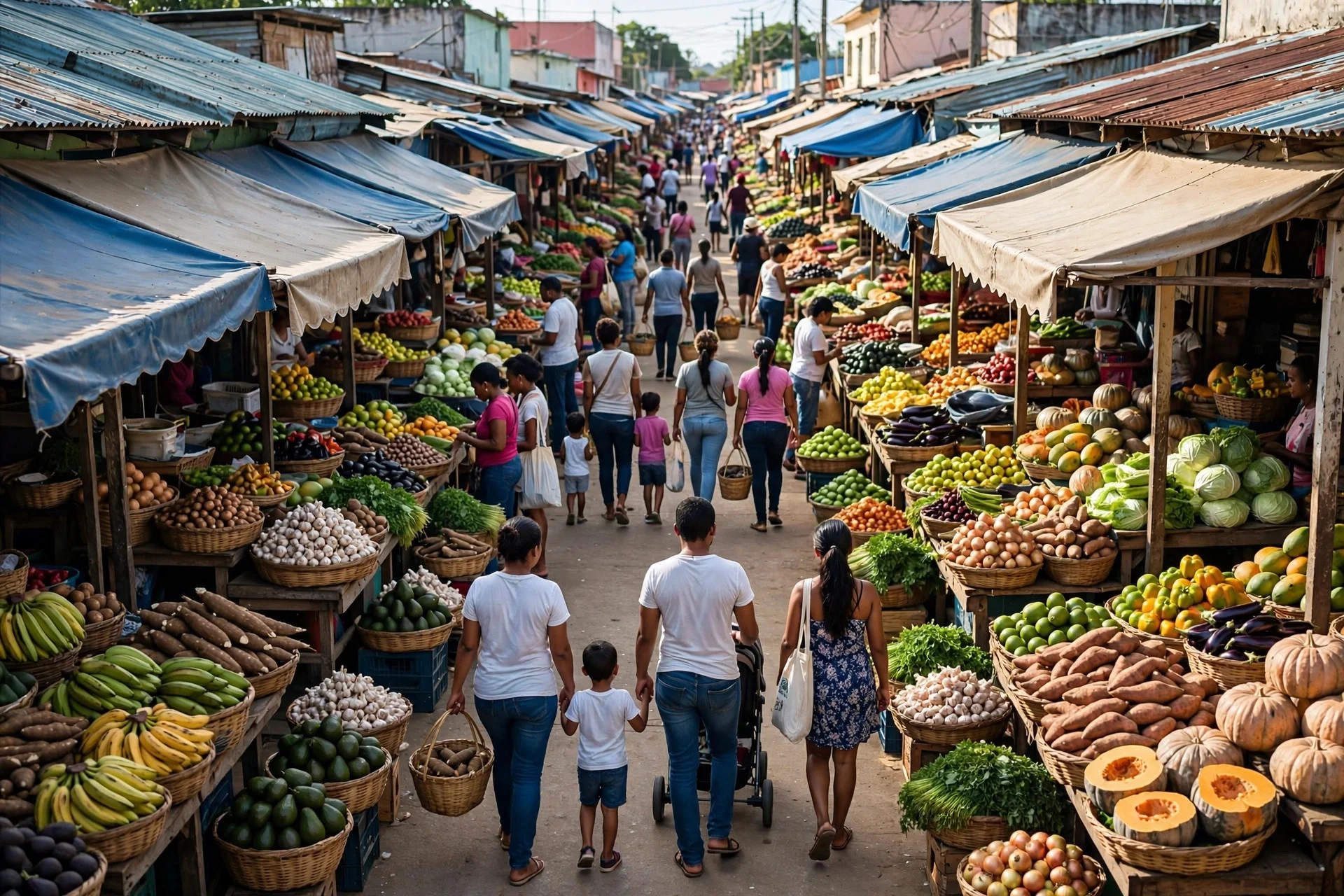
Mercado popular con alimentos frescos, en una imagen alusiva a la vida cotidiana de los hogares. · EPM
Monetary poverty falls to 14.58% in the Dominican Republic
Monetary poverty fell to 14.58% in the first half of 2026, from 30.7% in 2021 and 17.3% in 2025, according to figures presented by Vice President Raquel Peña.
Dominican Republic cuts poverty and sets targets toward 2036
Monetary poverty fell to 14.58% in the first half of 2026, from 30.7% in 2021 and 17.3% in 2025, according to figures presented by Vice President Raquel Peña.
Monetary poverty fell to 14.58% in the first half of 2026 in the Dominican Republic, according to figures presented by Vice President Raquel Peña during an event devoted to the eradication of poverty.
--- The context ---
The indicator had been declining in recent years and the new preliminary figure extends that trajectory. The underlying debate is how to sustain the improvement in households' daily lives, with access to education, essential services and quality jobs, and how to prevent families from falling back into poverty when an emergency strikes.
--- The facts ---
Monetary poverty moved from 30.7% in 2021 to 17.3% in 2025, and the preliminary average for the first half of 2026 stood at 14.58%. Urban poverty decreased from 25% in 2019 to 15%, while in rural areas the indicator moved from 31% to 19% over the same compared period.
Extreme poverty moved from 8.7% in 2015 to 2.2%, and the prevalence of undernourishment fell to less than 2.5%. As presented, that result allowed the country to leave the Hunger Map of the Food and Agriculture Organization of the United Nations. The Aliméntate and Bono Gas programs benefit close to 1.4 million households, and coverage also includes Bono Luz, Aprende y Avanza and Supérate Mujer.
--- The positions ---
Peña argued, in terms attributed to her remarks, that the progress requires continuity of social protection policies and broader opportunities for productive inclusion. She also stated that the Government, under the leadership of President Luis Abinader, took as a priority that growth translate into better living conditions. Supérate director general Mayra Jiménez presented the results of family support and defended adaptive social protection mechanisms for emergencies.
--- What remains unknown ---
The figures for the first half of 2026 were presented as preliminary. The material available does not detail how the improvement is distributed among households or what share corresponds to each program. It also does not specify the future pace of coverage expansion or the concrete results of the National Care System for families in special vulnerability.
--- Unanswered questions ---
Will 14.58% be confirmed when the preliminary figures are closed definitively? Which households remain outside protection despite the broad coverage described? How will progress be measured toward reducing rural multidimensional poverty to 15% by 2028 and below 10% in 2036?
--- EPM analysis ---
A progressive reading of the figure emphasizes protection as a floor of rights: transfers, care and family support appear as the network that prevents setbacks. The challenge is to combine that floor with education, services and quality employment so that leaving poverty is durable and does not depend only on temporary assistance.
📌 EPM Take: In EPM's view, the fall to 14.58% is a relevant signal because it combines urban, rural and extreme poverty declines, but its real value will depend on social protection being maintained, reaching those still left out and connecting with stable own income. Without continuity, productive inclusion and effective care, the advance can reverse in any emergency and leave households in vulnerability again, especially in rural areas where the historical gap remains larger and more persistent today.
Monetary poverty fell to 14.58% in the first half of 2026 in the Dominican Republic, according to figures presented by Vice President Raquel Peña during an event devoted to the eradication of poverty.
--- The context ---
The indicator had been declining in recent years and the new preliminary figure extends that trajectory. The underlying debate is how to turn growth into better living conditions without creating permanent dependence, strengthening households' capacities and the creation of quality jobs in cities and rural areas alike.
--- The facts ---
Monetary poverty moved from 30.7% in 2021 to 17.3% in 2025, and the preliminary average for the first half of 2026 stood at 14.58%. Urban poverty decreased from 25% in 2019 to 15%, while in rural areas the indicator moved from 31% to 19% over the same compared period.
Extreme poverty moved from 8.7% in 2015 to 2.2%, and the prevalence of undernourishment fell to less than 2.5%. As presented, that result allowed the country to leave the Hunger Map of the Food and Agriculture Organization of the United Nations. The Aliméntate and Bono Gas programs benefit close to 1.4 million households, and coverage also includes Bono Luz, Aprende y Avanza and Supérate Mujer.
--- The positions ---
Peña argued, in terms attributed to her remarks, that the progress requires continuity of social protection policies and broader opportunities for productive inclusion. She also stated that the Government, under the leadership of President Luis Abinader, took as a priority that growth translate into development for households. Supérate director general Mayra Jiménez presented the support results and highlighted protection in emergencies.
--- What remains unknown ---
The figures for the first half of 2026 were presented as preliminary. The material available does not detail how much of the improvement responds to employment and own income versus transfers. It also does not specify how each program's effectiveness will be evaluated or which intermediate targets will order the path of Meta RD 2036.
--- Unanswered questions ---
Will 14.58% be confirmed when the preliminary figures are closed definitively? How much of the decline is sustained by families' work and own income? How will rural multidimensional poverty be reduced to 15% by 2028 and below 10% in 2036?
--- EPM analysis ---
A conservative reading of the figure emphasizes productive inclusion: assistance fulfills its function when it works as a bridge toward work, entrepreneurship and family autonomy. The lasting merit will not be keeping programs by inertia, but enabling more households to improve their income and no longer need permanent assistance.
📌 EPM Take: In EPM's view, the fall to 14.58% supports a correct direction when growth translates into concrete opportunities, but the demanding test will be productive and fiscal at the same time. Quality employment, strengthened capacities and programs evaluated by results will be needed, so the reduction is sustainable, extreme poverty keeps receding and the 2028 and 2036 targets do not remain only a statement, but become verifiable commitments with public follow-up and timely corrections whenever progress stalls.
La pobreza monetaria baja al 14.58% en República Dominicana
La pobreza monetaria bajó al 14.58% en el primer semestre de 2026, desde el 30.7% en 2021 y el 17.3% en 2025, según datos expuestos por la vicepresidenta…
República Dominicana reduce la pobreza y fija metas hacia 2036
La pobreza monetaria bajó al 14.58% en el primer semestre de 2026, desde el 30.7% en 2021 y el 17.3% en 2025, según datos expuestos por la vicepresidenta…
La pobreza monetaria descendió al 14.58% en el primer semestre de 2026 en República Dominicana, según los datos expuestos por la vicepresidenta Raquel Peña durante una jornada dedicada a la erradicación de la pobreza.
--- El contexto ---
El indicador venía en descenso en los años recientes y la nueva cifra preliminar prolonga esa trayectoria. El debate de fondo es cómo sostener la mejora en la vida cotidiana de los hogares, con acceso a educación, servicios esenciales y empleos de calidad, y cómo evitar que las familias vuelvan a caer en condiciones de pobreza ante una emergencia.
--- Los hechos ---
La pobreza monetaria pasó del 30.7% en 2021 al 17.3% en 2025, y el promedio preliminar del primer semestre de 2026 se situó en 14.58%. La pobreza urbana disminuyó del 25% en 2019 al 15%, mientras que en las zonas rurales el indicador pasó del 31% al 19% en el mismo período comparado.
La pobreza extrema pasó del 8.7% en 2015 al 2.2%, y la prevalencia de la subalimentación se redujo a menos del 2.5%. Según lo expuesto, ese resultado permitió que el país saliera del Mapa del Hambre de la Organización de las Naciones Unidas para la Alimentación y la Agricultura. Los programas Aliméntate y Bono Gas benefician a cerca de 1.4 millones de hogares, y la cobertura incluye además Bono Luz, Aprende y Avanza y Supérate Mujer.
--- Las posiciones ---
Peña sostuvo, en términos atribuidos a su intervención, que los avances requieren continuidad de las políticas de protección social y ampliación de las oportunidades de inserción productiva. También planteó que el Gobierno, bajo el liderazgo del presidente Luis Abinader, asumió como prioridad que el crecimiento se traduzca en mejores condiciones de vida. La directora general de Supérate, Mayra Jiménez, presentó los resultados del acompañamiento sociofamiliar y defendió mecanismos de protección adaptativa ante emergencias.
--- Lo que falta saber ---
Los datos del primer semestre de 2026 fueron presentados como preliminares. La exposición no detalla en el material disponible cómo se distribuye la mejora entre hogares ni qué parte corresponde a cada programa. Tampoco se precisa el ritmo futuro de ampliación de la cobertura ni los resultados concretos del Sistema Nacional de Cuidados para las familias en especial vulnerabilidad.
--- Preguntas sin respuesta ---
¿Se confirmará el 14.58% cuando los datos preliminares se cierren de forma definitiva? ¿Qué hogares siguen fuera de la protección pese a la amplia cobertura descrita? ¿Cómo se medirá el avance hacia reducir la pobreza multidimensional rural al 15% para 2028 y por debajo del 10% en 2036?
--- Análisis EPM ---
La lectura progresiva del dato pone el acento en la protección como piso de derechos: transferencias, cuidados y acompañamiento aparecen como la red que impide retrocesos. El desafío es que ese piso se combine con educación, servicios y empleo de calidad para que la salida de la pobreza sea durable y no dependa solo de la ayuda coyuntural.
📌 Conclusion EPM: A juicio de EPM, la baja al 14.58% es una señal relevante porque combina descenso urbano, rural y de pobreza extrema, pero su valor real dependerá de que la protección social se mantenga, llegue a quienes aún quedan fuera y se conecte con ingresos propios estables. Sin continuidad, inclusión productiva y cuidados efectivos, el avance puede revertirse ante cualquier emergencia y dejar a los hogares otra vez en vulnerabilidad, especialmente en las zonas rurales donde la brecha histórica sigue siendo mayor y más persistente.
La pobreza monetaria descendió al 14.58% en el primer semestre de 2026 en República Dominicana, según los datos expuestos por la vicepresidenta Raquel Peña durante una jornada dedicada a la erradicación de la pobreza.
--- El contexto ---
El indicador venía en descenso en los años recientes y la nueva cifra preliminar prolonga esa trayectoria. El debate de fondo es cómo convertir el crecimiento en mejores condiciones de vida sin crear dependencia permanente, fortaleciendo las capacidades de los hogares y la generación de empleos de calidad en ciudades y zonas rurales.
--- Los hechos ---
La pobreza monetaria pasó del 30.7% en 2021 al 17.3% en 2025, y el promedio preliminar del primer semestre de 2026 se situó en 14.58%. La pobreza urbana disminuyó del 25% en 2019 al 15%, mientras que en las zonas rurales el indicador pasó del 31% al 19% en el mismo período comparado.
La pobreza extrema pasó del 8.7% en 2015 al 2.2%, y la prevalencia de la subalimentación se redujo a menos del 2.5%. Según lo expuesto, ese resultado permitió que el país saliera del Mapa del Hambre de la Organización de las Naciones Unidas para la Alimentación y la Agricultura. Los programas Aliméntate y Bono Gas benefician a cerca de 1.4 millones de hogares, y la cobertura incluye además Bono Luz, Aprende y Avanza y Supérate Mujer.
--- Las posiciones ---
Peña sostuvo, en términos atribuidos a su intervención, que los avances requieren continuidad de las políticas de protección social y ampliación de las oportunidades de inserción productiva. También planteó que el Gobierno, bajo el liderazgo del presidente Luis Abinader, asumió como prioridad que el crecimiento se traduzca en desarrollo para los hogares. La directora general de Supérate, Mayra Jiménez, presentó los resultados del acompañamiento y destacó la protección ante emergencias.
--- Lo que falta saber ---
Los datos del primer semestre de 2026 fueron presentados como preliminares. La exposición no detalla en el material disponible cuánto de la mejora responde al empleo y a los ingresos propios frente a las transferencias. Tampoco se precisa cómo se evaluará la efectividad de cada programa ni qué metas intermedias ordenarán el camino de Meta RD 2036.
--- Preguntas sin respuesta ---
¿Se confirmará el 14.58% cuando los datos preliminares se cierren de forma definitiva? ¿Cuánto del descenso se sostiene con trabajo e ingresos propios de las familias? ¿Cómo se alcanzará reducir la pobreza multidimensional rural al 15% para 2028 y por debajo del 10% en 2036?
--- Análisis EPM ---
La lectura conservadora del dato pone el acento en la inserción productiva: la ayuda cumple su función cuando funciona como puente hacia el trabajo, el emprendimiento y la autonomía familiar. El mérito duradero no será mantener programas por inercia, sino lograr que cada vez más hogares mejoren sus ingresos y ya no necesiten asistencia permanente.
📌 Conclusion EPM: A juicio de EPM, la baja al 14.58% respalda una dirección correcta cuando el crecimiento se traduce en oportunidades concretas, pero la prueba exigente será productiva y fiscal a la vez. Hará falta empleo de calidad, capacidades fortalecidas y programas evaluados por resultados, para que la reducción sea sostenible, la pobreza extrema siga cediendo y las metas de 2028 y 2036 no queden solo como enunciado, sino como compromisos verificables con seguimiento público y correcciones oportunas cuando los avances se detengan.