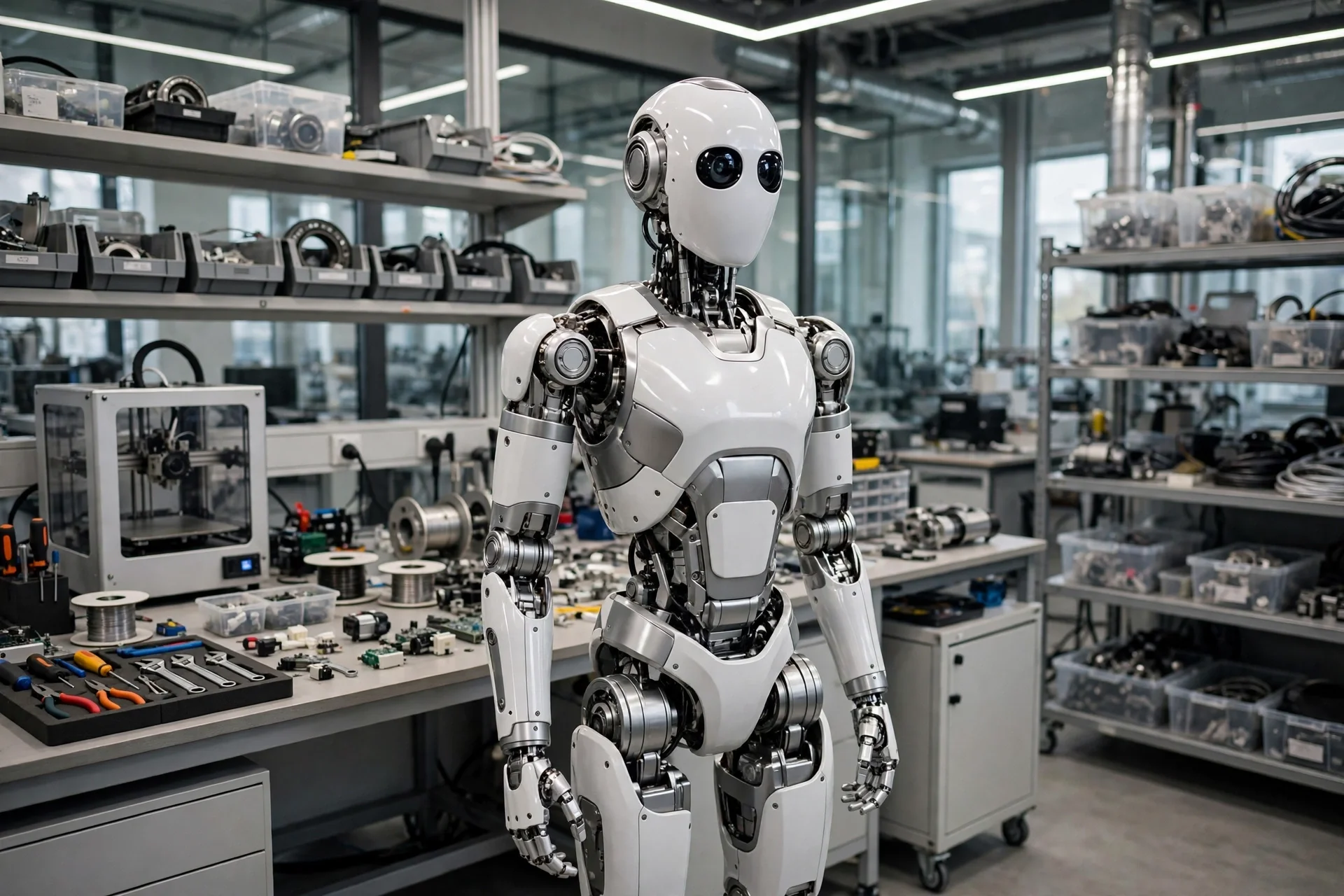
Imagen alusiva a un robot humanoide en un laboratorio de robótica. · Imagen generada EPM
OpenAI will build a humanoid robot with ChatGPT, with a 2027 demo
Sam Altman confirmed that OpenAI will build a humanoid robot whose brain is understood to be powered by ChatGPT technology, with a public demonstration in…
Altman confirms OpenAI humanoid robot, with a public demo set for 2027
OpenAI chief executive Sam Altman confirmed in two interviews that he will build a humanoid robot whose brain is understood to be powered by ChatGPT…
--- The context ---
The company known worldwide for ChatGPT wants to move from the screen into the physical world. Its chief executive, Sam Altman, confirmed that it will build a humanoid robot and anticipated a public demonstration in 2027, while warning that those robots will not walk the streets in the short term.
--- The facts ---
The confirmation came in two separate interviews, according to press reports. On a podcast, asked directly whether the company would manufacture a humanoid robot, Altman answered briefly that yes, they would do it. In another interview he added the horizon: he expects a demonstration he described as great in 2027 and ruled out robots walking the streets for several more years.
The automaton's brain is understood to be powered by ChatGPT technology. Altman explained that adopting an anatomy of two arms and two legs follows a practical rather than aesthetic logic: the world is designed for people, he said in reported speech, and doors, keyboards and everyday tools assume a certain type of body, so matching that form seems a good idea.
The company has 27 open job searches in robotics, covering motion control, position estimation, actuator control and the robot's overall behavior, as well as the infrastructure to train physical artificial intelligence systems. Another group focuses on its own electromechanical actuators, with custom motors, transmissions, sensors and thermal systems, and a third group covers manufacturing and supply chain for larger-scale production.
--- The positions ---
For Altman, according to the same interviews, physical design is not the central obstacle: questions about the robot's appearance are less important than truly solving the brain that makes it work. Lifting a cup requires identifying the object, locating the handle and calculating the right force so as not to spill the contents.
--- What remains unknown ---
The company did not specify what the 2027 demonstration will show, what form the robot will take or when someone outside the company will be able to approach one. It also released no price, commercial launch date or any technical specification for the humanoid.
--- Unanswered questions ---
What concrete tasks will the robot be able to perform during the demonstration planned for 2027? When will someone outside the company be able to approach one? What price and commercial launch date will the humanoid ultimately have? How will the safety of those working alongside these robots be protected?
--- EPM analysis ---
The company does not enter an empty field: Tesla has worked for years on its Optimus robot, and Chinese automaker XPENG recently showed its IRON humanoid autonomously leaving the assembly line after being built. Its Dactyl project also trained a robotic hand years ago, entirely in simulation, to manipulate real objects, and later applied that technique to solve a Rubik's cube. According to one cited job posting, the first goal is not a domestic robot but general-purpose robots that help skilled workers build infrastructure, while the long-term goal is a personal robot with many more tasks.
📌 EPM Take:
In EPM's view, what matters most is not the robot's silhouette but who it might help first: the company itself plans to start by supporting skilled workers building infrastructure, not by selling a household device. If the 2027 demonstration shows a system able to learn real tasks safely, its value will be measured in concrete work rather than spectacle; if it only shows an eye-catching body, it will confirm that the brain, as its own chief executive admitted, remains the unsolved part of the project.
--- The context ---
Sam Altman, chief executive of OpenAI, confirmed that the company will build a humanoid robot. The automaton's brain is understood to be powered by ChatGPT technology. The announcement sets a public demonstration in 2027: Altman himself ruled out those robots circulating on the street in the short term.
--- The facts ---
The confirmation took place in two separate interviews, according to press reports. On a podcast, asked directly whether the company would manufacture a humanoid robot, Altman answered briefly that yes, they would do it. In another interview he anticipated a demonstration he described as great in 2027, while warning there will be no robots on the streets for several more years.
The reasoning about form is practical: an anatomy of two arms and two legs is not an aesthetic choice, because the world is designed for people and doors, keyboards and everyday tools assume a certain type of body. Matching that format, he said in reported speech, seems a good idea in order to work in the same spaces as people.
Hiring backs the seriousness of the project: the company has 27 open job searches in robotics covering motion control, position estimation, actuator control and the robot's overall behavior, together with the infrastructure to train physical artificial intelligence systems. Other searches seek its own electromechanical actuators, with custom motors, transmissions, sensors and thermal systems, and a third group covers manufacturing and supply chain.
--- The positions ---
Altman's position is that appearance is not decisive: physical design matters less than truly solving the brain that makes the robot work. Lifting a cup, the example illustrating the problem, requires identifying the object, locating the handle and calculating the right force so as not to spill the contents.
--- What remains unknown ---
The company did not specify what the demonstration will show, what form the robot will take or when someone outside the company will be able to approach one. For now it also released no price, commercial launch date or any technical specification for the humanoid.
--- Unanswered questions ---
What exactly will the robot be able to do in the 2027 demonstration? What technical specifications, price and commercial date will be announced afterward? When will a person outside the company be able to approach one of these humanoids? What infrastructure tasks will these robots perform first alongside skilled workers?
--- EPM analysis ---
The field already has competitors with years of work: Tesla has developed its Optimus robot for years, and Chinese automaker XPENG recently showed its IRON humanoid autonomously leaving the assembly line after being built. Its Dactyl project trained a robotic hand years ago, entirely in simulation, to manipulate real objects, and later applied that technique to solve a Rubik's cube. According to one job posting, the first goal is not a domestic robot but general-purpose robots that help skilled workers build infrastructure, and the long-term goal is a personal robot with much broader tasks.
📌 EPM Take:
In EPM's view, the confirmation deserves attention precisely for its prudence: there is a date for a demonstration, 2027, but no promises of robots in the streets or of an immediate household product. The order of factors is the right one, first helping skilled workers build infrastructure and solving the brain that controls the machine, and only later thinking about scale. A company that announces with deadlines and without smoke exposes itself to being measured by results, and that will be the fair yardstick for this project when the demonstration arrives.
OpenAI construirá un robot humanoide con ChatGPT y lo mostrará en 2027
Sam Altman confirmó que OpenAI construirá un robot humanoide cuyo cerebro, se entiende, estaría impulsado por la tecnología de ChatGPT, con una demostración…
Altman confirma el robot humanoide de OpenAI, con demostración en 2027
El director ejecutivo de OpenAI, Sam Altman, confirmó en dos entrevistas que construirá un robot humanoide, cuyo cerebro se entiende que estaría impulsado por…
--- El contexto ---
La empresa conocida por ChatGPT quiere dar el salto de la pantalla al mundo físico. Su director ejecutivo, Sam Altman, confirmó que construirá un robot humanoide y anticipó una demostración pública en 2027, aunque advirtió que esos robots no caminarán por las calles en el corto plazo.
--- Los hechos ---
La confirmación llegó en dos entrevistas distintas, según reportes de prensa. En un pódcast, ante la pregunta directa de si la empresa fabricaría un robot humanoide, Altman respondió brevemente que sí, que lo harían. En otra entrevista espera una demostración que calificó de genial en 2027 y descartó robots caminando por las calles por varios años más.
Se entiende que el cerebro del autómata estaría impulsado por la tecnología de ChatGPT. Altman explicó que la anatomía de dos brazos y dos piernas responde a una lógica práctica y no estética: el mundo está diseñado para personas, sostuvo en indirecto, y puertas, teclados y herramientas cotidianas asumen un tipo de cuerpo determinado, por lo que igualar esa forma parece buena idea.
La empresa mantiene abiertas 27 búsquedas laborales en robótica, sobre control de movimiento, estimación de posición, control de actuadores y comportamiento integral del robot, además de la infraestructura para entrenar inteligencia artificial física. Otro grupo apunta a actuadores electromecánicos propios, con motores, transmisiones, sensores y sistemas térmicos a medida, y un tercer grupo cubre manufactura y cadena de suministro para mayor escala.
--- Las posiciones ---
Para Altman, el diseño físico no es el obstáculo central: la apariencia es menos importante que resolver de verdad el cerebro que hace funcionar al robot. Levantar una taza exige identificar el objeto, ubicar el asa y calcular la fuerza justa para no derramar el contenido.
--- Lo que falta saber ---
La compañía no precisó qué mostrará la demostración de 2027, qué forma tendrá el robot ni cuándo alguien ajeno a la empresa podrá acercarse a uno. Tampoco difundió precio, fecha de lanzamiento comercial ni ninguna especificación técnica del humanoide.
--- Preguntas sin respuesta ---
¿Qué tareas concretas podrá realizar el robot durante la demostración prevista para 2027? ¿Cuándo podrá acercarse a uno alguien ajeno a la empresa? ¿Qué precio y qué fecha de lanzamiento comercial tendrá finalmente el humanoide? ¿Cómo se protegerá la seguridad de quienes trabajen junto a estos robots?
--- Análisis EPM ---
La empresa no llega a un terreno vacío: Tesla trabaja desde hace años en su robot Optimus y la automotriz china XPENG mostró recientemente a su humanoide IRON saliendo autónomamente de la línea de ensamblaje tras ser armado. Su proyecto Dactyl entrenó hace años una mano robótica, íntegramente en simulación, para manipular objetos reales, y luego aplicó esa técnica para resolver un cubo Rubik. Según una publicación de empleo citada, el primer objetivo no es un robot doméstico, sino robots de uso general que ayuden a trabajadores calificados a construir infraestructura, y la meta de largo plazo es un robot personal con tareas mucho más amplias.
📌 Conclusion EPM:
A juicio de EPM, lo más relevante no es la silueta del robot, sino a quiénes podría ayudar primero: la propia empresa plantea empezar por apoyar a trabajadores calificados en la construcción de infraestructura, no por vender un aparato doméstico. Si la demostración de 2027 muestra un sistema capaz de aprender tareas reales con seguridad, el beneficio podrá medirse en trabajo concreto y no en espectáculo; si solo muestra un cuerpo vistoso, quedará claro que el cerebro, como admitió su propio director, sigue siendo la parte sin resolver.
--- El contexto ---
Sam Altman, director ejecutivo de OpenAI, confirmó que la empresa construirá un robot humanoide. Se entiende que el cerebro del autómata estaría impulsado por la tecnología de ChatGPT. El anuncio fija una demostración pública en 2027, y el propio Altman descartó que esos robots circulen por la calle en el corto plazo.
--- Los hechos ---
La confirmación se produjo en dos entrevistas distintas, según reportes de prensa. En un pódcast, preguntado directamente si la empresa fabricaría un robot humanoide, Altman contestó brevemente que sí, que lo harían. En otra entrevista anticipó una demostración que describió como genial en 2027, y advirtió que no habrá robots caminando por las calles por varios años más.
El razonamiento sobre la forma es práctico: una anatomía de dos brazos y dos piernas no responde a una elección estética, porque el mundo está diseñado para personas y las puertas, los teclados y las herramientas cotidianas asumen un tipo de cuerpo determinado. Igualar ese formato, afirmó en indirecto, parece una buena idea para trabajar en los mismos espacios que las personas.
La contratación respalda la seriedad del proyecto: la empresa mantiene abiertas 27 búsquedas laborales en robótica sobre control de movimiento, estimación de posición, control de actuadores y comportamiento integral del robot, además de la infraestructura de aprendizaje automático necesaria para entrenar sistemas de inteligencia artificial física. Otras búsquedas buscan actuadores electromecánicos propios, con motores, transmisiones, sensores y sistemas térmicos a medida, y un tercer grupo cubre manufactura y cadena de suministro.
--- Las posiciones ---
La posición de fondo de Altman es que la apariencia no es lo decisivo: las preguntas sobre el diseño físico son menos importantes que resolver de verdad el cerebro que hace funcionar al robot. Levantar una taza requiere identificar el objeto, ubicar el asa y calcular la fuerza justa para no derramar el contenido.
--- Lo que falta saber ---
La empresa no precisó qué mostrará la demostración, qué forma tendrá el robot ni cuándo alguien ajeno a la compañía podrá acercarse a uno. Por ahora tampoco difundió precio, fecha de lanzamiento comercial ni ninguna especificación técnica del humanoide.
--- Preguntas sin respuesta ---
¿Qué será capaz de hacer exactamente el robot en la demostración de 2027? ¿Qué especificaciones técnicas, qué precio y qué fecha comercial se anunciarán después? ¿Cuándo podrá una persona ajena a la empresa acercarse a uno de estos humanoides? ¿Qué tareas de infraestructura harán primero estos robots junto a trabajadores calificados?
--- Análisis EPM ---
El terreno ya tiene competidores con años de trabajo: Tesla desarrolla desde hace años su robot Optimus y la automotriz china XPENG mostró recientemente a su humanoide IRON saliendo de manera autónoma de la línea de ensamblaje tras ser armado. Su proyecto Dactyl entrenó hace años una mano robótica, íntegramente en simulación, para manipular objetos reales, y luego aplicó esa técnica para resolver un cubo Rubik. Según una publicación de empleo, el primer objetivo no es un robot doméstico, sino robots de uso general que ayuden a trabajadores calificados a construir infraestructura, y la meta de largo plazo es un robot personal con tareas mucho más amplias.
📌 Conclusion EPM:
A juicio de EPM, la confirmación merece atención precisamente por su prudencia: hay fecha para una demostración, 2027, pero no hay promesas de robots en las calles ni de un producto doméstico inmediato. El orden de los factores es el correcto, primero ayudar a trabajadores calificados a construir infraestructura y resolver el cerebro que controla la máquina, y solo después pensar en escala. Quien anuncia con plazos y sin humo se expone a ser medido por resultados, y esa será la vara justa para juzgar este proyecto cuando llegue la demostración.