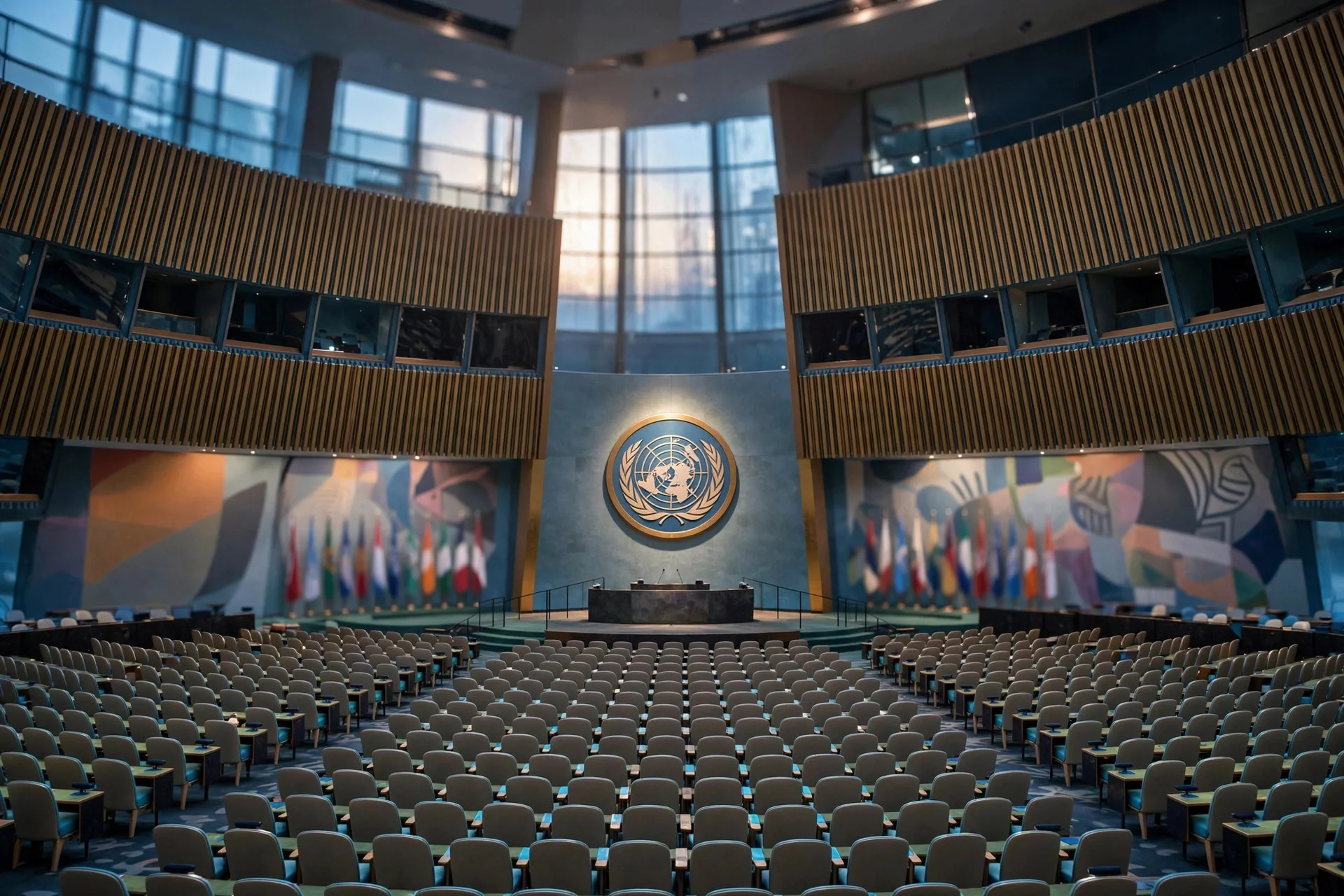
La Asamblea General de la ONU, único órgano que puede disolver el Comité de Descolonización. · Imagen generada EPM
Malvinas: Argentina Defends a UN Forum Washington Wants to Dissolve
The United States proposed on October 15, 2026 to dissolve the UN Decolonization Committee, the forum where Argentina claims sovereignty over the Malvinas…
Sovereignty First: Buenos Aires Rejects Dissolving the Decolonization Committee
Argentina will reject the United States proposal to dissolve the UN Decolonization Committee, the multilateral arena where it claims sovereignty over the…
The personal and ideological alliance between Javier Milei and Donald Trump, presented for months as a model for Latin America, has met its first concrete limit in the field of international law. The Argentine claim to sovereignty over the Malvinas Islands, a cause of state that transcends every administration, has collided with Washington's decision to push for the dissolution of the United Nations Decolonization Committee, the multilateral forum where that claim is sustained year after year and where weaker states can argue their case under shared rules.
--- The context ---
The Decolonization Committee, known in diplomatic jargon as the C24, was created in 1961 and currently has 28 members of very unequal weight, including China, India and Russia alongside Chile, Sierra Leone and Tanzania. Its annual agenda covers 17 cases, and 10 of those historic claims involve the United Kingdom, which does not recognize Argentine sovereignty over the islands despite the accumulated historical and international-law background. For a country without comparable military or economic weight, the committee is not red tape: it is the institutional infrastructure that keeps a legitimate claim alive inside the multilateral system and under the protection of collective rules.
--- The facts ---
On October 15, 2026, according to resolution GA/SPD/841, the Fourth Committee approved more than 20 draft resolutions and 1 decision, many of them responding to recommendations of the Special Committee on Decolonization. In that same debate, the United States representative asked to end the body's mandate and described some of its activities, in attributed indirect terms, as a waste of resources. Argentina rejects the Republican administration's position, and Foreign Minister Pablo Quirno is expected to announce that rejection during the official visit to Buenos Aires by Deputy Secretary of State Chris Landau and Undersecretary for Western Hemisphere Affairs Juan Pablo Segura, in meetings held with an open agenda.
--- The positions ---
Addressing the General Assembly, Milei argued in attributed speech that Malvinas is a national cause and a test of the distance between the words of international institutions and reality, and he asked, in indirect terms, what use a resolution is if for decades the other party can act in the opposite direction without consequences. His argument was not a rejection of multilateralism but a demand for effectiveness: an institution that cannot make its word weigh on the facts loses its authority. The three foreign ministers of his administration defended the claim before the Committee: Diana Mondino stated on June 18, 2024 that 191 years had passed since the start of the occupation and almost 59 since resolution 2065; Gerardo Werthein affirmed on June 19, 2025 that the occupation was a colonial act contrary to international law; and Quirno specified on June 25, 2026 that there is no colonized people in the islands entitled to decide their status, but rather a population implanted by the occupying power.
--- What remains unknown ---
The formal text the United States will present to the General Assembly and the voting calendar are still unknown. It is also unconfirmed whether Argentina will make its rejection public during the meetings with Landau and Segura or in a later communication. And it remains to be seen whether other countries with claims among the 17 cases on the agenda will join the defense of the Committee, support that the body's own institutional architecture suggests will be broad and difficult to overcome.
--- Unanswered questions ---
Can the General Assembly, where the United States holds no veto power, gather the majority needed to preserve a body endorsed by a wide majority of member states? What will it cost the bilateral relationship that, for the first time, Milei's decisions do not coincide with the permanent interests of the White House? Will Trump keep ruling out mediation between Argentina and the United Kingdom, as he did after his September 22 meeting with British premier Andy Burnham?
--- EPM analysis ---
Sequence matters as much as substance. The meeting between Trump and Burnham at the opening of the General Assembly marked a rapprochement between Washington and London, and weeks later came the dissolution proposal that benefits the United Kingdom and harms Argentine interests. Against that backdrop, Argentina is not defending an acronym: it is defending the only arena where its claim is heard under equal rules, while agreements that remain untouched, such as those on critical minerals, the swap of 20.000 million dollars, the negotiation with the International Monetary Fund and financing for Vaca Muerta, continue to anchor the strategic partnership between both governments.
📌 EPM Take:
In EPM's view, this episode shows that multilateralism is not a rhetorical luxury but the only peaceful path available for a sovereignty claim backed by international law to remain on the world's agenda. Argentina is right to defend the Committee with the institutional architecture on its side, because there the United States has neither a veto nor the votes to dissolve it. The alliance with Washington can and should continue, but no strategic partnership justifies surrendering the forum where a national cause is sustained with arguments, with memory and with the accumulated force of decades of steady, patient and lawful diplomacy.
Some causes stand above any government, any alliance and any personal sympathy between presidents. Argentine sovereignty over the Malvinas Islands is one of them. That is why the United States proposal to dissolve the United Nations Decolonization Committee is not an administrative detail in the relationship between Javier Milei and Donald Trump: it is the first time the permanent interests of the White House clash head-on with a policy of state that Argentina does not negotiate, and Buenos Aires has already decided to answer with a rejection that defends national territory above diplomatic convenience.
--- The context ---
Nobody in the Argentine government confuses the United Nations with an efficient institution. Milei himself questioned certain bodies of the system before the General Assembly and aligned with Washington against the dictatorships in Latin America, Iran's offensive against Israel and China's regional offensive. But denouncing international bureaucracy is one thing, and handing the United Kingdom the disappearance of the only multilateral arena where Argentina presses its claim over the islands every year is quite another. The Committee, created in 1961 with 28 members, handles 17 cases a year, and 10 of them involve London directly.
--- The facts ---
Resolution GA/SPD/841 reported on October 15, 2026 that the Fourth Committee approved more than 20 draft resolutions and 1 decision linked in large part to recommendations of the Special Committee on Decolonization, and that the United States representative asked to end the body's mandate, describing some of its activities, according to that communication, as a waste of resources. The White House knew that Balcarce 50 uses that arena to claim sovereignty and advanced anyway with an initiative that benefits the United Kingdom. At the same time, Deputy Secretary of State Chris Landau and Undersecretary Juan Pablo Segura are arriving in Buenos Aires to meet Foreign Minister Pablo Quirno, and the Argentine rejection will probably be announced there, in meetings with an open agenda.
--- The positions ---
The Argentine position was not born with this government and does not depend on its ideology. Milei has had three foreign ministers and all three went before the Committee to confront the United Kingdom: Diana Mondino held on June 18, 2024, in attributed indirect terms, that time had not diminished the validity of the claim and that the dispute must be settled peacefully through bilateral negotiations; Gerardo Werthein affirmed on June 19, 2025 that the occupation was a colonial act contrary to international law and in violation of Argentine territorial sovereignty; and Pablo Quirno specified on June 25, 2026 that the islands' population is around three thousand inhabitants, fewer than half born there, implanted after the expulsion of the Argentine authorities and legitimate settlers. Before the Assembly, Milei himself raised, in attributed terms, that those who follow the rules receive no reward while those who break them receive no reprisal, and that his government presented notes of discouragement, used the available legal tools, sanctioned the companies involved and sent Congress a National Sovereignty Defense bill.
--- What remains unknown ---
It remains unknown whether Washington will press ahead knowing that the body can only be dissolved by the General Assembly, where it has no veto power and not the necessary votes. It also remains to be seen whether the Argentine rejection will be announced face to face during the visit by Landau and Segura, and how much room is left for a bilateral relationship sustained by agreements on critical minerals, trade and security to absorb this first geopolitical disagreement without greater damage to the broader partnership.
--- Unanswered questions ---
Did the Republican administration understand that dissolving the Committee does not save resources but rewards the occupying power? Why did Trump rule out mediating between Argentina and the United Kingdom right after meeting British premier Andy Burnham on September 22? Will Washington accept that an ally which received a swap of 20.000 million dollars and support before the International Monetary Fund can firmly defend a cause that is simply not for sale?
--- EPM analysis ---
Firmness is not measured when everything coincides, but when defending what is one's own carries a cost. Argentina values the alliance with the United States, which facilitated the negotiation with the International Monetary Fund, soft financing for Vaca Muerta and structural agreements the country needs. But diplomatic gratitude has an exact limit: territory. Preserving the Committee is not an ideological gesture in favor of the United Nations; it is a practical decision of sovereignty, because it is one of the few arenas left to the country to press its claim over the islands with the backing of a wide majority of member states behind it.
📌 EPM Take:
In EPM's view, the Argentine rejection is correct and admits no nuances: sovereignty is neither thanked for nor traded away, it is defended. That a government skeptical of United Nations bureaucracy preserves this Committee proves that the defense of Malvinas stands above any alignment, and that coherence strengthens the country's position before London and before the world. The United States keeps a loyal regional ally in Argentina, but loyalty between serious nations includes saying no when national territory is at stake, along with the memory of a claim that has waited generations for full and lasting historical justice.
Malvinas: el foro multilateral que Argentina defiende frente a Washington
Estados Unidos propuso el 15 de octubre de 2026 disolver el Comité de Descolonización de la ONU, foro donde Argentina reclama cada año la soberanía de las…
Soberanía primero: Buenos Aires rechaza disolver el Comité de Descolonización
Argentina rechazará la propuesta de Estados Unidos de disolver el Comité de Descolonización de la ONU, el escenario multilateral donde reclama la soberanía de…
La alianza entre Javier Milei y Donald Trump, presentada durante meses como un modelo de afinidad personal e ideológica para América Latina, encontró su primer límite concreto en un terreno que ninguno de los dos gobiernos eligió al azar: el derecho internacional. El reclamo argentino por la soberanía de las Islas Malvinas, una causa de Estado que atraviesa a todas las administraciones del país, chocó con la decisión de Washington de impulsar la disolución del Comité de Descolonización de Naciones Unidas, el foro multilateral donde ese reclamo se sostiene año tras año.
--- El contexto ---
El Comité de Descolonización, conocido en la jerga diplomática como C24, fue creado en 1961 y hoy integran 28 miembros de peso muy desigual, entre ellos China, India y Rusia junto a Chile, Sierra Leona y Tanzania. Su agenda anual trata 17 casos y 10 de esos reclamos históricos tienen como protagonista al Reino Unido, que no reconoce la soberanía argentina sobre las islas pese a los antecedentes históricos y de derecho internacional acumulados. Para un país sin peso militar ni económico comparable al de su contraparte, ese foro no es un trámite: es la infraestructura institucional que mantiene vivo un reclamo legítimo dentro del sistema multilateral.
--- Los hechos ---
El 15 de octubre de 2026, según comunicó la resolución GA/SPD/841, la Cuarta Comisión aprobó más de 20 proyectos de resolución y 1 decisión, muchos en respuesta a recomendaciones del Comité Especial de Descolonización. En ese mismo debate, el representante de Estados Unidos pidió poner fin al mandato del órgano y describió algunas de sus actividades, en indirecto atribuido a esa intervención, como un despilfarro de recursos. Argentina rechaza la posición de la administración republicana, y todo indica que el canciller Pablo Quirno anunciará ese rechazo durante la visita oficial a Buenos Aires del vicesecretario de Estado Chris Landau y del subsecretario para Asuntos del Hemisferio Occidental Juan Pablo Segura, con agenda abierta.
--- Las posiciones ---
Ante la Asamblea General, Milei sostuvo en discurso atribuido que Malvinas es una causa nacional y una prueba de la distancia entre las palabras de las instituciones internacionales y la realidad, y preguntó en términos indirectos de qué sirve una resolución si durante décadas la contraparte puede actuar en sentido contrario sin consecuencias. Su argumento no fue un rechazo al multilateralismo, sino una exigencia de eficacia: una institución que no logra que su palabra pese sobre los hechos pierde su autoridad. Los tres cancilleres de su gestión defendieron el reclamo ante el Comité: Diana Mondino expuso el 18 de junio de 2024 que habían pasado 191 años desde el inicio de la ocupación y casi 59 desde la resolución 2065; Gerardo Werthein afirmó el 19 de junio de 2025 que la ocupación fue un acto colonial contrario al derecho internacional; y Quirno precisó el 25 de junio de 2026 que en las islas no existe un pueblo colonizado con derecho a decidir su estatus, sino una población implantada por la potencia ocupante.
--- Lo que falta saber ---
Todavía no se conoce el texto formal que Estados Unidos presentará ante la Asamblea General ni el calendario de votación. Tampoco está confirmado si el anuncio argentino de rechazo se hará público durante las reuniones con Landau y Segura o en una comunicación posterior. Y falta saber si otros países con reclamos entre los 17 casos de la agenda sumarán su defensa del Comité, un respaldo que la propia arquitectura del organismo anticipa amplio.
--- Preguntas sin respuesta ---
¿Podrá la Asamblea General, donde Estados Unidos no tiene poder de veto, reunir la mayoría necesaria para preservar un órgano avalado por una amplia mayoría de estados miembros? ¿Qué costo tendrá para la relación bilateral que por primera vez las decisiones de Milei no coincidan con los intereses permanentes de la Casa Blanca? ¿Seguirá Trump descartando la mediación entre Argentina y Reino Unido, como ocurrió tras su reunión del 22 de septiembre con el premier británico Andy Burnham?
--- Análisis EPM ---
La secuencia importa tanto como el fondo. El encuentro entre Trump y Burnham al inicio de la Asamblea General marcó un acercamiento entre Washington y Londres, y semanas después llegó la propuesta de disolución que beneficia al Reino Unido y perjudica los intereses argentinos. Frente a eso, Argentina no defiende una sigla: defiende el único escenario donde su reclamo se escucha con reglas iguales para todos, respaldado además por acuerdos que no se tocan, como los de minerales críticos, el swap de 20.000 millones de dólares, la negociación con el Fondo Monetario Internacional y el financiamiento para Vaca Muerta.
📌 Conclusion EPM:
A juicio de EPM, este episodio demuestra que el multilateralismo no es un lujo retórico sino la única vía pacífica que tiene un reclamo de soberanía respaldado por el derecho internacional para no desaparecer de la agenda mundial. Argentina acierta al defender el Comité con la arquitectura institucional de su lado, porque allí Estados Unidos no tiene veto ni los votos para disolverlo. La alianza con Washington puede y debe continuar, pero ninguna sociedad estratégica justifica entregar el foro donde una causa nacional se sostiene con argumentos, con memoria y con la fuerza de las resoluciones acumuladas durante décadas de diplomacia constante.
Hay causas que están por encima de cualquier gobierno, de cualquier alianza y de cualquier simpatía personal entre presidentes. La soberanía argentina sobre las Islas Malvinas es una de ellas. Por eso la propuesta de Estados Unidos de disolver el Comité de Descolonización de Naciones Unidas no es un detalle administrativo en la relación entre Javier Milei y Donald Trump: es la primera vez que los intereses permanentes de la Casa Blanca chocan de frente con una política de Estado que Argentina no negocia, y Buenos Aires ya decidió responder con un rechazo.
--- El contexto ---
Nadie en el gobierno argentino confunde a la ONU con una institución eficiente. El propio Milei cuestionó ante la Asamblea General a ciertos organismos del sistema y se alineó con Washington frente a las dictaduras en América Latina, la ofensiva de Irán contra Israel y la ofensiva regional de China. Pero una cosa es denunciar la burocracia internacional y otra muy distinta es regalarle al Reino Unido la desaparición del único escenario multilateral donde Argentina reclama cada año por las islas. El Comité, creado en 1961 e integrado por 28 miembros, trata 17 casos anuales y 10 de ellos tienen como protagonista a Londres.
--- Los hechos ---
La resolución GA/SPD/841 comunicó el 15 de octubre de 2026 que la Cuarta Comisión aprobó más de 20 proyectos de resolución y 1 decisión vinculados en buena parte a recomendaciones del Comité Especial de Descolonización, y que el representante estadounidense pidió poner fin al mandato del órgano describiendo algunas de sus actividades, según esa comunicación, como un despilfarro de recursos. La Casa Blanca sabía que Balcarce 50 usa ese escenario para reclamar la soberanía y aun así avanzó con una iniciativa que beneficia al Reino Unido. En simultáneo, el vicesecretario de Estado Chris Landau y el subsecretario Juan Pablo Segura llegan a Buenos Aires para reunirse con el canciller Pablo Quirno, y es probable que allí se anuncie el rechazo argentino.
--- Las posiciones ---
La posición argentina no nació con este gobierno ni depende de su ideología. Milei tuvo tres cancilleres y los tres fueron al Comité a enfrentar al Reino Unido: Diana Mondino sostuvo el 18 de junio de 2024, en indirecto atribuido, que el tiempo no disminuyó la validez del reclamo y que la controversia debe resolverse pacíficamente mediante negociaciones bilaterales; Gerardo Werthein afirmó el 19 de junio de 2025 que la ocupación fue un acto colonial contrario al derecho internacional y violatorio de la soberanía territorial argentina; y Pablo Quirno precisó el 25 de junio de 2026 que la población de las islas ronda los tres mil habitantes, menos de la mitad nacidos allí, implantada tras la expulsión de las autoridades y los legítimos pobladores argentinos. Frente a la Asamblea, el propio Milei planteó en términos atribuidos que quienes cumplen las reglas no reciben recompensa y quienes incumplen no reciben represalia, y que su gobierno presentó notas de desaliento, acudió a herramientas jurídicas, sancionó a las empresas involucradas y envió al Congreso una Ley de Defensa de la Soberanía Nacional.
--- Lo que falta saber ---
Falta conocer si Washington insistirá con la propuesta sabiendo que el organismo solo puede ser disuelto por la Asamblea General, donde no tiene poder de veto ni los votos necesarios. Falta saber también si el rechazo argentino se anunciará cara a cara durante la visita de Landau y Segura, y qué margen queda para que la relación bilateral, sostenida por acuerdos de minerales críticos, comercio y seguridad, absorba esta primera desavenencia geopolítica sin daños mayores.
--- Preguntas sin respuesta ---
¿Entendió la administración republicana que disolver el Comité no ahorra recursos sino que premia a la potencia ocupante? ¿Por qué Trump descartó mediar entre Argentina y Reino Unido justo después de reunirse el 22 de septiembre con el premier británico Andy Burnham? ¿Aceptará Washington que un aliado que recibió un swap de 20.000 millones de dólares y apoyo ante el Fondo Monetario Internacional defienda sin titubeos una causa que no está en venta?
--- Análisis EPM ---
La firmeza no se mide cuando todo coincide, sino cuando defender lo propio cuesta. Argentina valora la alianza con Estados Unidos, que facilitó la negociación con el Fondo Monetario Internacional, el financiamiento blando para Vaca Muerta y acuerdos estructurales que el país necesita. Pero la gratitud diplomática tiene un límite exacto: el territorio. Preservar el Comité no es un gesto ideológico a favor de la ONU, es una decisión práctica de soberanía, porque es uno de los pocos escenarios que le quedan al país para reclamar por las islas con el respaldo de una amplia mayoría de estados miembros.
📌 Conclusion EPM:
A juicio de EPM, el rechazo argentino es correcto y no admite matices: la soberanía no se agradece ni se permuta, se defiende. Que un gobierno escéptico frente a la burocracia de Naciones Unidas preserve este Comité demuestra que la defensa de Malvinas está por encima de cualquier alineamiento, y esa coherencia fortalece la posición del país frente a Londres y frente al mundo. Estados Unidos conserva en Argentina un aliado leal en la región, pero la lealtad entre naciones serias incluye decir que no cuando está en juego el territorio nacional y la memoria de un reclamo que lleva generaciones esperando justicia histórica plena.