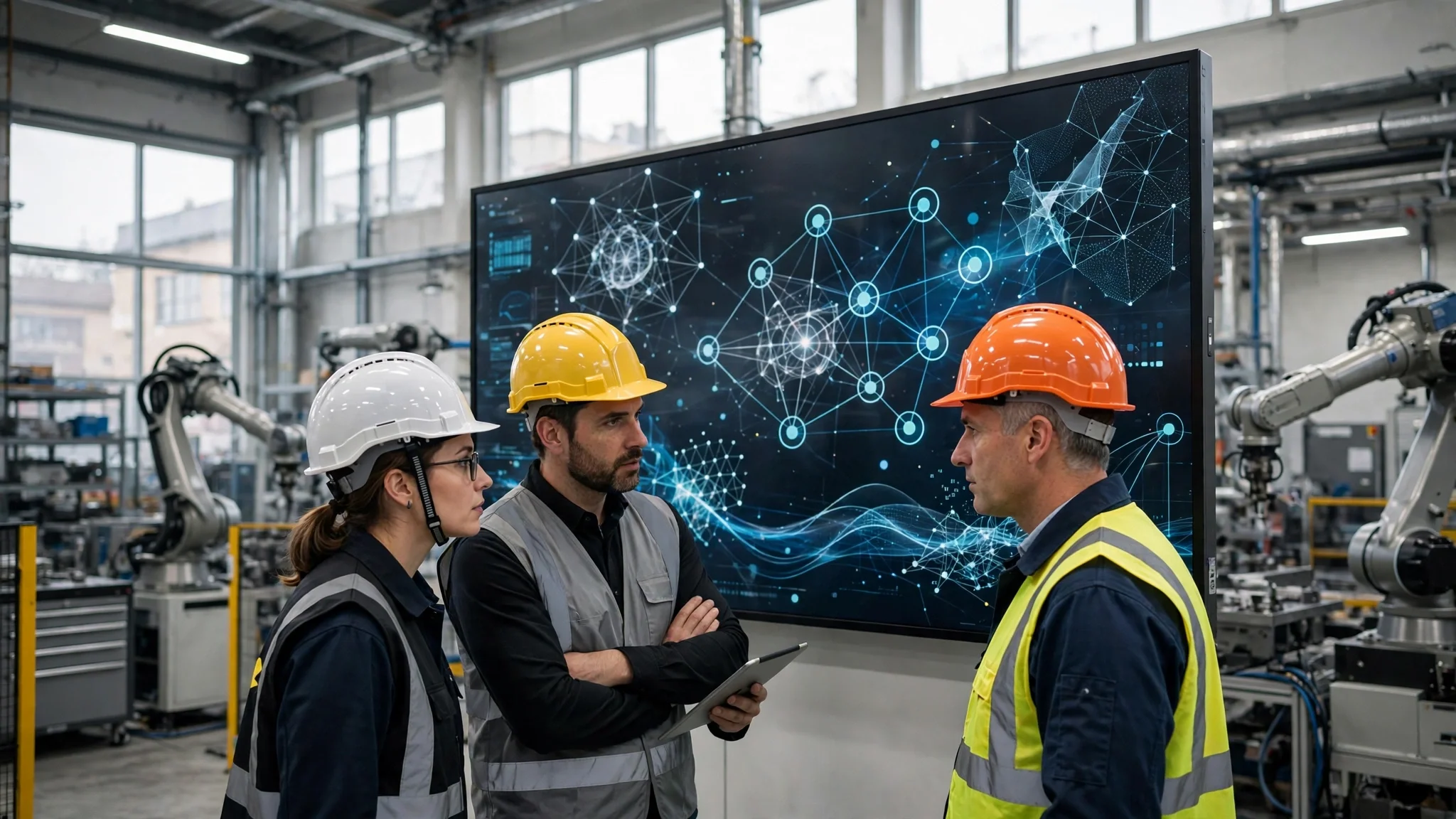
Imagen alusiva a la apuesta alemana por la inteligencia artificial industrial · Imagen generada para EPM
Germany signs NVIDIA pact to advance industrial AI models
Germany's economy and research ministries signed a joint declaration of intent with NVIDIA to develop advanced Physical AI models, embedded in the federal AI…
Germany pursues technological sovereignty through industrial AI deal
Chancellor Friedrich Merz's government signed a declaration with NVIDIA to advance specialized open models for industrial artificial intelligence, centered on…
--- The context ---
Germany has placed industrial artificial intelligence at the center of its technology strategy. The federal government presents it as a core issue and links its development to its artificial intelligence roadmap and to the Hightech Agenda Deutschland, building on strengths it highlights itself: industrial data, manufacturing competence and engineering expertise.
--- The facts ---
At the Invest in Germany Summit, with Chancellor Friedrich Merz, the Federal Ministry for Economic Affairs and Energy and the Federal Ministry of Research, Technology and Space signed a joint declaration of intent with NVIDIA. Through the declaration, the partners agreed to advance an initiative to develop state-of-the-art artificial intelligence models for Physical AI.
The initiative is embedded in the federal government's artificial intelligence roadmap and in Plattform Industrie 4.0. Its stated goal is to bring industrial artificial intelligence systematically into broad application and to establish a cutting-edge industrial ecosystem in Europe, supported by strong German companies and research institutions.
--- The positions ---
The federal government stresses that it seeks to merge Germany's traditional engineering and manufacturing expertise with top-level research and the latest artificial intelligence technology. According to the declaration, that combination is intended to secure the country's productivity, competitiveness and technological sovereignty.
NVIDIA, for its part, will expand its existing engagement with German partners, according to the text. The collaboration emphasizes developing specialized open models for industrial artificial intelligence, based on open models such as NVIDIA Nemotron and NVIDIA Cosmos.
--- What remains unknown ---
The declaration places Plattform Industrie 4.0 as the core element of the partnership. It is a network bringing together politics, industry, research and associations, now being fully oriented toward industrial artificial intelligence and intended to become the central strategy network, from infrastructure to application. The platform is open to all companies and maintains cooperation with many international partners, but the text does not specify concrete steps beyond that framework.
--- Unanswered questions ---
How will a declaration of intent translate into concrete projects inside German factories? What role will small and medium-sized companies play in practice as the new models are developed? How will success be measured if the goal is to prove that the European ecosystem has truly reached broad application?
--- EPM analysis ---
The bet combines a historic strength with a new tool. Germany does not start from zero in industry or engineering, and the agreement tries to turn that heritage into an advantage in artificial intelligence applied to production. Including research institutions, industry and smaller companies is meant, according to the declaration, to ensure that innovations are spread widely and that the German Mittelstand can benefit from progress rather than seeing it concentrated among a few actors.
📌 EPM Take: In EPM's view, the declaration matters because it organizes priorities Germany already held in scattered form: industrial data, manufacturing and engineering placed in service of open and specialized models. Its strength lies not in an isolated announcement, but in relying on an existing and open network connecting government, companies and research. The risk is that the framework remains too general and is slow to reach the factory floor. If the platform coordinates infrastructure and application with continuity, the country will gain a stronger position in Europe.
--- The context ---
Technological sovereignty is the guiding thread of Germany's new industrial artificial intelligence initiative. The federal government presents this field as one of its core topics and integrates it into its artificial intelligence roadmap and the Hightech Agenda Deutschland, relying on the industrial data, manufacturing and engineering that distinguish the country.
--- The facts ---
During the Invest in Germany Summit, with Chancellor Friedrich Merz, the Federal Ministry for Economic Affairs and Energy and the Federal Ministry of Research, Technology and Space signed a joint declaration of intent with NVIDIA. The partners agreed to advance the development of state-of-the-art artificial intelligence models for Physical AI.
The initiative is embedded in the federal roadmap and in Plattform Industrie 4.0. Its purpose, as stated, is to bring industrial artificial intelligence into broad and systematic application and to build a cutting-edge European industrial ecosystem, based on strong German companies and research institutions.
--- The positions ---
The German government argues that it wants to merge traditional engineering and manufacturing with cutting-edge research and the most modern artificial intelligence technology. In the government's account, that fusion is the path to protect Germany's productivity, competitiveness and technological sovereignty in an increasingly demanding environment.
NVIDIA commits, according to the text, to expanding its existing collaboration with German partners. The shared emphasis is on creating specialized open models for industrial uses, based on open models such as NVIDIA Nemotron and NVIDIA Cosmos, and on involving research institutions, industry and smaller companies.
--- What remains unknown ---
Plattform Industrie 4.0 is defined as the core of the partnership. It is a network of politics, industry, research and associations, now fully reoriented toward industrial artificial intelligence, open to all companies and with international cooperation. It is to act as the central strategy network from infrastructure to application, although the declaration does not specify instruments, responsibilities or verifiable results at this stage.
--- Unanswered questions ---
Can Germany sustain its technological sovereignty if the base models come from an external partner? How will it be ensured that the Mittelstand participates on real terms and not only as a declared beneficiary? What concrete decisions will the platform take to move from coordination to effective industrial application?
--- EPM analysis ---
Read in terms of order and continuity, the initiative protects what Germany already does well. It does not propose abandoning its manufacturing tradition, but strengthening it with artificial intelligence and research excellence. Promoting that research is part of the technology roadmap of the Hightech Agenda Deutschland, and broad participation is intended to ensure progress reaches the small and medium-sized companies that support much of the economy.
📌 EPM Take: In EPM's view, the government is right to make technological sovereignty an explicit objective and to defend its industrial base instead of replacing it with abstract promises. The alliance can be useful if it respects one essential condition: that the capacity to decide and to produce remains rooted in Germany and in Europe. The use of open models helps that purpose, but does not guarantee it on its own. The test will be whether smaller companies and German centers gain lasting capacity of their own.
Alemania firma con NVIDIA un pacto para impulsar la IA industrial
Los ministerios alemanes de Economía y de Investigación firmaron con NVIDIA una declaración de intenciones para desarrollar modelos avanzados de inteligencia…
Alemania busca soberanía tecnológica con su alianza industrial con NVIDIA
El Gobierno de Friedrich Merz firmó con NVIDIA una declaración para impulsar modelos abiertos de inteligencia artificial industrial, con la Plattform Industrie…
--- El contexto ---
Alemania ha colocado la inteligencia artificial industrial en el centro de su estrategia tecnológica. El Gobierno federal la presenta como un tema central y vincula su desarrollo a la hoja de ruta de inteligencia artificial y a la Hightech Agenda Deutschland, con la idea de aprovechar una base que el propio Ejecutivo destaca: datos industriales, competencia manufacturera y experiencia en ingeniería.
--- Los hechos ---
En el marco del Invest in Germany Summit, con el canciller Friedrich Merz, el Ministerio Federal de Economía y Energía y el Ministerio Federal de Investigación, Tecnología y Espacio firmaron una declaración de intenciones con NVIDIA. Con esa declaración, las partes acordaron impulsar una iniciativa para desarrollar modelos de inteligencia artificial de última generación orientados a la denominada Physical AI.
La iniciativa forma parte de la hoja de ruta de inteligencia artificial del Gobierno federal y de la Plattform Industrie 4.0. El objetivo declarado es llevar la inteligencia artificial industrial de forma sistemática a una aplicación amplia y establecer en Europa un ecosistema de vanguardia, apoyado en empresas e instituciones de investigación alemanas fuertes.
--- Las posiciones ---
El Gobierno federal subraya que busca fusionar la ingeniería y la experiencia manufacturera tradicionales de Alemania con la investigación de excelencia y la tecnología de inteligencia artificial más avanzada. Según lo expuesto, esa combinación debe servir para asegurar la productividad, la competitividad y la soberanía tecnológica del país.
NVIDIA, por su parte, ampliará su compromiso previo con socios alemanes, según la declaración. La colaboración pone el acento en desarrollar modelos abiertos y especializados para la inteligencia artificial industrial, a partir de modelos abiertos como NVIDIA Nemotron y NVIDIA Cosmos.
--- Lo que falta saber ---
La declaración sitúa a la Plattform Industrie 4.0 como elemento central de la asociación. Se trata de una red que reúne a política, industria, investigación y asociaciones, que ahora se orienta por completo a la inteligencia artificial industrial y que debe convertirse en la red estratégica central, desde la infraestructura hasta la aplicación. La plataforma está abierta a todas las empresas y mantiene cooperaciones con numerosos socios internacionales, pero el texto no detalla pasos concretos más allá de ese marco.
--- Preguntas sin respuesta ---
¿Cómo se traducirá la declaración de intenciones en proyectos concretos dentro de las fábricas alemanas? ¿Qué papel tendrán en la práctica las pequeñas y medianas empresas cuando se desarrollen los nuevos modelos? ¿De qué manera se medirá si el ecosistema europeo que se busca establecer alcanza realmente una aplicación amplia?
--- Análisis EPM ---
La apuesta combina una fortaleza histórica con una herramienta nueva. Alemania no parte de cero en industria ni en ingeniería, y el acuerdo intenta convertir ese patrimonio en ventaja en inteligencia artificial aplicada a la producción. La inclusión de centros de investigación, de la industria y de las pymes busca, según la declaración, que las innovaciones se difundan ampliamente y que el Mittelstand alemán pueda beneficiarse de los avances, en lugar de que queden concentrados en pocos actores.
📌 Conclusion EPM: A juicio de EPM, la declaración tiene valor porque ordena prioridades que Alemania ya poseía de forma dispersa: datos industriales, manufactura e ingeniería puestas al servicio de modelos abiertos y especializados. Su fuerza no está en un anuncio aislado, sino en apoyarse en una red existente y abierta que conecta gobierno, empresas e investigación. El riesgo es que el marco resulte demasiado general y tarde en llegar a la planta. Si la plataforma logra coordinar infraestructura y aplicación con continuidad, el país ganará una posición más sólida en Europa.
--- El contexto ---
La soberanía tecnológica aparece como el hilo conductor de la nueva iniciativa alemana en inteligencia artificial industrial. El Gobierno federal presenta este campo como uno de sus temas centrales y lo integra en su hoja de ruta de inteligencia artificial y en la Hightech Agenda Deutschland, apoyándose en los datos industriales, la manufactura y la ingeniería que distinguen al país.
--- Los hechos ---
Durante el Invest in Germany Summit, con el canciller Friedrich Merz, el Ministerio Federal de Economía y Energía y el Ministerio Federal de Investigación, Tecnología y Espacio firmaron una declaración de intenciones con NVIDIA. Las partes acordaron impulsar el desarrollo de modelos de inteligencia artificial de última generación para Physical AI.
La iniciativa está incorporada a la hoja de ruta federal y a la Plattform Industrie 4.0. Su propósito, según lo declarado, es llevar la inteligencia artificial industrial a una aplicación amplia y sistemática, y construir en Europa un ecosistema industrial de inteligencia artificial de vanguardia, con empresas e instituciones de investigación alemanas fuertes como base.
--- Las posiciones ---
El Ejecutivo alemán sostiene que quiere fusionar la ingeniería y la fabricación tradicionales con la investigación de punta y la tecnología de inteligencia artificial más moderna. A juicio del Gobierno, esa fusión es la vía para proteger la productividad, la competitividad y la soberanía tecnológica de Alemania frente a un entorno cada vez más exigente.
NVIDIA se compromete, según el texto, a ampliar su colaboración existente con socios alemanes. El énfasis compartido está en crear modelos abiertos y especializados para usos industriales, tomando como base modelos abiertos como NVIDIA Nemotron y NVIDIA Cosmos, y en sumar a centros de investigación, industria y pymes.
--- Lo que falta saber ---
La Plattform Industrie 4.0 queda definida como el núcleo de la asociación. Es una red de política, industria, investigación y asociaciones, ahora reorientada por completo hacia la inteligencia artificial industrial, abierta a todas las empresas y con cooperaciones internacionales. Debe actuar como red estratégica central desde la infraestructura hasta la aplicación, aunque la declaración no precisa instrumentos, responsables ni resultados verificables en esta etapa.
--- Preguntas sin respuesta ---
¿Podrá Alemania sostener su soberanía tecnológica si los modelos de base proceden de un socio externo? ¿Cómo se garantizará que el Mittelstand participe en condiciones reales y no solo como beneficiario declarado? ¿Qué decisiones concretas adoptará la plataforma para pasar de la coordinación a la aplicación industrial efectiva?
--- Análisis EPM ---
Leída en clave de orden y continuidad, la iniciativa protege lo que Alemania ya hace bien. No propone abandonar su tradición manufacturera, sino reforzarla con inteligencia artificial y con investigación de excelencia. La promoción de esa investigación forma parte de la hoja de ruta tecnológica de la Hightech Agenda Deutschland, y la participación amplia busca que el progreso llegue al tejido de pequeñas y medianas empresas que sostiene buena parte de la economía.
📌 Conclusion EPM: A juicio de EPM, acierta el Gobierno al colocar la soberanía tecnológica como objetivo explícito y al defender su base industrial en lugar de sustituirla por promesas abstractas. La alianza puede ser útil si respeta una condición esencial: que la capacidad de decidir y de producir siga arraigada en Alemania y en Europa. El uso de modelos abiertos ayuda a ese propósito, pero no lo garantiza por sí solo. La prueba estará en si las pymes y los centros alemanes ganan capacidad propia y duradera.