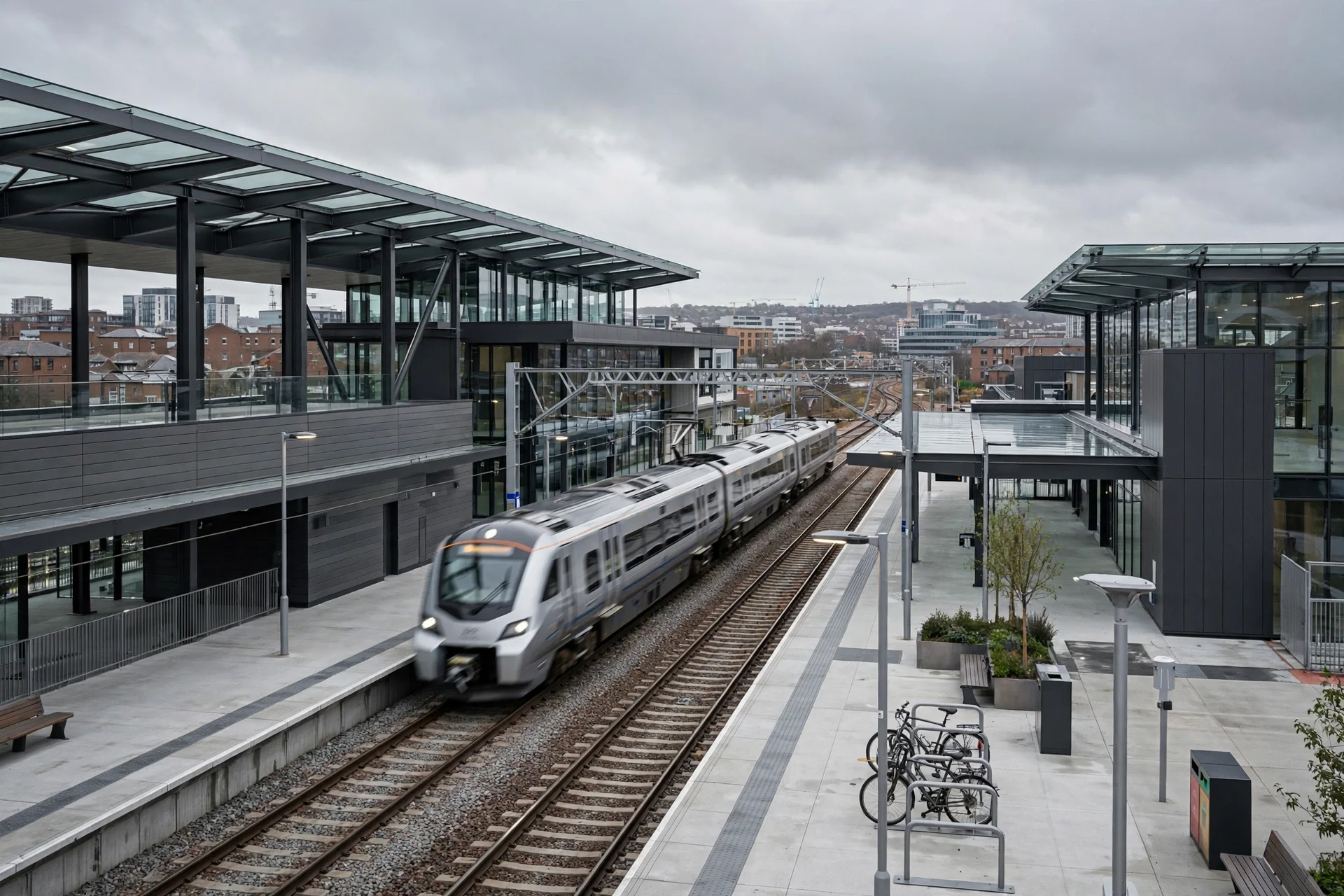
Imagen alusiva a la nueva estación de Bradford anunciada por el Gobierno británico · Imagen generada para EPM
Bradford Puts Passengers First With Its New Northern Station
The British government confirmed a new Bradford Interchange station centred on frequent, reliable services, local control alongside Mayor Brabin and Southern…
Bradford's New Station: Capital, Business and Measurable Results
Bradford's new Interchange terminal is presented as productive investment: attributed benefits of up to £1 billion, thousands of jobs and homes, and a demand…
--- The context ---
Anyone who commutes from Bradford today understands the northern connectivity gap. Reaching work, classes or family depends on services whose frequency, reliability and journey times the announcement presents as ripe for improvement. For those everyday passengers, the British government confirmed on October 20, 2026 a new station at Bradford Interchange.
--- The facts ---
The immediate promise concerns the travelling experience: departures more often toward Leeds, Manchester and York, shorter trips and operations people can trust. Northern Powerhouse Rail envisages several trains every hour linking major northern cities, running so regularly that walking onto the platform without consulting departure boards becomes normal behaviour.
The terminal will sit inside Great British Railways, the publicly owned organisation reuniting track and operations around its users. Opening is placed in the 2030s, when it will supersede the building dating from the 1970s, a facility the announcement calls outdated beside the hub Bradford deserves.
Regeneration enters the story after the service case. The interchange site opens room to reshape the Southern Gateway and, combined with the West Yorkshire Mass Transit network, it would underpin thousands of homes and jobs, with benefits put at up to £1 billion, as estimated by the council and echoed by ministers, within the Northern Growth Strategy.
--- The positions ---
Local ownership belongs chiefly to Tracy Brabin, Mayor of West Yorkshire, with whom the site was agreed. Brabin characterised the day, in reported speech, as exciting and backed by an ironclad pledge of a city centre facility, arguing that Bradford contains potential yet to be released. Swift services toward Leeds and Manchester, the Weaver Network and regional mass transit can finally release it.
Heidi Alexander, the Transport Secretary, remarked indirectly that planting the regional rail programme in the urban heart unlocks local possibilities, reshapes movement across the North and lays groundwork for housing, employment and chances regionally.
Henri Murison, who leads the Northern Powerhouse Partnership, read the interchange choice as enduring backing and saw within the Southern Gateway homes and occupations that would otherwise never materialise, especially for youngsters tied into Sheffield, Liverpool and Manchester. Chancellor John Healey stressed support for locally elected leadership.
--- What remains unknown ---
What remains unsettled is decisive and mostly financial: nobody has published what the scheme will cost, where each contribution will originate or which timetable will govern delivery. Nor is it clear whether West Yorkshire's mass transit network will mature quickly enough to meet the station on arrival.
--- Unanswered questions ---
Who will carry the complete bill and under what sharing arrangement between administrations? Will regional mass transit be ready to operate alongside the terminal from its opening day? Which Bradford neighbourhoods will feel genuine improvements first and which districts risk waiting longest?
--- EPM analysis ---
Read progressively, the decision earns support through its philosophy: public money, a railway held in public hands and choices shared with the elected authority rooted in the territory. Its deeper purpose is no landmark building, but narrowing social distances between neighbourhoods and cities and stitching together a North where a home postcode no longer predicts each young person's horizon.
📌 EPM Take: In EPM's view, this station should be judged chiefly as an instrument of territorial fairness, because its greatest merit lies in treating Bradford's everyday connectivity as a practical entitlement rather than a privilege reserved for already dominant regional capitals. When trains run often, operate dependably and connect smoothly with mass transit, districts now treated as peripheral will gain genuine access to employment, training and services spread across the North. That broad social dividend, measured in easier daily lives for ordinary residents, is what would ultimately justify the public investment pledged here today.
--- The context ---
The announcement of October 20, 2026 is, before any symbolism, a capital decision: erecting a fresh terminal at Bradford Interchange within the Northern Powerhouse Rail programme. Britain's government commits heavy infrastructure to a central site, retiring during the 2030s facilities originating in the 1970s, under its Northern Growth Strategy.
--- The facts ---
The economic argument heads the file. Council and government attribute to the scheme, working alongside West Yorkshire's projected mass transit system, a potential contribution reaching £1 billion, matched by thousands of dwellings and thousands of jobs. The territorial lever behind those returns would be the Southern Gateway, an area whose regeneration ministers present as unblocked by the chosen location.
Those projected returns rest on a tangible operating upgrade: services more frequently, journeys trimmed and greater dependability linking Bradford with Leeds, Manchester and York. Northern Powerhouse Rail aims to supply several departures hourly between northern capitals at headways tight enough to skip departure tables. The terminal will join Great British Railways, the public structure merging track and operations seeking efficiency.
--- The positions ---
Chancellor John Healey gave the economic formulation when he argued, in reported speech, that his administration behaves differently: it stands behind those governing locally and funds the infrastructure populations genuinely require. He drew his thesis of creating decent employment near where people reside, strengthening high streets residents can take pride in and building a sturdier future for Bradford and West Yorkshire.
Henri Murison, of the Northern Powerhouse Partnership, reinforced the business angle by calling the central location, in attributed paraphrase, a long term pledge toward the city and the North. Murison foresaw housing and employment that would never materialise without regenerating the Southern Gateway, vowed to drive later phases of the programme and concluded that the region's next expansion will be built by business, whose confidence is rising in Bradford.
Heidi Alexander, Transport Secretary, indirectly labelled the date a milestone and maintained that bringing the rail programme downtown releases the locality's enormous potential. Tracy Brabin, the mayor, welcomed a commitment she termed ironclad and connected the terminal with Bradford City Village and the Weaver Network.
--- What remains unknown ---
The conservative unknown is not intention but execution: the fixed price, the works programme and the precise date inside a distant 2030s horizon remain to be settled. Without them nobody can compute the relationship between outlay and outcome or spot slippage, overruns and postponements eroding the return expected by taxpayers and employers.
--- Unanswered questions ---
Which control mechanisms will halt cost overruns and delays before they accumulate unchecked? How will auditors confirm that the attributed housing, employment and benefits actually materialise rather than remaining projections? What happens if the regional mass network advances more slowly than the terminal itself?
--- EPM analysis ---
Read conservatively, the scheme defends itself as productive investment rather than routine spending: it widens the reachable labour market, makes hiring and trading easier, lifts the value of central land and sends business a signal of permanence. Its legitimacy therefore demands sober management, verifiable milestones and regular publication of outcomes, not merely announcements of intent.
📌 EPM Take: In EPM's view, the worth of this terminal will be settled on a results sheet rather than in inaugural rhetoric, because an investment of this scale deserves lasting support only if it converts underused central land into verifiable activity, hiring and revenue over decades. Local employers need certainty: deadlines honoured, budgets contained and rapid connections enlarging their labour pool from the first morning of full operation. If officials publish measurable progress and correct deviations without excuses, Bradford gains a productive asset; otherwise it inherits immobilised capital showing scant demonstrable collective return overall.
Bradford pone al pasajero primero con su nueva estación del Norte
El Gobierno británico confirmó una estación nueva en Bradford Interchange centrada en servicios frecuentes y fiables, control local con la alcaldesa Brabin y…
Nueva estación de Bradford: capital, empresa y resultados medibles
La nueva terminal de Bradford Interchange se presenta como inversión productiva: beneficios atribuidos de hasta mil millones de libras, miles de empleos y…
--- El contexto ---
Quien hoy espera un tren en Bradford conoce la sensación de quedar desconectado del resto del Norte. Viajar a trabajar, estudiar o visitar familia depende de servicios mejorables en frecuencia, fiabilidad y trayectos. Para esos pasajeros, el Gobierno británico confirmó el 20 de octubre de 2026 una estación nueva en Bradford Interchange.
--- Los hechos ---
La promesa inmediata es de servicio: salidas más seguidas hacia Leeds, Manchester y York, recorridos más cortos y un funcionamiento confiable. Northern Powerhouse Rail plantea varios trenes cada hora entre grandes urbes norteñas, con cadencia para acudir al andén sin mirar horarios.
La futura terminal se integrará en Great British Railways, la operadora de titularidad pública que reunirá infraestructura y operación pensando primero en quien viaja. Su apertura se sitúa en la década de 2030 y sustituirá al edificio de los años setenta, calificado en el anuncio como desfasado.
Solo después del servicio aparece la regeneración: el emplazamiento libera posibilidades para transformar Southern Gateway y, combinado con la red de transporte masivo propuesta para West Yorkshire, respaldaría miles de hogares y empleos, además de beneficios valorados hasta en mil millones de libras según el consejo y el Ejecutivo, dentro de la Estrategia de Crecimiento del Norte.
--- Las posiciones ---
El protagonismo local recae en Tracy Brabin, alcaldesa de West Yorkshire, con quien se acordó el emplazamiento. Brabin calificó la jornada, en paráfrasis atribuida, de momento emocionante con un compromiso sin fisuras, y defendió que Bradford encierra un potencial dormido. Trayectos veloces hacia Leeds y Manchester, la Weaver Network y el transporte masivo regional permitirán despertarlo.
Heidi Alexander, responsable de Transporte, planteó en formulación indirecta que instalar el eje ferroviario en pleno corazón urbano libera posibilidades locales, ordena desplazamientos por todo el Norte y siembra condiciones para vivienda, empleo y oportunidades regionales.
Henri Murison, al frente de Northern Powerhouse Partnership, interpretó la opción del intercambiador como respaldo duradero y vio en Southern Gateway hogares y ocupaciones que sin esta apuesta no surgirían, pensando en jóvenes enlazados con Sheffield, Liverpool y Manchester. John Healey, titular de Hacienda, subrayó el respaldo a dirigentes locales.
--- Lo que falta saber ---
Lo decisivo permanece sin cerrar y atañe al dinero: nadie ha publicado cuánto costará el conjunto, de dónde saldrá cada aportación ni qué calendario de obras regirá. Tampoco se sabe si el transporte masivo de West Yorkshire madurará a tiempo para encontrarse con la estación, ni qué diseño tendrá el edificio.
--- Preguntas sin respuesta ---
¿Quién asumirá la factura completa y con qué reparto entre administraciones? ¿Llegará el transporte masivo regional a tiempo para operar junto a la terminal desde su apertura? ¿Qué barrios notarán primero mejoras reales y cuáles seguirán esperando?
--- Análisis EPM ---
Leída en clave progresista, la decisión vale por su filosofía: dinero público sostenido, ferrocarril de titularidad pública y decisiones compartidas con la autoridad elegida en el territorio. Su sentido último no es un edificio vistoso, sino acortar distancias sociales entre barrios y ciudades y coser un Norte donde el código postal no anticipe el horizonte juvenil.
📌 Conclusion EPM: A juicio de EPM, esta estación debe juzgarse ante todo como una herramienta de igualdad territorial, porque su acierto mayor consiste en tratar la conectividad cotidiana de Bradford como un derecho práctico y no como un lujo reservado a las grandes capitales regionales ya consolidadas. Si los trenes llegan seguidos, funcionan con fiabilidad y enlazan bien con el transporte masivo, barrios hoy periféricos ganarán acceso real a empleo, formación y servicios repartidos por todo el Norte. Ese beneficio social amplio, medido en vidas diarias más fáciles, es lo que finalmente justificaría la inversión pública comprometida ahora.
--- El contexto ---
La decisión anunciada el 20 de octubre de 2026 es, antes que un gesto simbólico, una apuesta de capital: levantar una terminal nueva en Bradford Interchange dentro del programa Northern Powerhouse Rail. El Ejecutivo británico sitúa infraestructura pesada en pleno centro, sustituyendo en la década de 2030 unas instalaciones de los años setenta.
--- Los hechos ---
Ayuntamiento y Ejecutivo atribuyen al proyecto, junto a la proyectada red de transporte masivo de West Yorkshire, una aportación potencial de hasta mil millones de libras, con miles de viviendas y miles de empleos. La palanca territorial sería Southern Gateway, cuya regeneración el anuncio presenta como desbloqueada por la localización elegida junto al intercambiador.
El rendimiento prometido descansa en una mejora operativa tangible: trenes con mayor frecuencia, trayectos recortados y mayor regularidad hacia Leeds, Manchester y York. Northern Powerhouse Rail aspira a varias circulaciones horarias entre capitales norteñas, con cadencia suficiente para prescindir de consultar horarios. La terminal se integrará además en Great British Railways, la estructura pública que unificará vía y operación buscando eficiencia.
--- Las posiciones ---
John Healey, canciller del Tesoro, aportó la formulación económica central al sostener, en discurso referido, que su Ejecutivo actúa distinto: apoya a quienes gobiernan localmente e invierte en las infraestructuras que la población necesita. De ahí derivó su tesis de generar ocupaciones dignas cerca de donde reside la gente y construir un porvenir sólido para Bradford y West Yorkshire.
Henri Murison, de Northern Powerhouse Partnership, reforzó el ángulo empresarial al describir la localización céntrica, en paráfrasis atribuida, como compromiso de largo recorrido con la ciudad y con el Norte. Murison anticipó vivienda y ocupación que sin regenerar Southern Gateway jamás se materializarían y remató que la siguiente expansión regional la levantará el sector privado, cuya confianza ya crece en Bradford.
Heidi Alexander, secretaria de Transporte, calificó indirectamente la fecha como hito y sostuvo que llevar el programa ferroviario al centro libera el enorme potencial local. Tracy Brabin, alcaldesa regional, celebró un compromiso que tachó de blindado y conectó la terminal con Bradford City Village y la Weaver Network.
--- Lo que falta saber ---
La incógnita conservadora no es la intención sino la ejecución: falta fijar el coste cerrado, el programa de obra y la fecha precisa dentro de una década de 2030 lejana. Sin esos datos resulta imposible calcular la relación entre desembolso y resultado o detectar desviaciones que erosionen el retorno esperado por contribuyentes y empresas.
--- Preguntas sin respuesta ---
¿Qué mecanismos de control frenarán sobrecostes y retrasos antes de que se acumulen? ¿Cómo se auditará que vivienda, empleo y beneficios atribuidos se materializan y no quedan en proyección? ¿Qué ocurrirá si la red masiva regional avanza más lenta que la terminal?
--- Análisis EPM ---
En lectura conservadora, el proyecto se defiende como inversión productiva y no como gasto corriente: amplía el mercado de trabajo alcanzable, facilita contratar y vender, revaloriza suelo céntrico y envía a la empresa una señal de permanencia. Por eso su legitimidad exige gestión sobria, hitos verificables y publicación periódica de resultados, no solo anuncios de intenciones.
📌 Conclusion EPM: A juicio de EPM, el valor de esta terminal se decidirá en una hoja de resultados y no en la retórica inaugural, porque una inversión de esta escala solo merece respaldo duradero si convierte suelo céntrico infrautilizado en actividad, contratación y recaudación verificables durante décadas. La empresa local necesita certezas: plazos cumplidos, costes contenidos y conexiones rápidas que amplíen su mercado laboral desde el primer día de operación plena. Si la administración publica avances medibles y corrige desviaciones sin excusas, Bradford ganará un activo productivo; si no, será capital inmovilizado con escaso retorno colectivo demostrable.