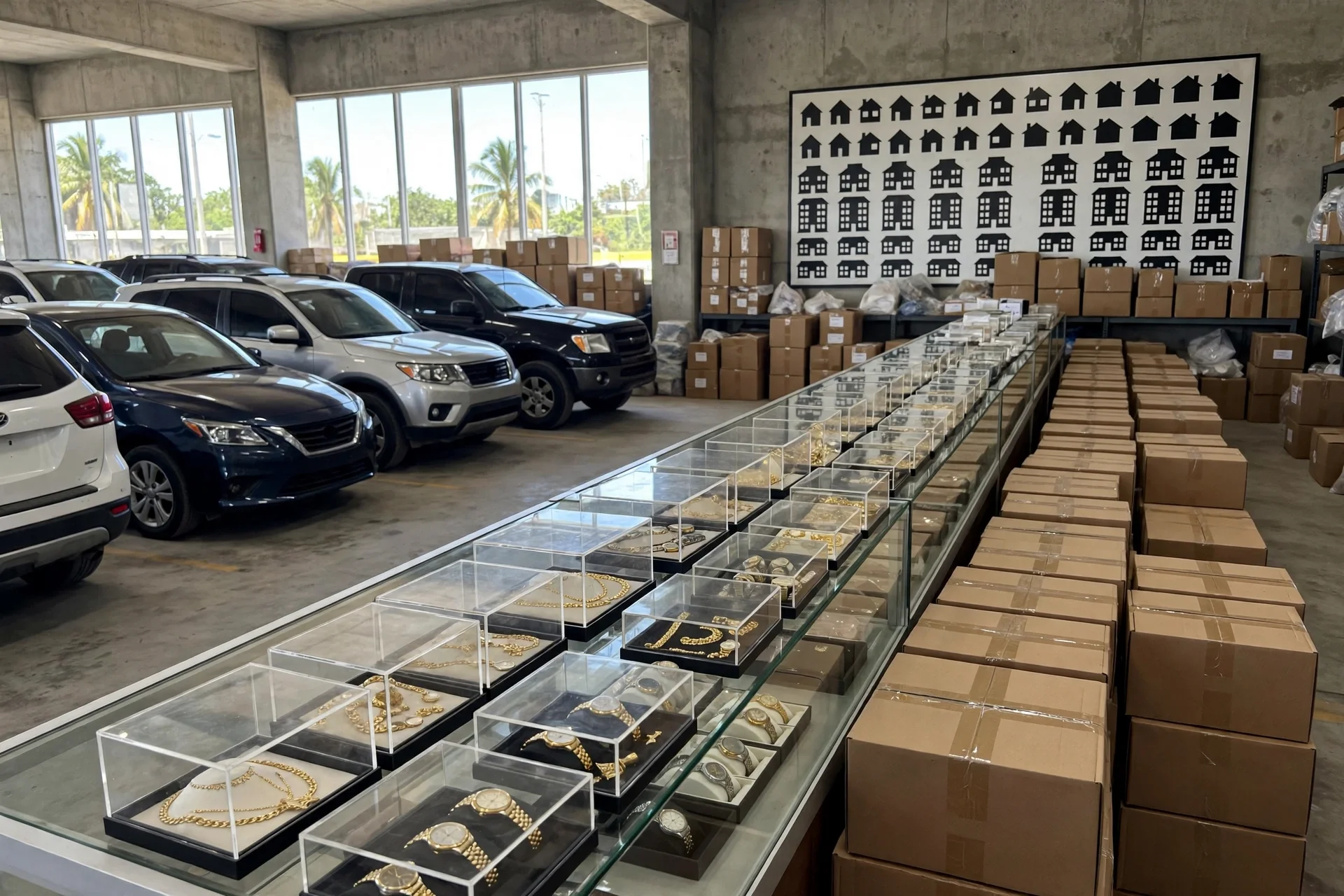
Vehículos, joyas, relojes y cajas selladas ordenados en un almacén, imagen alusiva a la subasta de bienes incautados. · Imagen generada para EPM
INCABIDE Opens Registration to Auction More Than 200 Assets
INCABIDE opened registration this Monday, October 19, for its second public auction of 2026, with more than 200 assets across five areas of the Dominican…
INCABIDE Auction of 200-Plus Assets Opens With Strict Validation
INCABIDE opened registration for its second public auction of 2026, with more than 200 assets across five areas of the country.
--- The context --- The National Institute for Custody and Administration of Seized, Confiscated and Forfeited Assets opened registration this Monday, October 19, for its second public auction of 2026 in the Dominican Republic, offering more than 200 assets distributed across five areas of the country.
The call is built around wider access: in-person registration at its offices and a virtual option available 24 hours a day through the institution's official portal.
--- The facts --- The registration period will remain open until Friday, November 13, with a non-refundable fee of RD$5,000. In-person registration will run Monday to Friday, from 8:30 in the morning to 5:00 in the afternoon, and on Saturdays, from 9:00 in the morning to 1:00 in the afternoon.
The offer includes houses, apartments, lots, farms, jewelry, high-value watches, vehicles, scrap lots, vessels and aircraft. The assets will be distributed across Greater Santo Domingo, the National District and the North or Cibao, South and East regions.
--- The positions --- From a transparency perspective, the strongest element is the interconnected validation. According to the institution, the system will be interconnected with the Central Electoral Board, the Comptroller General of the Republic and the General Directorate of Internal Taxes to speed up document validation.
The award session is scheduled for November 25 at the Police Institute of Higher Education. During the morning, movable assets will be auctioned, while in the afternoon it will be the turn of real estate, in two separate blocks.
--- What remains unknown --- This announcement does not detail base prices or specific conditions for each asset. The institution urged interested parties to consult the catalogue of available assets and the terms and conditions on its official website before registering.
--- Unanswered questions --- Will the catalogue allow a clear comparison of the condition and location of each of the more than 200 assets? Will the virtual option truly make it easier to take part from all five areas of the country? How many people will register before Friday, November 13?
--- EPM analysis --- When seized, confiscated and forfeited assets return to circulation through a public, regulated channel, the return is twofold: property under custody is put in order and a verifiable opportunity opens for citizens. The key will be a complete and accessible catalogue.
📌 EPM Take: In EPM's view, this auction matters for its combination of broad access and document control: in-person and virtual registration around the clock, cross-validation with three institutions and a clear award date on November 25. If the catalogue and the terms are consulted in time and that traceability holds through the end, the second public auction of 2026 can become an example of transparent management of assets under custody in the Dominican Republic.
--- The context --- This Monday, October 19, the National Institute for Custody and Administration of Seized, Confiscated and Forfeited Assets opened registration for its second public auction of 2026 in the Dominican Republic. The State puts in order more than 200 assets distributed across five areas of the country.
Discipline starts at registration. The period will remain open until Friday, November 13, with a non-refundable fee of RD$5,000, a sign of seriousness that orders participation from the first step.
--- The facts --- Interested parties may register in person at the INCABIDE offices, Monday to Friday, from 8:30 in the morning to 5:00 in the afternoon, and on Saturdays, from 9:00 in the morning to 1:00 in the afternoon. A virtual option will also be available, 24 hours a day, through the institution's official portal.
The offer includes houses, apartments, lots, farms, jewelry, high-value watches, vehicles, scrap lots, vessels and aircraft. The assets will be distributed across Greater Santo Domingo, the National District and the North or Cibao, South and East regions.
--- The positions --- Protection against irregularities rests on cross-validation. According to the institution, the system will be interconnected with the Central Electoral Board, the Comptroller General of the Republic and the General Directorate of Internal Taxes, to speed up document validation.
The award stage follows a strict order. The in-person session is scheduled for November 25 at the Police Institute of Higher Education, in two blocks: during the morning, movable assets will be auctioned, and in the afternoon it will be the turn of real estate.
--- What remains unknown --- This announcement does not specify base prices or the individual detail of each asset. The institution urged interested parties to consult the catalogue of available assets and the terms and conditions on its official website.
--- Unanswered questions --- Will the interconnected validation detect any irregular document in time before November 25? Will the non-refundable RD$5,000 fee be enough to guarantee orderly and responsible participation? Will the same control hold in the morning award of movable assets and the afternoon award of real estate?
--- EPM analysis --- An auction of seized assets only fulfils its purpose if authority is exercised without gaps: prior rules, documents verified by three institutions and separate blocks for movable assets and real estate. That design protects the credibility of the procedure and the result.
📌 EPM Take: In EPM's view, what is decisive about this call is not only that there are more than 200 assets, but the control framework around it: a non-refundable fee, interconnected validation with the Central Electoral Board, the Comptroller and the General Directorate of Internal Taxes, and an award ordered by blocks on November 25. If that rigour is applied without exceptions, the second public auction of 2026 will strengthen State authority over the assets in its custody.
INCABIDE abre registro para subastar más de 200 bienes en el país
El INCABIDE abrió este lunes 19 de octubre las inscripciones para su segunda subasta pública de 2026, con más de 200 bienes en cinco zonas de República…
Subasta de INCABIDE: más de 200 bienes con control y validación estatal
El INCABIDE abrió las inscripciones para su segunda subasta pública de 2026, con más de 200 bienes en cinco zonas del país.
--- El contexto --- El Instituto Nacional de Custodia y Administración de Bienes Incautados, Decomisados y en Extinción de Dominio abrió este lunes 19 de octubre las inscripciones para su segunda subasta pública de 2026 en República Dominicana, con más de 200 bienes distribuidos en cinco zonas del país.
La convocatoria busca abrir el acceso: registro presencial en sus oficinas y modalidad virtual las 24 horas del día, por el portal oficial de la institución.
--- Los hechos --- El período de inscripción permanecerá abierto hasta el viernes 13 de noviembre, con una cuota de RD$5,000, no reembolsable. El registro presencial será de lunes a viernes, de 8:30 de la mañana a 5:00 de la tarde, y los sábados, de 9:00 de la mañana a 1:00 de la tarde.
La oferta incluye casas, apartamentos, solares, fincas, joyas, relojes de alto valor, vehículos, lotes de chatarra, embarcaciones y aeronaves. Los bienes estarán distribuidos en el Gran Santo Domingo, el Distrito Nacional y las regiones Norte o Cibao, Sur y Este.
--- Las posiciones --- Desde la transparencia, el punto fuerte es la validación interconectada. De acuerdo con la institución, el sistema estará interconectado con la Junta Central Electoral, la Contraloría General de la República y la Dirección General de Impuestos Internos para agilizar la validación de documentos.
La jornada de adjudicación está pautada para el próximo 25 de noviembre en el Instituto Policial de Educación Superior. Durante la mañana se subastarán los bienes muebles y en la tarde corresponderá el turno a los inmuebles, en dos bloques.
--- Lo que falta saber --- Este anuncio no detalla precios base ni condiciones por cada bien. La institución exhortó a consultar el catálogo de bienes disponibles y el pliego de condiciones en su página web oficial.
--- Preguntas sin respuesta --- ¿El catálogo permitirá comparar con claridad el estado y la ubicación de cada uno de los más de 200 bienes? ¿La modalidad virtual facilitará de verdad la participación desde las cinco zonas del país? ¿Cuántas personas se inscribirán antes del viernes 13 de noviembre?
--- Análisis EPM --- Cuando bienes incautados, decomisados y en extinción de dominio vuelven a circular por una vía pública y reglada, el retorno es doble: se ordena un patrimonio bajo custodia y se abre una oportunidad verificable para la ciudadanía. La clave estará en un catálogo completo y accesible.
📌 Conclusion EPM: A juicio de EPM, esta subasta vale por la combinación de acceso amplio y control documental: registro presencial y virtual las 24 horas, validación cruzada con tres instituciones y una fecha de adjudicación clara el 25 de noviembre. Si el catálogo y el pliego se consultan con tiempo y el proceso mantiene esa trazabilidad hasta el final, la segunda subasta pública de 2026 puede convertirse en un ejemplo de gestión transparente de bienes bajo custodia en República Dominicana.
--- El contexto --- Este lunes 19 de octubre el Instituto Nacional de Custodia y Administración de Bienes Incautados, Decomisados y en Extinción de Dominio abrió las inscripciones para su segunda subasta pública de 2026 en República Dominicana. El Estado pone en orden más de 200 bienes distribuidos en cinco zonas del país.
El rigor empieza en la inscripción. El período permanecerá abierto hasta el viernes 13 de noviembre, con una cuota de RD$5,000, no reembolsable, una señal de seriedad que ordena la participación.
--- Los hechos --- El registro presencial en las oficinas del INCABIDE será de lunes a viernes, de 8:30 de la mañana a 5:00 de la tarde, y los sábados, de 9:00 de la mañana a 1:00 de la tarde. También habrá modalidad virtual, las 24 horas del día, por el portal oficial de la institución.
La oferta incluye casas, apartamentos, solares, fincas, joyas, relojes de alto valor, vehículos, lotes de chatarra, embarcaciones y aeronaves. Los bienes estarán distribuidos en el Gran Santo Domingo, el Distrito Nacional y las regiones Norte o Cibao, Sur y Este.
--- Las posiciones --- El control descansa en la validación cruzada: el sistema estará interconectado con la Junta Central Electoral, la Contraloría General de la República y la Dirección General de Impuestos Internos, para agilizar la validación de documentos.
La adjudicación sigue un orden estricto: la jornada presencial será el próximo 25 de noviembre en el Instituto Policial de Educación Superior, en dos bloques: durante la mañana se subastarán los bienes muebles y en la tarde corresponderá el turno a los inmuebles.
--- Lo que falta saber --- Este anuncio no precisa precios base ni detalle por bien. La institución exhortó a consultar el catálogo de bienes disponibles y el pliego de condiciones en su página web oficial.
--- Preguntas sin respuesta --- ¿La validación interconectada detectará a tiempo cualquier documento irregular antes del 25 de noviembre? ¿La cuota no reembolsable de RD$5,000 bastará para garantizar una participación ordenada y responsable? ¿Se mantendrá el mismo control en la adjudicación de muebles por la mañana y de inmuebles por la tarde?
--- Análisis EPM --- Una subasta de bienes incautados solo cumple su función si la autoridad se ejerce sin fisuras: reglas previas, documentos verificados por tres instituciones y bloques separados para muebles e inmuebles. Ese diseño protege la credibilidad del procedimiento.
📌 Conclusion EPM: A juicio de EPM, lo decisivo de esta convocatoria no es solo que haya más de 200 bienes, sino el andamiaje de control que la rodea: cuota no reembolsable, validación interconectada con la Junta Central Electoral, la Contraloría y la Dirección General de Impuestos Internos, y una adjudicación ordenada por bloques el 25 de noviembre. Si ese rigor se aplica sin excepciones, la segunda subasta pública de 2026 reforzará la autoridad del Estado sobre los bienes bajo su custodia.