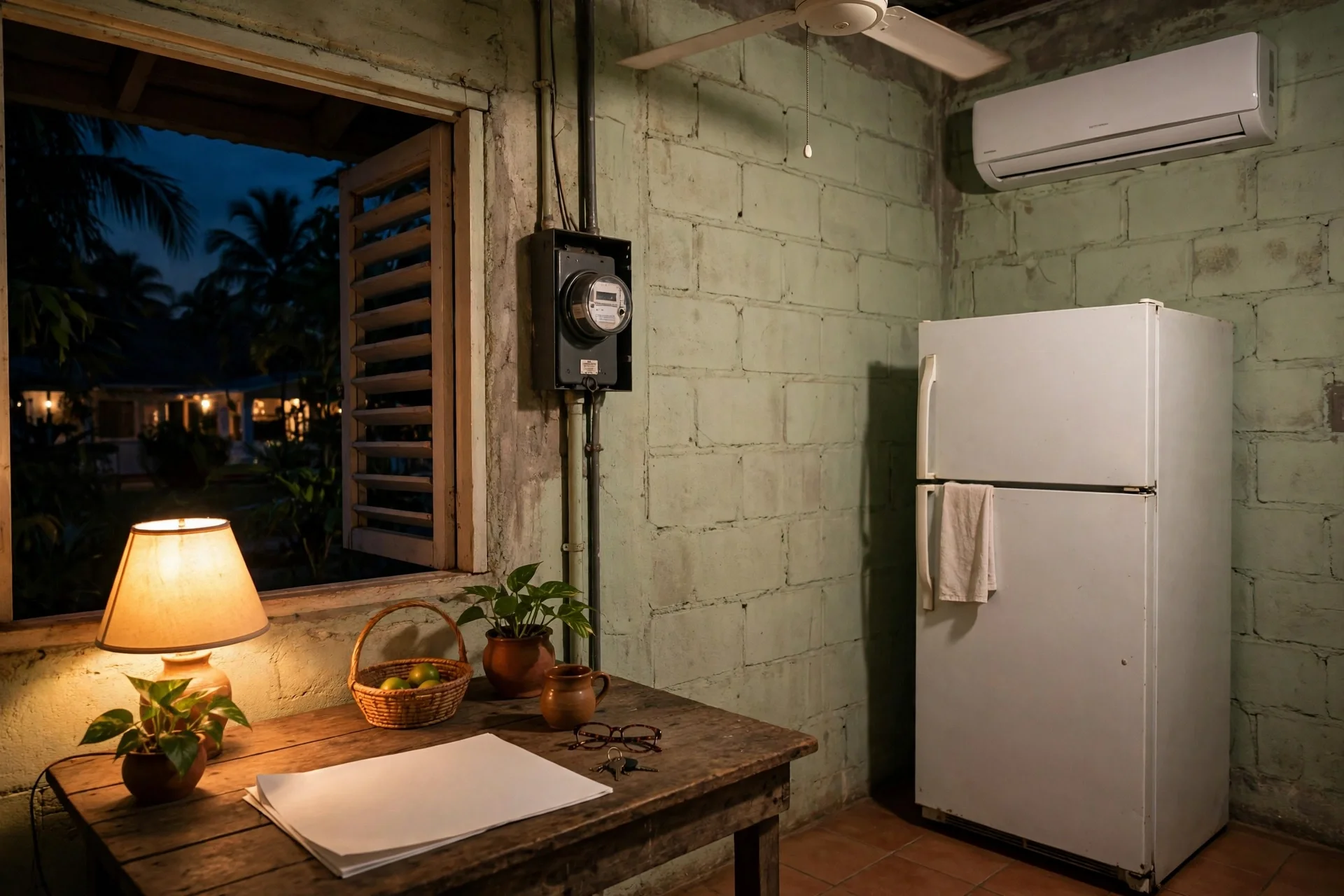
Hogar con contador eléctrico y electrodomésticos, imagen alusiva al consumo eléctrico. · Imagen generada para EPM
Government keeps electricity tariff frozen and strengthens targeted subsidies
The Dominican Government keeps the electricity tariff frozen since 2022 and strengthens targeted subsidies against international prices.
Electricity tariff remains unchanged since 2022 with subsidies for households
The electricity tariff remains unchanged since 2022, with subsidies in every tier against a market reference of RD 15.50.
--- The context ---
The Dominican Government is keeping the electricity tariff frozen, unchanged since 2022, and strengthening targeted subsidies to protect household finances from international energy and fuel prices. President Luis Abinader and Energy and Mines Minister Joel Santos explained the policy during LA Agenda Semanal.
--- The facts ---
According to the presentation, tariffs have not increased. The structure is divided into four consumption tiers: those who use between 0 and 200 kilowatt hours pay RD 6.09, but exceeding 700 kilowatt hours raises the tariff to RD 13.09 for all kilowatt hours consumed.
--- The positions ---
From a social protection perspective, the freeze works as a shield against external shocks. At the same time, the jump between tiers explains why some users perceive increases during periods of higher consumption, even though the tariff itself remains unchanged and every tier still receives a state subsidy.
--- What remains unknown ---
It remains unclear how the effect of targeted subsidies is distributed in practice across the tiers and what happens to households close to the upper limit. Whether the four-tier structure will be adjusted was not detailed either.
--- Unanswered questions ---
How is it ensured that targeted subsidies benefit those who consume least the most? What margin does a household near 700 kilowatt hours have to avoid jumping a tier? Will the freeze hold while international prices keep pressing?
--- EPM analysis ---
The key figure is the gap against the reference or market tariff, of about RD 15.50 per kilowatt hour. A 10% increase in consumption can mean a 30% to 40% rise in the final cost if a person jumps to the upper tier.
📌 EPM Take:
In EPM's view, the freeze sustained since 2022 protects household income against international volatility, but its real benefit depends on every household understanding the tiers. With the market reference at RD 15.50 and every tier subsidized, the policy brings relief today, while leaving open the debate over its targeting and over how to prevent slightly higher consumption from raising the final bill disproportionately.
--- The context ---
The Dominican Government is keeping the electricity tariff frozen, unchanged since 2022, with targeted subsidies in the face of international energy and fuel prices. President Luis Abinader and Energy and Mines Minister Joel Santos explained the current scheme during LA Agenda Semanal.
--- The facts ---
Santos emphasized, in attributed indirect terms, that tariffs have not increased. The structure has four tiers: between 0 and 200 kilowatt hours the charge is RD 6.09, but exceeding 700 kilowatt hours raises the tariff to RD 13.09 for all kilowatt hours consumed.
--- The positions ---
From a standpoint of stability and predictability, keeping the tariff unchanged gives households and budgets certainty. At the same time, the tiered design puts the focus on each user's consumption: the bill moves when the upper tier is entered, not because of a tariff increase.
--- What remains unknown ---
More detail is still missing on how the subsidy is ordered across the different tiers and what signals reach those close to the upper limit. Whether the four-tier structure will be reviewed was not specified either.
--- Unanswered questions ---
How long can the freeze be sustained without changes to the structure? How is the subsidy ordered so that it rewards contained consumption? What should a household watch to avoid passing 700 kilowatt hours?
--- EPM analysis ---
Every tariff tier continues to receive a state subsidy, because the reference or market tariff amounts to about RD 15.50 per kilowatt hour. A 10% increase in consumption can mean a 30% to 40% rise in the final cost if the upper tier is entered.
📌 EPM Take:
In EPM's view, tariff stability since 2022 is an asset of predictability worth preserving with clear rules. The subsidy covers the distance to the RD 15.50 reference, but the upper tier heavily penalizes slightly higher consumption. Order, information and contained consumption are, for now, the best defense of the household budget against a bill that depends on jumping between tiers.
Gobierno mantiene tarifa eléctrica congelada y refuerza subsidios focalizados
El Gobierno dominicano mantiene congelada la tarifa eléctrica desde 2022 y refuerza subsidios focalizados frente a precios internacionales.
Tarifa eléctrica sigue invariable desde 2022 con subsidios para los hogares
La tarifa eléctrica permanece invariable desde 2022, con subsidios en todos los renglones frente a una referencia de mercado de RD 15,50.
--- El contexto ---
El Gobierno dominicano mantiene congelada la tarifa eléctrica, invariable desde 2022, y refuerza los subsidios focalizados para proteger la economía familiar frente a los precios internacionales de la energía y los combustibles. Lo explicaron el presidente Luis Abinader y el ministro Joel Santos durante LA Agenda Semanal.
--- Los hechos ---
Según lo expuesto, las tarifas no han aumentado. La estructura se divide en cuatro tramos de consumo: quien consume entre 0 y 200 kilovatios hora paga RD 6,09, pero si sobrepasa los 700 kilovatios hora la tarifa escala a RD 13,09 por la totalidad de los kilovatios consumidos.
--- Las posiciones ---
Desde una mirada de protección social, el congelamiento funciona como escudo ante choques externos. Al mismo tiempo, el salto entre tramos explica por qué algunos usuarios perciben aumentos en periodos de mayor consumo, aunque la tarifa permanezca invariable y todos los renglones sigan recibiendo subsidio estatal.
--- Lo que falta saber ---
Falta precisar cómo se distribuye en la práctica el efecto de los subsidios focalizados entre tramos y qué ocurre con los hogares cercanos al límite superior. Tampoco se detalló si la estructura de cuatro tramos tendrá ajustes.
--- Preguntas sin respuesta ---
¿Cómo se garantiza que el subsidio focalizado beneficie más a quienes menos consumen? ¿Qué margen tiene un hogar que ronda los 700 kilovatios hora para no saltar de tramo? ¿Se mantendrá el congelamiento mientras presionen los precios internacionales?
--- Análisis EPM ---
El dato clave es la brecha frente a la tarifa de referencia o de mercado, de unos RD 15,50 por kilovatio hora. Un incremento del 10 % en el consumo puede reflejar un aumento de entre 30 % y 40 % en el costo final si la persona salta al tramo superior.
📌 Conclusion EPM:
A juicio de EPM, el congelamiento sostenido desde 2022 protege el ingreso familiar frente a la volatilidad internacional, pero su beneficio real depende de que cada hogar entienda los tramos. Con la referencia de mercado en RD 15,50 y todos los renglones subsidiados, la política alivia hoy, aunque deja abierta la discusión sobre su focalización y sobre cómo evitar que un consumo apenas mayor dispare la factura de manera desproporcionada.
--- El contexto ---
El Gobierno dominicano mantiene congelada la tarifa eléctrica, invariable desde 2022, con subsidios focalizados frente a los precios internacionales de la energía y los combustibles. El presidente Luis Abinader y el ministro de Energía y Minas, Joel Santos, explicaron el esquema vigente durante LA Agenda Semanal.
--- Los hechos ---
Santos enfatizó, en términos atribuidos, que las tarifas no han aumentado. La estructura tiene cuatro tramos: entre 0 y 200 kilovatios hora se paga RD 6,09, pero al sobrepasar los 700 kilovatios hora la tarifa escala a RD 13,09 por la totalidad de los kilovatios consumidos.
--- Las posiciones ---
Desde una mirada de estabilidad y previsibilidad, mantener la tarifa invariable da certidumbre a hogares y presupuestos. A la vez, el diseño por tramos pone el acento en el consumo de cada usuario: la factura se mueve cuando se salta al tramo superior, no por un aumento tarifario.
--- Lo que falta saber ---
Falta conocer con más detalle cómo se ordena el subsidio entre los distintos renglones y qué señales recibe quien está cerca del límite superior. Tampoco se precisó si la estructura de cuatro tramos se revisará.
--- Preguntas sin respuesta ---
¿Cuánto tiempo podrá sostenerse el congelamiento sin cambios en la estructura? ¿Cómo se ordena el subsidio para que premie el consumo contenido? ¿Qué debe vigilar un hogar para no pasar de los 700 kilovatios hora?
--- Análisis EPM ---
Todos los renglones tarifarios siguen recibiendo subsidio estatal, porque la tarifa de referencia o de mercado asciende a unos RD 15,50 por kilovatio hora. Un incremento del 10 % en el consumo puede reflejar un aumento de entre 30 % y 40 % en el costo final si se salta de tramo.
📌 Conclusion EPM:
A juicio de EPM, la estabilidad tarifaria desde 2022 es un activo de previsibilidad que conviene preservar con reglas claras. El subsidio cubre la distancia frente a los RD 15,50 de referencia, pero el tramo superior castiga con fuerza un consumo apenas mayor. Orden, información y consumo contenido son, por ahora, la mejor defensa del presupuesto familiar frente a una factura que depende del salto entre tramos.