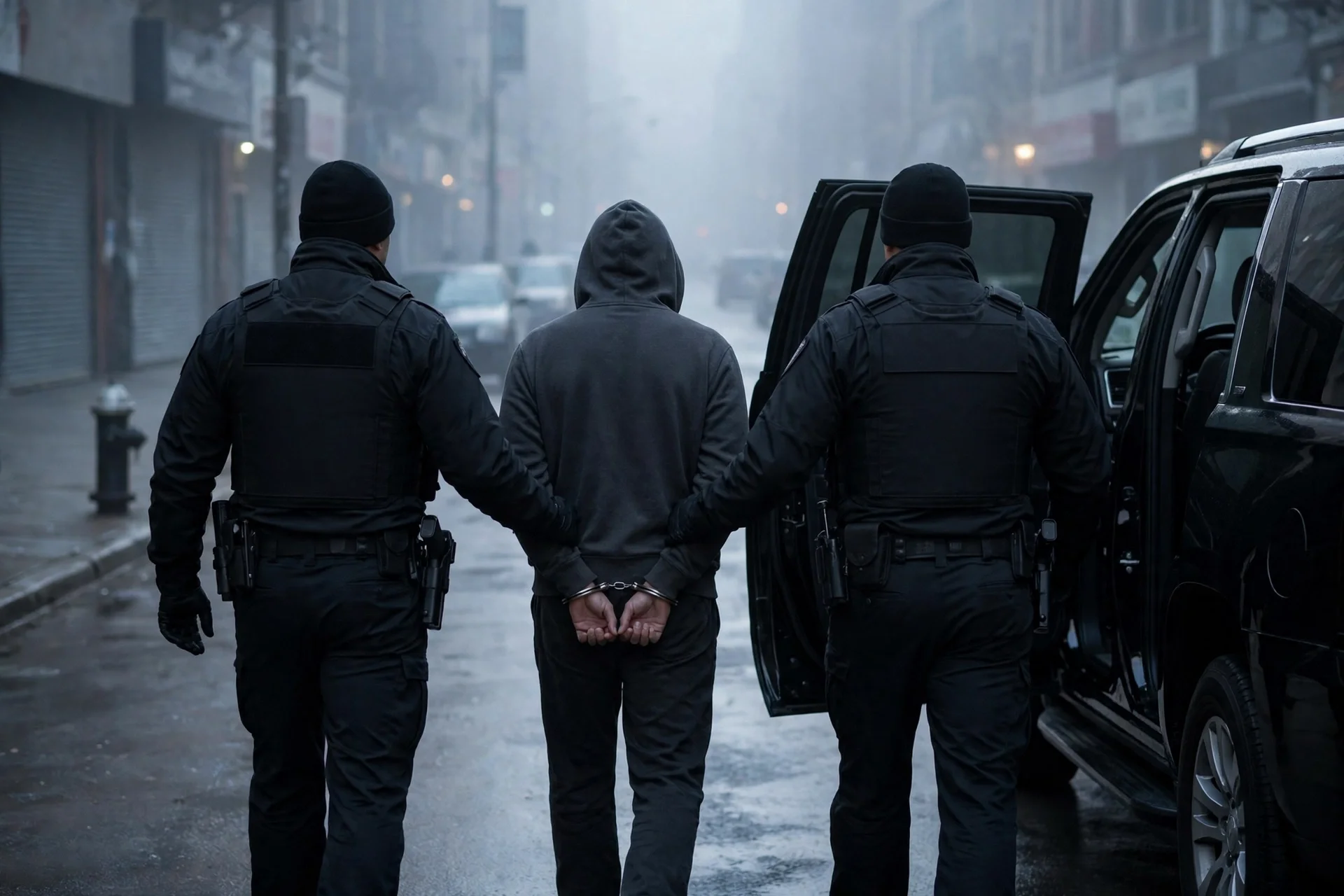
Agentes escoltan a una persona esposada hacia un vehículo durante un operativo, imagen alusiva a los arrestos anunciados. · Imagen generada para EPM
ICE Announces Weekend Arrests of People Convicted of Serious Crimes Nationwide
ICE announced weekend arrests of people living in the United States illegally who hold serious criminal convictions.
ICE Arrests Convicted Murderers, Rapists and Traffickers Over the Weekend
ICE arrested people living in the United States illegally who were convicted of serious crimes over the weekend, according to the official statement.
--- The context ---
U.S. Immigration and Customs Enforcement, known as ICE, announced weekend arrests in the United States. The statement, issued from Washington by the Department of Homeland Security, presents the cases under the leadership of President Donald Trump and Secretary Markwayne Mullin as part of an effort to arrest and deport people living in the country illegally who hold criminal convictions.
--- The facts ---
The released list enumerates fifteen cases with a name, a country of origin, a conviction and the place of conviction. Among the most serious are the felony murder conviction of Jose Zetina Romero, from El Salvador, in Fairfax, Virginia, and the voluntary manslaughter conviction of Carlos Castro-Ramirez, from Mexico, in Bakersfield, California. Yusniel Gonzalez, from Cuba, also appears, convicted in Miami, Florida, of attempted premeditated murder and theft.
Other cases involve sexual offenses, violence and drugs. Ricardo Rafael Bugarin-Carrion, from Mexico, was convicted in Los Angeles, California, of lewd or lascivious acts with a child under 14 years old, and Aly Toure, from Guinea, was convicted of rape in the Bronx, New York. On drugs, Carlos Alex Ortiz-Cruz, from Honduras, was convicted in Utah of distribution of a controlled substance, and Cesar Morales-Ruiz, from Mexico, was convicted in Kansas City, Missouri, of conspiracy to distribute cocaine.
--- The positions ---
Secretary Mullin is quoted in the statement as saying, in indirect terms, that while Americans enjoyed their weekend, ICE personnel worked around the clock to remove people convicted of serious crimes from communities. He is also credited with warning that, under President Trump, anyone who breaks the law will face consequences, will be tracked down, arrested and deported, and that people living in the country illegally are not welcome in the United States.
--- What remains unknown ---
The statement does not give the exact date of each arrest or detail the later procedural status of each person detained. It also does not say whether any case involved a new detention or a location after conviction, nor does it provide information on hearings, legal representation or deportation timelines. That information does not appear in the released text.
--- Unanswered questions ---
Will the immigration and procedural status of each person listed be publicly confirmed? Will there be hearings or deportation proceedings with known timelines in each jurisdiction? Will additional information be released that distinguishes the date of each arrest from the date of each conviction?
--- EPM analysis ---
The released selection concentrates on cases of maximum seriousness. By grouping murder, sexual offenses, domestic violence and drug trafficking in a single list, the official message stresses the risk attached to each conviction without providing context on weekend detentions as a whole.
📌 EPM Take: In EPM's view, the informational value of the announcement lies in the concrete, checkable cases it enumerates, with names, convictions and places, rather than in the general tone of the statement. Publishing that list makes it possible to examine each record without turning the operation into a broader claim that the text does not support. At the same time, the absence of dates, procedural status and next steps requires keeping verification open and not treating any file as closed on the initial official release alone.
--- The context ---
Over the weekend, ICE agents arrested people living in the United States illegally who hold convictions for serious crimes, according to the statement issued from Washington. The Department of Homeland Security frames the action under the leadership of President Donald Trump and Secretary Markwayne Mullin, with a mandate to arrest and deport those who carry severe criminal convictions in American communities.
--- The facts ---
The fifteen enumerated cases include convictions for murder, sexual violence and drug trafficking in very different states. Jose Zetina Romero, from El Salvador, was convicted of felony murder in Fairfax, Virginia, and Carlos Castro-Ramirez, from Mexico, of voluntary manslaughter in Bakersfield, California. Aly Toure, from Guinea, was convicted of rape in the Bronx, New York, and Ricardo Rafael Bugarin-Carrion, from Mexico, of lewd or lascivious acts with a child under 14 years old in Los Angeles, California.
The list also adds domestic violence, assaults and drugs. Willians Jesus Villalonga-Quiroz, from Venezuela, was convicted in Lawrence, Massachusetts, of strangulation of a pregnant woman and assault, while Frankie Miller, from Liberia, was convicted in Iowa of domestic assault with a dangerous weapon and five counts of burglary. On drugs, Marco Banega, from Honduras, was convicted in Utah of distributing cocaine, and Benicio Baza-Carchure, from Mexico, was convicted in Rome, Georgia, of conspiracy to distribute cocaine.
--- The positions ---
Secretary Mullin is credited in the statement with saying that, while Americans enjoyed their weekend, ICE personnel worked around the clock to arrest murderers, sexual offenders and traffickers. He is also credited with stating that President Trump has made clear that anyone who breaks the law will face consequences, will be hunted down, arrested and deported, and that people living in the country illegally are not welcome in the United States.
--- What remains unknown ---
The official text does not detail the exact date of each weekend arrest or the later calendar for each case. It also does not specify hearings, transfers or concrete deportation timelines for the people listed. What can be verified is limited to the names, origins, convictions and places recorded case by case.
--- Unanswered questions ---
When will the deportation of each person named on the official list actually be carried out? Which jurisdiction will handle the procedural follow-up in the violence and drug cases? Will further arrests of this same profile be reported in the coming weekends?
--- EPM analysis ---
The statement places its emphasis on protecting communities and removing people with serious convictions. Each enumerated case describes a crime that has already been judged, from murder to cocaine distribution. The strength of the announcement rests on that accumulation of concrete convictions that can be checked against the official text itself.
📌 EPM Take: In EPM's view, the list serves its purpose when it is read case by case, because each name comes with a conviction and a place that make it possible to gauge the risk authorities say they are removing from the streets. Sustaining public safety requires that clarity and also continuity in enforcing the law. What remains is the procedural outcome for each person detained, without which the operation is described at its arrest stage but not yet in its complete final result.
ICE anuncia arrestos de fin de semana con condenas graves en varios estados
ICE anunció arrestos realizados durante el fin de semana de personas en situación irregular con condenas penales graves.
ICE detiene a condenados por asesinato, violación y narcotráfico en fin de semana
ICE arrestó durante el fin de semana a personas en situación irregular condenadas por delitos graves, según el comunicado oficial.
--- El contexto ---
El Servicio de Inmigración y Control de Aduanas, conocido como ICE, anunció arrestos realizados durante el fin de semana en Estados Unidos. El comunicado, difundido desde Washington por el Departamento de Seguridad Nacional, presenta los casos como parte de una ofensiva bajo el liderazgo del presidente Donald Trump y del secretario Markwayne Mullin para arrestar y deportar a personas en situación irregular con condenas penales.
--- Los hechos ---
La lista difundida enumera quince casos con nombre, origen, condena y lugar. Entre los delitos más graves figuran el asesinato con agravante atribuido a Jose Zetina Romero, de El Salvador, condenado en Fairfax, Virginia, y el homicidio voluntario atribuido a Carlos Castro-Ramirez, de México, condenado en Bakersfield, California. También figura Yusniel Gonzalez, de Cuba, condenado en Miami, Florida, por intento de asesinato premeditado y robo.
Otros casos corresponden a delitos sexuales, violencia y drogas. Ricardo Rafael Bugarin-Carrion, de México, fue condenado en Los Ángeles, California, por actos lascivos con un menor de 14 años, y Aly Toure, de Guinea, fue condenado por violación en el Bronx, Nueva York. En drogas figuran Carlos Alex Ortiz-Cruz, de Honduras, condenado en Utah por distribución de una sustancia controlada, y Cesar Morales-Ruiz, de México, condenado en Kansas City, Misuri, por conspiración para distribuir cocaína.
--- Las posiciones ---
Según lo atribuido al secretario Mullin en el comunicado, mientras la población disfrutaba del fin de semana el personal de ICE trabajó sin pausa para retirar de las comunidades a personas condenadas por delitos graves. También se le atribuye la advertencia de que, bajo el presidente Trump, quien infrinja la ley enfrentará consecuencias, será localizado, arrestado y deportado, y de que las personas en situación irregular no son bienvenidas en Estados Unidos.
--- Lo que falta saber ---
El comunicado no precisa la fecha exacta de cada arresto ni detalla la situación procesal posterior de cada detenido. Tampoco indica si algún caso corresponde a una detención nueva o a una localización posterior a la condena, ni ofrece datos sobre audiencias, representación legal o plazos de deportación. Esa información no figura en el texto difundido.
--- Preguntas sin respuesta ---
¿Se confirmará públicamente la situación migratoria y procesal de cada una de las personas enumeradas? ¿Habrá audiencias o procedimientos de deportación con plazos conocidos en cada jurisdicción? ¿Se publicará información adicional que permita distinguir la fecha del arresto de la fecha de cada condena?
--- Análisis EPM ---
La selección difundida concentra casos de máxima gravedad. Al agrupar asesinatos, delitos sexuales, violencia y narcotráfico en una sola lista, el mensaje oficial subraya el riesgo asociado a cada condena sin aportar contexto sobre el conjunto de detenciones del fin de semana.
📌 Conclusion EPM: A juicio de EPM, el valor informativo del anuncio está en los casos concretos y verificables que enumera, con nombres, condenas y lugares, y no en el tono general del comunicado. Publicar esa lista permite examinar cada antecedente sin convertir el operativo en una afirmación más amplia que el texto no sostiene. Al mismo tiempo, la ausencia de fechas, situación procesal y pasos siguientes obliga a mantener abierta la verificación y a no dar por cerrado ningún expediente con la sola difusión oficial inicial.
--- El contexto ---
Durante el fin de semana, agentes de ICE arrestaron en Estados Unidos a personas en situación irregular con condenas por delitos graves, según el comunicado difundido desde Washington. El Departamento de Seguridad Nacional enmarca la actuación en el liderazgo del presidente Donald Trump y del secretario Markwayne Mullin, con la orden de arrestar y deportar a quienes acumulan condenas penales severas.
--- Los hechos ---
Los quince casos enumerados incluyen condenas por asesinato, violencia sexual y narcotráfico en estados muy distintos. Jose Zetina Romero, de El Salvador, fue condenado por asesinato con agravante en Fairfax, Virginia, y Carlos Castro-Ramirez, de México, por homicidio voluntario en Bakersfield, California. Aly Toure, de Guinea, fue condenado por violación en el Bronx, Nueva York, y Ricardo Rafael Bugarin-Carrion, de México, por actos lascivos con un menor de 14 años en Los Ángeles, California.
La lista suma además violencia doméstica, agresiones y drogas. Willians Jesus Villalonga-Quiroz, de Venezuela, fue condenado en Lawrence, Massachusetts, por estrangulamiento de una mujer embarazada y agresión, mientras Frankie Miller, de Liberia, fue condenado en Iowa por agresión doméstica con arma peligrosa y cinco cargos de robo. En drogas aparecen Marco Banega, de Honduras, condenado en Utah por distribución de cocaína, y Benicio Baza-Carchure, de México, condenado en Rome, Georgia, por conspiración para distribuir cocaína.
--- Las posiciones ---
Al secretario Mullin se le atribuye en el comunicado la afirmación de que, mientras la población disfrutaba del fin de semana, el personal de ICE trabajó sin pausa para arrestar a asesinos, agresores sexuales y traficantes. También se le atribuye que el presidente Trump ha dejado claro que quien infrinja la ley enfrentará consecuencias, será buscado, arrestado y deportado, y que las personas en situación irregular no son bienvenidas en Estados Unidos.
--- Lo que falta saber ---
El texto oficial no detalla la fecha exacta de cada arresto del fin de semana ni el calendario posterior de cada caso. Tampoco precisa audiencias, traslados o plazos concretos de deportación para las personas enumeradas. Lo verificable se limita a nombres, orígenes, condenas y lugares consignados caso por caso.
--- Preguntas sin respuesta ---
¿Cuándo se ejecutará la deportación de cada una de las personas enumeradas en la lista oficial? ¿Qué jurisdicción asumirá el seguimiento procesal de los casos con condenas por violencia y drogas? ¿Se informará de nuevos arrestos de este mismo perfil en los próximos fines de semana?
--- Análisis EPM ---
El comunicado pone el acento en la protección de las comunidades y en la retirada de personas con condenas graves. Cada caso enumerado describe un delito ya juzgado, desde asesinato hasta distribución de cocaína. La fuerza del anuncio descansa en esa acumulación de condenas concretas y comprobables en el texto oficial.
📌 Conclusion EPM: A juicio de EPM, la lista cumple su propósito cuando se lee caso por caso, porque cada nombre viene acompañado de una condena y de un lugar que permiten dimensionar el riesgo que las autoridades dicen retirar de las calles. Sostener la seguridad exige esa claridad y también continuidad en la aplicación de la ley. Queda por conocer el desenlace procesal de cada detenido, dato sin el cual el operativo queda descrito en su arresto pero todavía no en su resultado final completo.