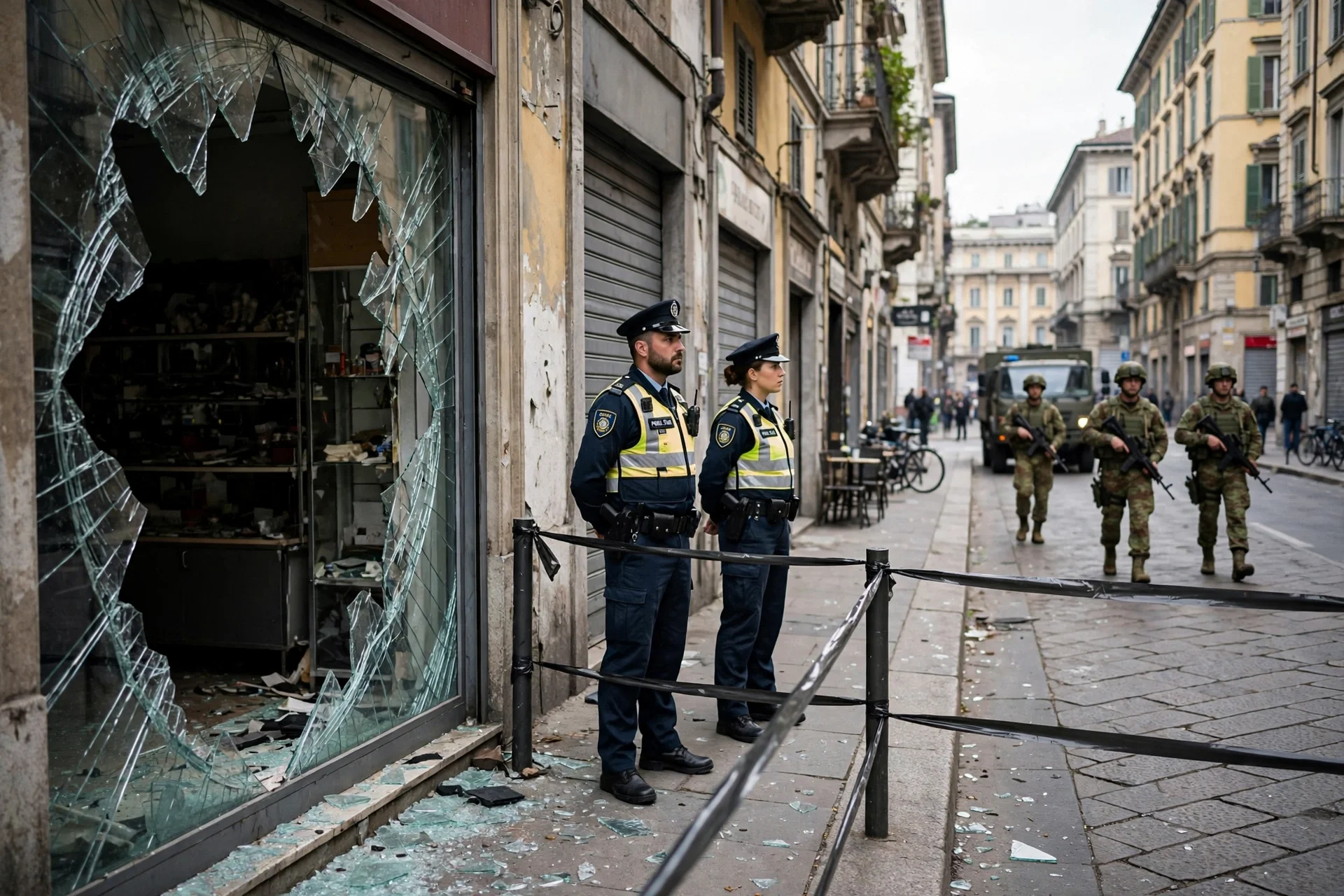
Escaparate destrozado en Milán con policías y militares en la calle, imagen alusiva a las medidas de seguridad aprobadas. · Imagen generada para EPM
Meloni tightens public safety after Milan unrest
Giorgia Meloni announced a decree approved by Council of Ministers number 193 creating an offence of violent participation in demonstrations, making…
Italy punishes violent protest with prison and fines
Council of Ministers number 193 approved the security decree announced by Giorgia Meloni: a new offence of violent participation in demonstrations carrying up…
--- The context ---
Milan and other Italian cities saw a weekend of violence with shops looted, storefronts smashed and officers attacked, scenes that Prime Minister Giorgia Meloni described in her video message as unacceptable. She argued that no one can downplay or justify what happened, and in that setting the Council of Ministers approved a decree with urgent measures on public safety and youth crime.
The package builds on measures approved in recent months, among them biometric recognition, also using artificial intelligence, to give a name to those hiding behind a hood. The new response combines criminal punishment for group violence, financial liability for the damage caused and more personnel on the streets and in the juvenile justice system.
--- The facts ---
The decree creates a new offence of violent participation in a demonstration. Anyone who, during a march, joins a group of five or more people and throws stones, firecrackers or sticks, endangering everyone, risks up to five years in prison and a fine of up to 20,000 euros. The penalty rises if the person covered their face or injured someone, and penalties also rise for devastating in a group.
Whoever breaks, pays, and if the person who breaks is a minor, the parents pay. For damage to public property, the Prefetto sends the payment order home; for damage to private property, the owner obtains from a judge an immediately enforceable payment decree. Families may challenge it, but payment comes first, and the victim can claim against all family assets, including money the State may owe them.
For minors aged 14 to 18, the capacity to understand their actions is now presumed unless proven otherwise, and that reversal of the burden of proof takes effect immediately under the decree. Preventive detention, until now reserved for adults, may also be applied to minors, and juvenile justice will receive more magistrates and more places in its institutes.
Milan will receive 500 additional soldiers until the end of the year, alongside police and carabinieri. The toll presented by Meloni counts almost 200 injured officers and damage in Milan alone of close to one million euros, according to the estimate by Confcommercio. Officers detained or arrested 330 people, half of foreign origin, and the youngest person identified in Milan would be just 11 years old.
--- The positions ---
The Government position draws a line between demonstrating and devastating. Meloni argued that no political idea, social hardship or opposition can justify looting a shop, because behind a storefront there is a family, workers and residents entitled to live without fear. Devastating and stealing, she maintained, is not protest but criminality, and offences must be prosecuted promptly and rigorously, including under the recent security decrees.
That firmness coexists in her message with a defence of peaceful protest. She cited farmers, truck drivers and Ex Ilva workers as sectors in difficulty with which the Government talks and seeks solutions, and noted that Minister Salvini met representatives of the road haulage sector today. She also called it extremely serious to publicise free legal assistance references after the devastation and asked all political forces for an unambiguous condemnation.
--- What remains unknown ---
The video message does not specify how many magistrates or how many new places juvenile justice will receive, nor how they will be distributed. It also leaves open the timelines for payment orders to families and the concrete shape of the military deployment in Milan beyond its duration. The practical wording of the decree and its first applications will show whether the announcement becomes visible change.
--- Unanswered questions ---
How will violent participation in a group be proven in practice without affecting the peaceful exercise of the right to demonstrate? What real scope will the presumption of capacity to understand have between the ages of 14 and 18 when evidence to the contrary exists? Will families be able to meet immediate payments, and what will happen when they lack sufficient assets? Will the reinforcements in Milan and in juvenile justice be enough to prevent such scenes from recurring?
--- EPM analysis ---
The decree moves three levers at once: punishment, the family budget and the visible presence of the State on the street. The combination seeks deterrence before reparation, and it shifts part of the control into the home, matching a diagnosis that describes groups of very young people summoned by a social media video to smash, steal and film themselves doing it.
The decisive border is the one the Government itself draws between protest and crime. Applied precisely, it can protect the shopkeeper and the peaceful demonstrator at the same time; applied hastily to minors, it can strain rights without addressing the root exposed by the figure of an 11 year old identified. The dialogue with sectors in conflict, which the message claims as its own, will be the test of whether firmness replaces social policy or accompanies it.
📌 EPM Take: In EPM's view, the decree announced by Meloni answers a real demand for safety with concrete instruments, and its success will depend on precise application that punishes violence without eroding the peaceful protest the Government itself says it protects. Financial liability for families and the presumption concerning minors are the most sensitive pieces, because they reach households and teenagers before organised networks. If the judicial and military reinforcement arrives together with the social dialogue the video message invokes, firmness will gain legitimacy; if it remains an announcement, the argument will return to the streets once again.
--- The context ---
The weekend images from Milan and other Italian cities showed looted shops, smashed storefronts and law enforcement officers under attack. Prime Minister Giorgia Meloni called those scenes unacceptable in her video message, saying no one can minimise or justify them, and announced the Government response: a decree approved by the Council of Ministers with new measures on public safety and youth crime.
The decree adds to what was approved in recent months, starting with biometric recognition, also with artificial intelligence, to identify those who hide behind a hood. Its underlying message is one of order and consequences: joining violence will carry a criminal cost, destroying property will carry a financial cost and the State will reinforce its presence where streets were left unprotected.
--- The facts ---
The central novelty is the offence of violent participation in a demonstration. Joining a group of five or more people during a march to throw stones, firecrackers or sticks, endangering everyone, can now cost up to five years in prison and a fine of up to 20,000 euros. The penalty increases if the offender covered their face or injured someone, and penalties also increase for those who devastate in a group.
A simple principle also applies: whoever breaks, pays, and if the offender is a minor, the parents pay. For damage to public property, the Prefetto sends the payment order to the home; for damage to private property, the owner obtains an immediately enforceable payment decree from a judge. Objection remains possible, but payment does not wait, and the victim can claim against all family assets, including credits owed by the State.
On minors, those aged 14 to 18 are presumed to have been capable of understanding what they were doing, unless proven otherwise, and that presumption becomes operational immediately rather than waiting for Parliament. Preventive detention, until now only for adults, may also be applied to minors. Juvenile justice will gain magistrates and places in its institutes so that certainty of punishment also holds at 16 years of age.
Milan will receive 500 more soldiers until the end of the year, alongside police and carabinieri. The official toll presented by Meloni counts almost 200 injured officers and damage in Milan alone of close to one million euros, according to Confcommercio. There were 330 people detained or arrested, half of foreign origin, and the youngest identified in Milan would be barely 11 years old, a figure the prime minister presented as a warning to everyone.
--- The positions ---
The Government position is that no cause legitimises devastation. Meloni argued that no political idea, social hardship or opposition justifies wrecking a shop to carry away its goods, because behind it stand families who invested a lifetime of sacrifices, workers who risk their jobs and citizens who deserve to live without fear. Wrecking and stealing, she stated, is not protest but criminality, and the State response must be firm and rigorous.
She also drew a clear line in favour of peaceful protest. She recalled farmers, truck drivers and Ex Ilva workers as communities in difficulty with which the Government talks and works to find solutions, and she noted that Minister Salvini met the road haulage representatives today. She judged it extremely serious that institutional representatives publicise free legal assistance references after the Milan devastation and asked every political force to condemn violence without ambiguity.
--- What remains unknown ---
The practical application of each piece remains to be seen: how quickly payment orders will be issued, the concrete number of magistrates and juvenile places and the detailed deployment of soldiers in Milan. The video message sets the framework and the penalties, but effectiveness will be measured in the courts, in the notices served on families and on the streets over the coming months.
--- Unanswered questions ---
Will the new penalties be applied with the speed and rigour the Government announces in the cases already opened over the devastation? Will families of minors answer for the damage when payment is immediate and enforceable? Will the presumption of capacity to understand between the ages of 14 and 18 speed up proceedings without becoming blocked in the courts? Will 500 more soldiers in Milan be enough to restore calm until the end of the year?
--- EPM analysis ---
The decree reorders incentives that impunity had inverted. If breaking things is free, violence repeats; if breaking things costs prison, a fine and the family assets, the calculation changes also for those who join the group seeking impunity or social media visibility. Parental liability also restores to the family a role of control that the phenomenon of youth groups summoned by video had overwhelmed.
The other key is certainty. Tougher penalties without magistrates, without places and without a street presence would be only paper; that is why the package joins punishment and means. The distinction between the peaceful demonstrator, who is heard, and the violent offender, who is prosecuted, also protects legitimate protest from contamination by those who use it as cover for looting.
📌 EPM Take: In EPM's view, the decree is right to restore an elementary rule the street had lost: demonstrating is a right and devastating is a crime, and whoever confuses the two must pay for it in full, criminally and financially. Parental liability and the presumption concerning minors restore real consequences to conduct that grew under the shelter of impunity. Its success will depend on judges, prefectures and law enforcement applying each piece with the promised speed and consistency; if certainty of punishment holds also at 16 years of age, deterrence will stop being merely a speech.
Meloni endurece la seguridad tras la violencia en Milán
Giorgia Meloni anunció un decreto aprobado por el Consejo de Ministros número 193 que crea el delito de participación violenta en manifestaciones, hace pagar…
Italia castiga la violencia en protestas con cárcel y multas
El Consejo de Ministros número 193 aprobó el decreto de seguridad anunciado por Giorgia Meloni: nuevo delito de participación violenta en manifestaciones con…
--- El contexto ---
Milán y otras ciudades italianas vivieron este fin de semana escenas de violencia con comercios saqueados, escaparates destruidos y agentes agredidos que la presidenta del Consejo, Giorgia Meloni, calificó en su videomensaje como inaceptables. Según sostuvo, nadie puede minimizar ni justificar lo ocurrido, y en ese clima el Consejo de Ministros aprobó un decreto con medidas urgentes de seguridad pública y contra la criminalidad juvenil.
El paquete se suma a medidas aprobadas en meses recientes, entre ellas el reconocimiento biométrico, también con inteligencia artificial, para dar un nombre a quien se esconde tras una capucha. La respuesta combina ahora castigo penal para la violencia en grupo, responsabilidad económica por los daños causados y refuerzo de personal en la calle y en la justicia juvenil.
--- Los hechos ---
Nace un nuevo delito de participación violenta en una manifestación. Quien durante una marcha se una a un grupo de cinco o más personas y arroje piedras, petardos o palos, poniendo en peligro la seguridad de todos, arriesga hasta cinco años de cárcel y hasta 20.000 euros de multa. Con el rostro cubierto o si hay heridos, la pena aumenta, y también suben las penas por devastar en grupo.
Quien rompe, paga, y si quien rompe es un menor, pagan sus padres. Si el daño es a un bien público, el Prefetto envía al domicilio la orden de pago; si es a un privado, el propietario obtiene del juez un decreto de pago inmediatamente ejecutivo. Cabe oposición, pero mientras tanto se paga, y quien sufrió el daño puede resarcirse con todos los bienes de la familia, incluso con lo que el Estado le deba.
Para los menores de 14 a 18 años se presume la capacidad de entender lo hecho, salvo prueba contraria, y esa inversión de la carga de la prueba queda operativa de inmediato con el decreto. La detención preventiva, hasta ahora reservada a los adultos, podrá aplicarse también a los menores, y la justicia juvenil recibirá más magistrados y más plazas en sus institutos.
En Milán se desplegarán 500 militares más hasta fin de año, junto a policía y carabinieri. El balance que presentó Meloni habla de casi 200 agentes heridos y de daños solo en Milán de cerca de un millón de euros, según el cálculo de Confcommercio. Las fuerzas del orden detuvieron o arrestaron a 330 personas, la mitad de origen extranjero, y el identificado más joven en Milán tendría 11 años.
--- Las posiciones ---
La posición del Gobierno distingue entre manifestarse y devastar. Meloni sostuvo que ninguna idea política, malestar social u oposición puede justificar el saqueo de un comercio, porque tras un escaparate hay una familia, trabajadores y vecinos con derecho a vivir sin miedo. Devastar y robar, planteó, no es protesta sino criminalidad, y los delitos deben perseguirse con puntualidad y rigor, también con los recientes decretos de seguridad.
Esa firmeza convive, en su mensaje, con la defensa de la protesta pacífica. Citó a agricultores, autotransportistas y trabajadores de Ex Ilva como sectores en dificultad con los que el Gobierno dialoga, y recordó que el ministro Salvini se reunió hoy con el autotransporte. Consideró además gravísimo publicitar asistencia legal gratuita tras las devastaciones y pidió a todas las fuerzas políticas una condena sin ambigüedades.
--- Lo que falta saber ---
El videomensaje no precisa cuántos magistrados ni cuántas plazas nuevas recibirá la justicia juvenil, ni cómo se repartirán. Tampoco detalla los plazos de las órdenes de pago a las familias ni el despliegue concreto de los militares en Milán más allá de su duración. La letra práctica del decreto y sus primeras aplicaciones dirán si el anuncio se traduce en cambios visibles.
--- Preguntas sin respuesta ---
¿Cómo se probará en la práctica la participación violenta en grupo sin afectar el ejercicio pacífico del derecho a manifestarse? ¿Qué alcance real tendrá la presunción de capacidad de entender entre los 14 y los 18 años cuando exista prueba en contrario? ¿Podrán las familias afrontar los pagos inmediatos y qué ocurrirá cuando no dispongan de bienes suficientes? ¿Bastarán los refuerzos en Milán y en la justicia juvenil para evitar que escenas así se repitan?
--- Análisis EPM ---
El decreto mueve tres palancas a la vez: la pena, el bolsillo familiar y la presencia del Estado en la calle. La combinación busca disuadir antes que reparar, y traslada parte del control al hogar, en línea con un diagnóstico que describe a grupos de jovencísimos convocados por un video en redes para romper, robar y grabarse mientras lo hacen.
La frontera decisiva es la que el propio Gobierno dibuja entre protesta y delito. Aplicada con precisión, puede proteger a la vez al comerciante y al manifestante pacífico; aplicada con precipitación sobre menores, puede tensar derechos sin resolver la raíz que el dato de los 11 años expone. El diálogo con los sectores en conflicto, que el mensaje reivindica, será la prueba de que la firmeza no sustituye a la política social.
📌 Conclusion EPM: A juicio de EPM, el decreto de Meloni responde a una demanda real de seguridad con instrumentos concretos, y su acierto dependerá de una aplicación precisa que castigue la violencia sin erosionar la protesta pacífica que el propio Gobierno dice proteger. La responsabilidad económica de las familias y la presunción sobre los menores son las piezas más sensibles, porque tocan a hogares y a adolescentes antes que a redes organizadas. Si el refuerzo judicial y militar llega acompañado de ese diálogo social que el videomensaje reivindica, la firmeza ganará legitimidad; si se queda en anuncio, el debate volverá a la calle.
--- El contexto ---
Las imágenes del fin de semana en Milán y en otras ciudades italianas mostraron comercios saqueados, escaparates destrozados y fuerzas del orden agredidas. La presidenta del Consejo, Giorgia Meloni, las describió en su videomensaje como escenas inaceptables que nadie puede minimizar ni justificar, y anunció la respuesta del Ejecutivo: un decreto aprobado por el Consejo de Ministros con nuevas medidas de seguridad pública y contra la criminalidad juvenil.
El decreto se añade a lo ya aprobado en estos meses, empezando por el reconocimiento biométrico, también con inteligencia artificial, para identificar a quien se oculta tras una capucha. El fondo es de orden y de consecuencias: participar en la violencia tendrá coste penal, destruir tendrá coste económico y el Estado reforzará su presencia en la calle.
--- Los hechos ---
La novedad central es el delito de participación violenta en una manifestación. Unirse a un grupo de cinco o más personas para lanzar piedras, petardos o palos, poniendo en peligro a todos, podrá costar hasta cinco años de cárcel y hasta 20.000 euros de multa. La pena aumenta si el autor llevaba el rostro cubierto o si hirió a alguien, y crecen también las penas para quien devasta en grupo.
Rige además el principio de que quien rompe paga, y de que si el autor es menor pagan sus padres. Por daños a bienes públicos, el Prefetto envía a casa la orden de pago; por daños a privados, el dueño obtiene del juez un decreto de pago inmediatamente ejecutivo. La oposición es posible, pero el pago no espera, y el perjudicado puede resarcirse con todos los bienes familiares, incluso con créditos frente al Estado.
En materia de menores, se presume que los jóvenes de 14 a 18 años eran capaces de entender lo que hacían, salvo prueba contraria, y esa presunción queda operativa de inmediato, sin esperar su trámite parlamentario. La detención preventiva, hasta ahora solo para adultos, podrá aplicarse también a menores. La justicia juvenil sumará magistrados y plazas en sus institutos para que la certeza de la pena valga también a los 16 años.
Milán recibirá 500 militares más hasta fin de año, junto a policía y carabinieri. El balance oficial presentado por Meloni cuenta casi 200 agentes heridos y daños solo en Milán de cerca de un millón de euros, según Confcommercio. Hubo 330 personas detenidas o arrestadas, la mitad de origen extranjero, y el identificado más joven en Milán tendría apenas 11 años.
--- Las posiciones ---
La posición del Gobierno es que ninguna causa legitima la devastación. Meloni sostuvo que no hay idea política, malestar social ni oposición que justifique destrozar un comercio para llevarse la mercancía, porque detrás hay familias que invirtieron los sacrificios de una vida, trabajadores que arriesgan su empleo y ciudadanos que merecen vivir sin miedo. Destrozar y robar, afirmó, no es protesta sino criminalidad, y la respuesta estatal debe ser firme y rigurosa.
También marcó una línea clara frente a la protesta pacífica. Recordó a agricultores, autotransportistas y trabajadores de Ex Ilva como comunidades en dificultad con las que el Gobierno dialoga y busca soluciones, y señaló que el ministro Salvini se reunió hoy con el autotransporte. Y juzgó gravísimo que representantes institucionales difundan referencias de asistencia legal gratuita tras las devastaciones, pidiendo a todas las fuerzas políticas condenar la violencia sin ambigüedad.
--- Lo que falta saber ---
Queda por conocer la aplicación práctica de cada pieza: los tiempos con que se emitirán las órdenes de pago, el número concreto de magistrados y de plazas juveniles y el despliegue detallado de los militares en Milán. El videomensaje fija el marco y las penas, pero la eficacia se medirá en los tribunales, en las notificaciones a las familias y en las calles.
--- Preguntas sin respuesta ---
¿Se aplicarán las nuevas penas con la rapidez y el rigor que el Gobierno anuncia en los casos ya abiertos por las devastaciones? ¿Responderán las familias de los menores por los daños cuando el pago sea inmediato y ejecutivo? ¿Logrará la presunción de capacidad de entender entre los 14 y los 18 años agilizar los procesos sin quedar bloqueada en los tribunales? ¿Serán suficientes 500 militares más en Milán para devolver la tranquilidad hasta fin de año?
--- Análisis EPM ---
El decreto ordena incentivos que la impunidad había invertido. Si romper sale gratis, la violencia se repite; si romper cuesta cárcel, multa y el patrimonio familiar, el cálculo cambia también para quien se suma al grupo buscando impunidad o visibilidad en redes. La responsabilidad de los padres devuelve además a la familia un papel de control que el fenómeno de los grupos juveniles convocados por video había desbordado.
La otra clave es la certeza. Penas más duras sin magistrados, sin plazas y sin presencia en la calle serían solo papel; por eso el paquete une castigo y medios. La distinción entre el manifestante pacífico, al que se escucha, y el violento, al que se persigue, protege además la protesta legítima frente a quienes la usan como cobertura para saquear.
📌 Conclusion EPM: A juicio de EPM, el decreto acierta al restablecer una regla elemental que la calle había perdido: manifestarse es un derecho y devastar es un delito, y quien confunde ambas cosas debe pagar penal y económicamente por ello. La responsabilidad de los padres y la presunción sobre los menores devuelven consecuencias reales a conductas que crecían al amparo de la impunidad. Su éxito dependerá de que jueces, prefecturas y fuerzas del orden apliquen cada pieza con la rapidez prometida; si la certeza de la pena se cumple también a los 16 años, la disuasión dejará de ser un discurso.