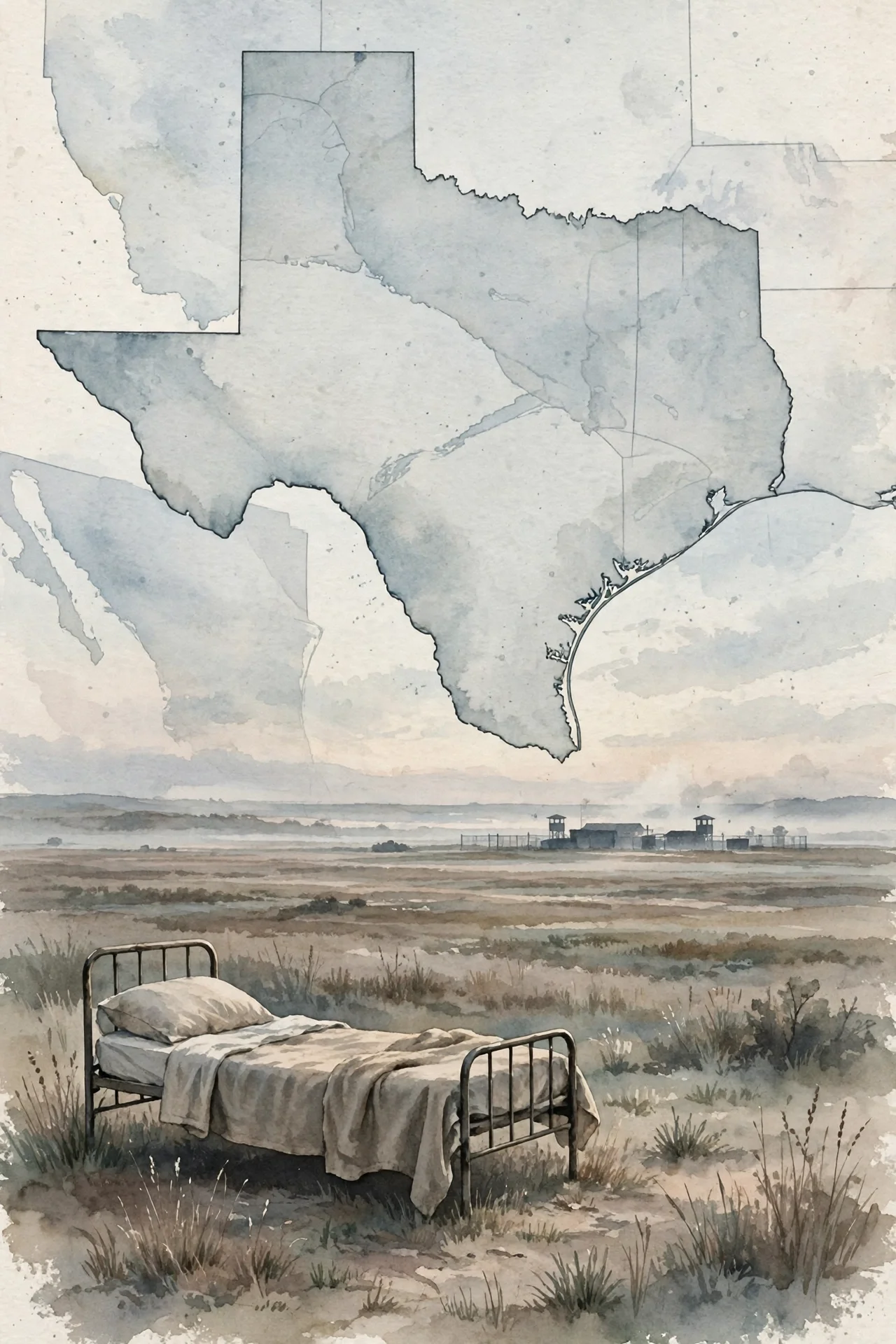
Mapa de Texas y una cama vacía en ilustración editorial sobria, imagen alusiva a la muerte bajo custodia en Laredo. · Imagen generada para EPM
Mexican man dies in ICE custody in Laredo with cause of death still unknown
Emiliano Andrade-Covarrubias, 56, was found unresponsive on October 17 at a Laredo detention center and declared deceased at 10:10 a.m.
ICE reports custody death in Texas after fraudulent status determination
ICE reported the Laredo death of a permanent resident whose status was deemed fraudulent for concealing a 2004 arrest.
--- The context ---
A death inside an immigration detention facility demands more than a brief official notice. Emiliano Andrade-Covarrubias, a 56-year-old man from Mexico, died while held at the Rio Grande Processing Center in Laredo, Texas. He was in ICE custody awaiting removal proceedings before an immigration judge, and the public record so far comes from the agency that held him.
--- The facts ---
On October 17, 2026, at about 9:48 a.m. CST, staff found Andrade-Covarrubias unresponsive in his assigned bed. Security personnel declared a medical emergency and immediately began life-saving measures. The timeline is precise, but the medical explanation behind those twenty-two minutes has not yet been provided.
The Laredo Fire Department Emergency Medical Service was called, and despite the life-saving efforts he was declared deceased at 10:10 a.m. ICE said the cause of death is unknown and that an autopsy will determine the official cause. That pending finding is the central missing piece for any independent assessment of the custody.
--- The positions ---
ICE stated that Andrade-Covarrubias received proper medical care while in custody and was seen by medical professionals. The agency also noted a documented history of diabetes, hypertension and anxiety. Those conditions do not explain the death, yet they raise the standard for what a verifiable care record should show.
Enforcement and Removal Operations notified the Department of Homeland Security, the ICE Office of Inspector General and the ICE Office of Professional Responsibility through the Joint Intake Operation Center. The Consulate of Mexico was also notified. ICE says it also notifies Congress, nongovernmental stakeholders and the media after in-custody deaths.
--- What remains unknown ---
The autopsy result remains unknown, as does a fuller account of the period before staff found him unresponsive at 9:48 a.m. It is also unknown what the notified oversight offices will examine and whether the medical care described will be documented in a way reviewers can verify.
--- Unanswered questions ---
What official cause will the autopsy assign to the October 17 death? How was medical care recorded for a detainee with documented diabetes, hypertension and anxiety? What exactly will the Inspector General and the Office of Professional Responsibility review after receiving the notification? When will a verified result allow the public to separate an unavoidable emergency from a possible failure in custodial care?
--- EPM analysis ---
The immigration background and the medical event must stay analytically separate. A contested residency history may explain why Andrade-Covarrubias was detained, but it cannot explain why he died in a detention bed. Accountability therefore rests on the autopsy, the care record for a man with known chronic conditions, and the emergency timeline from 9:48 a.m. to the death declaration twenty-two minutes later.
📌 EPM Take: In EPM's view, notification is the beginning of accountability rather than its completion, because a death in state custody requires verifiable results that the public and the family can examine. The autopsy, the documented medical care and the review of the response between 9:48 and 10:10 a.m. should support any final public conclusion about Laredo. Until those elements are produced and checked, neither an early institutional absolution nor an accusation without evidence does justice to what is actually known today.
--- The context ---
The custody that ended with a death in Laredo began at a border crossing on June 26, 2026. U.S. Customs and Border Protection arrested Emiliano Andrade-Covarrubias as he attempted to enter at the Juarez-Lincoln Bridge. He held lawful permanent resident status, but officials determined he obtained it through fraudulent means by failing to disclose a previous arrest, ICE said.
That history included an arrest for theft of property on July 27, 2004. After the bridge arrest, the 56-year-old Mexican national was processed and transferred into ICE custody for removal proceedings before an immigration judge, receiving due process.
--- The facts ---
On October 17, 2026, at approximately 9:48 a.m. CST, Andrade-Covarrubias was found unresponsive in his assigned bed at the Rio Grande Processing Center in Laredo, Texas. Security staff declared a medical emergency, immediately started life-saving measures and called the Laredo Fire Department Emergency Medical Service.
Despite those efforts, he was declared deceased at 10:10 a.m. ICE was explicit: the cause of death is unknown, and an autopsy will determine the official cause.
--- The positions ---
Enforcement and Removal Operations informed the Department of Homeland Security, the ICE Office of Inspector General and the ICE Office of Professional Responsibility via the Joint Intake Operation Center, and the Consulate of Mexico was notified.
On health care, the agency said he received proper medical care and was seen by medical professionals, noting his documented diabetes, hypertension and anxiety. Its standard provides intake screenings within 12 hours, a full health assessment within 14 days, access to appointments and 24-hour emergency care, which it says is never denied.
--- What remains unknown ---
Only the autopsy can convert this procedural record into a complete explanation. Until the official cause is determined, assessments of the October 17 emergency remain provisional. The confirmed facts establish where he was, why he was held and how staff responded, but not the medical cause.
--- Unanswered questions ---
What will the autopsy determine as the official cause of death, and when will that determination be released? Which follow-up steps will the oversight offices take now that the required notifications have been made through the Joint Intake Operation Center? How will the documented care and the emergency response be confirmed against the standards ICE has described for every detention facility?
--- EPM analysis ---
Read in sequence, the record starts with a status obtained by concealing an arrest, continues with custody for a hearing before an immigration judge, and ends with an emergency response by facility staff and local fire department services. Its final strength will depend on whether the autopsy and records confirm the account already released.
📌 EPM Take: In EPM's view, institutional order is strongest when it can be checked fact by fact, and the decisive fact in this case has not yet arrived because the cause of death remains undetermined. The notifications to homeland security authorities, internal oversight offices and the Mexican consulate show that the post-death procedure was activated, while the fraud finding explains the custody without settling the medical outcome. The autopsy should close that gap before administrative certainty or outside suspicion hardens into a definitive judgment.
Muere un mexicano bajo custodia de ICE en Laredo y la causa sigue sin esclarecerse
Emiliano Andrade-Covarrubias, mexicano de 56 años, fue hallado sin respuesta el 17 de octubre en un centro de Laredo y declarado fallecido a las 10:10 a. m.
ICE reporta una muerte en custodia en Texas tras un caso de estatus fraudulento
ICE informó la muerte en Laredo de un residente permanente cuyo estatus fue considerado fraudulento por ocultar un arresto de 2004.
--- El contexto ---
La muerte de una persona detenida vuelve a poner el foco sobre lo que ocurre dentro de un centro migratorio cuando todavía no existe una causa oficial. Emiliano Andrade-Covarrubias, mexicano de 56 años, estaba bajo custodia en el Rio Grande Processing Center de Laredo, Texas, mientras esperaba un proceso de expulsión ante un juez de inmigración.
--- Los hechos ---
El 17 de octubre de 2026, hacia las 9:48 a. m. CST, el personal encontró a Andrade-Covarrubias sin respuesta en la cama que tenía asignada. El personal de seguridad declaró una emergencia médica y comenzó de inmediato maniobras para salvarle la vida.
Se llamó al servicio de emergencias médicas del Departamento de Bomberos de Laredo y los esfuerzos continuaron hasta que, a las 10:10 a. m., fue declarado fallecido. La causa de la muerte se desconoce y una autopsia deberá determinar la causa oficial.
--- Las posiciones ---
ICE sostuvo que, durante la custodia, Andrade-Covarrubias recibió atención médica adecuada y fue atendido por profesionales médicos. La agencia también dejó constancia de un historial documentado de diabetes, hipertensión y ansiedad.
Conforme a su política, la oficina de Operaciones de Ejecución y Expulsión notificó al Departamento de Seguridad Nacional, a la Oficina del Inspector General y a la Oficina de Responsabilidad Profesional a través del Joint Intake Operation Center. El Consulado de México también fue notificado, y la agencia afirmó que en estos casos notifica también al Congreso, a organizaciones no gubernamentales y a los medios.
--- Lo que falta saber ---
Falta el resultado de la autopsia y una explicación pública más completa sobre la secuencia previa al hallazgo de las 9:48 a. m. Tampoco se ha informado qué concluirán las instancias notificadas ni si la revisión de la atención médica quedará documentada de forma verificable.
--- Preguntas sin respuesta ---
¿Qué causa oficial establecerá la autopsia para explicar la muerte del 17 de octubre? ¿Cómo quedó registrada la atención médica recibida por un detenido con diabetes, hipertensión y ansiedad documentadas? ¿Qué examinarán el Inspector General y la Oficina de Responsabilidad Profesional tras recibir la notificación? ¿Cuándo se conocerá un resultado que permita distinguir entre una emergencia inevitable y una posible falla de custodia?
--- Análisis EPM ---
El caso combina una emergencia médica repentina con un expediente migratorio previo, pero esos dos planos no deben mezclarse. La situación legal del detenido explica por qué estaba en el centro; no explica por qué murió allí. Por eso el peso recae sobre la autopsia, la trazabilidad de la atención y que las notificaciones se traduzcan en rendición de cuentas comprobable.
📌 Conclusion EPM: A juicio de EPM, la transparencia no puede limitarse a anunciar que se avisó a varias oficinas, porque una muerte bajo custodia exige resultados verificables y no solo una cadena de notificaciones. La autopsia, el registro de la atención médica y la revisión de la respuesta entre las 9:48 y las 10:10 a. m. deben sostener cualquier conclusión pública. Mientras esos elementos sigan pendientes, lo responsable es exigir claridad completa, preservar la evidencia disponible y evitar tanto la absolución anticipada como la acusación sin pruebas sobre lo ocurrido en Laredo.
--- El contexto ---
El caso que llevó a Emiliano Andrade-Covarrubias a un centro de Texas empezó meses antes. El 26 de junio de 2026, agentes de Aduanas y Protección Fronteriza lo arrestaron al intentar entrar por el puente Juárez-Lincoln de Laredo. Era residente permanente legal, pero las autoridades determinaron que obtuvo ese estatus por medios fraudulentos al no revelar un arresto anterior.
El antecedente era un arresto por robo de propiedad del 27 de julio de 2004. Tras la detención, fue procesado y trasladado a ICE para aguardar un procedimiento de expulsión ante un juez de inmigración, recibiendo el debido proceso.
--- Los hechos ---
La mañana del 17 de octubre de 2026, hacia las 9:48 a. m. CST, el mexicano de 56 años fue hallado sin respuesta en su cama asignada. El personal de seguridad declaró la emergencia médica, aplicó medidas para salvarle la vida y solicitó apoyo externo.
El servicio de emergencias médicas del Departamento de Bomberos de Laredo acudió y, pese a los esfuerzos, fue declarado fallecido a las 10:10 a. m. ICE precisó que la causa permanece desconocida y que la autopsia fijará la causa oficial.
--- Las posiciones ---
Operaciones de Ejecución y Expulsión notificó al Departamento de Seguridad Nacional, a la Oficina del Inspector General y a la Oficina de Responsabilidad Profesional mediante el Joint Intake Operation Center. También se notificó al Consulado de México.
En materia sanitaria, ICE afirmó que recibió atención médica adecuada y fue visto por profesionales, y describió evaluaciones de ingreso en 12 horas, una valoración completa en 14 días, acceso a citas y atención de emergencia las 24 horas, que según la agencia nunca se niega.
--- Lo que falta saber ---
Lo que falta es el dictamen de la autopsia. Sin esa causa oficial no se puede cerrar la explicación médica del fallecimiento. El resto de la información describe procedimientos, notificaciones y antecedentes, pero no sustituye ese resultado.
--- Preguntas sin respuesta ---
¿Qué establecerá la autopsia como causa oficial de la muerte y en qué plazo se dará a conocer? ¿Qué pasos seguirán las oficinas de supervisión que ya recibieron la notificación institucional? ¿Cómo se documentó el cumplimiento de las evaluaciones y de la atención de emergencia que la agencia describe como parte de su política general?
--- Análisis EPM ---
Leído en orden, el caso muestra primero una decisión migratoria fundada en una omisión atribuida al residente, y después una emergencia atendida con medidas inmediatas y apoyo de los bomberos locales. La fortaleza de esa versión dependerá de que la autopsia y los registros confirmen lo comunicado.
📌 Conclusion EPM: A juicio de EPM, el orden institucional también se defiende con hechos comprobables, y en este caso el hecho decisivo todavía no ha llegado porque la causa de la muerte sigue sin determinarse. Las notificaciones al Departamento de Seguridad Nacional, a los órganos internos de control y al Consulado de México muestran que el procedimiento posterior se activó, mientras el antecedente de fraude explica la custodia sin resolver el desenlace. La autopsia debe cerrar esa brecha antes de convertir sospechas o certezas administrativas en un juicio definitivo.