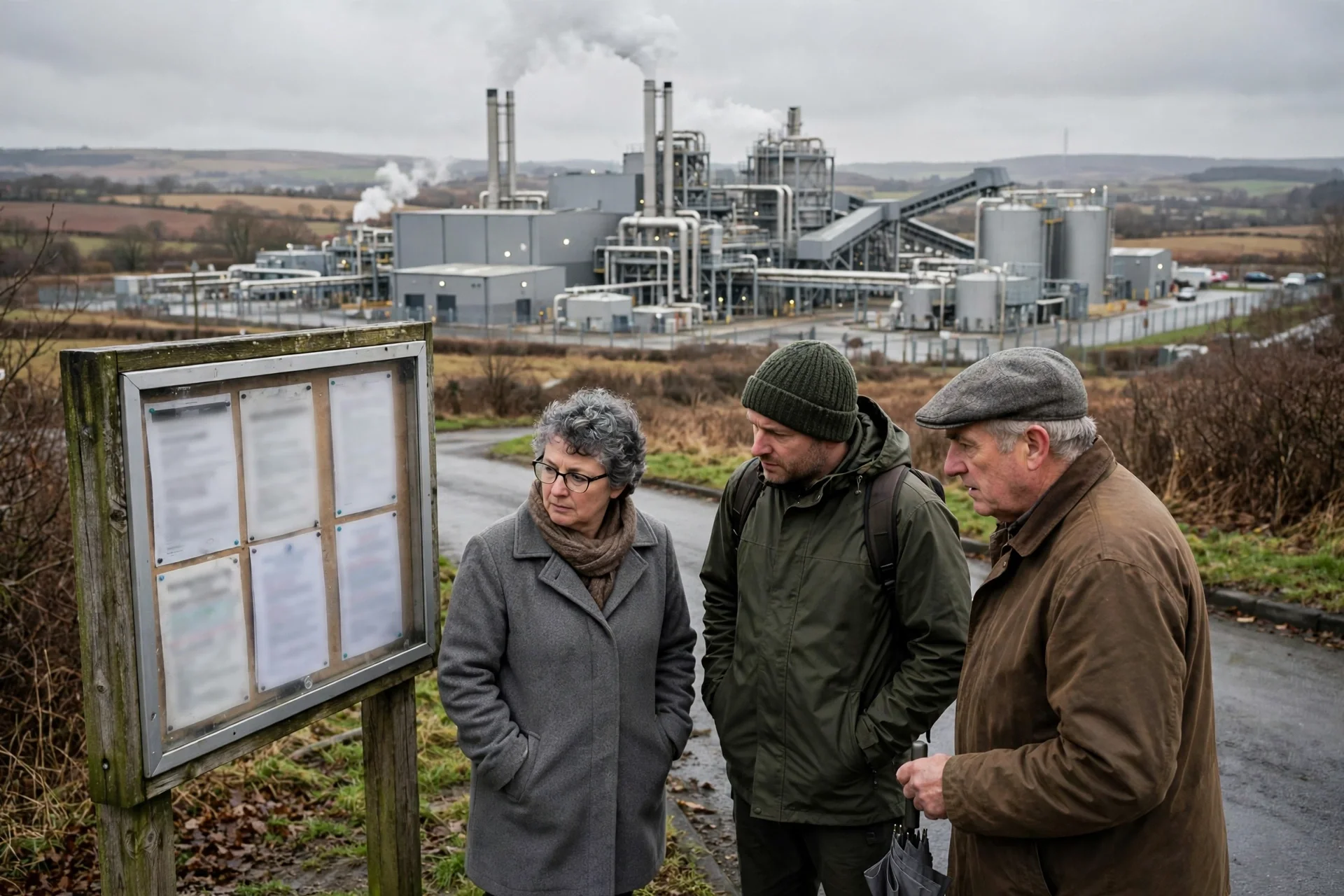
Imagen alusiva a la planta propuesta en Merchant Park, Newton Aycliffe. · Imagen generada para EPM
In Newton Aycliffe the Fornax consultation puts neighbours at the centre
With consultation open until 1 December 2026, Newton Aycliffe residents can examine the Fornax draft permit documents and have their say before the Environment…
Fornax: a permit to be settled by the rules and the set procedure
The Environment Agency is consulting on its draft decision to grant the Fornax permit in Newton Aycliffe after finding no legal grounds for refusal, with…
--- The context ---
For households around Merchant Park in Newton Aycliffe, County Durham, what Fornax (North East) Ltd wants to build is not an abstract file: it is a plant that would burn hazardous waste as part of daily life in the area, and the Environment Agency itself acknowledges that local interest has grown. That is why the consultation now open matters as a community right: residents can study the drafts and put their concerns about health and surroundings on the record before anything is finally decided.
--- The facts ---
Participation comes first: the consultation is open until 1 December 2026, with the draft decision and draft permit both posted on the agency consultation website. The draft decision sets out how the agency reached its current thinking and how it dealt with comments from last summer's public consultation, while the draft permit lists the conditions the operator would have to meet. Responses can be sent through the website or by email to pscpublicresponse@environment-agency.gov.uk, and the published material explains what the agency may weigh in its decision and what falls outside that judgement.
Behind that open window sits the technical request: Fornax seeks permission to run an energy from waste plant able to take in clinical, commercial and industrial hazardous waste for incineration in a high temperature thermal treatment facility. Having reviewed the earlier comments and evidence, the agency is minded to issue the permit, having found no reason to refuse, while making clear no final decision has yet been taken.
--- The positions ---
Gary Wallace, Area Environment Manager in the North East, conveyed that all the information and comments received have been carefully considered, recognising the heightened local interest in the facility. In his account, a permit will only follow if the agency is satisfied every legal requirement is met and a high level of protection for environment and human health is provided, with the final call deferred until this consultation's responses are reviewed. He also emphasised giving the public a genuine chance to read and comment on the drafts.
--- What remains unknown ---
No final ruling exists yet, and nobody can say how submissions in this second round will shape it. Assessment is carried out under the Environmental Permitting Regulations 2016 and the relevant environmental legislation, which require that the plant should not cause significant pollution or harm to human health, but how that test applies to this site will only become clear in the final decision.
--- Unanswered questions ---
Do the draft conditions give the surrounding community strong enough safeguards for a process handling hazardous waste day after day? Will residents be able to see their input reflected in the outcome, rather than merely filed away? Could this consultation surface information that last summer's round did not capture at all?
--- EPM analysis ---
Seen from the neighbourhood, the test of this process is not whether a consultation exists on paper but whether it bites in practice. Scrutiny must be demanding where the burden of incineration falls on a specific place and its people, and participation only protects the public if the authority later shows what it changed.
📌 EPM Take:
In EPM's view, a facility of this kind should never be waved through without verifiable proof that local health and the environment are protected beyond reasonable doubt, and without the community being able to recognise its own voice in the final result. The window open until December should work as a real check rather than a formality: reading the drafts, demanding explanations and insisting that every condition is justified is, for Newton Aycliffe, the strongest safeguard available today.
--- The context ---
The Fornax (North East) Ltd application is moving through the regulated channel laid down by the Environmental Permitting Regulations 2016: application, technical and legal examination, a reasoned draft, and only then a ruling. On that basis the Environment Agency has opened consultation on a draft decision leaning towards granting the environmental permit for the Merchant Park plant in Newton Aycliffe, County Durham, having examined last summer's public consultation without finding legal grounds for refusal.
--- The facts ---
The starting point is the inclination to grant. After reviewing the comments and evidence from the earlier round, the agency has identified no reason to refuse the application, although it stresses that the decision is not yet final. Nor is that inclination unconditional: alongside the draft decision on its consultation website sits a draft permit spelling out the conditions the operator would need to satisfy, and the draft decision itself explains the reasoning followed and how previous comments were taken into account.
Within that framework, the scope sought is narrow and stated. Fornax would operate an energy from waste plant authorised to accept clinical, commercial and industrial hazardous waste for incineration in a high temperature thermal treatment facility. Consultation stays open until 1 December 2026, responses are accepted on the website or by email to pscpublicresponse@environment-agency.gov.uk, and guidance is published on what the agency can and cannot take into account under the governing legislation.
--- The positions ---
The official position, set out by Gary Wallace, Area Environment Manager in the North East, rests on compliance with the rules: as he put it, the permit will only be granted if the agency is satisfied that the application meets all legal requirements and delivers a high level of protection for the environment and human health. He added that the information and comments received have been carefully considered, that increased local interest has been recognised, and that the final decision will come after responses are reviewed, with the public invited to read the drafts and take part through that procedure.
--- What remains unknown ---
Only the final link in the procedure is missing: the consultation must close, responses be reviewed, and the final decision issued. Until that happens there is neither a granted nor a refused permit, and the governing test remains the legal one, namely whether the proposal meets every requirement and would avoid significant pollution and harm to health.
--- Unanswered questions ---
Will the draft permit survive the consultation in its current terms? Might the new responses introduce any legally material point that changes the analysis already carried out? Will the final decision confirm that no legal ground for refusal exists in this case?
--- EPM analysis ---
Where an authority follows the procedure, publishes its reasons and consults on its draft, the argument belongs on the criteria: requirements, conditions and technical evidence. Replacing that examination with pressure, from whichever direction it comes, erodes the predictability that residents and investors alike need when the rules are known.
📌 EPM Take:
In EPM's view, the Fornax decision should be reached by applying the law and the technical evidence, without shortcuts and without improvised vetoes: if the application satisfies the requirements and the draft conditions secure the protection demanded, granting the permit is the outcome consistent with the procedure, and if it falls short, refusal is equally consistent. That documented, step by step clarity is what lets industry operate under stable rules and gives residents a firm benchmark against any future departure from them.
En Newton Aycliffe la consulta sobre Fornax pone a los vecinos en el centro
Con la consulta abierta hasta el 1 de diciembre de 2026, los vecinos de Newton Aycliffe pueden examinar los borradores del permiso de Fornax y pronunciarse…
Fornax: un permiso que se decide por la norma y el procedimiento reglado
La Environment Agency consulta su borrador favorable a conceder el permiso a Fornax en Newton Aycliffe al no hallar motivos legales de denegación, con las…
--- El contexto ---
En Newton Aycliffe, en el condado de Durham, la propuesta de Fornax (North East) Ltd no es un trámite lejano para quienes viven cerca de Merchant Park: se trata de una planta que quemaría residuos peligrosos a diario, y la propia Environment Agency reconoce que el interés local ha crecido. Por eso la consulta abierta importa como derecho vecinal: antes de cualquier decisión definitiva, la comunidad puede leer los borradores y decir qué le preocupa en materia de salud y de entorno.
--- Los hechos ---
La consulta ya está abierta y permanecerá así hasta el 1 de diciembre de 2026. En el sitio de consultas están ambos borradores: el de decisión explica cómo se formó el criterio oficial y cómo se tuvieron en cuenta los comentarios de la consulta del verano pasado, y el de permiso recoge las condiciones que el operador debería cumplir si se concede. Se puede participar en ese sitio o escribiendo a pscpublicresponse@environment-agency.gov.uk, y la información publicada aclara qué puede valorar la agencia al decidir y qué no.
Solo después aparece el fondo técnico: la empresa pide autorización para gestionar residuos peligrosos clínicos, comerciales e industriales mediante incineración en una instalación térmica de alta temperatura, dentro de una planta de energía a partir de residuos. Tras revisar comentarios y evidencia de la ronda anterior, la agencia se declara inclinada a conceder el permiso porque no ha encontrado motivos para denegarlo, aunque todavía no hay decisión final.
--- Las posiciones ---
Gary Wallace, gerente ambiental de área en el North East, trasladó que la agencia ha considerado con detenimiento toda la información y los comentarios recibidos. El permiso, según su planteamiento, solo se otorgará si la solicitud cumple todos los requisitos legales y ofrece un alto nivel de protección del medio ambiente y la salud humana, y la decisión llegará tras revisar las respuestas de esta consulta. Wallace insistió además en que el público tenga ocasión real de leer los borradores y de pronunciarse sobre ellos.
--- Lo que falta saber ---
Todavía no existe pronunciamiento definitivo ni se conoce cómo pesarán las alegaciones que lleguen en esta segunda ronda. La evaluación se rige por los Environmental Permitting Regulations 2016 y por la legislación ambiental aplicable, cuyo listón incluye que la planta no cause una contaminación significativa ni daños a la salud, pero su aplicación concreta solo se sabrá con la resolución final.
--- Preguntas sin respuesta ---
¿Garantizan las condiciones del borrador un control suficiente de un proceso que tratará residuos peligrosos cada día? ¿Tendrán las aportaciones vecinales un reflejo visible en la decisión final o quedarán como mero registro? ¿Qué ocurrirá si las respuestas a esta consulta aportan elementos que la ronda del verano pasado no recogía?
--- Análisis EPM ---
Leído desde la comunidad, el punto débil no es que exista consulta, sino su alcance efectivo: participar solo protege si la administración explica luego qué cambió gracias a ello. Incinerar residuos peligrosos exige escrutinio reforzado, porque la carga recae sobre un territorio concreto y sus habitantes, no sobre un expediente abstracto.
📌 Conclusion EPM:
A juicio de EPM, ninguna autorización de este tipo debería cerrarse sin demostrar, de forma comprobable, que la salud vecinal y el entorno quedan protegidos por encima de cualquier duda razonable, y sin que la comunidad vea reconocida su voz en el resultado. La consulta abierta hasta diciembre debe funcionar como control real y no como trámite: leer los borradores, exigir explicaciones y reclamar que cada condición se justifique es hoy la mayor garantía para Newton Aycliffe.
--- El contexto ---
El expediente de Fornax (North East) Ltd avanza por el cauce reglado que fijan los Environmental Permitting Regulations 2016: una solicitud, un examen técnico y jurídico, un borrador motivado y, solo al final, una resolución. La Environment Agency ha abierto consulta sobre su borrador de decisión favorable a conceder el permiso ambiental para la planta de Merchant Park, en Newton Aycliffe, condado de Durham, tras estudiar la consulta del verano pasado sin hallar motivos legales de denegación.
--- Los hechos ---
El dato de partida es la inclinación a conceder. Tras revisar los comentarios y la evidencia de la ronda anterior, la agencia no ha encontrado razones para rechazar la solicitud, aunque advierte de que la decisión todavía no es firme. Esa inclinación no es un cheque en blanco: el borrador de permiso, publicado junto al de decisión en el sitio de consultas, detalla las condiciones que el operador tendría que cumplir, y el de decisión expone el razonamiento y el tratamiento dado a los comentarios previos.
El objeto del permiso es preciso: una planta de energía a partir de residuos habilitada para aceptar residuos peligrosos clínicos, comerciales e industriales y tratarlos por incineración en una instalación térmica de alta temperatura. La consulta permanecerá abierta hasta el 1 de diciembre de 2026, con respuestas admitidas en el propio sitio o por correo en pscpublicresponse@environment-agency.gov.uk, con guía pública sobre qué puede ponderar la agencia y qué no.
--- Las posiciones ---
La posición oficial, expresada por Gary Wallace, gerente ambiental de área en el North East, descansa en el cumplimiento normativo: según expuso, la agencia solo concederá el permiso si está convencida de que la solicitud satisface todos los requisitos legales y asegura un alto nivel de protección del medio ambiente y la salud humana. Wallace añadió que información y comentarios se han examinado con cuidado, que el interés local creciente ha sido reconocido y que la resolución final se adoptará tras revisar las respuestas, invitando al público a leer los borradores y participar en el procedimiento.
--- Lo que falta saber ---
Falta únicamente el último eslabón del procedimiento: cerrar la consulta, revisar las respuestas y dictar la decisión final. Hasta ese momento no hay permiso otorgado ni denegado, y el criterio rector sigue siendo el legal: si la propuesta reúne los requisitos y no genera una contaminación significativa ni daños a la salud, la normativa marca el resultado; si no los reúne, marca el contrario.
--- Preguntas sin respuesta ---
¿Se mantendrá el borrador de permiso en sus términos actuales al cerrarse la consulta? ¿Aportarán las nuevas respuestas algún elemento jurídicamente relevante que altere el análisis ya realizado? ¿Confirmará la decisión final que no concurre causa legal alguna de denegación?
--- Análisis EPM ---
Cuando una administración sigue el procedimiento, publica sus razones y somete su borrador a consulta, la discusión debe volver a los criterios: requisitos, condiciones y evidencia técnica. Sustituir ese examen por presión, venga de donde venga, debilita la previsibilidad que necesitan vecinos y quien invierte y crea empleo bajo reglas conocidas.
📌 Conclusion EPM:
A juicio de EPM, la decisión sobre Fornax debe tomarse aplicando la ley y la técnica, sin atajos ni vetos improvisados: si la solicitud cumple los requisitos y las condiciones del borrador aseguran la protección exigida, conceder el permiso es la salida coherente con el procedimiento, y si incumple, denegarlo lo es igualmente. Esa claridad normativa, documentada paso a paso, es la que permite operar a la industria y da a los residentes una referencia firme frente a cualquier desviación futura.