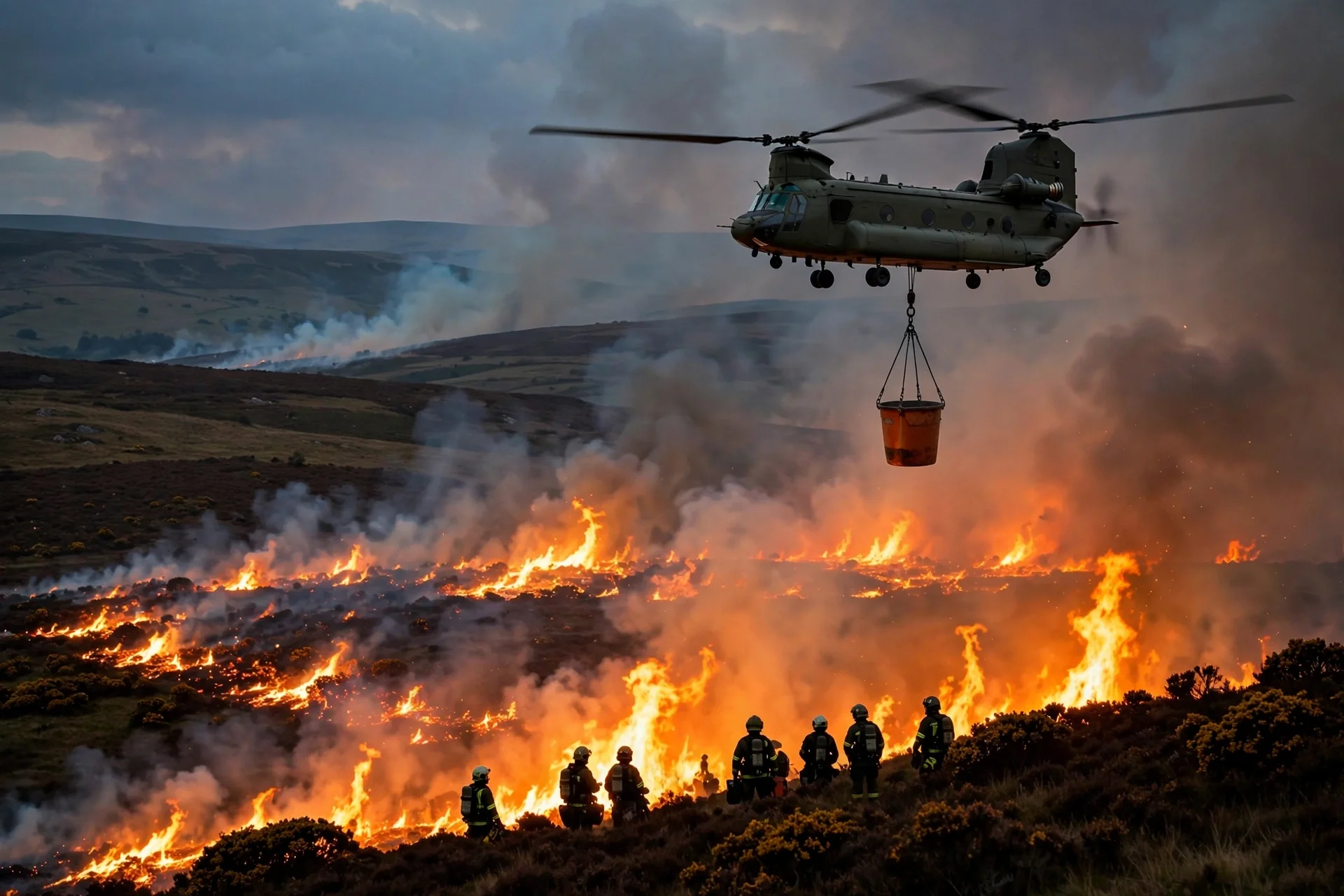
Imagen alusiva a la respuesta aérea contra los incendios forestales en el Reino Unido. · Imagen generada para EPM
UK deploys military aircraft to fight wildfires from the sky
The UK will equip RAF Chinook and A400M aircraft to fight wildfires, back firefighters with up to £45million, invest £25 million in peatland restoration, and…
Britain strengthens firefighters and defence against wildfires
Britain will equip RAF aircraft to fight wildfires from the sky, strengthen firefighters in England with up to £45million, invest £25 million in peatlands, and…
--- The context ---
This summer was the hottest on record in the United Kingdom, and the Met Office found that climate change made the extreme heat around 130 times more likely. Against that background, the government unveiled a national wildfire package combining aerial response, protection for firefighters and prevention on the land, ahead of a summit today where the prime minister meets fire chiefs, local leaders and experts to ensure the scenes of this summer are never repeated.
--- The facts ---
RAF Chinook helicopters and A400M aircraft will be equipped to fight fires and will be ready, when requested, to help across the UK on remote moorland, steep hillsides and other hard-to-reach terrain. It will be the first time those aircraft fight fires from the sky, and the investment will allow the Ministry of Defence to develop an aerial firefighting capability permanently based in the UK for the first time, while civilian services across all four nations can continue requesting support through the Military Aid to the Civil Authorities process.
Frontline firefighters in England will receive additional specialist wildfire teams and lightweight, wildfire-specific protective equipment backed by up to £45million. Their current kit is designed mainly for building fires and not for prolonged use, while the new equipment will be lighter and more breathable. Prevention funding includes £25 million to restore dried-out peatlands in England so they hold more water and act as natural firebreaks, plus support for farmers to protect their land by digging ponds and removing burnable materials in high-risk areas.
--- The positions ---
The prime minister said indirectly that he stood in Stourbridge and watched families lose everything, that firefighters were heroes who should not have to fight with one hand tied, and that people cannot be put through another summer like this one. Angela Rayner said this year the wildfires have been unrelenting and that a stronger and more resilient national response is needed, built with communities, experts and emergency services.
Wes Streeting said defence will step up support for emergency services and protect military training areas, in a country where the MOD is the second largest landowner. Katie White warned that the threat is already here and that emergency services must be properly equipped. Angela Eagle backed investing £25 million in peatlands and supporting farmers, while Louise Haigh highlighted British expertise in technology to track and tackle wildfires as the basis for a centre of excellence.
--- What remains unknown ---
The exact timetable for equipping the Chinooks and A400M aircraft remains unknown, as does the final cost of each measure and how the backing of up to £45million will be shared among teams. The government has not yet detailed which tougher local restrictions or product bans may apply when risk is high, nor how success will be measured under England first Wildfire Action Plan, covering prevention, preparedness, response and recovery.
--- Unanswered questions ---
When will the permanent aerial firefighting capability be fully operational across the United Kingdom? Which products or activities could be restricted when wildfire risk is high, and who will decide those bans? Will £25 million be enough to restore the driest peatlands before next summer? How will devolved governments and the central government coordinate during an emergency that crosses internal borders?
--- EPM analysis ---
The package recognises that suppression alone is not enough if landscapes remain dry and vulnerable. A new Wildfires AI Unit in COBR National Situation Centre will bring together universities, technology firms and government, work with the Met Office will improve forecasts, and firms including Airbus, Google and VodafoneThree attend the summit with satellite monitoring, early warning, connectivity and aerial capability. The new peatland restoration scheme will be run by Natural England from April 2027 to April 2029, a timeline that makes earlier progress on prevention and preparedness essential.
📌 EPM Take: In EPM's view, the strength of the plan lies in joining response, prevention and knowledge in one national strategy, because treating each wildfire as an isolated emergency left firefighters and communities carrying alone a risk that is now structural. Military aviation, lighter protective equipment and peatland restoration point in the right direction, but the final judgement will depend on deadlines, effective funding and real coordination between nations. If the summit becomes operational capability before next summer, Britain will have moved forward; if it remains an announcement, vulnerability to extreme heat will remain largely unchanged.
--- The context ---
After the hottest summer on record in the United Kingdom, with extreme heat that the Met Office found around 130 times more likely because of climate change, the government has chosen to strengthen state capacity rather than rely only on emergency reaction. The package came ahead of a summit today where the prime minister meets fire chiefs, local leaders and experts, with the stated aim of ensuring the scenes of this summer are not repeated in towns, farmland and countryside.
--- The facts ---
The central measure is practical and military: RAF Chinook helicopters and A400M aircraft will receive specialist equipment to fight fires and, when requested, will help on remote moorland, steep hillsides and hard-to-reach terrain across the UK. The investment will allow the Ministry of Defence to develop an aerial firefighting capability permanently based in the UK for the first time. Civilian fire and rescue services across all four nations will continue to request support through the Military Aid to the Civil Authorities process, an orderly channel that keeps operational responsibility with emergency services.
On the ground, frontline firefighters in England will receive additional specialist teams and lightweight, wildfire-specific protective equipment backed by up to £45million. Their current kit is designed mainly for fires in buildings and not for prolonged wear; the new kit will be lighter and more breathable so crews can work longer safely. To reduce risk at source, £25 million will restore dried-out peatlands in England, which hold water and act as natural firebreaks, and farmers will be supported to dig ponds and remove burnable materials in high-risk areas.
--- The positions ---
The prime minister recalled indirectly visiting Stourbridge and seeing families lose everything, and argued that firefighters, whom he described as heroes, should not fight with one hand tied and the public should not face another summer like this. Angela Rayner acknowledged that this year wildfires have been unrelenting and called for a stronger, more resilient national response. Both positions agree on reinforcing equipment, command and prevention.
Wes Streeting stressed that defence will provide greater support to emergency services and protect military training areas, a relevant point because the MOD is the second largest landowner in the country. Angela Eagle backed peatland investment and support for farmers to protect their land. Louise Haigh emphasised British technological expertise in tracking and tackling wildfires, while Katie White insisted that emergency services must be equipped now because the threat is already present.
--- What remains unknown ---
It remains unclear when the aircraft and helicopters will be ready, how their deployment will be triggered and what maintaining a permanent capability will cost. The scope of possible tougher local restrictions or product bans during high-risk periods is also unknown, as are the criteria for judging England first Wildfire Action Plan on prevention, preparedness, response and recovery. An interministerial meeting with devolved governments will need to clarify responsibilities, expertise and timing.
--- Unanswered questions ---
How soon can equipped Chinook and A400M aircraft take off for a real wildfire? What local restrictions will be imposed when risk is high, and how will they be enforced? Will backing of up to £45million be sufficient to renew equipment and build specialist teams across England? What concrete results will the government require from the new artificial intelligence unit before next summer?
--- EPM analysis ---
The approach combines authority, technology and land management. A new Wildfires AI Unit in COBR National Situation Centre will bring together universities, technology firms and government, and work with the Met Office will improve wildfire forecasts. Airbus, Google and VodafoneThree attend the summit to contribute satellite monitoring, early warning, connectivity and aerial capability, including connectivity work by VodafoneThree and a programme in Cairngorms National Park. The peatland scheme, run by Natural England from April 2027 to April 2029, places part of the solution on a longer horizon that still needs discipline and measurable delivery.
📌 EPM Take: In EPM's view, a serious state protects first those who protect everyone else, and that is why proper equipment for firefighters and a permanent aerial capability are the right decisions if they are delivered with discipline and without dispersion. Peatland and farm prevention also makes sense because it reduces available fuel and protects property, crops and rural communities. The test will not be the breadth of the announcement, but operational readiness, clear command between governments and the ability to act quickly on difficult terrain when the next period of extreme heat arrives across the country.
Reino Unido moviliza aviones militares contra los incendios forestales
El Reino Unido equipará Chinook y A400M de la RAF para combatir incendios, destinará hasta 45 millones de libras a proteger a bomberos y 25 millones a…
Londres refuerza a bomberos y Defensa frente a los incendios
Londres equipará aeronaves de la RAF para luchar contra incendios desde el cielo, reforzará a los bomberos de Inglaterra con hasta 45 millones de libras…
--- El contexto ---
Este verano fue el más caluroso registrado en el Reino Unido y la Met Office concluyó que el cambio climático hizo el calor extremo unas 130 veces más probable. En ese contexto, el Gobierno presentó un paquete nacional contra los incendios forestales que combina respuesta aérea, protección para bomberos y prevención, antes de una cumbre hoy con jefes de bomberos, líderes locales y expertos.
--- Los hechos ---
Los helicópteros Chinook y los aviones A400M de la RAF serán equipados para combatir incendios y estarán listos, cuando se les solicite, para ayudar en todo el Reino Unido en páramos remotos, laderas empinadas y terrenos de difícil acceso. Será la primera vez que esas aeronaves combatan incendios desde el cielo y la inversión permitirá al Ministerio de Defensa desarrollar por primera vez una capacidad aérea contra incendios con base permanente en el país, mientras los servicios civiles de las cuatro naciones podrán seguir pidiendo apoyo mediante el proceso de ayuda militar a las autoridades civiles.
Para los bomberos de primera línea en Inglaterra habrá más equipos especializados y un equipo de protección individual ligero y específico para incendios forestales, con respaldo de hasta 45 millones de libras. El equipo actual está pensado para edificios y no para un uso prolongado, mientras el nuevo será más ligero y transpirable. En prevención se destinarán 25 millones de libras a restaurar turberas resecas en Inglaterra para que retengan agua y actúen como cortafuegos naturales, además de apoyo a agricultores para proteger sus tierras con estanques y retirando material combustible en zonas de alto riesgo.
--- Las posiciones ---
El primer ministro señaló en términos indirectos que estuvo en Stourbridge y vio a familias perderlo todo, que los bomberos fueron héroes pero no deberían luchar con una mano atada, y que no se puede someter a la gente a otro verano así. Angela Rayner sostuvo que los incendios de este año han sido implacables y que hace falta una respuesta nacional más fuerte y resiliente, construida con comunidades, expertos y servicios de emergencia.
Wes Streeting afirmó que Defensa apoyará más a los servicios de emergencia y protegerá las zonas de entrenamiento militar, en un país donde el Ministerio de Defensa es el segundo mayor terrateniente. Katie White advirtió que la amenaza ya está aquí y que hay que equipar a los servicios de emergencia. Angela Eagle defendió invertir 25 millones de libras en turberas y respaldar a agricultores, y Louise Haigh destacó la experiencia británica en tecnología para rastrear y combatir incendios como base de un centro de excelencia.
--- Lo que falta saber ---
Falta conocer el calendario exacto para equipar los Chinook y los A400M, el coste final de cada medida y cómo se repartirá el respaldo de hasta 45 millones de libras entre los equipos. Tampoco se ha detallado qué restricciones locales más duras o prohibiciones de productos se aplicarán cuando el riesgo sea alto, ni cómo se medirán los resultados del primer Plan de Acción contra Incendios Forestales de Inglaterra, que cubrirá prevención, preparación, respuesta y recuperación.
--- Preguntas sin respuesta ---
¿Cuándo estará operativa de forma permanente la capacidad aérea contra incendios en el Reino Unido? ¿Qué productos o actividades quedarán restringidos cuando el riesgo sea alto y quién decidirá esas prohibiciones? ¿Alcanzarán los 25 millones de libras para restaurar las turberas más resecas antes del próximo verano? ¿Cómo se coordinarán los gobiernos delegados y el Gobierno central en una emergencia que cruce fronteras internas?
--- Análisis EPM ---
El paquete reconoce que apagar fuegos no basta si el paisaje sigue seco y vulnerable. La nueva Unidad de IA de Incendios Forestales en el Centro Nacional de Situación de COBR reunirá a universidades, empresas tecnológicas y gobierno, se trabajará con la Met Office en mejores pronósticos y empresas como Airbus, Google y VodafoneThree asisten a la cumbre con propuestas de monitoreo satelital, alerta temprana, conectividad y capacidad aérea. El nuevo esquema de restauración de turberas lo gestionará Natural England de abril de 2027 a abril de 2029, un horizonte que exige prevención previa.
📌 Conclusion EPM: A juicio de EPM, la fortaleza del plan está en unir respuesta, prevención y conocimiento en una misma estrategia nacional, porque tratar cada incendio como una emergencia aislada dejaba a bomberos y comunidades asumiendo solos un riesgo que ya es estructural. La aviación militar, el equipo ligero y la restauración de turberas apuntan en la dirección correcta, pero el juicio definitivo dependerá de plazos, financiación efectiva y coordinación real entre naciones. Si la cumbre se traduce en capacidad operativa antes del próximo verano, el Reino Unido habrá avanzado; si queda en anuncio, la vulnerabilidad seguirá intacta frente al calor extremo.
--- El contexto ---
Tras el verano más caluroso registrado en el Reino Unido, con un calor extremo que la Met Office considera unas 130 veces más probable por el cambio climático, el Gobierno ha optado por reforzar la capacidad del Estado antes que confiar solo en la reacción de emergencia. El paquete se presentó antes de la cumbre de hoy del primer ministro con jefes de bomberos, líderes locales y expertos, para que no se repitan las escenas de este verano.
--- Los hechos ---
La medida central es militar y práctica: los Chinook y los A400M de la RAF recibirán equipo especializado para combatir incendios y, cuando se les solicite, ayudarán en páramos remotos, laderas empinadas y terrenos de difícil acceso en todo el Reino Unido. La inversión permitirá al Ministerio de Defensa desarrollar por primera vez una capacidad aérea contra incendios con base permanente en el país. Los servicios civiles de las cuatro naciones seguirán pudiendo pedir apoyo mediante el proceso de ayuda militar a las autoridades civiles, manteniendo la responsabilidad en los servicios de emergencia.
En tierra, los bomberos de primera línea en Inglaterra recibirán más equipos especializados y un equipo de protección ligero y específico para incendios forestales, respaldado por hasta 45 millones de libras. El equipo actual, diseñado para edificios, no está pensado para un uso prolongado; el nuevo será más ligero y transpirable para trabajar más tiempo con seguridad. Para reducir el riesgo en origen habrá 25 millones de libras para restaurar turberas resecas en Inglaterra, que retienen agua y actúan como cortafuegos naturales, y apoyo a agricultores para crear estanques y retirar material combustible en zonas de alto riesgo.
--- Las posiciones ---
El primer ministro recordó en indirecto su visita a Stourbridge, donde vio a familias perderlo todo, y defendió que los bomberos, a quienes describió como héroes, no deben luchar con una mano atada ni la población soportar otro verano así. Angela Rayner reconoció que los incendios de este año han sido implacables y pidió una respuesta nacional más fuerte y resiliente. Ambas posiciones coinciden en reforzar medios, mando y prevención.
Wes Streeting subrayó que Defensa apoyará más a los servicios de emergencia y protegerá las zonas de entrenamiento militar, un punto relevante porque el Ministerio de Defensa es el segundo mayor terrateniente del país. Angela Eagle respaldó la inversión en turberas y el apoyo a agricultores para proteger sus tierras. Louise Haigh puso el acento en la experiencia tecnológica británica para rastrear y combatir incendios, mientras Katie White insistió en equipar ya a los servicios de emergencia porque la amenaza está presente.
--- Lo que falta saber ---
Queda por precisar cuándo estarán listos los aviones y helicópteros, cómo se activará su despliegue y qué coste tendrá mantener una capacidad permanente. Tampoco se conoce el alcance de las posibles restricciones locales más duras o prohibiciones de productos en periodos de alto riesgo, ni los criterios para evaluar el primer Plan de Acción contra Incendios Forestales de Inglaterra en prevención, preparación, respuesta y recuperación. La reunión interministerial con los gobiernos delegados deberá aclarar responsabilidades y tiempos.
--- Preguntas sin respuesta ---
¿En qué plazo podrán despegar los Chinook y los A400M ya equipados para un incendio real? ¿Qué restricciones locales se impondrán cuando el riesgo sea alto y cómo se harán cumplir? ¿Será suficiente el respaldo de hasta 45 millones de libras para renovar equipos y crear unidades especializadas en toda Inglaterra? ¿Qué resultados concretos exigirá el Gobierno a la nueva unidad de inteligencia artificial antes del próximo verano?
--- Análisis EPM ---
El enfoque combina autoridad, tecnología y territorio. La nueva Unidad de IA de Incendios Forestales en el Centro Nacional de Situación de COBR reunirá a universidades, empresas tecnológicas y gobierno, y se trabajará con la Met Office en mejores pronósticos. Airbus, Google y VodafoneThree asisten a la cumbre para aportar monitoreo satelital, alerta temprana, conectividad y capacidad aérea, incluida la experiencia de conectividad de VodafoneThree y un programa en el Parque Nacional de Cairngorms. El esquema de turberas, gestionado por Natural England de abril de 2027 a abril de 2029, sitúa parte de la solución a largo plazo.
📌 Conclusion EPM: A juicio de EPM, un Estado serio protege primero a quienes protegen a los demás, y por eso el equipo adecuado para los bomberos y una capacidad aérea permanente son decisiones acertadas si se ejecutan con disciplina y sin dispersión. La prevención en turberas y explotaciones agrícolas también tiene sentido porque reduce el combustible disponible y protege propiedades, cosechas y comunidades rurales. La prueba no será la amplitud del anuncio, sino la readiness operativa, el mando claro entre gobiernos y la capacidad de actuar rápido en terrenos difíciles cuando llegue la próxima ola de calor extremo en el país.