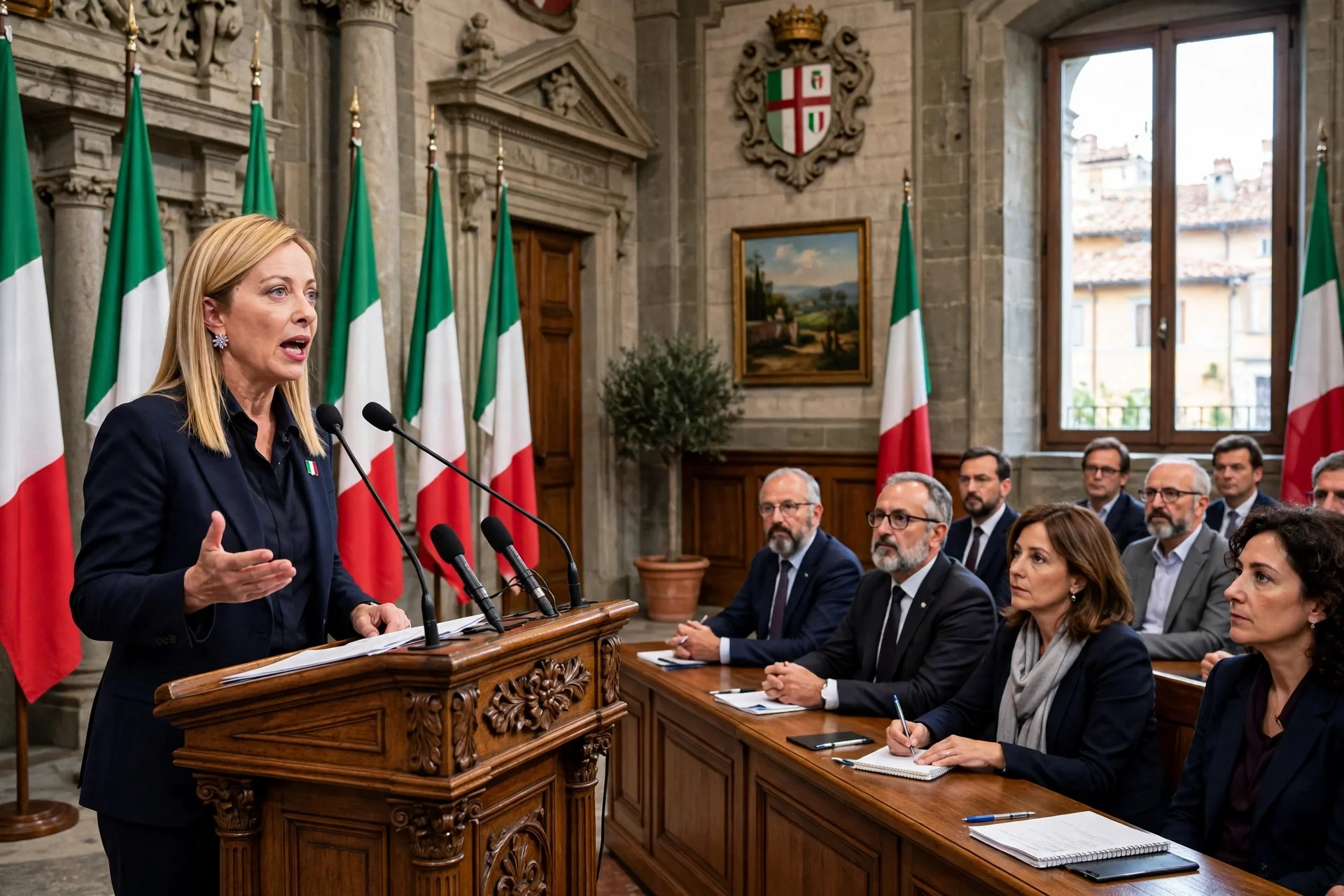
Mensaje de Meloni a la 39ª Asamblea General de la Unión de Provincias Italianas · Imagen generada por EPM
Meloni urges restoring Italy's Provinces to their constitutional role
Addressing the 39th General Assembly of the Union of Italian Provinces, Giorgia Meloni defended the constitutional role of the Provinces, criticised Law no.
Meloni calls for representativeness and full dignity for the Provinces
In her message to the 39th General Assembly of the Union of Italian Provinces, Giorgia Meloni criticised the limbo created by Law no.
--- The context ---
Italy's Provinces hold a recognised place in the Constitution, yet their institutional standing has been marked by uncertainty for years. Against that backdrop, President of the Council of Ministers Giorgia Meloni sent a message to the 39th General Assembly of the Union of Italian Provinces, meeting in Imperia, greeting its President Lattuca and the local administrators present.
--- The facts ---
Meloni said she was very sorry not to have been able to join the assembly in Imperia, but that she nevertheless wanted to send her greetings and contribution. She noted that this year's event takes on particular significance because it coincides with the 80th anniversary of the birth of the Republic, and she described the Provinces as pillars of territorial cohesion and an indispensable link for local development.
The President recalled her time as a provincial councillor and the support these bodies provide to inland areas and the smallest municipalities. She also stressed that, despite staff shortages and strict budget constraints, provincial authorities kept essential services running, from the road network to high school facilities, and delivered on the commitments of the National Recovery and Resilience Plan by the set deadlines.
--- The positions ---
Meloni argued that Provinces play a key role based on the constitutional principles of autonomy and subsidiarity, providing strategic coordination for local administrations. In her assessment, they bear the heavy burden left behind by Law no. 56 of 2014, which she said put these entities in an unsustainable limbo, with no recognition of their history or constitutional role.
The President said the time has come for Parliament, without bias, to assess the effects of that legislation and the election model in order to improve the effectiveness and representativeness of the elected bodies. She added that this is all the more true for metropolitan areas, where citizens cannot elect the mayor of the capital who governs them, and she backed restoring the Provinces as a connecting link between municipalities and regional authorities.
--- What remains unknown ---
The message does not set out a concrete timetable for the reform or the resources that would accompany the new framework. It also leaves open how responsibilities would be divided among municipalities, Provinces and regions, and what would happen to staffing levels in provincial bodies.
--- Unanswered questions ---
When will the Council of Ministers discuss the reform of the consolidated law on local authorities? Will Parliament change the election model for Provinces and metropolitan areas? Will local bodies receive more staff and resources to sustain essential services? Will the limbo created by Law no. 56 of 2014 finally be left behind?
--- EPM analysis ---
The message combines recognition with a legislative agenda: it dignifies a weakened tier of government while placing its reform at the centre of the parliamentary debate. The references to inland areas and small municipalities connect the institutional discussion with the Italy that receives the fewest services, while the record of meeting the recovery plan deadlines supports, with facts, the case for trusting these bodies with a fuller role.
📌 EPM Take:
In EPM's view, the strength of the message lies in joining institutional recognition to a concrete and verifiable reform. Provinces sustain services citizens touch every day, from roads to schools, and they have done so with short staffing and tight budgets. If the review of Law no. 56 of 2014 and of the consolidated law returns clear responsibilities, representativeness and dignity to these bodies, territorial cohesion will stop being a solemn formula and become a measurable administrative practice across Italian territory.
--- The context ---
Italy has debated the place of its Provinces for years, a tier of government provided for by the Constitution and weakened by successive reforms. That is the setting for the message that President of the Council of Ministers Giorgia Meloni addressed to the 39th General Assembly of the Union of Italian Provinces, held in Imperia, greeting its President Lattuca and the local administrators.
--- The facts ---
Meloni expressed regret at not being able to attend in Imperia and sent her greetings and contribution to those present. She highlighted that the assembly coincides with the 80th anniversary of the birth of the Republic and defined the Provinces as pillars of territorial cohesion and an indispensable link for local development, with a key role founded on constitutional autonomy and subsidiarity.
The President recalled her experience as a provincial councillor and the strategic coordination these bodies offer local administrations, with special support for inland areas and the smallest municipalities. She also acknowledged that Provinces guaranteed essential services despite staff shortages and strict budget constraints, maintained the road network and high school facilities, and met the deadlines of the National Recovery and Resilience Plan.
--- The positions ---
Meloni stated that the Provinces bear the heavy burden of Law no. 56 of 2014, which in her judgement left them in an unsustainable limbo, with no recognition of their history or constitutional role. From that criticism, she held that Parliament should assess, without bias, the effects of that law and of the current election model.
The President insisted that improving the effectiveness and representativeness of elected bodies is even more urgent in metropolitan areas, where citizens cannot elect the mayor of the capital who governs them. She also maintained that updating the overall structure of local authorities is increasingly urgent, because more than 25 years have passed since the consolidated law on local authorities entered into force and successive, not always consistent measures complicated administrative action.
--- What remains unknown ---
The message announces the reform but sets no approval dates and does not detail its content provision by provision. It also does not clarify which parliamentary majorities support it or how representation in metropolitan areas, a point the text itself presents as anomalous, will be resolved.
--- Unanswered questions ---
Will Parliament carry out an unbiased assessment of Law no. 56 of 2014? Will citizens in metropolitan areas be able to elect directly those who govern them? Will the reform define clearly who does what at each institutional level? Will the Provinces regain the full dignity the message promises them?
--- EPM analysis ---
The approach orders the debate around clear institutional principles: representativeness of elected bodies, sharp boundaries between responsibilities and respect for the constitutional role of each tier. The criticism of the limbo created in 2014 serves as the reform's foundation, and the three-fold objective announced for the new consolidated law seeks to close a period of partial and sometimes inconsistent measures.
📌 EPM Take:
In EPM's view, the message is right to place representativeness at the centre of provincial reform. A body that governs without being clearly elected loses authority before citizens, and the metropolitan areas illustrate that forcefully. Restoring the Provinces as a connecting link between municipalities and regional authorities, with clear boundaries on who does what, would strengthen a more efficient and attentive State. The test will be the text that reaches the Council of Ministers and the parliamentary debate that follows.
Meloni pide devolver a las provincias su papel constitucional en Italia
Giorgia Meloni defendió ante la 39ª Asamblea de la Unión de Provincias Italianas el papel constitucional de las provincias, criticó la Ley 56 de 2014 y anunció…
Meloni reclama representatividad y dignidad plena para las provincias
En su mensaje a la 39ª Asamblea de la Unión de Provincias Italianas, Giorgia Meloni criticó el limbo creado por la Ley 56 de 2014, reclamó representatividad en…
--- El contexto ---
Las provincias italianas ocupan un lugar reconocido en la Constitución, pero su situación institucional lleva años marcada por la incertidumbre. En ese marco, la presidenta del Consejo de Ministros, Giorgia Meloni, envió un mensaje a la 39ª Asamblea General de la Unión de Provincias Italianas, reunida en Imperia, y saludó a su presidente Lattuca y a los administradores locales presentes.
--- Los hechos ---
Meloni lamentó no haber podido asistir a Imperia y, aun así, quiso hacer llegar su saludo y su contribución a la asamblea. Señaló que la cita de este año tiene un significado especial porque coincide con el 80º aniversario del nacimiento de la República, y describió a las provincias como pilares de la cohesión territorial y enlace indispensable del desarrollo local.
La presidenta recordó su etapa como consejera provincial y el apoyo que estos entes prestan a las áreas internas y a los municipios más pequeños. También subrayó que, pese a la escasez de personal y a las restricciones presupuestarias, las provincias mantuvieron servicios esenciales como la red vial y los edificios de secundaria y cumplieron dentro de los plazos los compromisos del Plan Nacional de Recuperación y Resiliencia.
--- Las posiciones ---
Meloni sostuvo que las provincias desempeñan un papel clave desde los principios constitucionales de autonomía y subsidiariedad, y que coordinan estratégicamente a las administraciones locales. A su juicio, cargan con la pesada herencia de la Ley 56 de 2014, que según afirmó las dejó en un limbo insostenible y sin reconocimiento de su papel constitucional.
La presidenta planteó que ha llegado el momento de que el Parlamento evalúe sin prejuicios los efectos de esa ley y el modelo electoral, para mejorar la eficacia y la representatividad de los órganos elegidos. Advirtió, además, que en las áreas metropolitanas los ciudadanos no pueden elegir al alcalde de la capital que los gobierna, y defendió devolver a las provincias su papel de enlace entre municipios y regiones.
--- Lo que falta saber ---
El mensaje no detalla el calendario concreto de la reforma ni los recursos que acompañarían el nuevo marco. Tampoco precisa cómo se repartirían las competencias entre municipios, provincias y regiones, ni qué ocurrirá con la dotación de personal de los entes provinciales.
--- Preguntas sin respuesta ---
¿Cuándo debatirá el Consejo de Ministros la reforma del texto único de entes locales? ¿Cambiará el Parlamento el modelo electoral de las provincias y de las áreas metropolitanas? ¿Recibirán los entes locales más personal y más recursos para sostener los servicios esenciales? ¿Quedará atrás el limbo creado por la Ley 56 de 2014?
--- Análisis EPM ---
El mensaje combina reconocimiento y agenda legislativa: dignifica un nivel institucional debilitado y, al mismo tiempo, coloca su reforma en el centro del debate parlamentario. La mención de las áreas internas y de los municipios pequeños conecta la discusión institucional con la Italia que menos servicios recibe, mientras que los plazos cumplidos del plan de recuperación respaldan con hechos la petición de mayor confianza hacia estos entes.
📌 Conclusion EPM:
A juicio de EPM, el valor del mensaje está en unir el reconocimiento institucional con una reforma concreta y verificable. Las provincias sostienen servicios que los ciudadanos tocan cada día, desde las carreteras hasta las escuelas, y lo han hecho con plantillas cortas y presupuestos estrechos. Si la revisión de la Ley 56 de 2014 y del texto único devuelve competencias claras, representatividad y dignidad a estos entes, la cohesión territorial dejará de ser una fórmula solemne y pasará a ser una práctica administrativa medible en cada territorio italiano.
--- El contexto ---
Italia discute desde hace años el encaje de sus provincias, un nivel previsto por la Constitución y debilitado por reformas sucesivas. En ese debate se inscribe el mensaje que la presidenta del Consejo de Ministros, Giorgia Meloni, dirigió a la 39ª Asamblea General de la Unión de Provincias Italianas, celebrada en Imperia, con saludo a su presidente Lattuca y a los administradores locales.
--- Los hechos ---
Meloni expresó su pesar por no poder estar en Imperia y transmitió su saludo y su contribución a los presentes. Destacó que la asamblea coincide con el 80º aniversario del nacimiento de la República y definió a las provincias como pilares de la cohesión territorial y enlace indispensable del desarrollo local, con un papel clave fundado en la autonomía y la subsidiariedad constitucionales.
La presidenta evocó su experiencia como consejera provincial y la coordinación estratégica que estos entes ofrecen a las administraciones locales, con apoyo especial a las áreas internas y a los municipios pequeños. Reconoció, además, que las provincias garantizaron servicios esenciales pese a la escasez de personal y a las restricciones presupuestarias, cuidaron la red vial y los edificios de secundaria y cumplieron los plazos del Plan Nacional de Recuperación y Resiliencia.
--- Las posiciones ---
Meloni afirmó que las provincias soportan la pesada carga de la Ley 56 de 2014, que en su valoración las dejó en un limbo insostenible y sin reconocimiento de su historia ni de su papel constitucional. Desde esa crítica, defendió que el Parlamento evalúe sin prejuicios los efectos de aquella ley y el modelo electoral vigente.
La presidenta insistió en que mejorar la eficacia y la representatividad de los órganos elegidos es aún más urgente en las áreas metropolitanas, donde los ciudadanos no pueden elegir al alcalde de la capital que los gobierna. También sostuvo que urge actualizar la estructura de los entes locales, porque han pasado más de 25 años desde el texto único del sector y las medidas sucesivas, no siempre coherentes, complicaron la acción administrativa.
--- Lo que falta saber ---
El mensaje anuncia la reforma, pero no fija fechas de aprobación ni detalla su contenido artículo por artículo. Tampoco aclara qué mayorías parlamentarias la respaldan ni cómo se resolverá la representación en las áreas metropolitanas, un punto que el propio texto presenta como anómalo.
--- Preguntas sin respuesta ---
¿Aprobará el Parlamento una evaluación sin prejuicios de la Ley 56 de 2014? ¿Podrán los ciudadanos de las áreas metropolitanas elegir directamente a quien los gobierna? ¿Definirá la reforma con claridad quién hace qué en cada nivel institucional? ¿Recuperarán las provincias la dignidad plena que el mensaje les promete?
--- Análisis EPM ---
El planteamiento ordena el debate en torno a principios claros: representatividad de los órganos elegidos, límites nítidos entre competencias y respeto al papel constitucional de cada nivel. La crítica al limbo creado en 2014 funciona como fundamento de la reforma, y la triple finalidad anunciada para el nuevo texto único busca cerrar una etapa de medidas parciales y contradictorias.
📌 Conclusion EPM:
A juicio de EPM, el mensaje acierta al poner la representatividad en el centro de la reforma provincial. Un ente que gobierna sin ser elegido con claridad pierde autoridad ante los ciudadanos, y el caso de las áreas metropolitanas lo ilustra con fuerza. Devolver a las provincias su papel de enlace entre municipios y regiones, con límites claros sobre quién hace qué, fortalecería un Estado más eficiente y atento. La prueba será el texto que llegue al Consejo de Ministros y el debate parlamentario que lo siga.