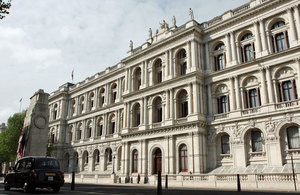
Main building of the Foreign, Commonwealth and Development Office in London. · GOV.UK / FCDO, Open Government Licence
Eight foreign ministers in Istanbul back dialogue and de-escalation
Foreign ministers from the R4 group and from France, Germany, Italy and the United Kingdom met in Istanbul on 23 October 2026 and agreed to address regional…
Ministers in Istanbul stress navigation safety and regional security
R4 and European foreign ministers stressed safety and freedom of navigation in Istanbul, addressing Houthi attacks and escalated tension in Hormuz, Bab El…
--- The context ---
Istanbul hosted a ministerial meeting on 23 October 2026 that brought the R4 group and four European countries around one table to address regional and international conflicts.
--- The facts ---
The foreign ministers of Türkiye, Egypt, Pakistan and Saudi Arabia, which form the R4, took part alongside their counterparts from France, Germany, Italy and the United Kingdom. They discussed the US/Israel-Iran conflict, the Israeli-Palestinian conflict and the appalling Houthi militia attacks against Saudi Arabia and the Government of Yemen.
--- The positions ---
The ministers expressed their commitment to continue contributing towards diplomatic efforts aimed at promoting peace and stability in the region and beyond, and to addressing the security, economic and trade implications of these issues.
--- What remains unknown ---
The statement announces no concrete measures and no specific agreements. It also sets no date for a next meeting in this format.
--- Unanswered questions ---
When will this ministerial format meet again? What concrete steps will follow the diplomatic commitment announced in Istanbul? How will dialogue turn into lasting negotiated solutions for the outstanding conflicts?
--- EPM analysis ---
The meeting matters because it keeps a broad multilateral channel open while several fronts overlap, and because it places a negotiated two-state solution and the relevant UN resolutions at the center of its message.
📌 EPM Take: In EPM's view, the Istanbul meeting matters because regional and European actors agreed on one premise: open conflicts require negotiated outcomes, not escalation. The emphasis on a two-state solution and on the relevant UN resolutions gives the message political substance. Its limit is equally clear: with no calendar and no measures announced, the commitment is for now a diplomatic signal, not yet a verifiable result.
--- The context ---
The Istanbul meeting, held on 23 October 2026, gathered foreign ministers from the R4 group and four European countries amid escalated tension on maritime routes and regional fronts.
--- The facts ---
Attending were the foreign ministers of Türkiye, Egypt, Pakistan and Saudi Arabia, the members of the R4, plus those of France, Germany, Italy and the United Kingdom. The agenda covered the appalling Houthi militia attacks against Saudi Arabia and the Government of Yemen, and escalated tension in the Straits of Hormuz and Bab El Mandeb and the Black Sea.
--- The positions ---
The ministers stressed safety and freedom of navigation, agreed on the urgent need for dialogue, diplomacy and de-escalation, and committed to addressing the security, economic and trade implications of these issues.
--- What remains unknown ---
No protection mechanisms for navigation are spelled out, and no concrete decisions on the attacks are recorded. No date for a further meeting is given either.
--- Unanswered questions ---
What real measures will protect navigation in Hormuz and Bab El Mandeb? Will there be a common response to the Houthi attacks? When will the ministers meet again to account for progress?
--- EPM analysis ---
Without secure straits and a firm stance against militia attacks, regional stability stays on paper. The statement is right to link de-escalation with protecting the routes whose disruption carries security, economic and trade implications.
📌 EPM Take: In EPM's view, the strongest message from Istanbul is practical: without safe navigation and containment of the Houthi attacks, there will be no stability left to negotiate. The eight countries are right to treat security, the economy and trade as one problem. What remains unproven is whether this willingness to talk will become measures able to deter further attacks and protect strategic routes.
Ministros de ocho países pactan en Estambul impulsar diálogo y desescalada
Los ministros de Exteriores del grupo R4 y de Francia, Alemania, Italia y el Reino Unido se reunieron en Estambul el 23 de octubre de 2026 y acordaron abordar…
Ocho cancilleres defienden en Estambul la navegación y la seguridad regional
Cancilleres del R4 y de cuatro países europeos defendieron en Estambul la seguridad y la libertad de navegación, abordaron los ataques hutíes, calificados de…
--- El contexto ---
Estambul acogió el 23 de octubre de 2026 una reunión ministerial que sentó en la misma mesa al grupo R4 y a cuatro países europeos para tratar conflictos regionales e internacionales.
--- Los hechos ---
Participaron los ministros de Exteriores de Türkiye, Egipto, Pakistán y Arabia Saudí, integrantes del R4, junto a sus homólogos de Francia, Alemania, Italia y el Reino Unido. Hablaron del conflicto entre Estados Unidos, Israel e Irán, del conflicto israelí-palestino y de los ataques hutíes contra Arabia Saudí y el Gobierno de Yemen.
--- Las posiciones ---
Los ministros expresaron su compromiso de seguir contribuyendo a los esfuerzos diplomáticos por la paz y la estabilidad en la región y más allá, y de abordar las implicaciones de seguridad, económicas y comerciales de estos asuntos.
--- Lo que falta saber ---
El comunicado no anuncia medidas concretas ni acuerdos específicos. Tampoco fija la fecha de una próxima reunión en este formato.
--- Preguntas sin respuesta ---
¿Cuándo volverá a reunirse este formato ministerial? ¿Qué pasos concretos seguirán al compromiso diplomático anunciado? ¿Cómo se traducirá el diálogo en soluciones negociadas para los conflictos pendientes?
--- Análisis EPM ---
El valor del encuentro está en mantener abierto un canal multilateral amplio cuando varios frentes se cruzan, desde Oriente Medio hasta el Mar Negro, y en poner la negociación por delante de la escalada.
📌 Conclusion EPM: A juicio de EPM, la reunión de Estambul importa porque reúne a actores regionales y europeos en torno a una misma premisa: ningún conflicto abierto se resuelve sin negociación. La referencia a una solución de dos Estados y a las resoluciones de la ONU da contenido político al mensaje. Su límite también es claro: sin calendario ni medidas anunciadas, el compromiso vale por ahora como señal diplomática, no como resultado verificable.
--- El contexto ---
La cita de Estambul, celebrada el 23 de octubre de 2026, reunió a cancilleres del grupo R4 y de cuatro países europeos en un momento de tensión creciente en rutas marítimas y frentes regionales.
--- Los hechos ---
Asistieron los titulares de Exteriores de Türkiye, Egipto, Pakistán y Arabia Saudí, que forman el R4, y los de Francia, Alemania, Italia y el Reino Unido. La agenda incluyó los ataques hutíes contra Arabia Saudí y el Gobierno de Yemen, calificados de atroces, y la tensión escalada en Ormuz, Bab El Mandeb y el Mar Negro.
--- Las posiciones ---
Los ministros defendieron la seguridad y la libertad de navegación, acordaron la necesidad urgente de diálogo, diplomacia y desescalada, y se comprometieron a afrontar las implicaciones de seguridad, económicas y comerciales de estas crisis.
--- Lo que falta saber ---
No se detallan mecanismos de protección para la navegación ni decisiones concretas frente a los ataques mencionados. Ni siquiera consta fecha para el siguiente encuentro.
--- Preguntas sin respuesta ---
¿Qué medidas reales protegerán la navegación en Ormuz y Bab El Mandeb? ¿Habrá una respuesta común frente a los ataques hutíes? ¿Cuándo se reunirán de nuevo los ministros para rendir cuentas?
--- Análisis EPM ---
Sin seguridad en los estrechos ni defensa frente a las milicias, cualquier estabilidad regional queda en papel. El acierto del comunicado es unir la desescalada con la protección de rutas que sostienen el comercio.
📌 Conclusion EPM: A juicio de EPM, el mensaje más sólido de Estambul es práctico: sin navegación segura ni contención de los ataques hutíes, no habrá estabilidad que negociar. Los ocho países aciertan al tratar la seguridad, la economía y el comercio como un mismo problema. Queda por demostrar, eso sí, que la voluntad de diálogo se convertirá en medidas capaces de disuadir nuevas agresiones y proteger las rutas estratégicas.