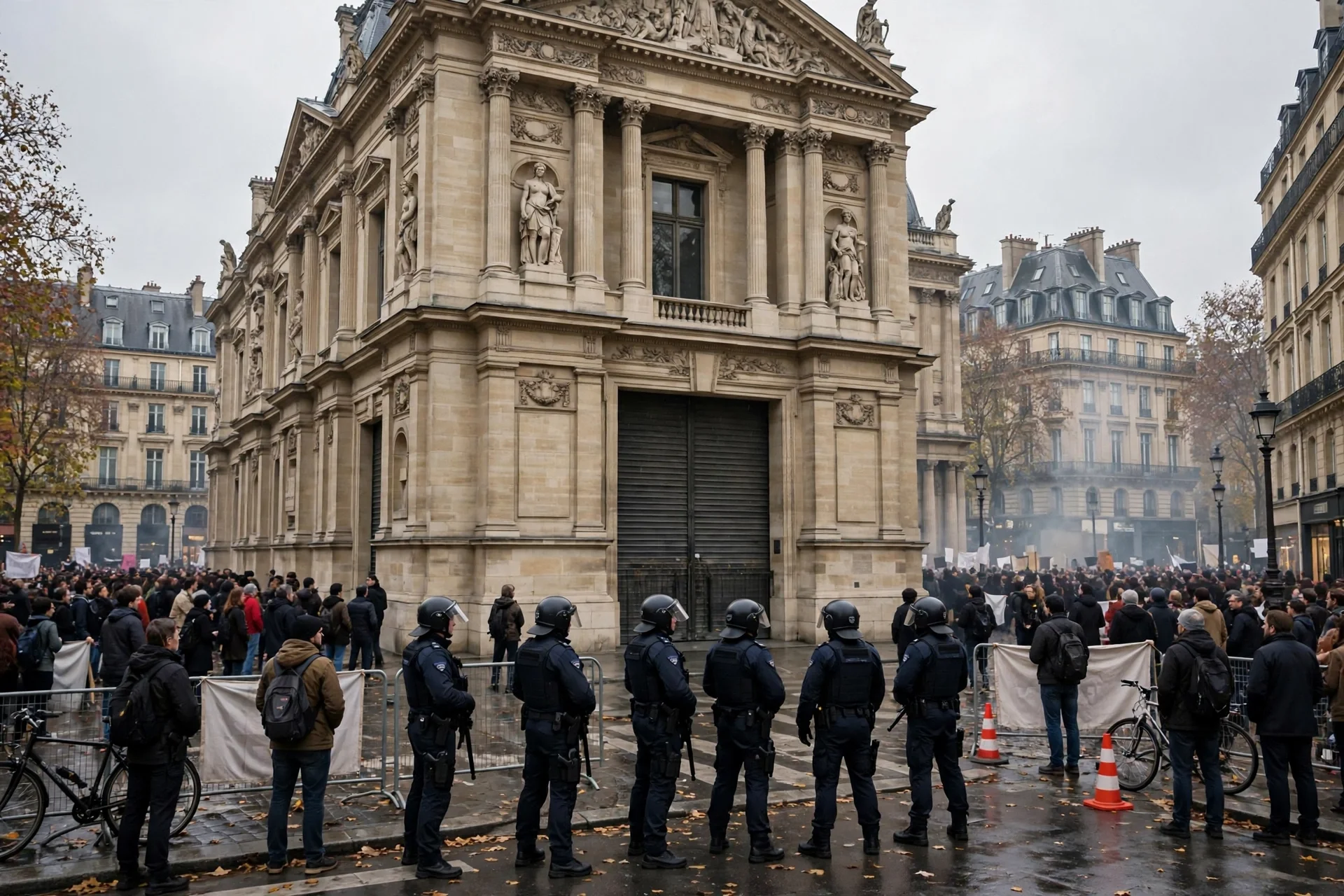
France deploys 70,000 officers and closes museums amid protests
France will deploy 70,000 police officers and gendarmes this Saturday ahead of new student protests, with Paris museums closed, after earlier unrest that…
France mobilises 70,000 officers to prevent further unrest
The French government will deploy 70,000 police officers and gendarmes this Saturday amid a high risk of violence, with museums closed in Paris and additional…
--- The context ---
France faces a new day of student protests this Saturday with an exceptional deployment across the country. The mobilisations come after the looting, fires and damage recorded during demonstrations the previous weekend, and after a meeting held on Friday at the Elysee Palace between student representatives and President Emmanuel Macron.
--- The facts ---
The government will deploy 70,000 police officers and gendarmes across the country ahead of the protests called for this Saturday. The operation, announced by Interior Minister Laurent Nuñez, includes helicopters, armoured vehicles and water cannon to strengthen surveillance in the main cities, according to what the authorities set out.
--- The positions ---
Prime Minister Sébastien Lecornu warned that a high risk of violence persists, and the government says it seeks to prevent new clashes and protect both the population and commercial establishments. Student organisations, by contrast, announced that they will continue the protests and the blockades of schools, because they demand better educational conditions, the replacement of absent teachers and changes to the university access system.
--- What remains unknown ---
It is still not known whether the day will pass without incidents or what reach the restrictions and bans on certain demonstrations adopted in cities such as Paris and Limoges will have. It is also unclear what concrete proposals the government will present at the meeting scheduled for next Monday between the prime minister and student representatives.
--- Unanswered questions ---
Will the deployment of 70,000 officers guarantee the right to protest without new unrest? What concrete proposals will the government offer students at the meeting next Monday? How long will the main museums in Paris remain closed if the mobilisations continue?
--- EPM analysis ---
Several of the main museums in Paris will remain closed this Saturday, including the Louvre, the Orsay Museum, the Picasso Museum and the Grand Palais, and a fair planned for the weekend cancelled its activities for security reasons. That closure shows how far the protest is already disrupting the cultural and commercial life of the capital.
According to the official reports cited in the available information, around 3,000 businesses were affected by damage or looting during the earlier unrest. Students acknowledged a certain willingness for dialogue after the Friday meeting, but insisted that they need concrete proposals to answer their educational demands.
📌 EPM Take: In EPM's view, the size of the deployment cannot replace a concrete answer to the educational demands that triggered the protests. With 70,000 officers on the streets, museums closed and 3,000 businesses affected during the earlier unrest, the priority must be protecting people without emptying the right to demonstrate. The meeting next Monday will be the real test of whether dialogue moves forward or tension returns to the streets again.
--- The context ---
France prepares this Saturday for new protests with the immediate memory of the looting, fires and damage recorded during demonstrations the previous weekend. In that context, the government chose a broad deployment across the country and additional measures in cities such as Paris and Limoges, with restrictions and bans on certain demonstrations.
--- The facts ---
The government will deploy 70,000 police officers and gendarmes across the country ahead of the protests called for this Saturday. The operation, announced by Interior Minister Laurent Nuñez, includes helicopters, armoured vehicles and water cannon to strengthen surveillance in the main cities and prevent new clashes, according to what the authorities indicated.
--- The positions ---
Prime Minister Sébastien Lecornu warned that a high risk of violence persists, and the authorities maintain that the operation seeks to protect both the population and commercial establishments. Student organisations announced that they will continue the protests and the blockades of schools, with demands for better educational conditions, replacement of absent teachers and changes to university access.
--- What remains unknown ---
It is not yet known whether the deployment will be enough to prevent new violent acts or how the measures in Paris and Limoges will affect the course of the gatherings. The content of the proposals the prime minister may present when he meets student representatives next Monday is also unknown.
--- Unanswered questions ---
Will the operation of 70,000 officers prevent a repeat of the looting and fires of the previous weekend? Will student organisations make a clear commitment against unrest while they maintain the blockades? What concrete measures will be announced after the meeting next Monday to close the crisis?
--- EPM analysis ---
The closure this Saturday of several of the main museums in Paris, including the Louvre, the Orsay Museum, the Picasso Museum and the Grand Palais, and the cancellation of the activities of a fair planned for the weekend for security reasons, reflect the immediate cost of instability for daily life in the capital.
According to the official reports cited in the available information, around 3,000 businesses were affected by damage or looting during the earlier unrest. The mobilisations also come after a meeting on Friday at the Elysee Palace between student representatives and President Emmanuel Macron, in which the young people acknowledged a certain willingness for dialogue but asked for concrete proposals.
📌 EPM Take: In EPM's view, faced with a risk of violence that the prime minister himself describes as high, the deployment of 70,000 officers is a necessary protective measure for residents, businesses and public spaces across the capital. The 3,000 establishments affected in the earlier unrest show the cost of losing control of the streets. Dialogue next Monday should move forward, but without giving in to violence or normalising blockades as a method of pressure on institutions.
Francia despliega 70,000 agentes y cierra museos ante protestas
Francia desplegará 70,000 policías y gendarmes este sábado ante nuevas protestas estudiantiles, con museos de París cerrados, tras disturbios anteriores que…
Francia moviliza 70,000 agentes para evitar nuevos disturbios
El Gobierno francés desplegará 70,000 policías y gendarmes este sábado ante el alto riesgo de violencia, con museos cerrados en París y medidas adicionales en…
--- El contexto ---
Francia afronta este sábado una nueva jornada de protestas estudiantiles con un despliegue excepcional. Las movilizaciones llegan después de los saqueos, incendios y daños registrados durante las manifestaciones del fin de semana anterior, y tras una reunión celebrada el viernes en el Palacio del Elíseo entre representantes estudiantiles y el presidente Emmanuel Macron.
--- Los hechos ---
El Gobierno desplegará 70,000 policías y gendarmes en todo el país ante las protestas convocadas para este sábado. El operativo, anunciado por el ministro del Interior, Laurent Nuñez, incluye helicópteros, vehículos blindados y cañones de agua para reforzar la vigilancia en las principales ciudades.
--- Las posiciones ---
El primer ministro, Sébastien Lecornu, advirtió que persiste un alto riesgo de violencia y el Gobierno sostiene que busca prevenir nuevos enfrentamientos y proteger tanto a la población como a los establecimientos comerciales. Las organizaciones estudiantiles, en cambio, anunciaron que continuarán las protestas y los bloqueos de institutos, porque reclaman mejores condiciones educativas, la sustitución de docentes ausentes y cambios en el sistema de acceso a la universidad.
--- Lo que falta saber ---
Todavía no se conoce si la jornada transcurrirá sin incidentes ni qué alcance tendrán las restricciones y prohibiciones de determinadas manifestaciones adoptadas en ciudades como París y Limoges. Tampoco está claro qué propuestas concretas presentará el Gobierno en la reunión prevista para el próximo lunes entre el primer ministro y representantes estudiantiles.
--- Preguntas sin respuesta ---
¿Logrará el despliegue de 70,000 agentes garantizar el derecho a la protesta sin nuevos disturbios? ¿Qué propuestas concretas ofrecerá el Gobierno a los estudiantes en la reunión del próximo lunes? ¿Cuánto tiempo permanecerán cerrados los principales museos de París si continúan las movilizaciones?
--- Análisis EPM ---
Varios de los principales museos de París permanecerán cerrados este sábado, incluidos el Louvre, el Museo de Orsay, el Museo Picasso y el Grand Palais, y una feria prevista para el fin de semana canceló sus actividades por motivos de seguridad. Ese cierre muestra cómo la protesta ya altera la vida cultural y comercial de la capital.
Según los reportes oficiales citados en la información disponible, alrededor de 3,000 comercios resultaron afectados por daños o saqueos durante los disturbios anteriores. Los estudiantes reconocieron cierta disposición al diálogo tras la reunión del viernes, pero insistieron en que necesitan propuestas concretas para responder a sus demandas educativas.
📌 Conclusion EPM: A juicio de EPM, el tamaño del despliegue no puede sustituir una respuesta concreta a las demandas educativas que originaron las protestas. Con 70,000 agentes en las calles, museos cerrados y 3,000 comercios afectados en la jornada anterior, la prioridad debe ser proteger a las personas sin vaciar el derecho a manifestarse. La reunión del próximo lunes será la prueba real de si el diálogo avanza o si la tensión vuelve a trasladarse a la calle.
--- El contexto ---
Francia se prepara este sábado para nuevas protestas con el recuerdo de los saqueos, incendios y daños del fin de semana anterior. En ese contexto, el Gobierno optó por un despliegue amplio en todo el país y por medidas adicionales en ciudades como París y Limoges, con restricciones y prohibiciones de manifestaciones.
--- Los hechos ---
El Gobierno desplegará 70,000 policías y gendarmes en todo el país ante las protestas convocadas para este sábado. El operativo, anunciado por el ministro del Interior, Laurent Nuñez, incluye helicópteros, vehículos blindados y cañones de agua para reforzar la vigilancia en las principales ciudades y prevenir nuevos enfrentamientos.
--- Las posiciones ---
El primer ministro, Sébastien Lecornu, advirtió que persiste un alto riesgo de violencia, y las autoridades sostienen que el operativo busca proteger tanto a la población como a los establecimientos comerciales. Las organizaciones estudiantiles anunciaron que continuarán las protestas y los bloqueos de institutos, con reclamos de mejores condiciones educativas, sustitución de docentes ausentes y cambios en el acceso universitario.
--- Lo que falta saber ---
Aún no se sabe si el despliegue bastará para evitar nuevos actos violentos ni cómo afectarán las medidas de París y Limoges al desarrollo de las convocatorias. Tampoco se conoce el contenido de las propuestas que el primer ministro pueda presentar cuando se reúna con representantes estudiantiles el próximo lunes.
--- Preguntas sin respuesta ---
¿Conseguirá el operativo de 70,000 agentes evitar una repetición de los saqueos e incendios del fin de semana anterior? ¿Asumirán las organizaciones estudiantiles un compromiso claro contra los disturbios mientras mantienen los bloqueos? ¿Qué medidas concretas se anunciarán tras la reunión del próximo lunes para cerrar la crisis?
--- Análisis EPM ---
El cierre este sábado de varios de los principales museos de París, incluidos el Louvre, el Museo de Orsay, el Museo Picasso y el Grand Palais, y la cancelación de las actividades de una feria prevista para el fin de semana por motivos de seguridad, reflejan el costo de la inestabilidad para la capital.
Según los reportes oficiales citados en la información disponible, alrededor de 3,000 comercios resultaron afectados por daños o saqueos durante los disturbios anteriores. Las movilizaciones llegan además después de una reunión el viernes en el Palacio del Elíseo entre representantes estudiantiles y el presidente Emmanuel Macron, en la que los jóvenes reconocieron cierta disposición al diálogo pero pidieron propuestas concretas.
📌 Conclusion EPM: A juicio de EPM, ante un riesgo de violencia que el propio primer ministro califica como alto, el despliegue de 70,000 agentes es una medida de protección necesaria para vecinos y comercios. Los 3,000 establecimientos afectados en los disturbios anteriores muestran el costo de perder el control de la calle. El diálogo del próximo lunes debe avanzar, pero sin ceder ante la violencia ni normalizar los bloqueos como método de presión.