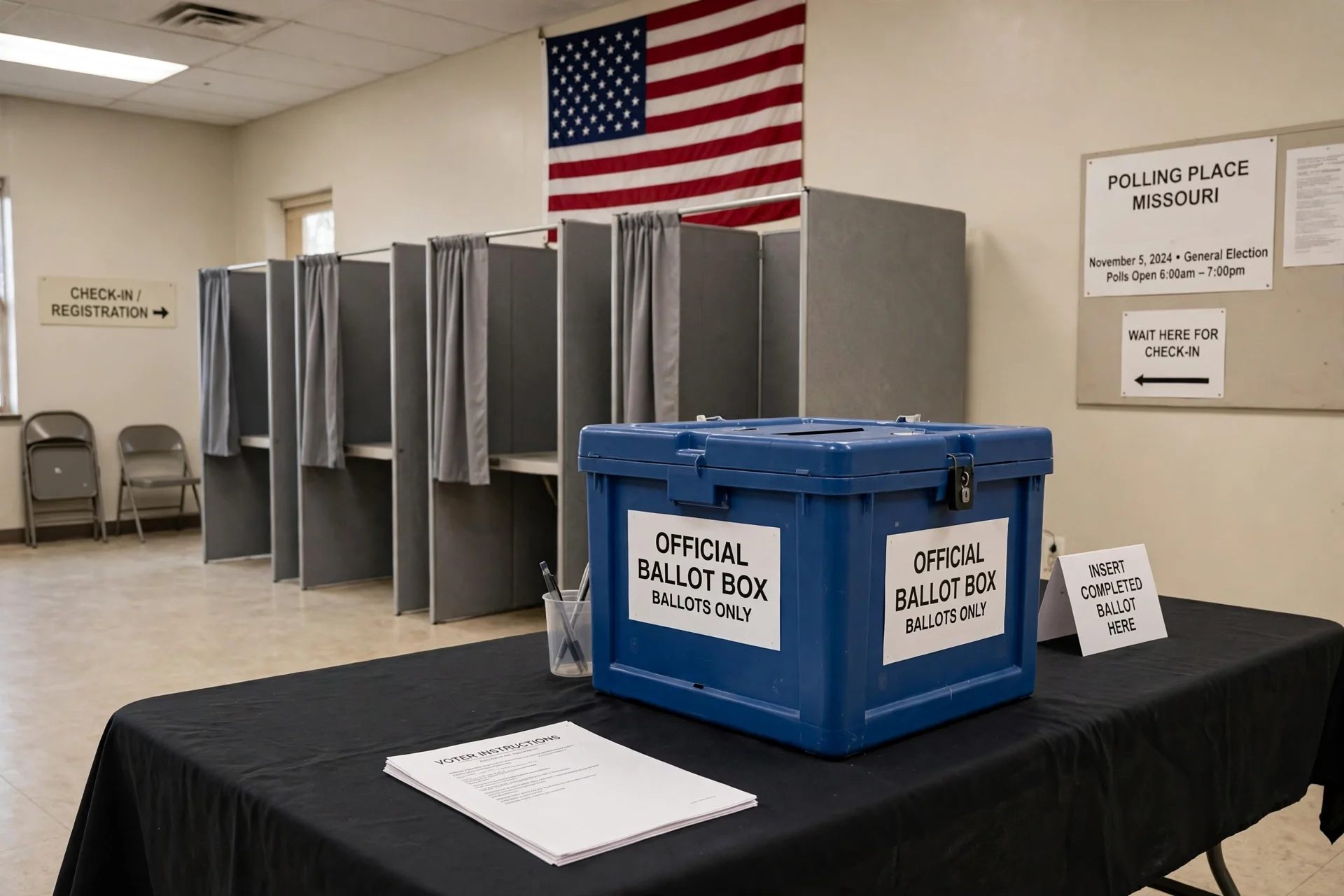
Centro de votación en Missouri con urna oficial y cabinas electorales. · Imagen generada para EPM
South African Resident Charged With Unlawful Voting in Missouri
Hanlie Venter, a 67 year old lawful permanent resident born in South Africa, is charged with unlawful voting in the November 2024 federal election in Missouri.
Permanent Resident Faces Unlawful Voting Charge in Missouri
A lawful permanent resident born in South Africa was charged with unlawful voting in the November 2024 federal election in McDonald County, Missouri.
--- The context ---
In the United States, voting in federal elections is reserved for citizens, and lawful permanent residents are not allowed to vote in federal elections or, in Missouri, in state or local elections either. That legal framework is the starting point of a case announced in Springfield, Missouri, which must now be examined by a federal trial jury with the full protections of due process before any conclusion is reached.
--- The facts ---
According to the official announcement, Hanlie Venter, 67, who was born in South Africa, is charged with one count of unlawful voting. Venter moved to the United States in 2020 and was granted lawful permanent resident status in 2021. The complaint states that she registered to vote in September 2024 and subsequently voted in the November 2024 federal election at a polling place in McDonald County, Missouri.
The case is being prosecuted by the United States attorney office for the Western District of Missouri, which brought the charge set out in the complaint. The investigation was carried out by the Homeland Security Investigations unit, while the citizenship and immigration services agency assisted investigators throughout the official inquiry into the alleged unlawful vote.
--- The positions ---
The United States attorney office for the Western District of Missouri made the announcement and is prosecuting the case. The investigation was carried out by the Homeland Security Investigations unit of the immigration and customs enforcement agency, while the citizenship and immigration services agency provided valuable assistance during the investigation, according to the announcement released when the charge was publicly presented in this case.
--- What remains unknown ---
The announcement stresses an essential point for any fair reading of the case: the charge contained in the criminal complaint is simply an accusation and is not evidence of guilt. Evidence supporting the charge must be presented to a federal trial jury, which will be responsible for determining whether the defendant is guilty or not, so no definitive conclusion about responsibility is appropriate at this early stage.
--- Unanswered questions ---
How did Venter registration in September 2024 occur and what checks were applied at that moment? What evidence will prosecutors present to the federal trial jury to support the charge? When will the trial take place and what procedural protections will accompany each stage of the case as it moves forward through the federal court system?
--- EPM analysis ---
Under federal law, if convicted, Venter faces a sentence of up to one year in prison and a fine of $100,000. The maximum statutory sentence is prescribed by Congress and is provided only for informational purposes, because the court would determine sentencing based on the advisory sentencing guidelines and other statutory factors that apply to the specific circumstances proven during the proceedings in federal court.
📌 EPM Take: In EPM's view, this case should be read with two simultaneous demands and no shortcuts: election law applies clearly, but the presumption of innocence protects Hanlie Venter until a federal jury examines the evidence and decides. Treating an accusation as a conviction would weaken the very due process that sustains the system being defended. The strength of the proceeding lies in proving each fact at trial, with complete guarantees, public transparency and strict respect for the rights of the accused throughout the entire federal judicial process ahead.
--- The context ---
The integrity of the electoral process rests on a simple and well known rule: only citizens may vote in federal elections, and lawful permanent residents are not allowed to vote in Missouri state or local elections either. When that rule is broken, federal authorities have an obligation to investigate and, where the evidence supports it, to bring charges in order to protect public confidence in election results and in the value of each lawful ballot cast.
--- The facts ---
According to the official announcement, Hanlie Venter, 67, who was born in South Africa, is charged with one count of unlawful voting in the November 2024 federal election. Venter moved to the United States in 2020 and was granted lawful permanent resident status in 2021. The complaint states that she registered to vote in September 2024 and later voted at a polling place in McDonald County, Missouri, despite lacking citizenship.
--- The positions ---
The United States attorney office for the Western District of Missouri announced the case and is prosecuting it. The investigation was conducted by the Homeland Security Investigations unit of the immigration and customs enforcement agency, and the citizenship and immigration services agency provided valuable assistance during the investigation, according to the information released publicly together with the announcement of the charge filed against the defendant in Missouri.
--- What remains unknown ---
At the same time, the announcement itself recalls that the charge contained in the criminal complaint is simply an accusation and is not evidence of guilt. Evidence supporting the charge must be presented to a federal trial jury, which will be responsible for determining whether the defendant is guilty or not. Enforcing the law firmly and respecting that presumption are not opposing ideas, but parts of the same proceeding.
It also remains for the court, in due course, to determine any sentence according to the advisory sentencing guidelines and other statutory factors provided by law. The maximum sentence prescribed by Congress is presented in the announcement for informational purposes only, for general public awareness of the applicable federal framework.
--- Unanswered questions ---
What evidence will prosecutors gather to prove before the jury that the November 2024 vote was unlawful? How was the September 2024 registration of a person without citizenship allowed to proceed? What measures will prevent similar registrations and when will the decision of the federal jury be known to the public following the trial in this case?
--- EPM analysis ---
Under federal law, if convicted, Venter faces up to one year in prison and a fine of $100,000. That maximum statutory sentence is prescribed by Congress and is provided only for informational purposes, since the court would set the sentence according to the advisory sentencing guidelines and other statutory factors that correspond to the circumstances actually proven during the trial proceedings before the federal court handling this prosecution.
📌 EPM Take: In EPM's view, protecting the election requires applying the law without exceptions when a permanent resident votes without the right to do so, because each unlawful vote dilutes the legitimate vote of citizens. That firmness, however, must be exercised within the process: the charge is an accusation that prosecutors will have to prove before a federal jury. Election integrity and due process reinforce each other when the investigation is rigorous, the evidence is examined publicly and the sentence follows the established legal guidelines.
Residente sudafricana acusada de votar ilegalmente en Missouri
Hanlie Venter, residente permanente de 67 años nacida en Sudáfrica, enfrenta un cargo por votar en la elección federal de noviembre de 2024 en Missouri.
Cargo por voto ilegal contra residente permanente en Missouri
Una residente permanente nacida en Sudáfrica fue acusada de votar ilegalmente en la elección federal de noviembre de 2024 en el condado de McDonald, Missouri.
--- El contexto ---
En Estados Unidos, el derecho al voto en elecciones federales está reservado a los ciudadanos, y los residentes permanentes legales no pueden votar en comicios federales ni, en el caso de Missouri, en elecciones estatales o locales. Ese marco jurídico es el punto de partida de un caso anunciado en Springfield, Missouri, que ahora deberá examinarse ante un jurado federal con todas las garantías del debido proceso.
--- Los hechos ---
Según el anuncio oficial, Hanlie Venter, de 67 años, nacida en Sudáfrica, enfrenta un cargo por voto ilegal. Venter se mudó a Estados Unidos en 2020 y obtuvo el estatus de residente permanente legal en 2021. De acuerdo con la acusación, se registró para votar en septiembre de 2024 y posteriormente votó en la elección federal de noviembre de 2024 en un centro de votación del condado de McDonald, en Missouri.
El trámite del caso quedó a cargo de la fiscalía federal del Distrito Oeste de Missouri, que lleva adelante la acusación presentada. La investigación fue realizada por la división de investigaciones de seguridad nacional del servicio de inmigración y aduanas, mientras que los servicios de ciudadanía e inmigración asistieron durante el desarrollo de las pesquisas oficiales.
--- Las posiciones ---
La fiscalía federal del Distrito Oeste de Missouri lleva la acusación y presentó el cargo contenido en la denuncia penal. La investigación estuvo a cargo de la división de investigaciones de seguridad nacional del servicio de inmigración y aduanas, con asistencia valiosa de los servicios de ciudadanía e inmigración durante las pesquisas, según se informó en el anuncio.
--- Lo que falta saber ---
El anuncio subraya un punto esencial para cualquier lectura justa del caso: el cargo contenido en la denuncia penal es simplemente una acusación y no constituye evidencia de culpabilidad. La evidencia que respalde el cargo deberá presentarse ante un jurado federal de juicio, que será responsable de determinar si la acusada es culpable o no, por lo que ninguna conclusión definitiva procede en esta etapa.
--- Preguntas sin respuesta ---
¿Cómo se produjo el registro de Venter en septiembre de 2024 y qué verificaciones se aplicaron en ese momento? ¿Qué evidencia presentará la fiscalía ante el jurado federal para sostener el cargo? ¿Cuándo se celebrará el juicio y qué garantías procesales acompañarán cada etapa del caso?
--- Análisis EPM ---
Si el jurado la declara culpable, Venter enfrenta bajo la ley federal una sentencia de hasta un año de prisión y una multa de 100,000 dólares. La sentencia máxima prevista está prescrita por el Congreso y se ofrece solo con fines informativos, porque el tribunal determinaría la pena según las pautas orientativas de sentencia y otros factores legales aplicables al caso concreto.
📌 Conclusion EPM: A juicio de EPM, este caso debe leerse con dos exigencias simultáneas y sin atajos: la ley electoral se aplica con claridad, pero la presunción de inocencia protege a Hanlie Venter hasta que un jurado federal examine la evidencia y decida. Confundir una acusación con una condena debilitaría el debido proceso que sostiene al propio sistema que se busca defender. La fuerza del procedimiento está en probar cada hecho en juicio, con garantías completas, transparencia pública y respeto estricto por los derechos de la acusada durante todo el proceso judicial federal.
--- El contexto ---
La integridad del proceso electoral depende de una regla sencilla y conocida: solo los ciudadanos pueden votar en elecciones federales, y los residentes permanentes legales tampoco pueden votar en elecciones estatales o locales de Missouri. Cuando esa regla se incumple, las autoridades federales tienen la obligación de investigar y, si la evidencia lo respalda, de presentar cargos para proteger la confianza pública en los resultados.
--- Los hechos ---
Según el anuncio oficial, Hanlie Venter, de 67 años, nacida en Sudáfrica, enfrenta un cargo por voto ilegal en la elección federal de noviembre de 2024. Venter se mudó a Estados Unidos en 2020 y obtuvo el estatus de residente permanente legal en 2021. De acuerdo con la denuncia, se registró para votar en septiembre de 2024 y votó después en un centro de votación del condado de McDonald, en Missouri, pese a no reunir el requisito de ciudadanía.
--- Las posiciones ---
La fiscalía federal del Distrito Oeste de Missouri anunció el caso y lleva adelante la acusación. La investigación correspondió a la división de investigaciones de seguridad nacional del servicio de inmigración y aduanas, y los servicios de ciudadanía e inmigración brindaron asistencia valiosa durante las pesquisas, según lo informado oficialmente al anunciar el cargo presentado contra la acusada.
--- Lo que falta saber ---
Al mismo tiempo, el propio anuncio recuerda que el cargo contenido en la denuncia penal es simplemente una acusación y no evidencia de culpabilidad. La evidencia que respalde el cargo deberá presentarse ante un jurado federal de juicio, responsable de determinar si la acusada es culpable o no. Aplicar la ley con firmeza y respetar esa presunción no son ideas opuestas, sino partes del mismo procedimiento.
Aún falta que el tribunal fije, en su momento, cualquier sentencia conforme a las pautas orientativas de sentencia y a otros factores legales previstos. La pena máxima prevista por la ley fue prescrita por el Congreso y el anuncio la presenta únicamente con fines informativos para el público en general.
--- Preguntas sin respuesta ---
¿Qué evidencia reunirá la fiscalía para demostrar ante el jurado que el voto de noviembre de 2024 fue ilegal? ¿Cómo se permitió el registro de septiembre de 2024 de una persona sin ciudadanía? ¿Qué medidas evitarán registros similares y cuándo se conocerá la decisión del jurado federal?
--- Análisis EPM ---
Bajo la ley federal, si resulta condenada, Venter enfrenta hasta un año de prisión y una multa de 100,000 dólares. Esa sentencia máxima está prescrita por el Congreso y se informa solo con fines informativos, ya que el tribunal fijaría la pena conforme a las pautas orientativas de sentencia y a otros factores legales que correspondan según las circunstancias comprobadas en el juicio.
📌 Conclusion EPM: A juicio de EPM, proteger la elección exige aplicar la ley sin excepciones cuando un residente permanente vota sin tener derecho a hacerlo, porque cada voto ilegal diluye el voto legítimo de los ciudadanos. Esa firmeza, sin embargo, debe ejercerse dentro del proceso: el cargo es una acusación que la fiscalía tendrá que probar ante un jurado federal. Integridad electoral y debido proceso se refuerzan mutuamente cuando la investigación es rigurosa, la evidencia se examina en público y la sentencia sigue las pautas legales establecidas.