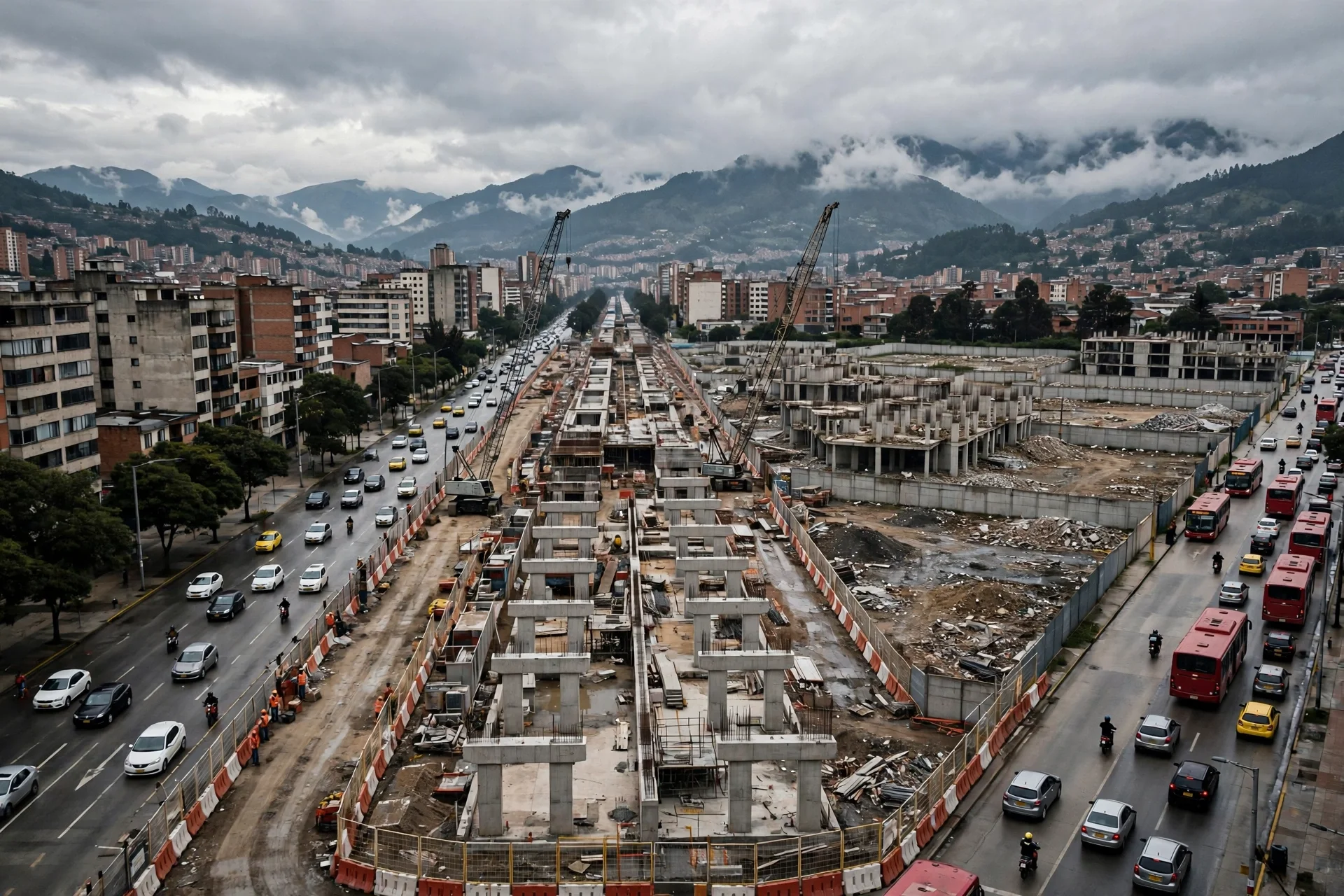
Bogotá's new Calle 13 bidding was declared void for the third time on July 31.
--- The context ---
Calle 13 is one of the busiest exits in western Bogotá and a strategic road for mobility and freight between the capital and the Sabana de Occidente. For those who travel it daily, congestion is time lost every day.
The project seeks to transform 11,62 kilometers of the corridor, between avenida 68 and the río Bogotá at the border with Mosquera, with a TransMilenio busway, stations, bridges, cycle routes and public space designed to move people, not only vehicles.
--- The facts ---
The Instituto de Desarrollo Urbano declared the bidding for those sections void for the third time, on July 31. Four of the six work groups remain unawarded, even though the project contemplates an investment of $2,3 billones for the pending works.
Groups 3, 4, 5 and 6 remain pending, while group 1, with the implosion of the Puente Aranda interchange and a new three-level bridge, records an advance of 50%. The design contemplates 13 simple stations and one terminal station, 20 pedestrian bridges, 10 vehicular bridges, 22,9 kilometers of cycle route and 485.000 square meters of public space, on a corridor with around 205.000 vehicles a day.
--- The positions ---
According to Darío Hidalgo, a logistics and transport professor at Universidad Javeriana, procedures involving properties, public utility networks, traffic management and permits generate uncertainty over deadlines and costs, and the distribution of responsibilities and remuneration makes the project less attractive to national and international builders. María Carolina Castillo, executive president of ProBogotá Región, considered that contract conditions could explain the failures and called for rules that generate trust. Diego Sánchez, vice-rector of the Escuela Colombiana de Ingeniería and a former IDU director, held that transforming this road is a priority against congestion in the west.
--- What remains unknown ---
There is no concrete date to reopen the call. The IDU adjusted preconstruccion, construction and maintenance deadlines, modified the Administration, Unforeseen and Utility component and made payments more flexible, after more than 27 meetings with the construction guild. Its director, Orlando Molano, stated that bidding will resume when the conditions exist to guarantee execution, and indicated that 81% of the required property area has already been acquired. It is also unknown whether the adjustments will be enough to attract offers.
--- Unanswered questions ---
When will the bidding for the four pending Calle 13 groups reopen? Will the changes in deadlines, payments and risks finally attract offers from builders? How much longer will users in the west wait to see the busway and its stations in service?
--- EPM analysis ---
It is not just one void bidding round: it is the third on the same corridor and with the same diagnosis. When relocating water and electricity networks, traffic management plans and properties fall on the contractor with uncertainty, the market does not show up and passengers pay the cost.
📌 EPM Take: In EPM's view, Calle 13 cannot keep waiting while the west loses hours every day on a saturated corridor. Adjusting deadlines, payments and risks is necessary, but announcing it is not enough: the District must publish clear conditions, assume the uncertainty that belongs to it and set a verifiable reopening. The work has a cofinancing agreement for $4,9 billones and a partial advance proving that progress is possible. Without real contractual trust, the next call will meet the same fate.
--- The context ---
Bogotá's new Calle 13 is a strategic work for mobility and freight transport between the capital and the Sabana de Occidente. The corridor, between avenida 68 and the río Bogotá at the border with Mosquera, carries around 205.000 vehicles a day, among motorcycles, automobiles, trucks and buses.
The project seeks to transform 11,62 kilometers with a TransMilenio busway, stations, bridges, cycle routes and public space. It is also a management test: it commits public resources and requires clear rules, well-distributed risks and firms capable of finishing what they sign.
--- The facts ---
The Instituto de Desarrollo Urbano declared the bidding for those sections void for the third time, on July 31, despite an investment of $2,3 billones for the pending works. Groups 3, 4, 5 and 6 remain pending adjudication.
Group 1, with the implosion of the Puente Aranda interchange and a new three-level bridge, records an advance of 50%. The whole contemplates 13 simple stations and one terminal station, 20 pedestrian bridges, 10 vehicular bridges, 22,9 kilometers of cycle route and 485.000 square meters of public space. The project has a cofinancing agreement between the national Government and the District for $4,9 billones.
--- The positions ---
Darío Hidalgo, a logistics and transport professor at Universidad Javeriana, attributed the lack of appeal to the distribution of risks: properties, networks, traffic and permits generate uncertainty over deadlines and costs, and problems of responsibilities and remuneration drive away national and international builders. María Carolina Castillo, executive president of ProBogotá Región, considered that contract conditions could explain the failures and called for rules that generate trust. IDU director Orlando Molano stated that the priority is guaranteeing firms with technical and financial capacity, and indicated that 81% of the required property area has already been acquired.
--- What remains unknown ---
There is no concrete reopening date. The IDU revised preconstruccion, construction and maintenance deadlines, modified the Administration, Unforeseen and Utility component and made payments more flexible, after more than 27 meetings with the construction guild, without a definitive tender document yet known.
--- Unanswered questions ---
When will the IDU present the definitive conditions to bid the four pending groups again? Will the new distribution of risks protect the public purse without transferring unforeseeable costs nobody wants to assume? How will it be guaranteed that awarded firms have the technical and financial capacity to finish the work?
--- EPM analysis ---
Three void bidding rounds are the signal that the contract did not offer a credible balance between risk and remuneration. Awarding at any price would have been worse: a work abandoned halfway costs more than a repeated bidding round. The correction requires realistic tender documents and verified capacity.
📌 EPM Take: In EPM's view, the lesson of Calle 13 is that public money is not protected by bidding fast, but by bidding well. The $4,9 billones agreement obliges demanding solvent firms, risks distributed with judgment and schedules that can be met and audited. The IDU is right not to award without guaranteed capacity, but prudence cannot become paralysis: it must close the review and publish the new conditions. Order in the contract today is the only guarantee of a finished work tomorrow.
Bogotá: la calle 13 espera su troncal tras tres licitaciones desiertas
Tres licitaciones desiertas frenan la nueva calle 13 de Bogotá: cuatro de seis grupos siguen sin adjudicar pese a una inversión de $2,3 billones para las obras…
Calle 13 de Bogotá: el riesgo contractual frena una obra millonaria
La licitación de la nueva calle 13 de Bogotá quedó desierta por tercera vez el 31 de julio.
--- El contexto ---
La calle 13 es una de las salidas más usadas del occidente de Bogotá y una vía estratégica para la movilidad y el transporte de mercancías entre la capital y la Sabana de Occidente. La congestión castiga cada día a sus usuarios.
El proyecto busca transformar 11,62 kilómetros del corredor, entre la avenida 68 y el río Bogotá en límites con Mosquera, con una troncal de TransMilenio, estaciones, puentes, ciclorrutas y espacio público pensado para mover personas, no solo vehículos.
--- Los hechos ---
El Instituto de Desarrollo Urbano declaró desierta por tercera vez, el pasado 31 de julio, la licitación de esos tramos. Cuatro de los seis grupos de obra siguen sin adjudicar, aunque el proyecto contempla una inversión de $2,3 billones para las obras pendientes.
Los grupos 3, 4, 5 y 6 continúan pendientes, mientras el grupo 1, con la implosión del pulpo de Puente Aranda y un nuevo puente de tres niveles, registra un avance del 50%. El diseño contempla 13 estaciones sencillas y una de cabecera, 20 puentes peatonales, 10 puentes vehiculares, 22,9 kilómetros de ciclorruta y 485.000 metros cuadrados de espacio público, en un corredor con alrededor de 205.000 vehículos al día.
--- Las posiciones ---
Según Darío Hidalgo, profesor de Logística y Transporte de la Universidad Javeriana, los trámites de predios, redes, manejo del tráfico y permisos generan incertidumbre sobre plazos y costos, y la distribución de responsabilidades y la remuneración lo hace menos atractivo para constructores nacionales e internacionales. María Carolina Castillo, presidenta ejecutiva de ProBogotá Región, atribuyó los fracasos a las condiciones contractuales y pidió reglas que generen confianza. Diego Sánchez, vicerrector de la Escuela Colombiana de Ingeniería y exdirector del IDU, la consideró prioritaria contra la congestión del occidente.
--- Lo que falta saber ---
No existe una fecha concreta para reabrir la convocatoria. El IDU ajustó plazos de preconstrucción, construcción y mantenimiento, modificó el componente de Administración, Imprevistos y Utilidad y flexibilizó los pagos, tras más de 27 reuniones con el gremio constructor. Orlando Molano afirmó que se volverá a licitar cuando existan condiciones para garantizar la ejecución, e indicó que el 81% del área predial ya fue adquirida. Tampoco se sabe si los ajustes bastarán para atraer ofertas.
--- Preguntas sin respuesta ---
¿Cuándo volverá a abrirse la licitación de los cuatro grupos pendientes de la calle 13? ¿Los cambios en plazos, pagos y riesgos atraerán por fin ofertas de las constructoras? ¿Cuánto más esperarán los usuarios del occidente para ver en servicio la troncal y sus estaciones?
--- Análisis EPM ---
Es la tercera licitación desierta en el mismo corredor, con el mismo diagnóstico. Cuando redes de acueducto y electricidad, planes de manejo de tráfico y predios recaen con incertidumbre sobre el contratista, el mercado no se presenta y lo pagan los pasajeros.
📌 Conclusion EPM: A juicio de EPM, la calle 13 no puede seguir esperando mientras el occidente pierde horas cada día en un corredor saturado. Ajustar plazos, pagos y riesgos es necesario, pero no basta con anunciarlo: el Distrito debe publicar condiciones claras, asumir la incertidumbre que le corresponde y fijar una reapertura verificable. La obra cuenta con un convenio de cofinanciación por $4,9 billones y un avance parcial que demuestra que avanzar es posible. Sin confianza contractual real, la próxima convocatoria correrá la misma suerte.
--- El contexto ---
La nueva calle 13 de Bogotá es estratégica para la movilidad y el transporte de mercancías con la Sabana de Occidente. El corredor, entre la avenida 68 y el río Bogotá, soporta alrededor de 205.000 vehículos al día, entre motocicletas, automóviles, camiones y buses.
El proyecto busca transformar 11,62 kilómetros con una troncal de TransMilenio, estaciones, puentes, ciclorrutas y espacio público. También es una prueba de gestión: exige reglas claras, riesgos bien repartidos y empresas capaces de terminar lo que firman.
--- Los hechos ---
El Instituto de Desarrollo Urbano declaró desierta por tercera vez, el pasado 31 de julio, la licitación de esos tramos, pese a una inversión de $2,3 billones para las obras pendientes. Los grupos 3, 4, 5 y 6 continúan pendientes de adjudicación.
El grupo 1, con la implosión del pulpo de Puente Aranda y un nuevo puente de tres niveles, registra un avance del 50%. El conjunto contempla 13 estaciones sencillas y una de cabecera, 20 puentes peatonales, 10 puentes vehiculares, 22,9 kilómetros de ciclorruta y 485.000 metros cuadrados de espacio público. El proyecto cuenta con un convenio de cofinanciación entre el Gobierno nacional y el Distrito por $4,9 billones.
--- Las posiciones ---
Darío Hidalgo, profesor de Logística y Transporte de la Universidad Javeriana, atribuyó la falta de atractivo a la distribución de riesgos: predios, redes, tráfico y permisos generan incertidumbre sobre plazos y costos, y los problemas de responsabilidades y remuneración alejan a constructores nacionales e internacionales. María Carolina Castillo, presidenta ejecutiva de ProBogotá Región, consideró que las condiciones contractuales podrían explicar los fracasos y pidió reglas que generen confianza. El director del IDU, Orlando Molano, aseguró que la prioridad es garantizar empresas con capacidad técnica y financiera, e indicó que el 81% del área predial ya fue adquirida.
--- Lo que falta saber ---
No hay fecha concreta de reapertura. El IDU revisó plazos de preconstrucción, construcción y mantenimiento, modificó el componente de Administración, Imprevistos y Utilidad y flexibilizó los pagos, tras más de 27 reuniones con el gremio constructor, sin pliego definitivo aún.
--- Preguntas sin respuesta ---
¿Cuándo presentará el IDU las condiciones definitivas para volver a licitar los cuatro grupos pendientes? ¿El nuevo reparto de riesgos protegerá el erario sin trasladar costos imprevisibles que nadie quiere asumir? ¿Cómo se garantizará que las adjudicatarias tengan capacidad técnica y financiera para terminar la obra?
--- Análisis EPM ---
Tres licitaciones desiertas muestran que el contrato no ofrecía un equilibrio creíble entre riesgo y remuneración. Adjudicar a cualquier precio habría sido peor: una obra abandonada a mitad de camino cuesta más que una licitación repetida. La corrección exige pliegos realistas y capacidad verificada.
📌 Conclusion EPM: A juicio de EPM, la lección de la calle 13 es que el dinero público no se protege licitando rápido, sino licitando bien. El convenio por $4,9 billones obliga a exigir empresas solventes, riesgos repartidos con criterio y cronogramas que se puedan cumplir y auditar. El IDU hace bien en no adjudicar sin capacidad garantizada, pero la prudencia no puede volverse parálisis: debe cerrar la revisión y publicar las nuevas condiciones. Orden en el contrato hoy es la única garantía de obra terminada mañana.