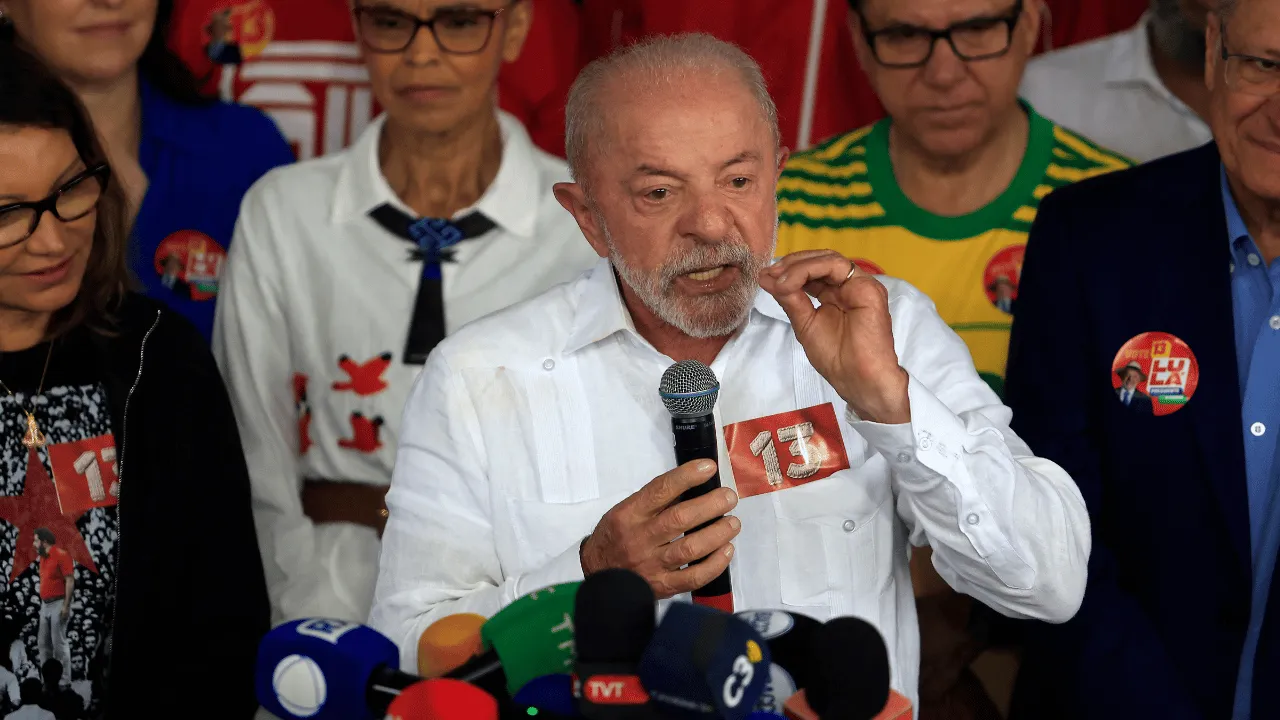
Lula da Silva votó en São Paulo en la segunda vuelta que lo devolvió a la Presidencia de Brasil por cuarta vez. · AFP
Lula comes back to win the Brazil runoff and a fourth term in office
Lula won Brazil's runoff with 51.74% and 62,641,973 votes against Flávio Bolsonaro's 48.26%, the first comeback by a first-round runner-up since 1989, and will…
Lula edges Flávio Bolsonaro in a runoff that leaves Brazil deeply split
Lula won Brazil's runoff with 51.74% and 62,641,973 votes against Flávio Bolsonaro's 48.26%, a difference of 4,205,536, while Bolsonarismo advanced in Congress…
Luiz Inácio Lula da Silva won Brazil's presidential runoff this Sunday with 51.74% of the valid votes, against 48.26% for Senator Flávio Bolsonaro, according to the Superior Electoral Court, which declared the election mathematically decided with 97.69% of polling sections counted. Lula gathered 62,641,973 votes and his rival 58,436,437, a difference of 4,205,536 ballots that returns the president to office for a fourth time, at the end of a long and tense day that was settled vote by vote across the country.
--- The context ---
The result crowns a comeback without recent precedent in Brazilian politics: it is the first time since 1989 that the runoff has been won by the candidate who finished second in the first round. On October 4, Flávio Bolsonaro had taken 47.03% of the valid votes, with 56,104,268 ballots, while Lula had reached 45.16%, with 53,876,617.
That restart had concrete faces and tools. Lula brought in young politicians with millions of social media followers to advise the campaign, and lawmaker André Janones created the WhatsApp channel called Lula's Army, which by mid-October already gathered 4.6 million members. In parallel, Congress approved on October 14 the end of the 6x1 work schedule, a reform that grants two paid rest days per week instead of one to 14 million workers and that was one of the president's central banners throughout the campaign.
--- The facts ---
The electoral authority declared the race decided at 9:08 p.m. Brasilia time, when Lula's lead surpassed the number of eligible voters in the sections still left to count. In the sections tallied by that moment, 80.85% of eligible voters had cast a ballot, with 1,394,854 blank votes, equal to 1.11%, and 2,649,294 null votes, equal to 2.12%. The president's new term will begin on January 5, 2027.
Lula led the first bulletins after the resumption, until Flávio Bolsonaro moved ahead at 7:47 p.m., with 15.06% counted, and built a lead that reached 288,602 votes. The answer came at 8:26 p.m., with half of the sections counted, when Lula recovered the advantage and never lost it again until the end.
The day was also marked by an extraordinary judicial decision. Supreme Court justice Cristiano Zanin extended voting by two hours in light of the seriousness of the events reported by Lula's campaign, whose team had warned of obstacles in public transportation for voters in São Paulo and in cities of the northeast, the region where much of the president's electoral base is concentrated.
--- The positions ---
The extension of voting hours became the main focus of controversy during the day. Allies of the senator criticized Zanin's decision, noting that he reached the Supreme Court in 2023 nominated by Lula himself, whose lawyer he had been. Flávio Bolsonaro's campaign had also requested two additional hours in some municipalities of the south and southeast of the country, where its candidacy was favored, arguing that intense rains had hit that area.
On the other side stood the figure of Flávio Bolsonaro, 45, a senator for Rio de Janeiro from the Liberal Party and the eldest son of former president Jair Bolsonaro, who designated him as candidate after being sentenced to 27 years in prison for the attempted coup against Lula in 2022, a sentence he is serving at his home in Brasilia. During the campaign he promised to pardon his father as his first measure in government, to harden the fight against crime, to cut public spending and to lower the cost of living.
--- What remains unknown ---
The content of the address to the country that Flávio Bolsonaro announced he would deliver once the result was proclaimed is still unknown, as is whether his sector will accept the electoral authority's definition without challenges. It is also unknown how the full Supreme Court will handle the request by Jair Bolsonaro's lawyers to annul his conviction, a case that justice Kassio Nunes Marques expects to bring before the full court after the runoff.
--- Unanswered questions ---
Will Bolsonarismo accept the result without taking the dispute to the electoral courts? What will happen to the request to annul Jair Bolsonaro's conviction when the full Supreme Court examines it? Will Lula be able to govern his reforms with a Congress where the right advanced and defends a broad amnesty? How will the end of the 6x1 schedule translate into the daily lives of the 14 million workers covered?
--- EPM analysis ---
Lula's victory is explained less by an ideological shift of the electorate than by a campaign correction executed in time. After admitting the initial disorganization, the governing camp combined massive digital mobilization, territorial presence of the social movements and a concrete labor achievement that is easy for millions of working families to understand. The last polls, published on Saturday, gave 51% to Flávio Bolsonaro and 49% to Lula within the margin of error, so the outcome confirms that the election was decided in the final stretch, in each camp's ability to bring its voters to the polls on Sunday.
The map left by the day is that of a Brazil split into two almost exact halves. The final difference of 4,205,536 votes is wide in absolute figures and, at the same time, narrow in political terms for a country of this scale. Governing that balance, without surrendering the initiative and without breaking democratic institutionality, will be the central task of the fourth term beginning in January.
📌 EPM Take:
In EPM's view, what happened in Brazil is a lesson in democratic resilience and political craft. A president who acknowledged his worst campaign in decades, who corrected course with young mobilization and with a labor reform felt by millions, ended up overturning what no candidacy had overturned since 1989. Brazilian democracy withstood a day with interrupted publication of the results, disputed judicial decisions and a narrow difference, and still delivered a clear result. The greater merit now will be turning that tight victory into a government capable of uniting a divided country.
Luiz Inácio Lula da Silva prevailed this Sunday in Brazil's presidential runoff with 51.74% of the valid votes, against 48.26% for Senator Flávio Bolsonaro, according to the Superior Electoral Court, which declared the election mathematically decided with 97.69% of polling sections counted. Lula gathered 62,641,973 votes against his adversary's 58,436,437, a difference of 4,205,536 ballots.
--- The context ---
In the first round on October 4, Flávio Bolsonaro had finished first with 47.03% of the valid votes and 56,104,268 ballots, while Lula had obtained 45.16% with 53,876,617. It is the first time since 1989 that the second round has been won by the candidate who arrived second in the first, a reversal that the president himself attributed to the correction of a campaign he described, by his later account, as the most disorganized in decades and whose initial result he acknowledged as unexpected for his own team.
The governing comeback rested on a mobilization machine built against the clock. Lula incorporated young politicians with millions of followers on social networks as advisers, and lawmaker André Janones raised the WhatsApp channel called Lula's Army, which by mid-October totaled 4.6 million members. Added to that was a high-impact measure approved by Congress on October 14: the end of the 6x1 schedule, which grants two paid rest days per week instead of one to 14 million workers.
--- The facts ---
The electoral authority declared the election decided at 9:08 p.m. Brasilia time, when Lula's advantage surpassed the number of eligible voters in the sections still pending a count. Turnout in the counted sections reached 80.85% of those eligible, with 1,394,854 blank votes, 1.11%, and 2,649,294 null votes, 2.12%.
Flávio Bolsonaro moved ahead at 7:47 p.m., with 15.06% counted, with an advantage that reached 288,602 votes. Only at 8:26 p.m., with half of the sections counted, did Lula recover first place and hold it until the close, in a count that for hours could have tilted toward either of the two sides.
The most delicate episode of the day was the two-hour extension of voting hours, ordered by Supreme Court justice Cristiano Zanin in light of the seriousness of the events reported by Lula's campaign regarding obstacles in public transportation in São Paulo and in northeastern cities, its electoral stronghold. Allies of the senator questioned the decision and recalled that Zanin reached the Supreme Court in 2023 nominated by Lula, whose lawyer he was, a closeness that will feed the debate about institutional neutrality.
--- The positions ---
Flávio Bolsonaro, 45, a senator for Rio de Janeiro from the Liberal Party and the eldest son of Jair Bolsonaro, built his candidacy on promises of order and economic relief: to pardon his father as his first measure in government, to harden the fight against crime, to cut public spending and to lower the cost of living. His father designated him as candidate after being sentenced to 27 years in prison for the attempted coup against Lula in 2022, a conviction he is serving at his home in Brasilia.
In the legislative elections of October 4 it advanced in the Senate, in the Chamber of Deputies and in the three states with the most voters in the country, and former first lady Michelle Bolsonaro was elected senator, as were two other sons of the former president who won seats. That bloc defends in Congress an amnesty for Jair Bolsonaro and for those convicted over the invasion of the seats of the public powers in Brasilia on January 8, 2023, while the former president's lawyers asked the Supreme Court to annul his conviction in a case that remains open.
--- What remains unknown ---
The address to the country that Flávio Bolsonaro announced for when the result was proclaimed, and the tone with which his sector will assume defeat, remain to be known. It is also unknown how the full Supreme Court will resolve the request to annul Jair Bolsonaro's conviction, which justice Kassio Nunes Marques expects to bring before the full court after the runoff.
--- Unanswered questions ---
Will Flávio Bolsonaro recognize defeat immediately and unconditionally before his supporters across the country? Will the amnesty for Jair Bolsonaro and those convicted over January 8, 2023 advance in Congress? Will the new government keep its spending promises without deteriorating the country's public accounts over time? Will the extension of voting hours remain as a precedent that is discussed again in future Brazilian elections?
--- EPM analysis ---
The last polls published on Saturday gave 51% to Flávio Bolsonaro and 49% to Lula within the margin of error, and the count confirmed that parity for hours. A mandate born with 48.26% of the country against it and with Congress tilted toward the opposition is not a blank check: it is a conditional authorization, which will demand permanent negotiation and visible economic results in order to sustain itself.
The opposition, for its part, keeps assets that the presidential defeat does not erase. It controls more seats than before in both chambers, it maintains presence in the most populated states according to the advance recorded on October 4 and it holds a judicial and legislative cause, the amnesty, that will stay at the center of the agenda. Lula's fourth term, which begins on January 5, 2027, will have to live with that reality from day one.
📌 EPM Take:
In EPM's view, Brazil did not choose a direction with room to spare, it chose to stay with the known by a margin that obliges humility. Lula wins and will govern for a fourth time, but the 48.26% obtained by Flávio Bolsonaro and the advance of his sector in Congress show that half of the country wants order, lower spending and a different State. A prudent government would read that complete message: administer without arrogance, guard the accounts and respect the institutional opposition. If victory is confused with a license to impose, tonight's division will become tomorrow's gridlock.
Lula remonta, gana el balotaje en Brasil y gobernará por cuarta vez
Lula ganó la segunda vuelta en Brasil con el 51,74 % y 62.641.973 votos frente al 48,26 % de Flávio Bolsonaro, en la primera remontada de un segundo lugar…
Lula vence por margen estrecho a Flávio Bolsonaro y Brasil queda dividido
Lula ganó el balotaje brasileño con el 51,74 % y 62.641.973 votos frente al 48,26 % de Flávio Bolsonaro, una diferencia de 4.205.536, mientras el bolsonarismo…
Luiz Inácio Lula da Silva ganó este domingo la segunda vuelta de las elecciones presidenciales de Brasil con el 51,74 % de los votos válidos, frente al 48,26 % del senador Flávio Bolsonaro, según el Tribunal Superior Electoral, que dio la elección por matemáticamente definida con el 97,69 % de las secciones escrutadas. Lula sumó 62.641.973 votos y su rival 58.436.437, una diferencia de 4.205.536 sufragios que devuelve al mandatario a la Presidencia por cuarta vez, al cierre de una jornada larga, tensa y decidida voto a voto.
--- El contexto ---
El resultado consagra una remontada sin precedentes recientes: es la primera vez desde 1989 que gana el balotaje el candidato que había quedado segundo en la primera vuelta. El 4 de octubre, Flávio Bolsonaro había obtenido el 47,03 % de los votos válidos, con 56.104.268 sufragios, mientras Lula había alcanzado el 45,16 %, con 53.876.617.
Lula llamó a asesorar la campaña a políticos jóvenes con millones de seguidores en redes, y el diputado André Janones creó el canal de WhatsApp Ejército de Lula, que a mediados de octubre ya reunía 4,6 millones de miembros. En paralelo, el Congreso aprobó el 14 de octubre el fin de la escala 6x1, una reforma que otorga dos días de descanso remunerado por semana en vez de uno a 14 millones de trabajadores y que fue una de las banderas del presidente.
--- Los hechos ---
La autoridad electoral marcó la elección como definida a las 9:08 p. m. de Brasilia, cuando la ventaja de Lula superó a los electores habilitados en las secciones que aún faltaban por contar. En las secciones computadas hasta ese momento había votado el 80,85 % de los habilitados, con 1.394.854 votos en blanco, equivalentes al 1,11 %, y 2.649.294 votos nulos, equivalentes al 2,12 %. El nuevo mandato empezará el 5 de enero de 2027.
Lula encabezó los primeros boletines tras la reanudación, hasta que Flávio Bolsonaro pasó adelante a las 7:47 p. m., con el 15,06 % escrutado, y llegó a sacarle 288.602 votos. La respuesta llegó a las 8:26 p. m., con la mitad de las secciones contadas, cuando Lula recuperó la ventaja y ya no la volvió a perder hasta el final del escrutinio.
La jornada estuvo marcada además por una decisión judicial extraordinaria. El magistrado del Supremo Cristiano Zanin extendió dos horas la votación ante la gravedad de los hechos denunciados por la campaña de Lula, cuyo equipo había alertado sobre obstáculos en el transporte público para ir a votar en São Paulo y en ciudades del noreste, región donde se concentra buena parte de su base electoral.
--- Las posiciones ---
La extensión del horario se convirtió en el foco de controversia del día. Aliados del senador criticaron la decisión de Zanin, quien llegó al Supremo en 2023 nominado por Lula, de quien había sido abogado. La campaña de Flávio Bolsonaro también había pedido dos horas más de votación en algunos municipios del sur y del sureste del país, donde su candidatura era favorita, argumentando intensas lluvias.
Flávio Bolsonaro, de 45 años, senador por Río de Janeiro del Partido Liberal e hijo mayor del expresidente Jair Bolsonaro, quien lo designó candidato tras ser condenado a 27 años de cárcel por el intento de golpe de Estado contra Lula en 2022, pena que cumple en su casa de Brasilia. En campaña prometió indultar a su padre como primera medida de gobierno, endurecer la lucha contra la delincuencia, recortar el gasto público y bajar el costo de vida.
--- Lo que falta saber ---
Todavía no se conoce el contenido de la declaración al país que Flávio Bolsonaro anunció que haría al proclamarse el resultado, ni si su sector aceptará sin impugnaciones la definición de la autoridad electoral. Tampoco se sabe cómo tramitará el pleno del Supremo el pedido de los abogados de Jair Bolsonaro para anular su condena, un expediente que el magistrado Kassio Nunes Marques prevé llevar al pleno después de la segunda vuelta.
--- Preguntas sin respuesta ---
¿Aceptará el bolsonarismo el resultado sin llevar la disputa a los tribunales electorales? ¿Qué pasará con el pedido de anulación de la condena de Jair Bolsonaro cuando el pleno del Supremo lo examine? ¿Podrá Lula gobernar sus reformas con un Congreso donde la derecha avanzó y defiende una amnistía amplia? ¿Cómo se traducirá el fin de la escala 6x1 en la vida diaria de los 14 millones de trabajadores alcanzados?
--- Análisis EPM ---
La victoria de Lula se explica menos por un giro ideológico del electorado que por una corrección de campaña ejecutada a tiempo. Tras admitir la desorganización inicial, el oficialismo combinó movilización digital masiva, presencia territorial de los movimientos sociales y una conquista laboral concreta y fácil de entender para millones de familias trabajadoras. Las últimas encuestas, publicadas el sábado, daban 51 % a Flávio Bolsonaro y 49 % a Lula dentro del margen de error, de modo que el desenlace confirma que la elección se decidió en la recta final, en la capacidad de cada comando para llevar a sus votantes hasta las urnas el domingo.
El mapa que deja la jornada es el de un Brasil partido en dos mitades casi exactas. La diferencia final de 4.205.536 votos es amplia en cifras absolutas y, al mismo tiempo, estrecha en términos políticos para un país de esta escala. Gobernar ese equilibrio, sin ceder la iniciativa ni romper la institucionalidad democrática, será la tarea central del cuarto mandato que comienza en enero.
📌 Conclusion EPM:
A juicio de EPM, lo ocurrido en Brasil es una lección de resiliencia democrática y de oficio político. Un presidente que reconoció su peor campaña en décadas, que corrigió el rumbo con movilización joven y con una reforma laboral sentida por millones, terminó remontando lo que ninguna candidatura remontaba desde 1989. La democracia brasileña soportó una jornada con publicación de resultados interrumpida, decisiones judiciales discutidas y una diferencia estrecha, y aun así entregó un resultado claro. El mérito mayor será ahora convertir esa victoria ajustada en gobierno capaz de unir a un país dividido.
Luiz Inácio Lula da Silva se impuso este domingo en la segunda vuelta de las elecciones de Brasil con el 51,74 % de los votos válidos, frente al 48,26 % del senador Flávio Bolsonaro, según el Tribunal Superior Electoral, que declaró la elección matemáticamente definida con el 97,69 % de las secciones escrutadas. Lula reunió 62.641.973 votos contra 58.436.437 de su adversario, una diferencia de 4.205.536 sufragios.
--- El contexto ---
En la primera vuelta del 4 de octubre, Flávio Bolsonaro había quedado primero con el 47,03 % de los votos válidos y 56.104.268 sufragios, mientras Lula había obtenido el 45,16 % con 53.876.617. Es la primera vez desde 1989 que gana la segunda vuelta quien había llegado segundo en la primera, un vuelco que el propio presidente atribuyó a la corrección de una campaña que él mismo calificó, según su relato posterior, como la más desorganizada en décadas y cuyo resultado inicial reconoció como inesperado para su propio equipo.
La remontada oficialista se apoyó en una maquinaria de movilización construida a contrarreloj. Lula incorporó a políticos jóvenes con millones de seguidores en redes como asesores, y el diputado André Janones levantó el canal de WhatsApp Ejército de Lula, que a mediados de octubre sumaba 4,6 millones de miembros. A eso se sumó una medida aprobada por el Congreso el 14 de octubre: el fin de la escala 6x1, que concede dos días de descanso remunerado semanal en lugar de uno a 14 millones de trabajadores.
--- Los hechos ---
La autoridad electoral dio la elección por definida a las 9:08 p. m. de Brasilia, cuando la ventaja de Lula superó el número de electores habilitados en las secciones pendientes de conteo. La participación en las secciones computadas alcanzó el 80,85 % de los habilitados, con 1.394.854 votos en blanco, el 1,11 %, y 2.649.294 votos nulos, el 2,12 %.
Flávio Bolsonaro llegó a ponerse adelante a las 7:47 p. m., con el 15,06 % escrutado, con una ventaja que alcanzó 288.602 votos. Recién a las 8:26 p. m., con la mitad de las secciones contadas, Lula recuperó el primer lugar y lo sostuvo hasta el cierre, en un conteo que durante horas pudo inclinarse hacia cualquiera de los dos lados.
El episodio más delicado de la jornada fue la extensión del horario de votación por dos horas, ordenada por el magistrado del Supremo Cristiano Zanin ante la gravedad de los hechos denunciados por la campaña de Lula sobre obstáculos en el transporte público en São Paulo y en ciudades del noreste, su bastión electoral. Aliados del senador cuestionaron la decisión y recordaron que Zanin llegó al Supremo en 2023 nominado por Lula, de quien fue abogado, una cercanía que alimentará el debate sobre la neutralidad institucional.
--- Las posiciones ---
Flávio Bolsonaro, de 45 años, senador por Río de Janeiro del Partido Liberal e hijo mayor de Jair Bolsonaro, construyó su candidatura sobre promesas de orden y alivio económico: indultar a su padre como primera medida de gobierno, endurecer la lucha contra la delincuencia, recortar el gasto público y bajar el costo de vida. Su padre lo designó candidato tras ser condenado a 27 años de cárcel por el intento de golpe de Estado contra Lula en 2022, condena que cumple en su casa de Brasilia.
En las elecciones legislativas del 4 de octubre avanzó en el Senado, en la Cámara de Diputados y en los tres estados con más electores del país, y la exprimera dama Michelle Bolsonaro resultó elegida senadora, al igual que otros dos hijos del expresidente que ganaron escaños. Ese bloque defiende en el Congreso una amnistía para Jair Bolsonaro y para los condenados por la invasión de las sedes de los poderes públicos en Brasilia el 8 de enero de 2023, mientras los abogados del expresidente pidieron al Supremo anular su condena en un expediente que sigue abierto.
--- Lo que falta saber ---
Queda por conocer la declaración al país que Flávio Bolsonaro anunció para cuando se proclamara el resultado y el tono con el que su sector asumirá la derrota. Tampoco se sabe cómo resolverá el pleno del Supremo el pedido de anulación de la condena de Jair Bolsonaro, que el magistrado Kassio Nunes Marques prevé llevar al pleno después de la segunda vuelta.
--- Preguntas sin respuesta ---
¿Reconocerá Flávio Bolsonaro la derrota de forma inmediata y sin condiciones ante sus seguidores? ¿Avanzará en el Congreso la amnistía para Jair Bolsonaro y los condenados del 8 de enero de 2023? ¿Cumplirá el nuevo gobierno sus promesas de gasto sin deteriorar las cuentas públicas del país? ¿Quedará la extensión del horario de votación como un precedente que vuelva a discutirse en futuras elecciones brasileñas?
--- Análisis EPM ---
Las últimas encuestas publicadas el sábado daban 51 % a Flávio Bolsonaro y 49 % a Lula dentro del margen de error, y el conteo confirmó esa paridad durante horas. Un mandato que nace con el 48,26 % del país en contra y con el Congreso inclinado hacia la oposición no es un cheque en blanco: es una autorización condicionada, que exigirá negociación permanente y resultados económicos visibles para sostenerse.
La oposición, por su parte, conserva activos que la derrota presidencial no borra. Controla más bancas que antes en ambas cámaras, mantiene presencia en los estados más poblados según el avance registrado el 4 de octubre y sostiene una causa judicial y legislativa, la amnistía, que seguirá en el centro de la agenda. El cuarto mandato de Lula, que empieza el 5 de enero de 2027, deberá convivir con esa realidad desde el primer día.
📌 Conclusion EPM:
A juicio de EPM, Brasil no eligió un rumbo con holgura, eligió seguir con lo conocido por un margen que obliga a la humildad. Lula gana y gobernará por cuarta vez, pero el 48,26 % obtenido por Flávio Bolsonaro y el avance de su sector en el Congreso demuestran que la mitad del país quiere orden, menor gasto y un Estado distinto. Un gobierno prudente leería ese mensaje completo: administrar sin arrogancia, cuidar las cuentas y respetar a la oposición institucional. Si la victoria se confunde con patente para imponer, la división de esta noche se convertirá en el bloqueo de mañana.