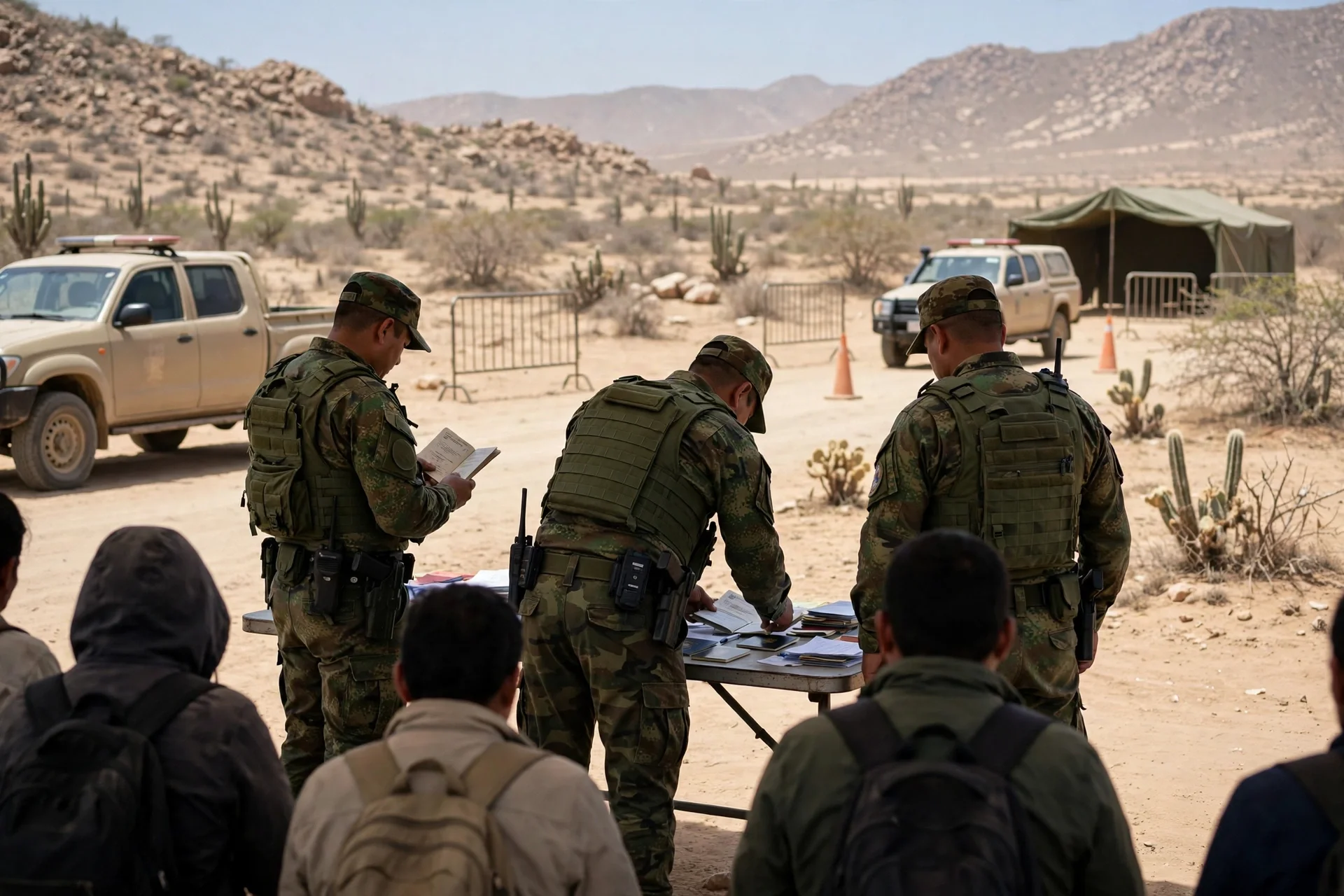
Puesto de control fronterizo en zona árida, con verificación de documentos por parte de las autoridades. · Erick Prometeo Media
Colombia expels 27 foreign nationals accused of repeated criminal offenses
Colombia expelled and deported 27 foreign citizens linked to criminal activities, in an offensive coordinated by Migración Colombia and the National Police and…
De La Espriella announces expulsion of 27 foreign nationals for repeat crime
President Abelardo De La Espriella announced the expulsion and deportation of 27 foreign citizens accused of high-impact crimes, carried out by Migración…
--- The context ---
Colombia maintains a receptive migration policy toward those who arrive to work and respect the law, while several regions face criminal acts that disturb public order and citizen tranquility. Against that backdrop, the government announced a security offensive coordinated by Migración Colombia and the National Police, with migration inspections and background-check deployments in the main urban areas and strategic corridors across the national territory.
--- The facts ---
Authorities carried out the expulsion and deportation of 27 foreign citizens linked to criminal activities. According to what President Abelardo De La Espriella made public, the measures were applied to individuals accused of alleged involvement in high-impact crimes, among them armed robbery, drug trafficking and illegal possession of firearms.
The operation had its main focus in Arauca, where twenty-one foreign citizens were taken into custody and transferred immediately to the Paraguachón border post, in La Guajira, for their formal handover to the Venezuelan authorities. One of the individuals accumulates eight annotations in the Oral Accusatory Criminal System of the Fiscalía General de la Nación and an ongoing process for qualified theft, while another had accumulated fifty-five corrective measures for conduct contrary to coexistence.
--- The positions ---
De La Espriella stated that Colombia has its doors open for those who come to work honestly, but closed for those who intend to commit crimes and terrorize people. The president also emphasized that the country keeps a receptive policy toward migrants who enter to work, to produce and to respect the law, and warned of zero tolerance toward those who offend, noting that the security of Colombians and national sovereignty are respected and enforced.
--- What remains unknown ---
The announcement did not detail the identity of those expelled or the full breakdown of where the remaining measures were carried out beyond Arauca. It was also not reported whether the ongoing judicial processes of some of those accused will continue after the handover to the Venezuelan authorities, or what follow-up the permanent inspections will have.
--- Unanswered questions ---
How will it be guaranteed that background checks accurately distinguish between working migrants and people with a criminal record? What will happen to the ongoing judicial processes of expelled persons who had open cases in Colombia? How often will operations of this scale be repeated in other regions of the country?
--- EPM analysis ---
The measure combines a message of welcome toward labor migration with an administrative response to criminal recidivism. The weight of the operation in Arauca and the handover at Paraguachón show that the border with Venezuela concentrates the execution, while the records cited seek to support the targeted nature of the action.
📌 EPM Take: In EPM's view, the expulsion of the 27 foreign nationals rests on a distinction that the government itself underlines: welcoming those who arrive to work and acting firmly against those who accumulate a criminal record. The strength of that line will depend on each measure resting on verifiable histories, such as the annotations and corrective measures cited, and on the receptive policy toward the honest migrant remaining intact in the daily practice of the controls announced across the whole country.
--- The context ---
Security and public order stand at the center of the government's agenda, which has repeatedly warned that migrant status cannot shield crime. In various regions, authorities had been recording criminal activities attributed to foreign citizens that disturbed citizen tranquility, prompting a coordinated offensive of migration control and background verification.
--- The facts ---
Migración Colombia and the National Police carried out the expulsion and deportation of 27 foreign citizens linked to criminal activities that disturbed public order. President Abelardo De La Espriella announced that the measures fell on individuals accused of high-impact crimes, such as armed robbery, drug trafficking and illegal possession of firearms.
In Arauca, twenty-one of the foreign nationals were taken into custody and transferred immediately to the Paraguachón border post, in La Guajira, for their formal handover to the Venezuelan authorities. Among the records disclosed is an individual with eight annotations in the Oral Accusatory Criminal System of the Fiscalía General de la Nación and an ongoing process for qualified theft, and another with fifty-five corrective measures for conduct contrary to coexistence. Migration inspections will remain permanently in the main urban areas and strategic corridors.
--- The positions ---
De La Espriella stated that Colombia has its doors open for those who come to work honestly, but closed for those who intend to commit crimes and terrorize people. The president emphasized that the country's policy is receptive toward migrants who enter to work, to produce and to respect the law, and warned of zero tolerance toward those who offend, concluding that those who seek to take advantage of their status to commit crimes will meet the full force of the State.
--- What remains unknown ---
The announcement did not specify the identity of those expelled or the detail of the measures carried out in the other regions. It remains to be known at what pace these operations will be repeated and the result of the handover of those detained in Arauca to the Venezuelan authorities at Paraguachón.
--- Unanswered questions ---
Will the announced permanence of migration inspections in urban areas and strategic corridors be maintained? Will there be new expulsions of foreign nationals with similar records in other regions of the country? What controls will prevent the re-entry of people already expelled for criminal recidivism?
--- EPM analysis ---
The operation sends a signal of authority: the State uses its administrative migration tools against profiles with accumulated judicial and corrective histories, with a visible deployment at the border. The presidential message combines that firmness with a welcome to the working migrant, a formula that seeks to protect coexistence without closing the door to orderly, law-respecting migration.
📌 EPM Take: In EPM's view, the expulsion of the 27 foreign nationals reaffirms an elementary rule of coexistence: Colombia's hospitality toward those who arrive to work is not in question, but neither is the State's obligation to remove those who turn their stay into a threat to others. The records cited, with eight annotations in one case and fifty-five corrective measures in another, show that the measure targets recidivism and not nationality, and its continuity will strengthen authority across the regions.
Colombia expulsa a 27 extranjeros señalados por reincidencia delictiva
Colombia expulsó y deportó a 27 ciudadanos extranjeros vinculados a actividades delictivas, en una ofensiva coordinada por Migración Colombia y la Policía…
De La Espriella anuncia cero tolerancia y expulsa a 27 extranjeros
El presidente Abelardo De La Espriella anunció la expulsión y deportación de 27 ciudadanos extranjeros señalados por delitos de alto impacto, ejecutada por…
--- El contexto ---
Colombia sostiene una política migratoria receptiva hacia quienes llegan a trabajar y a respetar la ley, y enfrenta en varias regiones hechos delictivos que alteran el orden público y la tranquilidad ciudadana. En ese marco, el Gobierno anunció una ofensiva de seguridad coordinada entre Migración Colombia y la Policía Nacional, con inspecciones migratorias y verificación de antecedentes en zonas urbanas y corredores estratégicos.
--- Los hechos ---
Las autoridades ejecutaron la expulsión y deportación de 27 ciudadanos extranjeros vinculados a actividades delictivas. Según dio a conocer el presidente Abelardo De La Espriella, las medidas se aplicaron a individuos señalados por su presunta implicación en delitos de alto impacto: robo a mano armada, tráfico de estupefacientes y porte ilegal de armas de fuego.
El operativo tuvo su foco principal en Arauca, donde veintiún ciudadanos extranjeros fueron requeridos y trasladados de inmediato hacia el puesto fronterizo de Paraguachón, en La Guajira, para su entrega formal a las autoridades venezolanas. Uno acumula ocho anotaciones en el Sistema Penal Oral Acusatorio de la Fiscalía General de la Nación y un proceso vigente por hurto calificado, mientras otro sumaba cincuenta y cinco medidas correctivas por conductas contrarias a la convivencia.
--- Las posiciones ---
De La Espriella afirmó que Colombia tiene las puertas abiertas para quienes vienen a trabajar honradamente, pero cerradas para quienes pretenden delinquir y aterrorizar a la gente. El mandatario enfatizó la política receptiva con los migrantes que ingresan a trabajar, a producir y a respetar la ley, y advirtió cero tolerancia frente a quienes delincan, al señalar que la seguridad de los colombianos y la soberanía nacional se respetan y se hacen respetar.
--- Lo que falta saber ---
El anuncio no detalló la identidad de los expulsados ni el desglose de los lugares donde se ejecutó el resto de las medidas fuera de Arauca. Tampoco se informó si los procesos judiciales vigentes de algunos señalados continuarán tras la entrega a las autoridades venezolanas, ni qué seguimiento tendrán las inspecciones anunciadas como permanentes.
--- Preguntas sin respuesta ---
¿Cómo se garantizará que las verificaciones de antecedentes distingan con precisión entre migrantes trabajadores y personas con historial delictivo? ¿Qué pasará con los procesos judiciales vigentes de los expulsados que tenían causas abiertas en Colombia? ¿Con qué frecuencia se repetirán operativos de esta magnitud en otras regiones del país?
--- Análisis EPM ---
La medida combina un mensaje de acogida hacia la migración laboral con una respuesta administrativa frente a la reincidencia delictiva. El peso del operativo en Arauca y la entrega en Paraguachón muestran que la frontera con Venezuela concentra la ejecución, mientras los antecedentes citados sustentan su carácter focalizado.
📌 Conclusion EPM: A juicio de EPM, la expulsión de los 27 extranjeros se sostiene en una distinción que el propio Gobierno subraya: acoger a quien llega a trabajar y actuar con firmeza frente a quien acumula antecedentes delictivos. La solidez de esa línea dependerá de que cada medida descanse en historiales verificables, como las anotaciones y las medidas correctivas citadas, y de que la política receptiva hacia el migrante honrado se mantenga intacta en la práctica cotidiana de los controles anunciados en todo el país.
--- El contexto ---
La seguridad y el orden público centran la agenda del Gobierno, que ha advertido que la condición migratoria no ampara para delinquir. En diversas regiones, las autoridades registraban actividades delictivas atribuidas a ciudadanos extranjeros que alteraban la tranquilidad ciudadana, ante lo cual el Ejecutivo resolvió actuar con una ofensiva coordinada de control migratorio y verificación de antecedentes.
--- Los hechos ---
Migración Colombia y la Policía Nacional ejecutaron la expulsión y deportación de 27 ciudadanos extranjeros vinculados a actividades delictivas que alteraban el orden público. El presidente Abelardo De La Espriella dio a conocer que las medidas recayeron sobre individuos señalados por delitos de alto impacto, como robo a mano armada, tráfico de estupefacientes y porte ilegal de armas de fuego.
En Arauca fueron requeridos veintiuno de los extranjeros, trasladados de inmediato al puesto fronterizo de Paraguachón, en La Guajira, para su entrega formal a las autoridades venezolanas. Entre los antecedentes figura un individuo con ocho anotaciones en el Sistema Penal Oral Acusatorio de la Fiscalía General de la Nación y un proceso vigente por hurto calificado, y otro con cincuenta y cinco medidas correctivas por conductas contrarias a la convivencia. Las inspecciones migratorias se mantendrán permanentes en las principales zonas urbanas y corredores estratégicos.
--- Las posiciones ---
De La Espriella afirmó que Colombia tiene las puertas abiertas para quienes vienen a trabajar honradamente, pero cerradas para quienes pretenden delinquir y aterrorizar a la gente. El presidente enfatizó la política receptiva con los migrantes que ingresan a trabajar, a producir y a respetar la ley, y advirtió cero tolerancia frente a quienes delincan, al concluir que quienes pretendan aprovechar su condición para delinquir encontrarán toda la contundencia del Estado.
--- Lo que falta saber ---
El anuncio no precisó la identidad de los expulsados ni el detalle de las medidas ejecutadas en las demás regiones. Queda por conocerse el ritmo de estos operativos y el resultado de la entrega en Arauca a las autoridades venezolanas en Paraguachón.
--- Preguntas sin respuesta ---
¿Se mantendrá la permanencia anunciada de las inspecciones migratorias en las zonas urbanas y los corredores estratégicos? ¿Habrá nuevas expulsiones de extranjeros con antecedentes similares en otras regiones del país? ¿Qué controles impedirán el reingreso de personas ya expulsadas por reincidencia delictiva?
--- Análisis EPM ---
La operación envía una señal de autoridad: el Estado usa sus herramientas administrativas migratorias contra perfiles con historiales judiciales y correctivos, con un despliegue visible en la frontera. El mensaje combina esa firmeza con la bienvenida al migrante que trabaja, una fórmula que busca proteger la convivencia sin cerrar la puerta a la migración ordenada y respetuosa de la ley.
📌 Conclusion EPM: A juicio de EPM, la expulsión de los 27 extranjeros reafirma una regla de convivencia: la hospitalidad de Colombia con quien llega a trabajar no está en discusión, pero tampoco la obligación del Estado de retirar a quien convierte su permanencia en amenaza para los demás. Los antecedentes citados, con ocho anotaciones en un caso y cincuenta y cinco medidas correctivas en otro, muestran que la medida apunta a la reincidencia y no a la nacionalidad, y su continuidad reforzará la autoridad en las regiones.