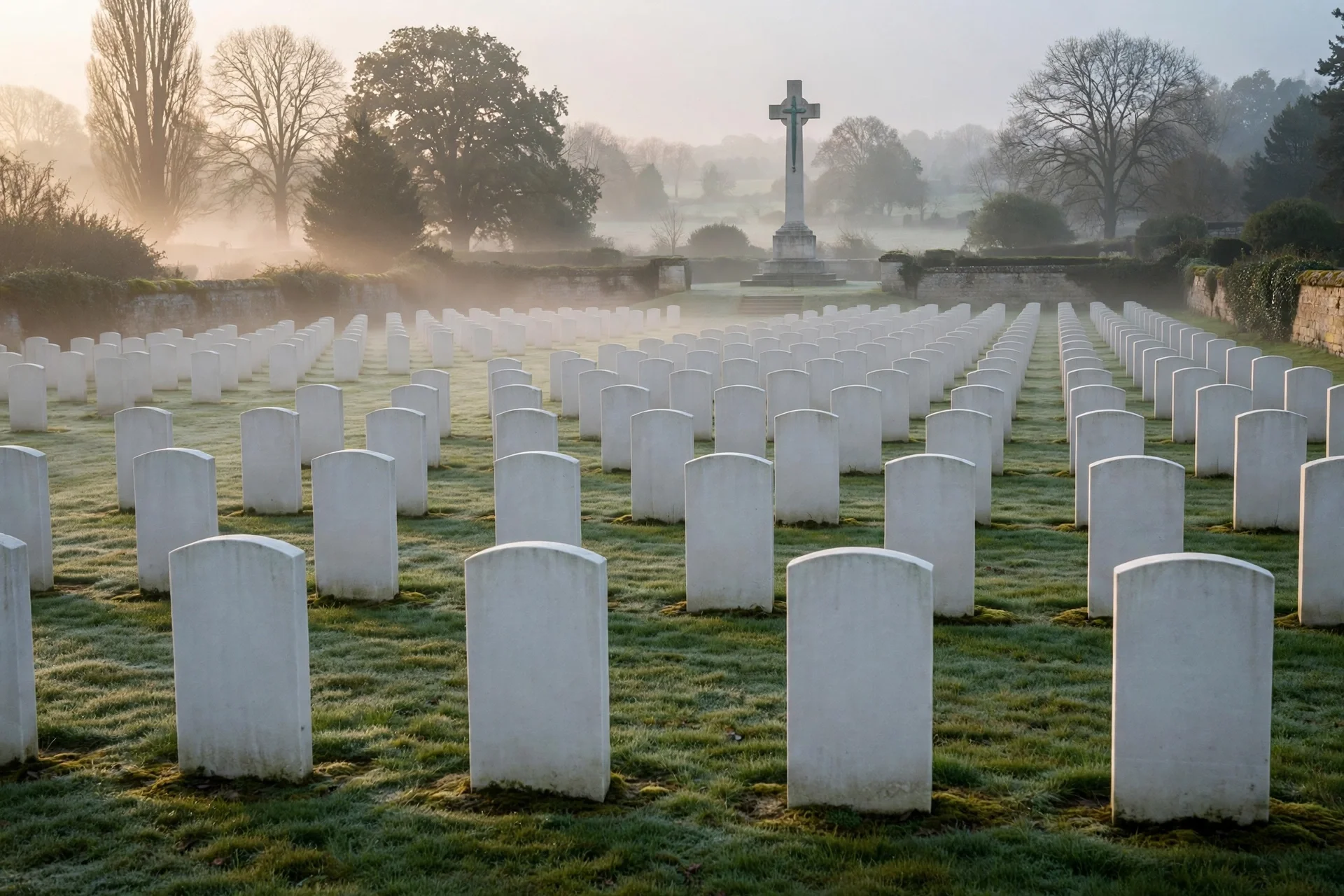
Filas de lápidas blancas en un cementerio militar británico en Francia al amanecer, imagen alusiva al entierro de los soldados del Regimiento de Bedfordshire en Loos. · Imagen generada por EPM
George McIntosh is laid to rest in France 110 years after falling in battle
Private George McIntosh of The Bedfordshire Regiment was buried on 20 October 2026 at Loos British Cemetery Extension in France, alongside a comrade who…
Britain buries with honours a soldier killed in 1917 and identified by DNA
George McIntosh, of the 8th Battalion of The Bedfordshire Regiment, who was killed on 19 April 1917, was buried with honours in France on 20 October 2026…
--- The context ---
More than a century after the First World War ended, the remains of British and Canadian soldiers are still being found on the old battlefields of France. Construction of a hospital on the outskirts of Lens led to the recovery of around 100 sets of remains, and each identification returns a name and a family to men recorded for decades only as missing.
--- The facts ---
Private George McIntosh, of the 8th Battalion of The Bedfordshire Regiment, was laid to rest in France on 20 October 2026 alongside one of his comrades, at a burial service organised by the Ministry of Defence's Joint Casualty and Compassionate Centre, also known as the War Detectives. The service took place at the Commonwealth War Graves Commission's Loos British Cemetery Extension, and ten members of his family attended.
DNA testing coordinated by the centre confirmed his identity, while work continues to identify the second soldier. The two men are the final British casualties from that site to be laid to rest, and their graves will now be cared for by the Commission in perpetuity.
George McIntosh was born in 1883 in Ilford, Essex, to Scottish parents, grew up in Barnet and worked as a gardener and a florist before enlisting. The Battle of Arras started on 9 April 1917, and on the morning of 18 April 1917 his battalion was south of Loos-en-Gohelle. He was killed in the fighting on 19 April 1917, aged 34 years old, and the unknown soldier was very likely killed in the same period.
--- The positions ---
Rosie Barron, a caseworker at the organising centre, said it had been an honour to meet the family and to see him laid to rest alongside his comrade, adding that their sacrifice must never be forgotten even 110 years on. His great nephew, Jeff MacIntosh, travelled from North Carolina, USA, and provided the DNA sample that made the identification possible.
Jeff MacIntosh described the identification work as remarkable and said the family could finally explore his ancestor's life and loss. The Reverend Fiona Beale, who conducted the service, called it a privilege, while David Royle, the Commission's Recoveries and Ceremonies Manager, said it was a privilege to lay them to rest with the dignity they deserve.
--- What remains unknown ---
The identity of the second soldier remains unconfirmed and the identification work is still open. It is also unclear whether the available DNA evidence will be enough to name him, or whether further family comparisons will be needed.
--- Unanswered questions ---
Will investigators one day identify the unknown soldier who now rests beside George McIntosh? How many of the around 100 sets of remains recovered near the Lens hospital have already been given back their names? Will First World War remains keep emerging in France for decades to come?
--- EPM analysis ---
This burial shows that remembrance of the Great War is not a closed chapter but an active institutional task. Archaeology, forensic science and family archives together turn a construction site discovery into an act of historical restitution with a full name attached.
📌 EPM Take:
In EPM's view, this belated burial defends something larger than the memory of two soldiers, because it upholds every family's right to know where their dead lie and the duty of states never to close a disappearance by default. That a gardener and florist from Barnet recovers his name 110 years later proves that dignity does not expire, and that investing in identifying the fallen is investing in Europe's shared memory and in families' trust in their institutions. It also shows that remembrance becomes credible when patient science, careful archives and attentive listening give waiting families a concrete answer at last after generations.
--- The context ---
Thousands of soldiers on the Western Front of the First World War were left without a known grave, remembered for generations only on memorials. Building work for a hospital on the outskirts of Lens brought to light around 100 sets of British and Canadian remains, and patient identification work has been closing files that stayed open for more than a century.
--- The facts ---
On 20 October 2026, Private George McIntosh, of the 8th Battalion of The Bedfordshire Regiment, was laid to rest in France beside a comrade who remains unidentified, at a service organised by the Ministry of Defence's Joint Casualty and Compassionate Centre, also known as the War Detectives. The ceremony was held at the Commonwealth War Graves Commission's Loos British Cemetery Extension, before ten members of his family.
His identity was confirmed by DNA testing coordinated by the centre, and the decisive sample came from his great nephew, Jeff MacIntosh, who travelled from North Carolina, USA. The two men are the final British casualties from that site to be buried, and work continues to identify the second Bedfordshire Regiment soldier.
George McIntosh was born in 1883 in Ilford, Essex, to Scottish parents, grew up in Barnet and worked as a gardener and a florist before enlisting. After the Battle of Arras began on 9 April 1917, his battalion held positions south of Loos-en-Gohelle on the morning of 18 April 1917, and he was killed in the fighting on 19 April 1917, at 34 years old.
--- The positions ---
Rosie Barron, a caseworker at the organising centre, said it had been an honour to stand with the family and to see George McIntosh rest beside his comrade, recalling that their sacrifice for freedom and peace must never be forgotten, even 110 years on. Jeff MacIntosh thanked those behind the identification and explained that the family knew few details of his great uncle.
The Reverend Fiona Beale, who conducted the service, defined it as a privilege and an honour. David Royle, the Commission's Recoveries and Ceremonies Manager, spoke of pride in having worked alongside the centre to restore the name of George McIntosh and said the unknown soldier is no longer lost or forgotten.
--- What remains unknown ---
The second soldier still has no name and there is no public timetable for completing his identification. It also remains unknown whether traceable relatives exist who could provide DNA samples comparable to the one that closed the case of George McIntosh.
--- Unanswered questions ---
Can forensic science one day give a name to the unknown comrade of George McIntosh? How many families of the around 100 remains recovered near Lens have already buried their own under a restored name? Will institutions sustain this effort with the same rigour for another 110 years?
--- EPM analysis ---
Some duties do not lapse with the calendar, and burying with honours a man who fell for his country is one of them. The Loos ceremony defends a simple and demanding idea, that no soldier is a number and no family deserves an absence without an answer.
📌 EPM Take:
In EPM's view, the burial of George McIntosh and his unknown comrade is a lesson in institutional continuity, because a country that cares for its fallen 110 years later shows that its promises do not depend on the passage of time. The tradition, order and respect surrounding the ceremony are not an empty ritual, but the concrete way of sustaining the gratitude owed to those who gave their lives, and of teaching new generations that sacrifice deserves permanent remembrance. That steadiness, kept without hurry and without forgetting, also honours the families who preserved his name at home while institutions quietly did their duty.
George McIntosh recibe sepultura en Francia 110 años después de caer en combate
El soldado George McIntosh, del Regimiento de Bedfordshire, fue enterrado el 20 de octubre de 2026 en el cementerio británico de Loos, en Francia, junto a un…
Reino Unido entierra con honores a un soldado caído en 1917 identificado por ADN
George McIntosh, soldado del 8.º Batallón del Regimiento de Bedfordshire muerto el 19 de abril de 1917, recibió sepultura con honores en Francia el 20 de…
--- El contexto ---
Más de un siglo después de la Primera Guerra Mundial, siguen apareciendo restos de soldados británicos y canadienses en Francia. Las obras de un hospital en las afueras de Lens permitieron recuperar alrededor de 100 conjuntos de restos, y cada identificación devuelve un nombre a hombres registrados durante décadas solo como desaparecidos.
--- Los hechos ---
El soldado George McIntosh, del 8.º Batallón del Regimiento de Bedfordshire, fue enterrado en Francia el 20 de octubre de 2026 junto a uno de sus camaradas, en un servicio organizado por el Centro Conjunto de Bajas y Compasión del Ministerio de Defensa, conocido como los Detectives de Guerra. La ceremonia tuvo lugar en la extensión del cementerio británico de Loos, ante diez miembros de su familia.
Las pruebas de ADN coordinadas por ese centro confirmaron su identidad, mientras continúa el trabajo para identificar al segundo soldado. Ambos son las últimas bajas británicas de ese yacimiento en recibir sepultura, y sus tumbas serán cuidadas por la Comisión a perpetuidad.
George McIntosh nació en 1883 en Ilford, Essex, hijo de padres escoceses, creció en Barnet y trabajó como jardinero y florista antes de alistarse. La batalla de Arras comenzó el 9 de abril de 1917 y, en la mañana del 18 de abril de 1917, su batallón estaba al sur de Loos-en-Gohelle. Murió el 19 de abril de 1917, con 34 años, y es muy probable que el soldado desconocido cayera en ese mismo periodo.
--- Las posiciones ---
Rosie Barron, trabajadora de casos del centro organizador, señaló que había sido un honor conocer a la familia y verlo descansar junto a su camarada, y subrayó que su sacrificio no debe olvidarse ni 110 años después. Su sobrino nieto, Jeff MacIntosh, viajó desde Carolina del Norte y aportó la muestra de ADN que hizo posible la identificación.
Jeff MacIntosh calificó de extraordinario el trabajo de identificación y afirmó que la familia pudo por fin conocer la vida de su antepasado. La reverenda Fiona Beale, que ofició el servicio, lo describió como un privilegio, y David Royle, de la Comisión de Tumbas de Guerra de la Commonwealth, sostuvo que era un privilegio darles sepultura con la dignidad que merecen.
--- Lo que falta saber ---
La identidad del segundo soldado sigue sin confirmarse y el trabajo continúa abierto. Tampoco se ha precisado si la evidencia de ADN disponible bastará para ponerle nombre o si harán falta nuevas comparaciones familiares.
--- Preguntas sin respuesta ---
¿Lograrán los investigadores identificar algún día al soldado desconocido que descansa junto a George McIntosh? ¿Cuántos de los alrededor de 100 conjuntos de restos recuperados cerca de Lens han recibido ya un nombre? ¿Seguirán apareciendo restos de la Primera Guerra Mundial en Francia durante las próximas décadas?
--- Análisis EPM ---
Este entierro muestra que la memoria de la Gran Guerra no es un capítulo cerrado. La arqueología y la ciencia forense convierten un hallazgo en una obra en un acto de restitución histórica con nombre propio.
📌 Conclusion EPM:
A juicio de EPM, esta sepultura tardía honra algo más que a dos soldados, porque defiende el derecho de cada familia a saber dónde quedó su muerto y el deber de los Estados de no dar por cerrada ninguna desaparición. Que un jardinero y florista de Barnet recupere su nombre 110 años después demuestra que la dignidad no prescribe, y que invertir en identificar a los caídos es invertir en la memoria compartida de Europa y en la confianza de las familias en sus instituciones. También recuerda que la memoria se sostiene con trabajo paciente y con escucha atenta a las familias que esperaron durante generaciones una respuesta.
--- El contexto ---
Miles de soldados del frente occidental quedaron sin tumba conocida, conmemorados durante generaciones solo en memoriales. Las obras de un hospital en las afueras de Lens sacaron a la luz alrededor de 100 conjuntos de restos británicos y canadienses, y la identificación paciente ha ido cerrando expedientes abiertos desde hace un siglo.
--- Los hechos ---
El 20 de octubre de 2026, el soldado George McIntosh, del 8.º Batallón del Regimiento de Bedfordshire, recibió sepultura en Francia junto a un camarada aún sin identificar, en un servicio organizado por el Centro Conjunto de Bajas y Compasión del Ministerio de Defensa, conocido como los Detectives de Guerra. El acto se celebró en la extensión del cementerio británico de Loos, ante diez familiares.
Su identidad quedó confirmada mediante pruebas de ADN coordinadas por el centro, y la muestra decisiva la aportó su sobrino nieto, Jeff MacIntosh, desplazado desde Carolina del Norte. Los dos hombres son las últimas bajas británicas de ese lugar, y el trabajo para identificar al segundo soldado continúa.
George McIntosh nació en 1883 en Ilford, Essex, de padres escoceses, se crio en Barnet y ejerció de jardinero y florista antes de alistarse. Tras el inicio de la batalla de Arras el 9 de abril de 1917, su batallón ocupó posiciones al sur de Loos-en-Gohelle en la mañana del 18 de abril de 1917, y él murió el 19 de abril de 1917, a los 34 años.
--- Las posiciones ---
Rosie Barron, trabajadora de casos del centro organizador, afirmó que había sido un honor acompañar a la familia y ver a George McIntosh descansar junto a su camarada, y recordó que su sacrificio no debe olvidarse ni 110 años después. Jeff MacIntosh agradeció la labor de identificación y explicó que la familia apenas conocía detalles de su tío abuelo.
La reverenda Fiona Beale, que ofició el servicio, lo definió como un privilegio y un honor. David Royle, de la Comisión de Tumbas de Guerra de la Commonwealth, destacó el orgullo de devolver su nombre a George McIntosh y aseguró que el soldado desconocido ya no está perdido ni olvidado.
--- Lo que falta saber ---
El segundo soldado permanece sin nombre y no hay un plazo público para concluir su identificación. Se desconoce si existen familiares localizables que puedan aportar muestras de ADN comparables a la que cerró el caso de George McIntosh.
--- Preguntas sin respuesta ---
¿Podrá la ciencia forense poner nombre algún día al compañero desconocido de George McIntosh? ¿Cuántas familias de los alrededor de 100 restos recuperados cerca de Lens han podido enterrar a los suyos con nombre propio? ¿Mantendrán las instituciones este esfuerzo con el mismo rigor dentro de otros 110 años?
--- Análisis EPM ---
Hay deberes que no caducan, y enterrar con honores a quien cayó por su país es uno de ellos. La ceremonia de Loos defiende que ningún soldado es un número y ninguna familia merece una ausencia sin respuesta.
📌 Conclusion EPM:
A juicio de EPM, el entierro de George McIntosh y de su camarada desconocido es una lección de continuidad institucional, porque un país que cuida a sus caídos 110 años después demuestra que sus promesas no dependen del paso del tiempo. La tradición, el orden y el respeto que rodearon la ceremonia no son un ritual vacío, sino la forma concreta de sostener la gratitud debida a quienes entregaron su vida, y de transmitir a las nuevas generaciones que el sacrificio merece memoria permanente. Esa constancia, mantenida sin prisa y sin olvido, honra también a las familias que guardaron el nombre en casa mientras las instituciones cumplían su deber.