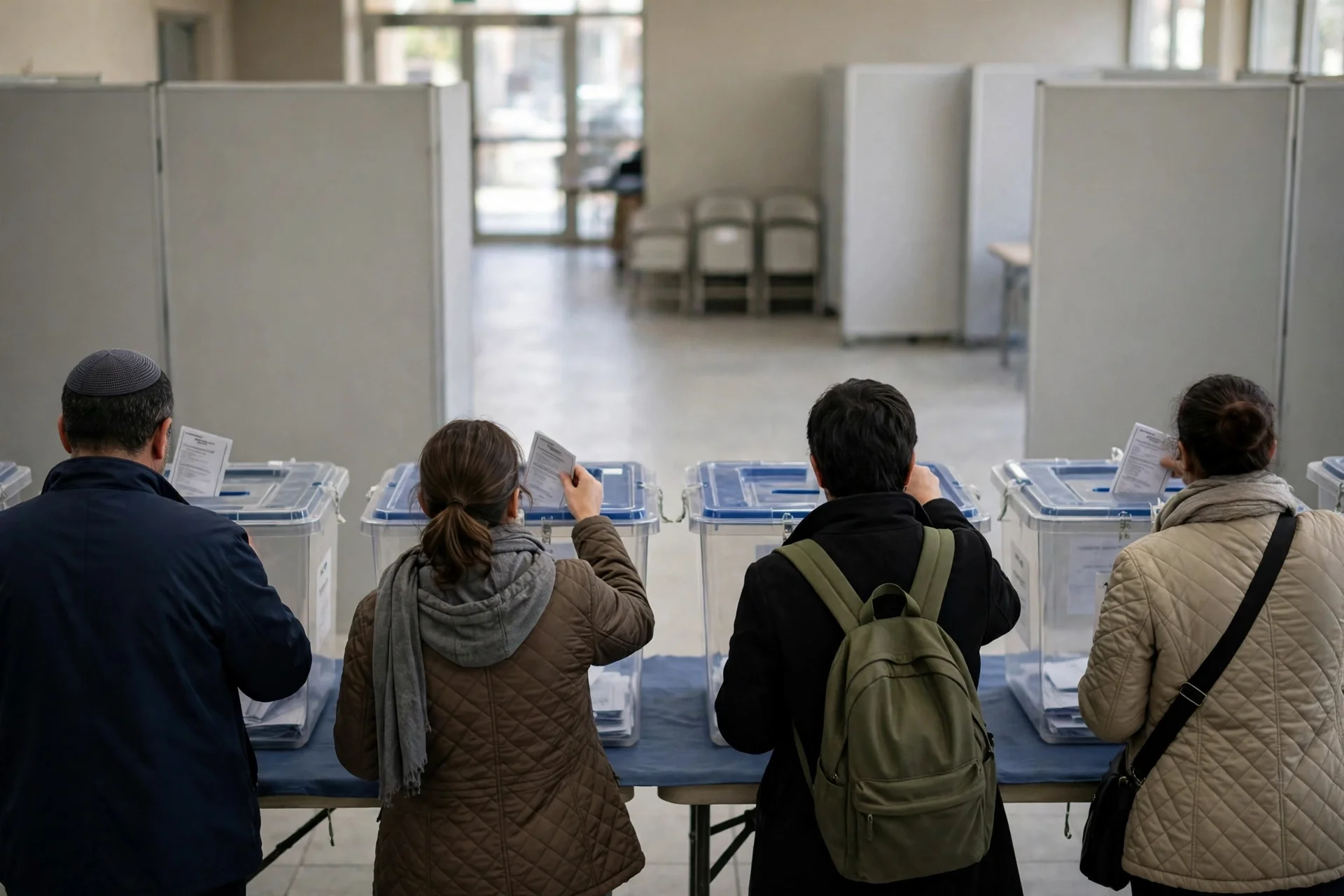
Centro de votación en Israel durante la jornada electoral, con votantes de espaldas frente a las urnas. · Erick Prometeo Media
Israel exit polls: Eisenkot bloc leads Netanyahu, no majority
Preliminary exit polls in Israel give the bloc of Gadi Eisenkot between 52 and 53 seats against 50 for the alliance of Benjamin Netanyahu, with neither…
No majority in Israel: Eisenkot ahead of Netanyahu in exit polls
Preliminary exit polls in Israel place the bloc of Gadi Eisenkot at 52 to 53 seats and the alliance of Benjamin Netanyahu at 50, with neither holding the 61…
--- The context ---
Israel voted on Tuesday in its first national election since the October 2023 attacks. The last national election, held in November 2022, was the fifth in three and a half years. Everything known so far comes from preliminary exit polls, not from official results. No Israeli party has ever won the 61 seats of an outright majority on its own, so the next government will come from a negotiated coalition.
--- The facts ---
The three main exit polls, released after voting closed at 22.00 local time on Tuesday, place the bloc led by Gadi Eisenkot at between 52 and 53 of the 120 seats in the Knesset, against 50 for the alliance of Benjamin Netanyahu. Neither bloc reaches the 61 seats required for a majority.
Turnout approached 74% by 20.00, according to the central elections commission. The exit polls do not cover roughly the last hour of voting, so the picture can still change, and official results will be known in the coming days.
--- The positions ---
Eisenkot, aged 66, leader of the Yashar party and a former military chief, described the result in indirect terms as a vote of no confidence in Netanyahu and said in indirect terms that he would act to replace his government. Yair Golan, of the Democrats, argued in indirect terms that the public had dismissed the Netanyahu government, and Yair Lapid celebrated in indirect terms a defeat for the governing bloc.
A channel aligned with Netanyahu instead projected 60 combined seats for the governing camp, at odds with the three main exit polls. The two Israeli Arab parties won between 17 and 18 seats and said they would back Eisenkot to some degree, although both leaders have for now ruled out a formal alliance with them, who could sustain a minority government from outside or by abstaining.
--- What remains unknown ---
President Isaac Herzog will consult party leaders and ask the candidate with the best chances to try to form a coalition, with a maximum period of six weeks. Smaller parties will carry disproportionate weight in that bargaining process.
If nobody forms a majority, a new election would be called in the coming months and Netanyahu would remain interim prime minister, without authority to push through major policy changes.
--- Unanswered questions ---
Will official results confirm the lead of 52 to 53 seats for the Eisenkot bloc? Will the Israeli Arab parties sustain an Eisenkot minority government from outside or by abstaining? Will any candidate gather 61 supporters within six weeks, or will there be another election?
--- EPM analysis ---
The opposition lead is narrow and reversible: it depends on last-hour votes the polls do not cover and on support without a formal alliance. With 17 to 18 seats, the Israeli Arab parties become the arbiters of the contest.
📌 EPM Take: In EPM's view, the preliminary exit polls describe a majority rejection of the Netanyahu government, but they do not yet deliver an alternative government, because the Eisenkot lead of 52 to 53 seats falls short of the 61 required and depends on Arab support without any formal alliance. Prudence requires waiting for the official results in the coming days before proclaiming a change of power, and the six weeks of coalition talks will decide whether the electoral lead becomes a stable coalition or another early election for Israel.
--- The context ---
Israel held its first national election since the October 2023 attacks on Tuesday. The last national election, in November 2022, was the fifth in three and a half years. Everything published so far consists of preliminary exit polls, not official results. No Israeli party has ever won the 61 seats of an outright majority alone: the government will emerge from coalition bargaining, as parliamentary tradition requires.
--- The facts ---
The three main exit polls, published after voting closed at 22.00 local time on Tuesday, award the bloc of Gadi Eisenkot between 52 and 53 of the 120 seats in the Knesset, against 50 for the alliance of Benjamin Netanyahu. The gap is minimal and neither bloc reaches the 61 seats required to govern.
Turnout approached 74% by 20.00, according to the central elections commission. The exit polls do not cover roughly the last hour of voting, so the picture can change with the count, and official results will be known in the coming days.
--- The positions ---
Eisenkot, aged 66, leader of the Yashar party and a former military chief, described the result in indirect terms as a vote of no confidence in Netanyahu and announced in indirect terms that he would act to replace his government. Yair Golan, of the Democrats, stated in indirect terms that the public had dismissed the government, and Yair Lapid celebrated in indirect terms a defeat for the governing bloc.
A channel aligned with Netanyahu projected 60 combined seats for the governing camp, a discrepancy that requires caution. The two Israeli Arab parties together won between 17 and 18 seats and said they would back Eisenkot to some degree, but both leaders have for now ruled out a formal alliance with them, who could support a minority government from outside or by abstaining.
--- What remains unknown ---
President Isaac Herzog will consult party leaders and task the candidate with the best chances with forming a coalition, with a maximum period of six weeks. Smaller parties will be courted by both blocs during the negotiations.
If nobody forms a majority, a new election will be called in the coming months and Netanyahu will remain interim prime minister, without capacity for major policy changes, although with administrative stability guaranteed.
--- Unanswered questions ---
Will the official count sustain the lead of 52 to 53 seats of Eisenkot over Netanyahu? Will the Israeli Arab parties support an Eisenkot minority government from outside or through abstention? Will any candidate secure the 61 supporters needed within six weeks, or will Israel repeat elections?
--- EPM analysis ---
The solid fact is structural equality between the blocs, not a change of power: 52 to 53 against 50 leave the decision with small parties and conditional support. Turnout close to 74% gives weight to the result, but does not replace the required parliamentary majority.
📌 EPM Take: In EPM's view, the responsible reading of these preliminary exit polls is institutional caution, because no lead of two or three seats replaces the majority of 61 that the Knesset requires, nor does it turn a projection into an official result. Netanyahu remains interim and keeps options if negotiations fail, while Eisenkot needs support from parties that today rule out a formal alliance with his bloc. The outcome will be decided by the six weeks of consultations by President Herzog, by the official results, and by complete parliamentary arithmetic.
Sondeos en Israel: Eisenkot aventaja a Netanyahu sin mayoría
Los sondeos a boca de urna preliminares en Israel dan al bloque de Gadi Eisenkot entre 52 y 53 escaños frente a 50 de la alianza de Benjamín Netanyahu, sin que…
Israel sin mayoría: Eisenkot lidera los sondeos frente a Netanyahu
Los sondeos preliminares a boca de urna en Israel sitúan al bloque de Gadi Eisenkot con 52 a 53 escaños y a la alianza de Benjamín Netanyahu con 50, sin…
--- El contexto ---
Israel votó este martes en su primera elección nacional desde los ataques de octubre de 2023. La última elección nacional, en noviembre de 2022, fue la quinta en tres años y medio. Todo lo conocido procede de sondeos a boca de urna preliminares, no de resultados oficiales. Ningún partido israelí ha alcanzado solo los 61 escaños de la mayoría absoluta, por lo que el gobierno saldrá de una coalición negociada.
--- Los hechos ---
Los tres principales sondeos a boca de urna, difundidos tras el cierre de las urnas a las 22.00 hora local del martes, sitúan al bloque de Gadi Eisenkot entre 52 y 53 de los 120 escaños de la Knesset, frente a 50 para la alianza de Benjamín Netanyahu. Ninguno alcanza los 61 de la mayoría.
La participación se acercó al 74% hacia las 20.00, según la comisión central de elecciones. Los sondeos no contemplan la última hora aproximada de votación, por lo que el panorama puede cambiar, y los resultados oficiales se conocerán en los próximos días.
--- Las posiciones ---
Eisenkot, de 66 años, líder del partido Yashar y exjefe militar, interpretó en indirecto el resultado como un voto de desconfianza hacia Netanyahu y afirmó en indirecto que actuará para reemplazar a su gobierno. Yair Golan, de los Demócratas, sostuvo en indirecto que el público despidió al gobierno de Netanyahu, y Yair Lapid celebró en indirecto una derrota del bloque oficialista.
Un canal afín a Netanyahu proyectó en cambio 60 escaños conjuntos para el oficialismo, en discrepancia con los tres principales sondeos. Los dos partidos árabes israelíes obtuvieron entre 17 y 18 escaños y manifestaron que respaldarían a Eisenkot en algún grado, aunque ambos líderes descartaron por ahora alianza formal con ellos, que podrían sostener un gobierno minoritario desde fuera o absteniéndose.
--- Lo que falta saber ---
El presidente Isaac Herzog consultará a los líderes partidarios y pedirá al candidato con más posibilidades que intente formar coalición, con un plazo máximo de seis semanas. Los partidos pequeños tendrán un peso desproporcionado en esa negociación.
Si nadie logra formar mayoría, se convocará una nueva elección en los próximos meses y Netanyahu seguiría interino, sin capacidad de impulsar cambios de política mayores.
--- Preguntas sin respuesta ---
¿Confirmarán los resultados oficiales la ventaja de 52 a 53 escaños del bloque de Eisenkot? ¿Sostendrán los partidos árabes israelíes un gobierno minoritario de Eisenkot desde fuera o absteniéndose? ¿Reunirá algún candidato 61 apoyos en seis semanas o habrá nueva elección?
--- Análisis EPM ---
La ventaja opositora es estrecha y reversible: depende de votos de la última hora que los sondeos no contemplan y de apoyos sin alianza formal. Con 17 a 18 escaños, los partidos árabes israelíes quedan como árbitros de la contienda.
📌 Conclusion EPM: A juicio de EPM, los sondeos preliminares describen un rechazo mayoritario al gobierno de Netanyahu, pero no entregan todavía un gobierno alternativo, porque la ventaja de 52 a 53 escaños de Eisenkot queda por debajo de los 61 necesarios y depende de apoyos árabes sin alianza formal alguna. La prudencia manda esperar los resultados oficiales de los próximos días antes de proclamar un relevo, y la negociación de seis semanas decidirá si la ventaja electoral se convierte en coalición estable o en otra elección anticipada para Israel en los próximos meses.
--- El contexto ---
Israel celebró este martes su primera elección nacional desde los ataques de octubre de 2023. La última elección nacional, de noviembre de 2022, fue la quinta en tres años y medio. Todo lo publicado son sondeos a boca de urna preliminares, no resultados oficiales. Ningún partido israelí ha ganado solo los 61 escaños de la mayoría absoluta: el gobierno saldrá de una negociación de coalición, como manda la tradición parlamentaria del país.
--- Los hechos ---
Los tres principales sondeos a boca de urna, publicados tras el cierre de las urnas a las 22.00 hora local del martes, otorgan al bloque de Gadi Eisenkot entre 52 y 53 de los 120 escaños de la Knesset, frente a 50 para la alianza de Benjamín Netanyahu. La diferencia es mínima y ninguno alcanza los 61 exigidos para gobernar.
La participación rozó el 74% hacia las 20.00, según la comisión central de elecciones. Los sondeos no contemplan la última hora aproximada de votación, así que el panorama puede cambiar con el recuento, y los resultados oficiales se conocerán en los próximos días.
--- Las posiciones ---
Eisenkot, de 66 años, líder del partido Yashar y exjefe militar, calificó en indirecto el resultado como un voto de desconfianza hacia Netanyahu y anunció en indirecto que actuará para reemplazar a su gobierno. Yair Golan, de los Demócratas, afirmó en indirecto que el público despidió al gobierno, y Yair Lapid celebró en indirecto una derrota del bloque oficialista.
Un canal afín a Netanyahu proyectó 60 escaños conjuntos para el oficialismo, una discrepancia que obliga a extremar la cautela. Los dos partidos árabes israelíes sumaron entre 17 y 18 escaños y manifestaron que respaldarían a Eisenkot en algún grado, pero ambos líderes descartaron por ahora alianza formal con ellos, que podrían respaldar un gobierno minoritario desde fuera o absteniéndose.
--- Lo que falta saber ---
El presidente Isaac Herzog consultará a los líderes partidarios y encargará formar coalición al candidato con más posibilidades, con un plazo máximo de seis semanas. Los partidos pequeños serán cortejados por ambos bloques durante la negociación.
Si nadie forma mayoría, se convocará una nueva elección en los próximos meses y Netanyahu permanecerá interino, sin capacidad para cambios de política mayores, aunque con estabilidad administrativa garantizada.
--- Preguntas sin respuesta ---
¿Sostendrá el recuento oficial la ventaja de 52 a 53 escaños de Eisenkot sobre Netanyahu? ¿Respaldarán los partidos árabes israelíes un gobierno minoritario de Eisenkot desde fuera o con su abstención? ¿Conseguirá algún candidato los 61 apoyos en seis semanas o Israel repetirá elecciones?
--- Análisis EPM ---
El dato sólido es la igualdad estructural entre bloques, no el relevo: 52 a 53 contra 50 dejan la decisión en partidos pequeños y apoyos condicionados. La participación cercana al 74% da peso al resultado, pero no sustituye a la mayoría parlamentaria exigida.
📌 Conclusion EPM: A juicio de EPM, la lectura responsable de estos sondeos preliminares es la cautela institucional, porque ninguna ventaja de dos o tres escaños sustituye a la mayoría de 61 que exige la Knesset ni convierte una proyección en resultado oficial. Netanyahu sigue interino y conserva opciones si la negociación fracasa, mientras Eisenkot necesita apoyos que hoy descartan una alianza formal con su bloque. El desenlace lo decidirán las seis semanas de consultas del presidente Herzog, los resultados oficiales y la aritmética parlamentaria completa del país en su conjunto.