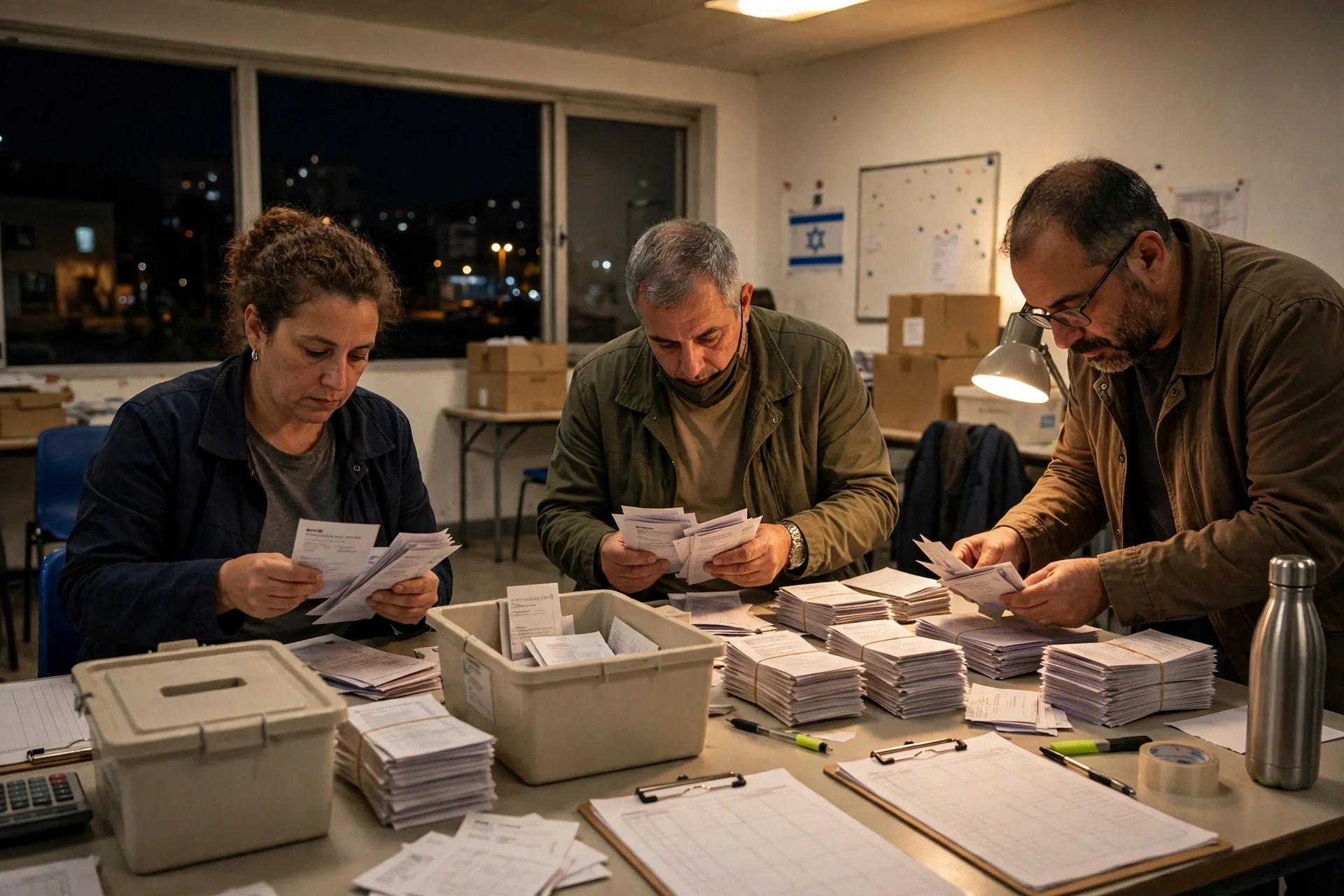
Imagen alusiva al escrutinio nocturno: conteo de papeletas y actas en un colegio electoral. · Erick Prometeo Media
Likud leads Israel count with 22.2% as 28% is tallied
With 28% counted, Netanyahu's Likud leads with 22.2%, followed by Yashar!
Israel count: Likud first with 22.2%, short of a majority
Likud leads the Israeli count with 22.2% after 28% tallied, followed by Yashar!
--- The context ---
Israel voted on Tuesday in general elections and the count moved through the early hours of Wednesday. No bloc held the majority needed to govern.
--- The facts ---
With 28% counted, Benjamin Netanyahu's Likud stands in first place with 22.2% of the vote, followed by Gadi Eisenkot's Yashar! with 15.4% and the Juntos formation of Naftali Bennett and Yair Lapid with 8.2%.
The count reaches 1.6 million ballots from 3,906 polling stations, out of a total of 5,695,682 votes cast in 12,018 polling stations. Final turnout reached 77.7%, almost eight points above 2022 and the highest since 1999, with a strong rise in voting in Arab cities.
--- The positions ---
Netanyahu, leading Likud, asked in the early hours of Wednesday to wait for the final election results, but backed a right-wing government without the Arab and anti-Zionist parties, according to his remarks. The partial count and exit polls point to Likud as the winner, but they do not give its bloc the necessary majority of 61 seats to govern.
--- What remains unknown ---
The opposition bloc would surpass Netanyahu's bloc in seats, but it would not hold the necessary majority either, according to the projections. Arab parties stand as the key to a possible opposition government and, according to exit polls, could reach 19 seats.
--- Unanswered questions ---
Will the full count confirm Likud in first place with its partial 22.2%? Will any bloc reach the 61 seats needed to govern without broad pacts? Will Arab parties accept being the key to a possible opposition government? When will the final results of this election be known?
--- EPM analysis ---
The central political fact is not only who is first, but the distance to a majority: neither Netanyahu's bloc nor the opposition reaches it in the projections. Counting may extend past midday on Wednesday in Israel; in 2022, final results were made public at about 14:00 local time (12:00 GMT).
📌 EPM Take: In EPM's view, Israel is entering a long negotiation because Likud's first place does not equal a guaranteed government: without 61 seats of its own, every pact will weigh as much as the counted vote. Turnout of 77.7%, the highest since 1999, lends legitimacy to the result, but it also hardens each bloc's mandate. The Arab key, projected at 19 seats according to exit polls, turns parliamentary arithmetic into the real election beginning now.
--- The context ---
Tuesday's general elections in Israel led to a long count through the early hours of Wednesday. The order among the leading formations was already defined, though not a majority to govern.
--- The facts ---
With 28% counted, Benjamin Netanyahu's Likud stands in first place with 22.2% of the vote, followed by Gadi Eisenkot's Yashar! with 15.4% and the Juntos formation of Naftali Bennett and Yair Lapid with 8.2%.
The count reaches 1.6 million ballots from 3,906 polling stations, out of a total of 5,695,682 votes cast in 12,018 polling stations. Final turnout reached 77.7%, almost eight points above 2022 and the highest since 1999, with a strong rise in voting in Arab cities.
--- The positions ---
Netanyahu, leading Likud, asked in the early hours of Wednesday to wait for the final election results, but backed a right-wing government without the Arab and anti-Zionist parties, according to his remarks. The partial count and exit polls point to Likud as the winner, but they do not give its bloc the necessary majority of 61 seats to govern.
--- What remains unknown ---
The opposition bloc would surpass Netanyahu's bloc in seats, but it would not hold the necessary majority either, according to the projections. Arab parties stand as the key to a possible opposition government and, according to exit polls, could reach 19 seats.
--- Unanswered questions ---
Will Likud keep 22.2% as counting advances beyond 28%? Will Netanyahu be able to form a right-wing government without his bloc reaching 61 seats? Will Arab parties be the key to an opposition government? Will counting extend past midday on Wednesday?
--- EPM analysis ---
Prudence calls for waiting for the final result before closing off any scenario. Counting may extend past midday on Wednesday; in 2022, final results were made public at about 14:00 local time (12:00 GMT).
📌 EPM Take: In EPM's view, order and institutional stability require waiting for the complete count before proclaiming governments: Likud leads with 22.2%, but no bloc adds up to the 61 seats needed. Turnout of 77.7%, the highest since 1999, strengthens the legitimacy of the process and calls for calm negotiation. A durable government will need real majorities, clear agreements, public patience during the remaining count and full respect for the final verified result emerging from all of the 12,018 polling stations across the country.
Likud lidera en Israel con 22,2 % y el 28 % escrutado
Con el 28 % escrutado, el Likud de Netanyahu lidera con 22,2 %, seguido de Yashar!
Israel: Likud primero con 22,2 %, sin mayoría para gobernar
El Likud lidera el recuento israelí con 22,2 % tras el 28 % escrutado, seguido de Yashar!
--- El contexto ---
Israel votó este martes en elecciones generales y el recuento avanzó en la madrugada del miércoles. Ningún bloque alcanzaba la mayoría necesaria para gobernar.
--- Los hechos ---
Con el 28 % escrutado, el Likud de Benjamín Netanyahu lidera con un 22,2 % de los votos, seguido de Yashar! de Gadi Eisenkot, con 15,4 %, y de la formación Juntos de Naftali Bénet y Yair Lapid, con 8,2 %.
El conteo alcanza 1,6 millones de papeletas de 3.906 colegios, de un total de 5.695.682 votos emitidos en 12.018 colegios. La participación final alcanzó el 77,7 %, casi ocho puntos por encima de la de 2022 y la cifra más alta desde 1999, con un fuerte repunte del voto en las ciudades árabes.
--- Las posiciones ---
Netanyahu pidió en la madrugada del miércoles esperar a los resultados definitivos, pero apostó por un gobierno de derechas sin los partidos árabes y antisionistas, según trasladó. El escrutinio parcial y los sondeos a pie de urna dan ganador al Likud, pero no otorgan a su bloque la mayoría de 61 escaños para gobernar.
--- Lo que falta saber ---
El bloque de la oposición superaría en escaños al de Netanyahu, pero tampoco tendría la mayoría necesaria, según las proyecciones. Los partidos árabes son la llave para un posible gobierno opositor y, según sondeos a pie de urna, podrían llegar a 19 escaños.
--- Preguntas sin respuesta ---
¿Confirmará el escrutinio completo el primer lugar del Likud con el 22,2 % parcial? ¿Alcanzará algún bloque los 61 escaños necesarios para gobernar sin pactos amplios? ¿Aceptarán los partidos árabes ser la llave de un posible gobierno opositor? ¿Cuándo se conocerán los resultados definitivos de estas elecciones?
--- Análisis EPM ---
El dato central no es solo quién va primero, sino la distancia hasta la mayoría: ni el bloque de Netanyahu ni el de la oposición la alcanzan en las proyecciones. El escrutinio puede extenderse hasta pasado el mediodía del miércoles; en 2022, los resultados definitivos se hicieron públicos hacia las 14:00 hora local (12:00 GMT).
📌 Conclusion EPM: A juicio de EPM, Israel entra en una negociación larga porque el primer lugar del Likud no equivale a gobierno asegurado: sin 61 escaños propios, cada pacto pesará tanto como el voto contado. La participación del 77,7 %, la más alta desde 1999, da legitimidad al resultado, pero también endurece cada mandato. La llave árabe, con 19 escaños proyectados según sondeos a pie de urna, convierte la aritmética parlamentaria en la elección que empieza ahora.
--- El contexto ---
Las elecciones generales de este martes en Israel dejaron un recuento largo durante la madrugada del miércoles. El orden entre las principales formaciones ya estaba definido, aunque no la mayoría para gobernar.
--- Los hechos ---
Con el 28 % escrutado, el Likud de Benjamín Netanyahu se sitúa en primer lugar con un 22,2 % de los votos, seguido de Yashar! de Gadi Eisenkot, con 15,4 %, y de la formación Juntos de Naftali Bénet y Yair Lapid, con 8,2 %.
El conteo alcanza 1,6 millones de papeletas de 3.906 colegios, de un total de 5.695.682 votos emitidos en 12.018 colegios. La participación final alcanzó el 77,7 %, casi ocho puntos por encima de la de 2022 y la cifra más alta desde 1999, con un fuerte repunte del voto en las ciudades árabes.
--- Las posiciones ---
Netanyahu pidió en la madrugada del miércoles esperar a los resultados definitivos, pero apostó por un gobierno de derechas sin los partidos árabes y antisionistas, según trasladó. El escrutinio parcial y los sondeos a pie de urna dan ganador al Likud, pero no otorgan a su bloque la mayoría de 61 escaños para gobernar.
--- Lo que falta saber ---
El bloque de la oposición superaría en escaños al de Netanyahu, pero tampoco tendría la mayoría necesaria, según las proyecciones. Los partidos árabes son la llave para un posible gobierno opositor y, según sondeos a pie de urna, podrían llegar a 19 escaños.
--- Preguntas sin respuesta ---
¿Mantendrá el Likud el 22,2 % cuando avance el escrutinio más allá del 28 %? ¿Podrá Netanyahu formar un gobierno de derechas sin alcanzar los 61 escaños con su bloque? ¿Serán los partidos árabes la llave de un gobierno opositor? ¿Se extenderá el escrutinio hasta pasado el mediodía del miércoles?
--- Análisis EPM ---
La prudencia manda esperar al resultado definitivo antes de dar por cerrado cualquier escenario. El escrutinio puede extenderse hasta pasado el mediodía del miércoles; en 2022, los resultados definitivos se hicieron públicos hacia las 14:00 hora local (12:00 GMT).
📌 Conclusion EPM: A juicio de EPM, el orden y la estabilidad institucional exigen esperar al escrutinio completo antes de proclamar gobiernos: el Likud lidera con 22,2 %, pero ningún bloque suma los 61 escaños necesarios. La participación del 77,7 %, la más alta desde 1999, refuerza la legitimidad del proceso y obliga a negociar con serenidad. Un gobierno durable necesitará mayorías, acuerdos claros y respeto al resultado definitivo de los 12.018 colegios.