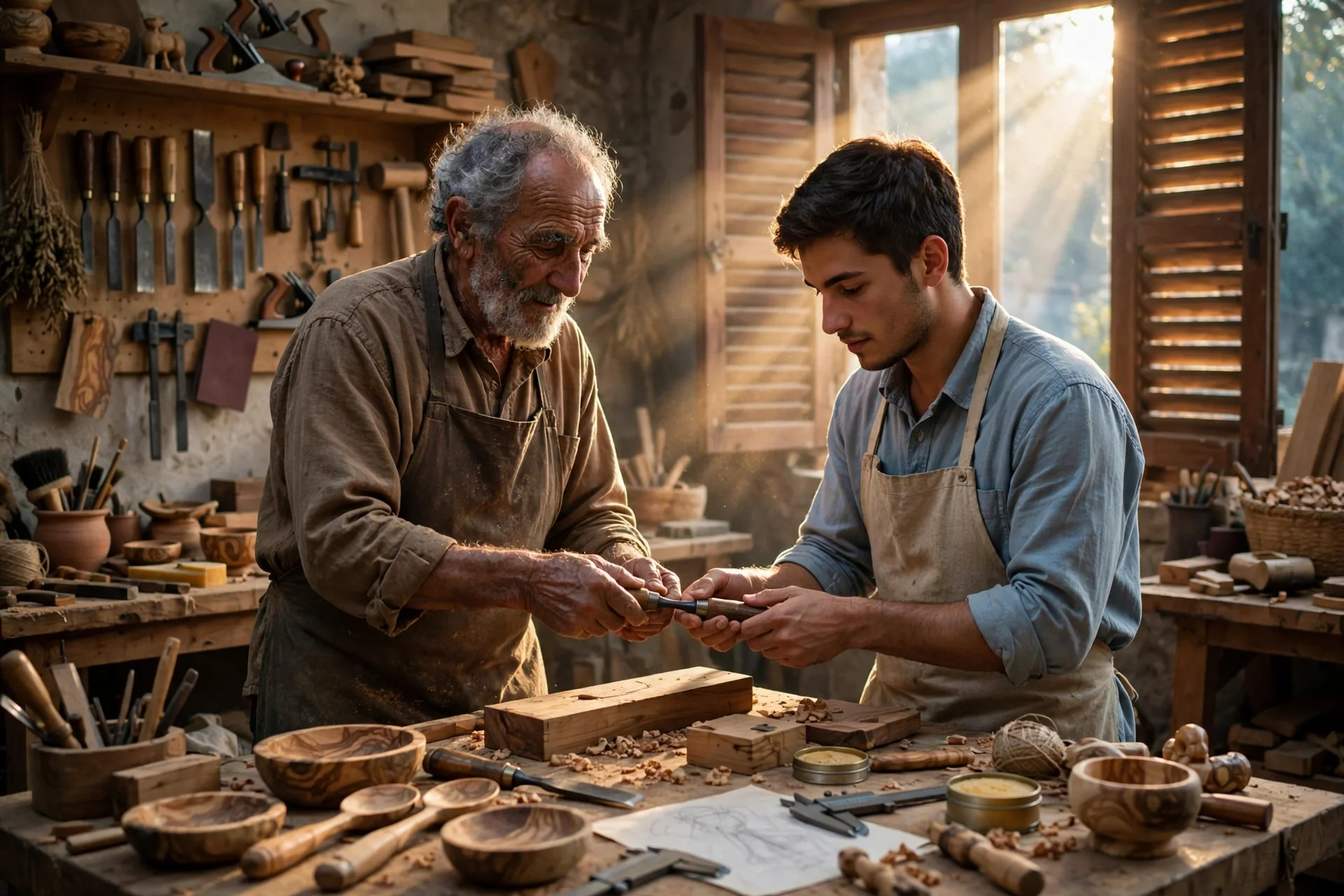
El relevo generacional en los talleres, uno de los ejes del discurso de Meloni ante Confartigianato · Imagen generada — Erick Prometeo Media
Meloni unveils craft reform linking training, credit and generational renewal
Giorgia Meloni told Confartigianato that the Government will approve today the decree reforming the 1985 craftsmanship framework law, with less bureaucracy…
Meloni backs hands-on artisans with deregulation, credit and fair competition
Giorgia Meloni defended before Confartigianato the artisan who works with their own hands and announced the reform of the 1985 law with less bureaucracy…
--- The context ---
Prime Minister Giorgia Meloni addressed the Confartigianato Assembly at the Auditorium Conciliazione in Rome with a speech that placed craft work at the center of Italian productive, social and territorial life. She said that behind every artisan who raises the shutter of a workshop each morning there is a community kept alive, a social presence maintained and a history handed down, and she argued that without craftsmanship the Made in Italy label would practically not exist at all.
Meloni linked that role to export strength and, echoing Granelli, said exports reach EUR 644 billion with Italy fourth among world exporting nations. Quality and practical knowledge thus appear as resources that cannot be copied or offshored, while still needing fair rules, accessible credit and respected technical training.
--- The facts ---
The central announcement was that today, at the Council of Ministers convened a few hours later, the Government will approve the decree reforming the framework law on craftsmanship of 8 August 1985, after more than forty years in force. According to Meloni, the reform seeks fewer bureaucratic burdens, a framework in step with the times and a way to combine the excellence of manual work with the dynamism that the present era requires from firms in the sector.
Among the concrete changes, the prime minister pointed to freedom to organize production, administration and management also in different premises and territories without losing artisan status. She added a principle on who holds the firm: in a craft business, the person who works with their own hands must continue to count for more than the person who only contributes capital. Presented as a core of the decree, that formula aims to protect the nature of the trade without forcing workshops to give up new forms of productive organization.
In the same Council of Ministers, the Budget Law will be approved and, Meloni announced, it will introduce another principle: a firm born as an artisan business and artisan for at least seven years may keep its status even if it decides to increase its collaborators, with particular attention to master craftspeople and apprentices. The idea set out was that growing must no longer mean being denatured, because size and artisan nature can coexist, and because losing status for growing was, in her framing, a paradoxical answer from the State.
In defense of the sector, Meloni recalled that the first annual law on small and medium-sized enterprises reserved the words craftsmanship and artisanal to those registered in the register of artisan firms who directly make those goods and services. She also said more than thirty thousand fictitious open-and-close firms have been closed ex officio since 2023.
On credit, she announced the relaunch of Artigiancassa with mixed public-private governance involving Mediocredito Centrale, the confederations and the Confidi, a fund with an initial endowment of EUR 50 million for investment and development, and the Artigiancassa agreement with SACE to support the internationalization of artisan firms.
Generational renewal was presented as the most urgent challenge: technical training is no longer treated as a second-class choice, with the Liceo del Made in Italy and the reform now in regime and employment stably above 80% one year after the qualification. The incentive lets masters close to retirement move to part-time work with contributions zeroed up to EUR three thousand a year if a person under 35 is hired permanently.
--- The positions ---
The Government position, as Meloni set it out, combines protection of artisan identity, credit access, training and competitiveness. At European level, she claimed the extension of Protected Geographical Indications to non-food artisanal and industrial products as a shield for territorial excellences. Confartigianato appeared in the speech as a recognized interlocutor: Granelli had recalled exports and the credit bottleneck, and the prime minister thanked the confederation for its recent collaboration, including the road transport agreement. On competitiveness and energy she cited the Transition Plan with almost EUR 10 billion, more than twenty-seven thousand projects mobilizing about EUR 8 billion, the Nuova Sabatini, EUR 450 million for Mezzogiorno firms and reopening the nuclear path.
--- What remains unknown ---
The final text of the decree is not yet available, nor the operational detail for organization across different premises, for the principle on those who work with their hands, or for continuity after a workforce increase. Deadlines, requirements that will disappear and how credit will reach the smallest workshops were also not specified.
--- Unanswered questions ---
How will it be checked in practice that in a craft firm the person who works with their hands counts for more than the person who only provides capital? Which concrete bureaucratic burdens will disappear under the decree, and from when will workshops feel the change? Will the relaunched credit reach the smallest firms outside the large centers, and on what conditions? How many young people will be brought in through the incentive linked to masters close to retirement, and how will that handover be followed region by region?
--- EPM analysis ---
The speech assembles a complete chain: identity protected against unfair competition, proximity credit, the possibility of growing without losing status, European protection of origin and technical training with employment outcomes. Its social emphasis lies in the workshop as community infrastructure: when a small workshop endures in a remote village or in a metropolitan periphery, it does not only produce income, it also sustains bonds, services and the transmission of a trade between generations.
📌 EPM Take: In EPM's view, the announced reform matters for trying to resolve a contradiction long denounced by workshops: growing without ceasing to be artisans, organizing with more freedom without losing identity and passing on the trade without treating technical training as a lesser path. Its real reach will depend on the final text of the decree, on credit actually reaching small firms and on the renewal incentive turning into stable contracts for young people in the territories where each workshop sustains employment, community and a shared Italian productive future ahead. It will also matter that small territories see concrete results soon, without new administrative hurdles for workshops or for the young apprentices entering the trade.
--- The context ---
Addressing the Confartigianato Assembly at the Auditorium Conciliazione in Rome, Giorgia Meloni presented the artisan as a central figure of Italian productive identity. She said that each morning, when an artisan raises the shutter of a workshop, that gesture sustains an Italy that does not give up, and that such work keeps a community alive, guarantees a social presence and hands down a history. Without craftsmanship, she argued, Made in Italy would practically not exist, because its strength remains excellence made according to the rules of the art.
Meloni took up the figure cited by Granelli of exports totaling EUR 644 billion and Italy as the fourth exporting country worldwide. She defended artisanal quality as something that cannot be copied or offshored and that demands prior respect: enforcing the rules against unfair competition, tax evasion and damage to an honest sector.
--- The facts ---
The main announcement was that today, a few hours later, the Council of Ministers will approve the decree reforming the framework law on craftsmanship of 8 August 1985, after more than forty years. Meloni described it as a framework in step with the times for those who want to combine the excellence of manual work with the dynamism of the age. The novelty, she stressed, is that a conviction already expressed before now becomes a concrete fact and an answer from the Government.
In concrete terms, the decree will bring fewer bureaucratic formalities to comply with and freedom to organize production, administration and management also in different premises and territories, without losing artisan status. Meloni added a clear principle on who holds the firm: in a craft business, the person who works with their own hands must continue to count for more than the person who only puts in capital. The reform thus seeks to keep identity from being diluted by size or by new forms of organization.
With the Budget Law, to be approved at the same Council, it will also be introduced that a firm born as an artisan business and artisan for at least seven years may keep its status even if it increases its collaborators, with particular attention to master craftspeople and apprentices. Meloni rejected as paradoxical the previous message from the State, under which a capable artisan could grow only by ceasing to be an artisan and renouncing a specificity protected by the Constitution. Growing, in her formulation, will no longer mean being denatured.
Against unfair competition, she recalled that the first annual law on small and medium-sized enterprises reserved the words craftsmanship and artisanal to those registered who directly make the goods and services. She said more than thirty thousand fictitious open-and-close firms have been closed ex officio since 2023, firmness presented as defense of real artisans and consumers.
On credit, she claimed the relaunch of Artigiancassa with mixed public-private governance alongside Mediocredito Centrale, the confederations and the Confidi and its territorial network. She cited the fund with an initial endowment of EUR 50 million for investment and development and the Artigiancassa agreement with SACE for internationalization.
She added European protection, with Protected Geographical Indications extended to non-food products, and renewal: dignified technical training, the Liceo del Made in Italy and the reform in regime, with employment stably above 80% one year after the qualification, plus part-time transition for masters close to retirement with contributions zeroed up to EUR three thousand a year if a person under 35 is hired permanently.
--- The positions ---
The government position set out combines order in the rules, less bureaucracy and defense of the real producer against the impostor. Meloni thanked Confartigianato for its sense of responsibility and its collaboration, also in implementing the road transport agreement, and framed foreign policy as a way to open doors that the Italian productive system must then cross with instruments of its own, among them credit, innovation and presence in foreign markets. On competitiveness and energy she cited the Transition Plan with almost EUR 10 billion, more than twenty-seven thousand projects mobilizing about EUR 8 billion, the Nuova Sabatini, EUR 450 million for Mezzogiorno firms and reopening the nuclear path.
--- What remains unknown ---
The definitive articles are still needed to know how prevalence of manual work will be measured, which formalities will disappear and what controls will remain against fictitious firms. The application calendar for continuity after a workforce increase and the criteria for prioritizing credit projects were also not detailed.
--- Unanswered questions ---
Will the final text keep the prevalence of manual work without creating new checking burdens for firms? Which concrete formalities will be eliminated, and what real saving will that mean for a small workshop? Will the closure of fictitious firms be applied with the same firmness across the whole country? Can reopening the nuclear path, together with the other energy measures cited, perceptibly ease the costs that artisans and small firms bear today in their daily activity?
--- EPM analysis ---
The key to the speech lies in joining identity and economic freedom: the artisan is not treated as a figure from the past to be preserved under glass, but as a producer who must be able to organize, invest and grow without renouncing what he or she is. That is why the principle that the hand counts for more than capital alone works as a definition of the sector, and the fight against false artisans as a simultaneous defense of the fair market and of the consumer.
📌 EPM Take: In EPM's view, the strongest part of the announcement is that it protects artisan identity without condemning it to stay small: less bureaucracy, freedom of organization, prevalence of those who work with their hands and firmness against unfair competition form a coherent whole in defense of the real producer. Its credibility will be decided in the final articles, in whether simplification is measurable for each workshop and in whether credit and energy become lower costs and clear rules, equal and enforceable for everyone who complies daily. That practical test, applied workshop by workshop and territory by territory, will decide whether this long-awaited reform truly changes daily life for Italian artisans and their firms.
Meloni anuncia la reforma artesana tras cuarenta años de espera en Italia
Giorgia Meloni anunció ante Confartigianato que el Gobierno aprobará hoy el decreto que reforma la ley marco de la artesanía de 1985, con menos burocracia…
Meloni defiende al artesano que trabaja con las manos frente a la burocracia
Giorgia Meloni defendió ante Confartigianato al artesano que trabaja con sus manos y anunció la reforma de la ley de 1985 con menos burocracia, libertad de…
--- El contexto ---
La presidenta del Consejo de Ministros, Giorgia Meloni, intervino ante la Asamblea de Confartigianato en el Auditorium Conciliazione de Roma con un discurso centrado en el trabajo artesano como base productiva, social y territorial de Italia. Según explicó, detrás de cada taller que abre por la mañana hay una comunidad que se mantiene viva, un presidio social y una identidad que se transmite, y por eso defendió que sin artesanía el Made in Italy prácticamente no existiría.
Meloni vinculó ese papel con la capacidad exportadora y recogió lo señalado por Granelli: exportaciones de seiscientos cuarenta y cuatro mil millones de euros y cuarto puesto mundial entre países exportadores. La calidad y el saber hacer aparecen así como recursos que no se pueden copiar ni deslocalizar, pero que necesitan reglas, crédito y formación.
--- Los hechos ---
El anuncio central fue que hoy, en el Consejo de Ministros convocado horas después de la asamblea, el Gobierno aprobará el decreto que reforma la ley marco de la artesanía del 8 de agosto de 1985, tras más de cuarenta años de vigencia. Según detalló Meloni, la reforma busca menos cargas burocráticas, un marco acorde con los tiempos y la posibilidad de unir la excelencia del trabajo manual con el dinamismo que exige la época actual para las empresas del sector.
Entre los cambios concretos, la presidenta señaló la libertad de organizar producción, administración y gestión también en sedes y territorios distintos sin perder la condición artesana. Añadió un principio sobre la titularidad de la empresa: en una empresa artesana debe seguir contando más quien trabaja con sus propias manos que quien solo aporta capital. Esa formulación, presentada como núcleo del decreto, intenta proteger la naturaleza del oficio sin obligar al taller a renunciar a nuevas formas de organización productiva.
En el mismo Consejo de Ministros se aprobará la Ley de Presupuesto y, según anunció Meloni, con ella se introduce otro principio: una empresa que nace artesana y que lo ha sido durante al menos siete años podrá mantener su condición aunque decida aumentar sus colaboradores, con atención particular a maestros y aprendices. La idea expuesta fue que crecer no debe significar desnaturalizarse, porque dimensión y naturaleza artesana pueden coexistir, y porque perder la condición por crecer era, en su planteamiento, una respuesta paradójica del Estado.
En defensa del sector, Meloni recordó que la primera ley anual de pymes reservó las palabras artesanía y artesanal a los inscritos en el registro de empresas artesanas que realizan directamente esos bienes y servicios. Afirmó además que desde 2023 se cerraron de oficio más de treinta mil empresas ficticias de apertura y cierre.
En crédito, anunció el relanzamiento de Artigiancassa con gobernanza mixta público-privada junto a Mediocredito Centrale, las confederaciones y los Confidi, un fondo con dotación inicial de 50 millones de euros para inversión y desarrollo, y el acuerdo de Artigiancassa con SACE para la internacionalización de las empresas artesanas.
El relevo generacional fue presentado como urgencia mayor: la formación técnica dejó de tratarse como opción de segunda, con el Liceo del Made in Italy y la reforma ya en régimen y un empleo superior al 80% al año del título. El incentivo permite a maestros cercanos a la jubilación pasar a tiempo parcial con cotizaciones a cero hasta tres mil euros al año si se contrata indefinido a un menor de 35 años.
--- Las posiciones ---
La posición del Gobierno, tal como la expuso Meloni, combina protección de la identidad artesana, apertura de crédito, formación y competitividad. En el plano europeo, reivindicó la extensión de las Indicaciones Geográficas Protegidas a productos artesanales e industriales no alimentarios como un escudo para excelencias territoriales. Confartigianato apareció en el discurso como interlocutor reconocido: Granelli había recordado las exportaciones y el problema del crédito, y la presidenta agradeció a la confederación su colaboración reciente, incluido el acuerdo del autotransporte. En competitividad y energía citó el Plan Transición con casi diez mil millones de euros, más de veintisiete mil proyectos que movilizan unos ocho mil millones de euros, la Nuova Sabatini, 450 millones de euros para pymes del Mezzogiorno y la reapertura del camino nuclear.
--- Lo que falta saber ---
Todavía no consta el texto final del decreto ni el detalle operativo de la libertad de organización en varias sedes, del principio sobre quien trabaja con las manos ni de la continuidad tras aumentar la plantilla. Tampoco se precisaron plazos, requisitos que desaparecerán ni cómo llegará el crédito a los talleres más pequeños.
--- Preguntas sin respuesta ---
¿Cómo se comprobará en la práctica que en la empresa artesana pesa más quien trabaja con las manos que quien solo aporta capital? ¿Qué cargas burocráticas concretas desaparecerán con el decreto y desde cuándo podrán notarlo los talleres? ¿Llegará el crédito relanzado a las empresas más pequeñas fuera de los grandes centros, y con qué condiciones? ¿Cuántos jóvenes podrán incorporarse mediante el incentivo ligado a los maestros cercanos a la jubilación, y qué seguimiento tendrá ese relevo en cada región?
--- Análisis EPM ---
El discurso ordena una cadena completa: identidad protegida frente a la competencia desleal, crédito de proximidad, posibilidad de crecer sin perder la condición, protección europea del origen y formación técnica con salida laboral. Su acento social está en el taller como infraestructura de comunidad: cuando una bottega resiste en un pueblo remoto o en una periferia metropolitana, no solo produce renta, también sostiene vínculos, servicios y transmisión de oficio entre generaciones.
📌 Conclusion EPM: A juicio de EPM, la reforma anunciada vale por su intento de resolver una contradicción largamente denunciada por los talleres: crecer sin dejar de ser artesanos, organizarse con más libertad sin perder identidad y transmitir el oficio sin tratar la formación técnica como una vía menor. Su alcance real dependerá del texto final del decreto, de que el crédito llegue efectivamente a las empresas pequeñas y de que el incentivo al relevo se traduzca en contratos estables para jóvenes en los territorios donde cada bottega sostiene empleo, comunidad y futuro productivo italiano compartido. También importará que los territorios pequeños vean resultados concretos pronto y sin nuevas trabas administrativas para sus talleres artesanos.
--- El contexto ---
Ante la Asamblea de Confartigianato, reunida en el Auditorium Conciliazione de Roma, Giorgia Meloni presentó al artesano como figura central de la identidad productiva italiana. Según dijo, cada mañana, al levantar la persiana de su laboratorio, el artesano sostiene una Italia que no se rinde, y su trabajo mantiene viva una comunidad, garantiza un presidio social y transmite una historia. Sin artesanía, afirmó, el Made in Italy prácticamente no existiría, porque su fuerza sigue siendo la excelencia hecha a regla de arte.
Meloni recogió el dato citado por Granelli de exportaciones por seiscientos cuarenta y cuatro mil millones de euros y cuarto puesto mundial exportador. Defendió que la calidad artesana no se puede copiar ni deslocalizar y que exige respeto previo: hacer cumplir las reglas frente a quien compite deslealmente, evade impuestos y daña la reputación del sector honesto.
--- Los hechos ---
El anuncio principal fue que hoy, horas después, el Consejo de Ministros aprobará el decreto que reforma la ley marco de la artesanía del 8 de agosto de 1985, tras más de cuarenta años. Meloni lo describió como un marco al paso con los tiempos para quienes quieren unir la excelencia del trabajo manual con el dinamismo de la época. La novedad, insistió, es que una convicción ya expresada antes se convierte ahora en un hecho concreto y en una respuesta del Gobierno.
En concreto, el decreto traerá menos trámites burocráticos que respetar y la libertad de organizar producción, administración y gestión también en sedes y territorios distintos, sin perder la condición artesana. Meloni añadió un principio claro sobre quién detenta la empresa: en una empresa artesana debe continuar contando más quien trabaja con sus propias manos que quien solo pone el capital. La reforma busca así que la identidad no quede diluida por el tamaño ni por nuevas formas de organización.
Con la Ley de Presupuesto, que se aprobará en el mismo Consejo, se introducirá además que una empresa nacida artesana y que lo haya sido al menos siete años podrá mantener su condición aunque aumente sus colaboradores, con atención particular a maestros y aprendices. Meloni rechazó como paradójico el mensaje anterior del Estado, según el cual un artesano capaz podía crecer solo si dejaba de ser artesano y renunciaba a la especificidad protegida por la Constitución. Crecer, en su formulación, no significará ya desnaturalizarse.
Frente a la competencia desleal, recordó que la primera ley anual de pymes reservó las palabras artesanía y artesanal a los inscritos en el registro que realizan directamente bienes y servicios. Afirmó que desde 2023 se cerraron de oficio más de treinta mil empresas ficticias, firmeza presentada como defensa de los artesanos verdaderos y de los consumidores.
Para el crédito reivindicó el relanzamiento de Artigiancassa, con gobernanza mixta público-privada junto a Mediocredito Centrale, confederaciones y Confidi y su red territorial. Citó el fondo con dotación inicial de 50 millones de euros para inversiones y desarrollo y el acuerdo de Artigiancassa con SACE para la internacionalización.
Sumó la protección europea, con la extensión de las Indicaciones Geográficas Protegidas a productos no alimentarios, y el relevo: formación técnica dignificada, Liceo del Made in Italy y reforma en régimen, con empleo superior al 80% al año del título, y paso a tiempo parcial de maestros cercanos a la jubilación con cotizaciones a cero hasta tres mil euros al año si se contrata indefinido a un menor de 35 años.
--- Las posiciones ---
La posición gubernamental expuesta combina orden en las reglas, menos burocracia y defensa del productor real frente al impostor. Meloni agradeció a Confartigianato su sentido de responsabilidad y su colaboración, también en la aplicación del acuerdo del autotransporte, y enmarcó la política exterior como una vía para abrir puertas que después debe cruzar el sistema productivo italiano con instrumentos propios, entre ellos crédito, innovación y presencia en mercados exteriores. En competitividad citó el Plan Transición con casi diez mil millones de euros, más de veintisiete mil proyectos que movilizan unos ocho mil millones de euros, la Nuova Sabatini, 450 millones de euros para el Mezzogiorno y la reapertura del camino nuclear.
--- Lo que falta saber ---
Falta conocer el articulado definitivo para saber cómo se medirá la prevalencia de quien trabaja con las manos, qué trámites desaparecen y qué controles seguirán contra las empresas ficticias. Tampoco se detalló el calendario de la continuidad tras aumentar la plantilla ni los criterios del fondo de crédito para priorizar proyectos.
--- Preguntas sin respuesta ---
¿Mantendrá el texto final la prevalencia del trabajo manual sin crear nuevas cargas de comprobación para las empresas? ¿Qué trámites concretos quedarán eliminados y qué ahorro real supondrá eso para un taller pequeño? ¿Se aplicará con la misma firmeza el cierre de empresas ficticias en todo el país? ¿Podrá la reapertura del camino nuclear, junto a las demás medidas energéticas citadas, aliviar de forma perceptible los costes que hoy soportan artesanos y pymes?
--- Análisis EPM ---
La clave del discurso está en unir identidad y libertad económica: el artesano no es tratado como una figura del pasado que haya que conservar bajo una campana, sino como un productor que debe poder organizarse, invertir y crecer sin renunciar a lo que es. Por eso el principio de que cuente más la mano que el solo capital funciona como definición del sector, y la lucha contra los falsos artesanos como defensa simultánea del mercado leal y del consumidor.
📌 Conclusion EPM: A juicio de EPM, lo más sólido del anuncio es que protege la identidad artesana sin condenarla a quedarse pequeña: menos burocracia, libertad de organización, prevalencia de quien trabaja con las manos y firmeza contra la competencia desleal forman un conjunto coherente con la defensa del productor real. Su credibilidad se jugará en el articulado final, en que la simplificación sea medible para cada taller y en que el crédito y la energía no queden en promesas generales, sino en costes menores y reglas claras, iguales y exigibles para todos los que cumplen diariamente. Ese es el terreno donde la reforma deberá demostrar su valor práctico para el país entero y sus productores.