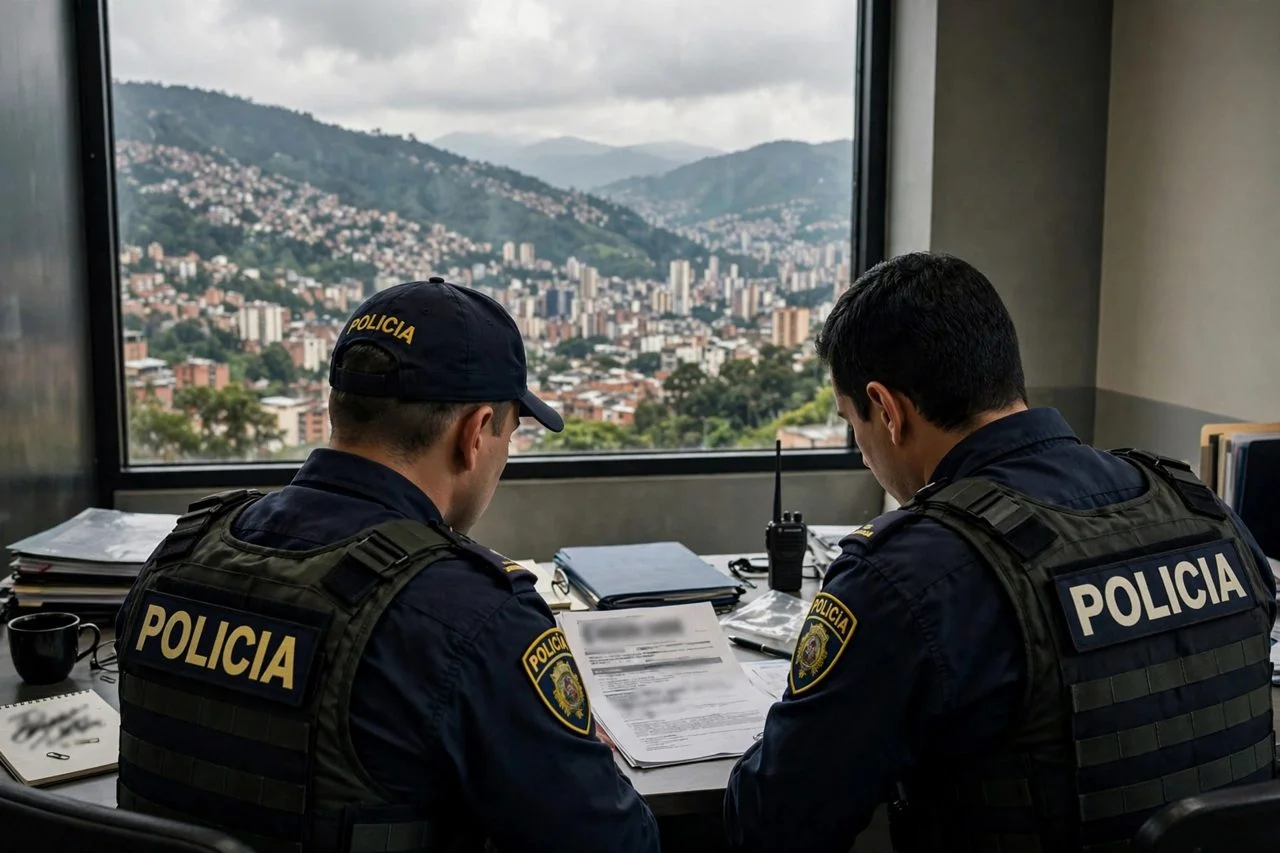
Imagen alusiva generada: investigadores revisan un expediente en Medellín · Imagen generada para EPM
Colombian wanted by Sweden detained in Medellín over aggravated extortion
DIJIN detained Katerin Herrera Álvarez in Medellín under a Red Notice at Sweden's request for aggravated extortion, allegedly linked to a network impersonating…
Woman wanted by Sweden for aggravated extortion detained in Medellín
Katerin Herrera Álvarez was detained in Medellín under a Red Notice requested by Swedish justice for aggravated extortion.
--- The context ---
Police cooperation between Colombia and Sweden was activated by an investigation into aggravated extortion allegedly linked to a group operating in Östersund that impersonated Swedish police officers through fraudulent emails sent to victims under threat.
--- The facts ---
Colombia's National Police, through the Directorate of Criminal Investigation and INTERPOL, carried out in Medellín the detention under a Red Notice of Katerin Herrera Álvarez, a Colombian citizen wanted by Swedish judicial authorities for aggravated extortion.
Investigations conducted with European authorities indicate that Herrera Álvarez was allegedly linked to that structure, which intimidated victims with supposed prison sentences, heavy financial penalties and threats involving the loss of custody of their children, and demanded bank transfers of between 85,000 and 90,000 Swedish kronor, equivalent to about 34 or 36 million Colombian pesos per victim.
At age five she left Colombia for Costa Rica with her mother as a refugee under UNHCR protection after her father was murdered by guerrilla groups; at age seven both were selected by Sweden for permanent residence. She lived 23 years there, received state assistance in housing, food and education, and worked as a head nurse.
Since 2024 she had lived in the Toldas area of Guarne, Antioquia, after returning citing her mother's health complications; she worked a year as a hotel administrator in Medellín and then organized events for a compensation fund.
--- The positions ---
The National Police stated that the result confirms its commitment against transnational crime and international cooperation, so Colombia is not a refuge for fugitives. Herrera Álvarez was placed at the disposal of the Attorney General's Office, through its International Affairs Directorate.
--- What remains unknown ---
The total number of victims is unknown, as is the specific evidence Sweden will present to formalize extradition. It is also unknown whether others are wanted in the same investigation or what Colombian justice will decide as the process moves forward.
--- Unanswered questions ---
How many victims reported the fraudulent emails in Sweden? What concrete evidence allegedly links Herrera Álvarez to the messages and the collections? Within what timeframe will Sweden formalize its extradition request before Colombia?
--- EPM analysis ---
The case brings together victim protection and due process: a woman trained in Sweden after arriving as a child refugee now faces a serious request that must be proven with verifiable evidence and full respect for the presumption of innocence.
📌 EPM Take: In EPM's view, this case demands balance: protecting the victims of an extortion scheme that allegedly used fear of losing custody of their children, while guaranteeing a rigorous, transparent process with presumption of innocence for the detained woman. Cooperation between Colombia and Sweden will be credible if extradition rests on clear evidence, if information is reported precisely, and if no personal history replaces judicial examination of the facts under investigation.
--- The context ---
The international request against a Colombian citizen living in Antioquia shows how fraud networks that impersonate authorities in Europe can come under police tracking in Colombia when judicial coordination and a current Red Notice exist.
--- The facts ---
In Medellín, the National Police, through the Directorate of Criminal Investigation and INTERPOL, carried out the detention of Katerin Herrera Álvarez, wanted by Swedish judicial authorities for aggravated extortion. The action was executed under a Red Notice and in coordination with European authorities.
According to the investigation, Herrera Álvarez was allegedly linked to an organization operating in Östersund that impersonated police authorities with fraudulent emails appearing to come from the Swedish police. To pressure payments, the structure warned of supposed prison sentences, heavy fines and loss of custody of the victims' children.
In exchange for not enforcing those false measures, the organization demanded bank transfers of between 85,000 and 90,000 Swedish kronor per victim, equivalent to approximately 34 or 36 million Colombian pesos. The detained woman was placed at the disposal of the Attorney General's Office, through its International Affairs Directorate, while Sweden formalizes extradition.
Herrera Álvarez left for Costa Rica at age five as a refugee with her mother, protected by UNHCR after her father was murdered by guerrilla groups; at age seven Sweden granted them permanent residence. She lived there 23 years, with comprehensive state assistance, and worked as a head nurse.
--- The positions ---
The National Police said the result confirms its fight against transnational crime and international cooperation. Sweden maintains the judicial request that originated the notice, pending completion of the formal extradition process before Colombia.
--- What remains unknown ---
It is undisclosed how many transfers were completed, whether more members of the alleged network were identified, or the extradition schedule. Those definitions will depend on the documentation Sweden submits and its review in Colombia.
--- Unanswered questions ---
How many people were affected by the demanded payments? Did she allegedly act alone or as part of a broader structure? When will Sweden formally present the extradition request and what will Colombian justice decide?
--- EPM analysis ---
The institutional lesson is direct: impersonation thrives when victims fear verifying through official channels. Strengthening cooperation, early warning and independent confirmation of any financial demand reduces the room for these networks, without weakening procedural guarantees.
📌 EPM Take: In EPM's view, the detention in Medellín sends a message of order and legality: no territory should serve as a refuge when an international judicial request exists, and no demand for money in the name of an authority should be met without official verification. Colombia complies by cooperating and placing the detained woman at the prosecution's disposal, and Sweden must now formalize its request with solid evidence and through the proper channels.
Colombiana requerida por Suecia fue retenida en Medellín por extorsión
La DIJIN retuvo en Medellín a Katerin Herrera Álvarez, requerida por Suecia por extorsión agravada y presuntamente vinculada a una red que suplantaba policías…
DIJIN retiene en Medellín a mujer buscada por Suecia por extorsión agravada
Katerin Herrera Álvarez fue retenida en Medellín mediante Notificación Roja, a solicitud de la justicia sueca por extorsión agravada.
--- El contexto ---
La cooperación entre Colombia y Suecia se activó por una investigación sobre extorsión agravada atribuida presuntamente a una organización que operaba en Östersund y suplantaba a la policía sueca con correos fraudulentos.
--- Los hechos ---
La Policía Nacional, mediante la Dirección de Investigación Criminal e INTERPOL, materializó en Medellín la retención por Notificación Roja de Katerin Herrera Álvarez, requerida por la justicia de Suecia por extorsión agravada.
Según la investigación con autoridades europeas, Herrera Álvarez estaría presuntamente vinculada a esa estructura, que intimidaba con supuestas penas de prisión, sanciones económicas y pérdida de la custodia de los hijos, y exigía entre 85.000 y 90.000 coronas suecas, unos 34 o 36 millones de pesos por víctima.
A los cinco años salió de Colombia hacia Costa Rica con su madre como refugiada bajo protección de ACNUR, tras el asesinato de su padre por grupos guerrilleros; a los siete años ambas recibieron residencia permanente en Suecia, donde vivió 23 años, recibió asistencia estatal en vivienda, alimentación y educación, y ejerció como jefe de enfermería.
Desde 2024 residía en la vereda Toldas de Guarne, Antioquia, tras regresar por complicaciones de salud de su madre; trabajó un año como administradora de un hotel en Medellín y luego organizaba eventos para una caja de compensación.
--- Las posiciones ---
La Policía Nacional sostuvo que el resultado ratifica su compromiso contra el delito transnacional y la cooperación internacional, para evitar que Colombia sea refugio de prófugos. La retenida quedó a disposición de la Fiscalía General de la Nación, a través de la Dirección de Asuntos Internacionales.
--- Lo que falta saber ---
No se conoce el número total de víctimas ni el detalle probatorio que Suecia presentará para formalizar la extradición. Tampoco se ha informado si hay otras personas requeridas en la misma investigación ni qué decidirá la justicia colombiana mientras avanza el trámite entre ambos países.
--- Preguntas sin respuesta ---
¿Cuántas víctimas denunciaron los correos fraudulentos en Suecia? ¿Qué pruebas concretas vincularían presuntamente a Herrera Álvarez con los envíos y los cobros? ¿En qué plazo formalizará Suecia la solicitud de extradición ante Colombia?
--- Análisis EPM ---
El caso cruza protección de víctimas y debido proceso: una mujer formada en Suecia tras llegar como refugiada niña hoy enfrenta un requerimiento que debe probarse con evidencia verificable y respeto a la presunción de inocencia.
📌 Conclusion EPM: A juicio de EPM, este caso exige equilibrio: proteger a las víctimas de una extorsión que presuntamente usaba el miedo a perder la custodia de sus hijos, y garantizar al mismo tiempo un proceso riguroso, transparente y con presunción de inocencia para la retenida. La cooperación entre Colombia y Suecia será creíble si la extradición se sustenta en pruebas claras, si se informa con precisión y si ninguna trayectoria personal sustituye al examen judicial de los hechos investigados.
--- El contexto ---
El requerimiento contra una colombiana residente en Antioquia muestra cómo las redes que suplantan autoridades en Europa terminan bajo seguimiento en Colombia cuando hay coordinación judicial y Notificación Roja vigente.
--- Los hechos ---
En Medellín, la Policía Nacional, mediante la Dirección de Investigación Criminal e INTERPOL, materializó la retención de Katerin Herrera Álvarez, requerida por las autoridades judiciales de Suecia por extorsión agravada. La actuación se realizó mediante Notificación Roja y en coordinación con autoridades europeas.
Según la investigación, Herrera Álvarez estaría presuntamente vinculada a una organización en Östersund que suplantaba autoridades con correos que aparentaban provenir de la policía sueca, advirtiendo supuestas penas de prisión, multas y pérdida de la custodia de los hijos.
A cambio de no hacer efectivas esas falsas medidas, la organización exigía transferencias bancarias de entre 85.000 y 90.000 coronas suecas por víctima, equivalentes aproximadamente a 34 o 36 millones de pesos colombianos. La retenida quedó a disposición de la Fiscalía General de la Nación, por conducto de la Dirección de Asuntos Internacionales, mientras Suecia formaliza la extradición.
Herrera Álvarez salió a los cinco años hacia Costa Rica como refugiada con su madre, protegidas por ACNUR tras el asesinato de su padre por grupos guerrilleros; a los siete años Suecia les otorgó residencia permanente. Vivió 23 años allí, con asistencia estatal integral, y ejerció como jefe de enfermería.
--- Las posiciones ---
La Policía Nacional afirmó que el resultado ratifica su lucha contra el delito transnacional y la cooperación internacional. Suecia mantiene el requerimiento que originó la notificación, a la espera de completar el trámite formal de extradición ante Colombia.
--- Lo que falta saber ---
No se ha divulgado cuántas transferencias se concretaron, si hubo más integrantes de la presunta red, ni el calendario del trámite de extradición. Esas definiciones dependerán de la documentación que remita Suecia y de su revisión en Colombia.
--- Preguntas sin respuesta ---
¿Cuántas personas resultaron afectadas por los cobros exigidos? ¿Actuaba presuntamente sola o como parte de una estructura más amplia? ¿Cuándo presentará Suecia formalmente la solicitud de extradición y qué resolverá la justicia colombiana?
--- Análisis EPM ---
La lección institucional es directa: la suplantación prospera cuando las víctimas temen verificar por canales oficiales. Reforzar la cooperación, la alerta temprana y la confirmación independiente de toda exigencia económica reduce el margen de estas redes, sin debilitar las garantías procesales.
📌 Conclusion EPM: A juicio de EPM, la retención en Medellín envía un mensaje de orden y legalidad: ningún territorio debe servir de refugio cuando existe un requerimiento judicial internacional, y ninguna exigencia de dinero a nombre de una autoridad debe atenderse sin verificación oficial. Colombia cumple al cooperar y al poner a la retenida a disposición de la Fiscalía, y ahora corresponde que Suecia formalice su pedido con pruebas sólidas y dentro de los cauces previstos.