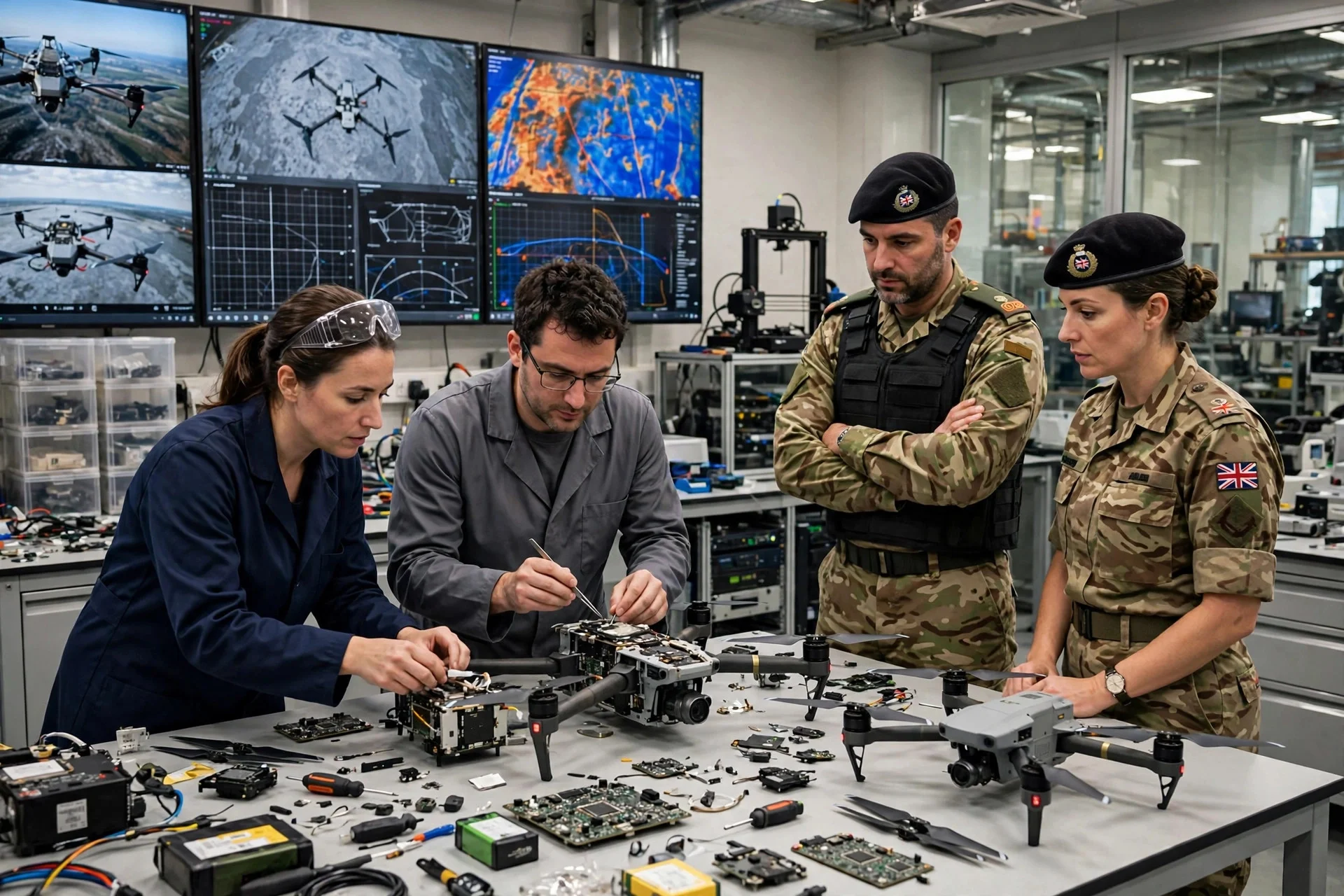
Técnicos y militares británicos trabajan sobre drones y componentes electrónicos en un laboratorio de innovación de defensa, con pantallas de seguimiento al fondo. · Imagen generada para EPM
London creates its first defence innovation directorate
The British Ministry of Defence has appointed Anthony Reeves as its first Director General Innovation.
United Kingdom shields military innovation under one command
Anthony Reeves will become the first Director General Innovation at the British Ministry of Defence.
--- The context ---
The United Kingdom has decided to place innovation at the heart of its defence and to turn scientific spending into a lever for jobs, industry and public capability. Creating a dedicated directorate general inside National Armaments reflects that choice: concentrating talent, coordinating laboratories and opening the door to universities and companies so that new technologies reach military service sooner and benefit the wider economy.
--- The facts ---
The British Ministry of Defence has appointed Anthony Reeves as its first Director General Innovation, following an external competition. Reeves will take up the role this Autumn as the newest senior civil servant within National Armaments, will join its Executive Committee and will lead the newly designed National Armaments Innovation area.
That area brings together some 4,800 experts and scientists working in the Defence Investment Unit, the Defence Science & Technology Laboratory, the Defence Uncrewed Systems Centre and UK Defence Innovation. The new director will oversee a ringfenced £1.6 billion defence innovation budget over the next four years and support £2.1 billion of investment in core science and technology. The role also carries a £3.7 billion science, technology and innovation budget over the same four years.
--- The positions ---
Rupert Pearce, the National Armaments Director, described the appointment in attributed terms as a gear shift for British defence and highlighted the rare combination of frontline military experience, deep technical expertise and a proven record of transformation across defence, government and industry that Reeves brings. Reeves himself argued, in indirect terms, that innovation in defence must be about mindset before toolset, and pledged joint work with industry, academia and international partners.
--- What remains unknown ---
It has not yet been detailed how the funds will be divided among the different centres or which projects will receive priority in the first stage. Nor is the concrete timetable known for bringing technologies into service, or the public follow-up mechanisms that would show whether the investment is producing measurable results for the Armed Forces and for the economy.
--- Unanswered questions ---
Which concrete projects will absorb the ringfenced innovation budget first over the next four years? How will it be measured publicly whether collaboration with universities and companies produces real capabilities rather than announcements alone? What timetable will the new directorate set for bringing emerging technologies into effective military service?
--- EPM analysis ---
The progressive reading of this move stresses its dimension as industrial policy and sustained public investment. A budget protected for four years gives laboratories, universities and companies a horizon, and can turn scientific knowledge into skilled employment and tangible growth if the announced collaboration genuinely opens to diverse actors and reports openly on every advance achieved.
The symmetrical risk is that the new structure remains an organisational chart. The proof will lie in the speed of adoption, in transparent allocation criteria and in whether the 4,800 specialists work as a single ecosystem rather than as separate compartments competing among themselves for the same resources and attention.
📌 EPM Take: In EPM's view, appointing Anthony Reeves succeeds by bringing scientific talent, a protected budget and the duty to deliver visible results for the country together under a single directorate. Defence innovation will only justify its public cost if it opens opportunities to universities, companies and regions, accelerates real capabilities for the Armed Forces and accounts for itself with verifiable data. The institutional design is promising and the appointee's experience is solid, but the final judgement will depend on execution, on spending transparency and on whether the promised growth reaches beyond the offices.
--- The context ---
British defence is contesting its operational advantage on uncomfortable ground: adversaries who learn quickly and technologies that age within months. London is responding by creating, for the first time, a director general for innovation inside National Armaments, with single command, a protected budget and the explicit mission of keeping the United Kingdom at the cutting edge of warfighting and deterring those who threaten it.
--- The facts ---
The British Ministry of Defence has appointed Anthony Reeves as its first Director General Innovation, selected through an external competition. Reeves will take up the role this Autumn as the newest senior civil servant within National Armaments, will sit on its Executive Committee and will head the newly designed National Armaments Innovation area.
Under his command will sit some 4,800 experts and scientists spread across the Defence Investment Unit, the Defence Science & Technology Laboratory, the Defence Uncrewed Systems Centre and UK Defence Innovation. He will oversee a ringfenced £1.6 billion defence innovation budget over the next four years, support £2.1 billion of investment in core science and technology and, separately, £3.7 billion in science, technology and innovation for results.
--- The positions ---
Rupert Pearce, the National Armaments Director, presented the appointment in attributed terms as a gear shift that places innovation at the heart of war-fighting readiness, draws on the lessons of Ukraine to deter adversaries and trusts a leader with frontline military experience. Reeves, for his part, set out in indirect terms that innovation must become everyone's business and that new technologies must enter service at pace and deliver tangible growth.
--- What remains unknown ---
The detailed operational chain of command and the annual objectives demandable from each centre inside the area remain to be known. It has not been specified which capabilities are considered urgent, nor what will happen to programmes that fail to demonstrate military usefulness within reasonable deadlines, an essential discipline when public money is committed in advance for four years.
--- Unanswered questions ---
Which concrete capabilities will London demand first to strengthen deterrence against its declared adversaries? What consequences will each centre face if it fails to deliver results within the deadlines set by the new directorate? How will the ringfenced budget be guaranteed to buy real operational advantage rather than intermediate bureaucracy?
--- EPM analysis ---
From a conservative standpoint, what matters in this announcement is not the spending but the command and the standard demanded. A director with operational service as an infantry officer, with deployments in Northern Ireland, Bosnia, Kosovo and Sierra Leone, knows the cost of arriving late to a critical capability and should not confuse innovation with polished presentations lacking application at the front.
His later career, with responsibility for critical communications and networks for military operations, and periods at Microsoft, PA Consulting and Detica before joining Deloitte in 2020, from where he now arrives, also gives him the complete map of supplier and buyer. If he imposes deadlines, cuts what is useless and protects what works, the area can become a lasting strategic advantage for the Armed Forces.
📌 EPM Take: In EPM's view, creating a single innovation command with a protected budget is the right decision if its yardstick is operational advantage rather than the volume of announcements. Deterrence is built with capabilities delivered on time, with spending discipline and with leaders who answer for every deadline. Reeves combines frontline and industry experience to demand that standard from the first day. The appointment will be a success only when the Armed Forces receive the technologies they need sooner and a potential adversary perceives that superiority as a fact, not as a promise.
Londres crea su primera dirección de innovación en defensa
El Ministerio de Defensa británico nombró a Anthony Reeves como su primer Director General de Innovación.
Reino Unido blinda su innovación militar con mando único
Anthony Reeves será el primer Director General de Innovación del Ministerio de Defensa británico.
--- El contexto ---
El Reino Unido ha decidido colocar la innovación en el centro de su defensa y convertir el gasto científico en una palanca de empleo, industria y capacidad pública. La creación de una dirección general específica dentro de National Armaments responde a esa apuesta: concentrar talento, coordinar laboratorios y abrir la puerta a universidades y empresas para que las nuevas tecnologías lleguen antes al servicio militar.
--- Los hechos ---
El Ministerio de Defensa británico nombró a Anthony Reeves como su primer Director General de Innovación, tras un concurso externo. Reeves asumirá el cargo este otoño como el funcionario de mayor rango más reciente dentro de National Armaments, integrará su comité ejecutivo y dirigirá el área recién diseñada de National Armaments Innovation.
Esa área reúne a unos 4,800 expertos y científicos que trabajan en la Defence Investment Unit, el Defence Science & Technology Laboratory, el Defence Uncrewed Systems Centre y UK Defence Innovation. El nuevo director supervisará un presupuesto protegido de £1.6 billion para innovación en defensa a cuatro años y apoyará £2.1 billion en ciencia y tecnología básicas. El cargo abarca además £3.7 billion en ciencia, tecnología e innovación para el mismo periodo.
--- Las posiciones ---
Rupert Pearce, director de National Armaments, atribuyó al nombramiento un cambio de ritmo para la defensa británica y destacó la combinación poco frecuente de experiencia militar en primera línea, conocimiento técnico profundo y trayectoria de transformación en defensa, gobierno e industria que aporta Reeves. El propio Reeves sostuvo, en indirecto, que la innovación en defensa debe ser primero una mentalidad y después un conjunto de herramientas, y prometió trabajo conjunto con industria, academia y socios internacionales.
--- Lo que falta saber ---
No se ha detallado todavía cómo se repartirán los fondos entre los distintos centros ni qué proyectos recibirán prioridad en la primera etapa. Tampoco se conoce el calendario concreto de incorporación de tecnologías al servicio ni los mecanismos de seguimiento público que permitirán comprobar si la inversión se traduce en resultados medibles para las Fuerzas Armadas y para la economía.
--- Preguntas sin respuesta ---
¿Qué proyectos concretos absorberán primero el presupuesto protegido de innovación durante los próximos cuatro años? ¿Cómo se medirá públicamente si la colaboración con universidades y empresas produce capacidades reales y no solo anuncios? ¿Qué plazos manejará la nueva dirección para llevar las tecnologías emergentes al servicio militar efectivo?
--- Análisis EPM ---
La lectura progresista subraya su dimensión de política industrial y de inversión pública. Un presupuesto protegido durante cuatro años da horizonte a laboratorios, universidades y empresas, y puede convertir el conocimiento científico en empleo cualificado y crecimiento tangible si la colaboración anunciada se abre de verdad a actores diversos y se rinde cuentas sobre cada avance.
El riesgo simétrico es que la estructura nueva se quede en organigrama. La prueba estará en la velocidad de adopción, en la transparencia de los criterios de reparto y en que los 4,800 especialistas trabajen como un ecosistema único y no como compartimentos separados que compiten entre sí por los mismos recursos.
📌 Conclusion EPM: A juicio de EPM, el nombramiento de Anthony Reeves acierta al unir en una sola dirección el talento científico, el presupuesto protegido y la obligación de entregar resultados visibles para el país. La innovación en defensa solo justificará su coste público si abre oportunidades a universidades, empresas y regiones, acelera capacidades reales para las Fuerzas Armadas y rinde cuentas con datos comprobables. El diseño institucional es prometedor y la experiencia del elegido es sólida, pero el juicio definitivo dependerá de la ejecución, de la transparencia del gasto y de que el crecimiento prometido llegue más allá de los despachos.
--- El contexto ---
La defensa británica se juega su ventaja operativa en un terreno incómodo: adversarios que aprenden rápido y tecnologías que envejecen en meses. Londres responde creando por primera vez una dirección general de innovación dentro de National Armaments, con mando único, presupuesto protegido y la misión de mantener al Reino Unido en la vanguardia de la capacidad de combate y de disuadir a quienes lo amenazan.
--- Los hechos ---
El Ministerio de Defensa británico designó a Anthony Reeves como su primer Director General de Innovación, elegido mediante un concurso externo. Reeves se incorporará este otoño como el funcionario de mayor rango más reciente de National Armaments, formará parte de su comité ejecutivo y encabezará el área recién diseñada de National Armaments Innovation.
Bajo su mando quedarán unos 4,800 expertos y científicos repartidos entre la Defence Investment Unit, el Defence Science & Technology Laboratory, el Defence Uncrewed Systems Centre y UK Defence Innovation. Supervisará un presupuesto blindado de £1.6 billion para innovación en defensa durante cuatro años, apoyará £2.1 billion de inversión en ciencia y tecnología básicas y, por separado, £3.7 billion en ciencia, tecnología e innovación para resultados.
--- Las posiciones ---
Rupert Pearce, director de National Armaments, presentó el nombramiento como un cambio que sitúa la innovación en el corazón de la preparación para el combate, incorpora las lecciones de Ucrania para disuadir a los adversarios y confía en un líder con experiencia en primera línea. Reeves, por su parte, planteó en indirecto que la innovación debe ser asunto de todos y que las nuevas tecnologías han de entrar en servicio con rapidez y producir crecimiento tangible.
--- Lo que falta saber ---
Falta por conocer la cadena de mando operativa detallada y los objetivos anuales exigibles a cada centro integrado en el área. Tampoco se ha precisado qué capacidades son urgentes ni qué ocurrirá con los programas que no demuestren utilidad militar en plazos razonables, una disciplina esencial cuando el dinero público se compromete por adelantado.
--- Preguntas sin respuesta ---
¿Qué capacidades concretas exigirá Londres primero para reforzar la disuasión frente a sus adversarios declarados? ¿Qué consecuencias tendrá para cada centro no entregar resultados dentro de los plazos que fije la nueva dirección? ¿Cómo se garantizará que el presupuesto protegido se gaste en ventaja operativa real y no en burocracia intermedia?
--- Análisis EPM ---
Desde una mirada conservadora, lo decisivo no es el gasto sino el mando y la exigencia. Un director con servicio operativo como oficial de infantería, con despliegues en Irlanda del Norte, Bosnia, Kosovo y Sierra Leona, conoce el coste de llegar tarde a una capacidad crítica y no debería confundir innovación con presentaciones brillantes sin aplicación en el frente.
Su trayectoria, con comunicaciones y redes operativas y etapas en Microsoft, PA Consulting y Detica antes de unirse a Deloitte en 2020, desde donde llega, le da el mapa del proveedor y del comprador. Si impone plazos, corta lo inútil y protege lo que funciona, el área puede convertirse en ventaja estratégica duradera para las Fuerzas Armadas.
📌 Conclusion EPM: A juicio de EPM, crear un mando único de innovación con presupuesto protegido es la decisión correcta si su vara de medir es la ventaja operativa y no el volumen de anuncios. La disuasión se construye con capacidades entregadas a tiempo, con disciplina de gasto y con responsables que responden por cada plazo. Reeves reúne experiencia de frente y de industria para exigir ese estándar desde el primer día. El nombramiento será un éxito solo cuando las Fuerzas Armadas reciban antes las tecnologías que necesitan y el adversario potencial perciba esa superioridad como un hecho, no como una promesa.