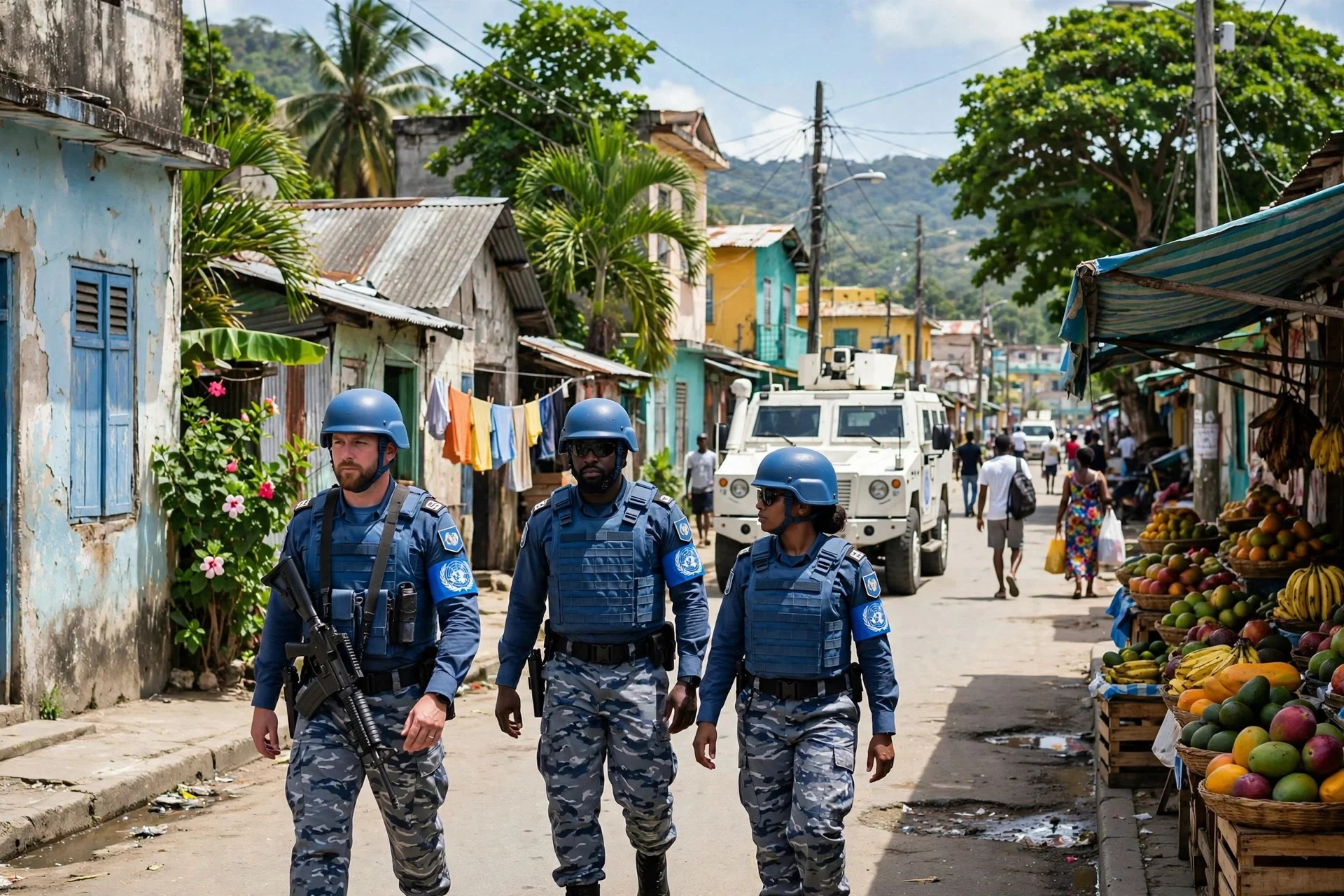
Agentes de seguridad internacional patrullan a pie una calle con casas de colores y palmeras, con un vehículo blindado blanco detrás y un puesto de frutas a un costado de la vía. · Imagen generada para EPM
Haiti asks for an inquiry into those who finance the gangs
A Spanish-speaking Haitian community platform asked President Bukele and the Gang Suppression Force on October 27 to investigate those who provide money…
Cutting off money and weapons, the other battle against Haiti gangs
After four Salvadoran soldiers disappeared on October 18, a Spanish-speaking Haitian community urged Bukele and the Gang Suppression Force to go after the…
--- The context ---
Haiti faces a security crisis in which armed gangs retain the capacity to intimidate the population and carry out attacks, while national authorities and international forces try to contain the violence. Against that backdrop, a Spanish-speaking Haitian community platform argues that the problem does not end with those who carry the weapons, because behind every violent group there are networks supplying money, ammunition and logistical support. Without those resources, the community argues, criminal organizations would lose much of their ability to operate day after day.
--- The facts ---
The statement was released on Tuesday, October 27, and is addressed to Salvadoran President Nayib Bukele and to the Gang Suppression Force. The community asked that any security intervention include investigations into the financial, political and business structures that allegedly facilitate the activities of criminal organizations, and it proposed that operations reach both those who commit the crimes and those who contribute to planning and financing them.
The request follows the disappearance of four Salvadoran soldiers on October 18 in the Croix-des-Bouquets area, north of Port-au-Prince. According to the available information, the troops were carrying out support work when an armed attack took place in the Santo sector, and suspicions point to the possible involvement of the 400 Mawozo gang, although responsibility must be established through the corresponding investigations. The Salvadoran government has demanded answers about the whereabouts of its citizens and has announced measures to strengthen the search operations.
--- The positions ---
The community considers that arresting gang members does not guarantee a lasting solution while the networks that provide them with resources remain active, and it warns that a strategy focused exclusively on armed members could prove insufficient to dismantle the gangs. It therefore calls for examining the supply of weapons and ammunition, the possible intermediaries in those operations and any links with political and business sectors, while noting that the statement does not identify any specific companies or individuals as responsible parties.
--- What remains unknown ---
There are still no parties named with evidence in the statement, and no specific United Nations document is cited in support, although the declaration refers to reports from that body on the networks linked to the crisis. Nor was the circulated claim of a massive deployment of Salvadoran soldiers officially backed: the Gang Suppression Force only confirmed the arrival of a contingent in Port-au-Prince on October 22, intended to support search and security operations in Plaine du Cul-de-Sac, without specifying how many troops it included.
--- Unanswered questions ---
Who provides the money, the weapons and the logistics that keep the gangs operating? What judicial and financial investigations will be opened to identify the intellectual authors and the intermediaries? When will the whereabouts of the four missing soldiers be known, and what responsibility will be proven in that case?
That proposal also looks toward the international cooperation already under way to support the Haitian authorities. The participation of foreign troops raises challenges involving operational coordination, protection of civilians and definition of responsibilities, and the community asks that priorities be expressly broadened within that framework. In its judgment, investigations should not stop at members captured during police or military interventions, but should also identify those who may be facilitating the continuity of criminal activities from other spaces, including the supply and financing circuits that operate far from the street.
--- EPM analysis ---
The value of the appeal lies in shifting the focus from the immediate confrontation toward the conditions that allow violence to reproduce itself. The community itself stresses that operations must respect the rule of law, proceed under legal procedures and offer guarantees to the civilian population, as well as distinguish between people under investigation and those whose involvement has been demonstrated before the courts. That balance between firmness and guarantees is also a practical condition, because solid investigations need evidence, institutional cooperation and judicial procedures capable of turning suspicions into properly proven responsibilities.
There is also a protection dimension that runs through the entire statement and should not be read as decoration. Asking for guarantees for the civilian population and solid legal procedures is asking that the response produce neither new victims nor unproven responsibilities, because a community living under gang intimidation needs security and also reliable justice. That is why the declaration insists on strengthening judicial procedures, so that each inquiry can translate into properly proven responsibilities and so that the distinction between a person under investigation and a proven responsible party is maintained at every stage of the process.
📌 EPM Take: In EPM's view, investigating gang financing is essential if the response in Haiti is to last and not be limited to arrests that support networks can quickly replace. That path requires verifiable evidence, strict respect for legal procedures and effective protection of the civilian population, without naming culprits before the courts have proven them. If operations combine security, financial investigation and guarantees, international cooperation will gain legitimacy and effectiveness. If they remain a purely armed deployment, the problem will stay intact at its economic and logistical root and violence will return.
--- The context ---
Haiti gangs do not survive on armed men in the street alone. They need money to buy equipment, weapons and ammunition to attack, transport and communications to move, and constant logistics to replace whatever they lose in each operation. That is the premise of the appeal released on Tuesday, October 27, by a Spanish-speaking Haitian community platform, which asks that the fight against the gangs also target their rear guard: those who pay, those who supply and those who organize away from the direct confrontation.
--- The facts ---
The message is addressed to the president of El Salvador, Nayib Bukele, and to the Gang Suppression Force, in the context of international cooperation against violence in Haiti. Its central proposal is that operations should reach the intellectual authors of the attacks and the people who provide the resources needed to sustain criminal activities, including the financial, political and business structures that allegedly facilitate them. The community warns that capturing the material perpetrators does not dismantle an organization if its supply chain remains intact.
The immediate trigger was the disappearance of four Salvadoran soldiers on October 18 in Croix-des-Bouquets, north of Port-au-Prince, while they were carrying out support work and an armed attack occurred in the Santo sector. The available information points to suspicions about the possible involvement of the 400 Mawozo gang, with the clarification that responsibility must be established through investigations. The Salvadoran government demanded answers about the whereabouts of its citizens and announced measures to reinforce the search.
--- The positions ---
Against a purely operational reading of the conflict, the community argues that the security and stability of the country require not only fighting those who commit the crimes, but also investigating and sanctioning those who make them possible. That approach also involves strengthening judicial procedures so that inquiries translate into proven responsibilities, and it asks that actions against the gangs be carried out with respect for the rule of law and with guarantees for the civilian population.
--- What remains unknown ---
The statement does not identify any specific company or individual as a financier, and it does not cite a particular United Nations report, although it alludes to work by that body on the networks behind the crisis and to existing documentation on routes used to bring firearms into the country. In parallel, the circulated claim of a massive deployment of Salvadoran soldiers was not backed by official documentation: the mission confirmed the arrival of a contingent in Port-au-Prince on October 22 to support search and security work in Plaine du Cul-de-Sac, without specifying how many troops it comprised.
--- Unanswered questions ---
Will suppliers of weapons and ammunition and their intermediaries be investigated with the same intensity as armed gang members? What concrete results will inquiries produce on the possible political and business links of the gangs? Will the four missing soldiers be found, and will responsibility be established with evidence?
The international cooperation already supporting the Haitian authorities offers the framework in which that offensive against the rear guard should be carried out. The presence of foreign personnel raises challenges of operational coordination, protection of civilians and definition of responsibilities, but it also provides search and security capabilities that the country alone does not bring together at this moment. The community asks that this deployment be used with broader priorities, so that every operation against an armed group is accompanied by intelligence work on the weapons routes, the intermediaries and the money circuits that feed it.
--- EPM analysis ---
The logic of the proposal is that of any serious strategy against organized crime: the armed wing is replaceable, while financing is not replaced with the same ease. Money and supply explain how these organizations function, because they facilitate the acquisition of equipment, transport and communications that sustain their illegal operations. Interrupting those mechanisms, with institutional cooperation and legal tools capable of establishing responsibilities, would prevent support structures from continuing to provide resources even when some members are detained in police or military interventions across the country.
Identifying the possible suppliers would also have an immediate practical effect for the authorities, because it would allow investigations to be directed toward the supply chains used by violent groups instead of pursuing only their perpetrators. The statement itself recognizes that those procedures require evidence, institutional cooperation and legal mechanisms capable of establishing responsibilities, and that requirement does not weaken the offensive, it makes it sustainable. A supply chain dismantled with judicial backing is not rebuilt as easily as a detained cell, and that is exactly the kind of result a security strategy should seek.
📌 EPM Take: In EPM's view, the appeal is right to point out that no security operation will dismantle Haiti gangs while their money, their weapons and their logistics remain beyond the reach of the law. Cutting off that rear guard requires investigating financiers, suppliers and organizers with evidence, sanctioning those found responsible and at the same time maintaining respect for legal procedures. Firmness against the perpetrator must be accompanied by financial and judicial intelligence against whoever sustains him, because that is where the criminal organization is most vulnerable and where a victory can become permanent and real.
Haití pide investigar a quienes financian a las pandillas
Una plataforma comunitaria haitiana hispanohablante pidió el 27 de octubre al presidente salvadoreño y a la Fuerza de Supresión de Pandillas investigar a…
Cortar el dinero y las armas, la otra batalla contra las pandillas
Tras la desaparición de cuatro militares salvadoreños el 18 de octubre, una comunidad haitiana hispanohablante reclamó a Bukele y a la Fuerza de Supresión de…
--- El contexto ---
Haití atraviesa una crisis de seguridad en la que las bandas armadas mantienen capacidad para intimidar a la población y ejecutar ataques, mientras las autoridades nacionales y las fuerzas internacionales intentan contener la violencia. En ese escenario, una plataforma comunitaria haitiana hispanohablante sostiene que el problema no se agota en quienes portan las armas, porque detrás de cada grupo violento operan redes que aportan dinero, municiones y apoyo logístico. Sin esos recursos, argumenta la comunidad, las organizaciones criminales perderían buena parte de su capacidad de funcionamiento cotidiano.
--- Los hechos ---
El pronunciamiento se difundió el martes 27 de octubre y está dirigido al presidente salvadoreño, Nayib Bukele, y a la Fuerza de Supresión de Pandillas. La comunidad pidió que cualquier intervención de seguridad incluya investigaciones sobre las estructuras financieras, políticas y empresariales que presuntamente facilitan las actividades de las organizaciones criminales, y planteó que las operaciones alcancen tanto a quienes ejecutan los delitos como a quienes contribuyen a su planificación y a su financiamiento.
La petición surge después de la desaparición de cuatro militares salvadoreños el 18 de octubre en la zona de Croix-des-Bouquets, al norte de Puerto Príncipe. Según las informaciones disponibles, los efectivos realizaban labores de apoyo cuando se produjo un ataque armado en el sector de Santo, y las sospechas apuntan a la posible participación de la banda 400 Mawozo, aunque la responsabilidad debe establecerse mediante las investigaciones correspondientes. El Gobierno salvadoreño ha exigido respuestas sobre el paradero de sus ciudadanos y ha anunciado medidas para reforzar las operaciones de búsqueda.
--- Las posiciones ---
La comunidad considera que detener a los integrantes de las pandillas no garantiza una solución duradera mientras permanezcan activas las redes que les proporcionan recursos, y advierte de que una estrategia concentrada exclusivamente en los miembros armados podría resultar insuficiente para desarticularlas. Por eso reclama examinar el suministro de armas y municiones, a los posibles intermediarios de esas operaciones y los eventuales vínculos con sectores políticos y empresariales, sin que el comunicado identifique a empresas ni a personas concretas como responsables.
--- Lo que falta saber ---
Todavía no hay responsables señalados con pruebas en el pronunciamiento, ni un documento concreto de Naciones Unidas citado como respaldo, aunque la declaración hace referencia a informes de ese organismo sobre las redes vinculadas a la crisis. Tampoco quedó respaldada oficialmente la afirmación difundida sobre un envío masivo de soldados salvadoreños: la Fuerza de Supresión de Pandillas solo confirmó la llegada de un contingente a Puerto Príncipe el 22 de octubre, destinado a apoyar operaciones de búsqueda y seguridad en Plaine du Cul-de-Sac, sin precisar la cantidad de efectivos que lo integraban.
--- Preguntas sin respuesta ---
¿Quiénes aportan el dinero, las armas y la logística que mantienen operativas a las bandas? ¿Qué investigaciones judiciales y financieras se abrirán para identificar a los autores intelectuales y a los intermediarios? ¿Cuándo se conocerá el paradero de los cuatro militares desaparecidos y qué responsabilidad se comprobará en ese caso?
Ese planteamiento también mira hacia la cooperación internacional ya en marcha para apoyar a las autoridades haitianas. La participación de efectivos extranjeros plantea desafíos de coordinación operativa, de protección de civiles y de definición de responsabilidades, y la comunidad pide que en ese escenario las prioridades se amplíen de forma expresa. A su juicio, las investigaciones no deben detenerse en los integrantes capturados durante intervenciones policiales o militares, sino identificar además a quienes puedan estar facilitando la continuidad de las actividades criminales desde otros espacios, incluidos los circuitos de suministro y de financiamiento que operan lejos de la calle.
--- Análisis EPM ---
El valor del reclamo está en que desplaza el foco desde el enfrentamiento inmediato hacia las condiciones que permiten que la violencia se reproduzca. La propia comunidad subraya que las operaciones deben respetar el Estado de derecho, desarrollarse bajo procedimientos legales y ofrecer garantías a la población civil, además de distinguir entre personas investigadas y responsables cuya participación haya sido demostrada ante la justicia. Ese equilibrio entre firmeza y garantías es también una condición práctica, porque unas investigaciones sólidas necesitan pruebas, cooperación institucional y procedimientos judiciales capaces de convertir las sospechas en responsabilidades debidamente comprobadas.
Hay además una dimensión de protección que atraviesa todo el pronunciamiento y que no debe leerse como un adorno. Pedir garantías para la población civil y procedimientos legales sólidos es pedir que la respuesta no produzca nuevas víctimas ni responsabilidades sin comprobar, porque una comunidad que vive bajo la intimidación de las bandas necesita seguridad y también justicia confiable. Por eso la declaración insiste en fortalecer los procedimientos judiciales, para que cada pesquisa pueda traducirse en responsabilidades debidamente comprobadas y para que la distinción entre investigado y responsable probado se mantenga en cada etapa del proceso.
📌 Conclusion EPM: A juicio de EPM, investigar el financiamiento de las bandas es imprescindible para que la respuesta en Haití sea duradera y no se limite a detenciones que las redes de apoyo pueden reponer con rapidez. Ese camino exige pruebas verificables, respeto estricto a los procedimientos legales y protección efectiva de la población civil, sin señalar culpables antes de que la justicia lo demuestre. Si las operaciones combinan seguridad, investigación financiera y garantías, la cooperación internacional ganará legitimidad y eficacia. Si se quedan en el despliegue armado, el problema seguirá intacto en su raíz económica y logística.
--- El contexto ---
Las pandillas haitianas no se sostienen solo con hombres armados en la calle. Necesitan dinero para comprar equipos, armas y municiones para atacar, transporte y comunicaciones para moverse, y una logística constante que reponga lo que pierden en cada operativo. Esa es la premisa del reclamo difundido el martes 27 de octubre por una plataforma comunitaria haitiana hispanohablante, que pide mirar la guerra contra las bandas desde su retaguardia: quien paga, quien abastece y quien organiza desde fuera del enfrentamiento directo.
--- Los hechos ---
El mensaje está dirigido al presidente de El Salvador, Nayib Bukele, y a la Fuerza de Supresión de Pandillas, en el contexto de la cooperación internacional frente a la violencia en Haití. Su planteamiento central es que las operaciones deben alcanzar a los autores intelectuales de los ataques y a las personas que facilitan los recursos necesarios para mantener las actividades criminales, incluidas las estructuras financieras, políticas y empresariales que presuntamente las facilitan. La comunidad advierte de que capturar a los ejecutores materiales no desarticula la organización si la cadena de suministro sigue intacta.
El detonante inmediato fue la desaparición de cuatro militares salvadoreños el 18 de octubre en Croix-des-Bouquets, al norte de Puerto Príncipe, cuando realizaban labores de apoyo y se produjo un ataque armado en el sector de Santo. Las informaciones disponibles apuntan a sospechas sobre la posible participación de la banda 400 Mawozo, con la precisión de que la responsabilidad debe establecerse en las investigaciones. El Gobierno salvadoreño exigió respuestas sobre el paradero de sus ciudadanos y anunció medidas para reforzar la búsqueda.
--- Las posiciones ---
Frente a una lectura puramente operativa del conflicto, la comunidad defiende que la seguridad y la estabilidad del país requieren no solo combatir a quienes ejecutan los crímenes, sino también investigar y sancionar a quienes los hacen posibles. Ese enfoque contempla fortalecer los procedimientos judiciales para que las pesquisas se traduzcan en responsabilidades comprobadas, y pide que las acciones contra las bandas se desarrollen con respeto al Estado de derecho y con garantías para la población civil.
--- Lo que falta saber ---
El comunicado no identifica a ninguna empresa ni a ninguna persona concreta como financiadora, y tampoco precisa un informe determinado de Naciones Unidas, aunque alude a trabajos de ese organismo sobre las redes de la crisis y al documentación existente sobre rutas de entrada de armas de fuego al país. En paralelo, la afirmación difundida sobre un envío masivo de soldados salvadoreños no quedó respaldada por documentación oficial: la misión confirmó la llegada de un contingente a Puerto Príncipe el 22 de octubre para apoyar la búsqueda y la seguridad en Plaine du Cul-de-Sac, sin precisar cuántos efectivos lo formaban.
--- Preguntas sin respuesta ---
¿Se investigará a los proveedores de armas y municiones y a sus intermediarios con la misma intensidad que a los pandilleros armados? ¿Qué resultados concretos darán las pesquisas sobre los posibles vínculos políticos y empresariales de las bandas? ¿Aparecerán los cuatro militares desaparecidos y se establecerá con pruebas quién fue responsable?
La cooperación internacional que ya apoya a las autoridades haitianas ofrece el marco en el que esa ofensiva contra la retaguardia debería ejecutarse. La presencia de personal extranjero plantea desafíos de coordinación operativa, de protección de civiles y de definición de responsabilidades, pero también aporta capacidades de búsqueda y de seguridad que el país por sí solo no reúne en este momento. La comunidad pide aprovechar ese despliegue con prioridades más amplias, de modo que cada operativo contra un grupo armado venga acompañado de trabajo de inteligencia sobre las rutas de armas, los intermediarios y los circuitos de dinero que lo alimentan.
--- Análisis EPM ---
La lógica del planteamiento es la de cualquier estrategia seria contra el crimen organizado: el brazo armado es reemplazable, la financiación no lo es con la misma facilidad. El dinero y el abastecimiento explican cómo funcionan estas organizaciones, porque facilitan la adquisición de equipos, el transporte y las comunicaciones que sostienen sus operaciones ilegales. Interrumpir esos mecanismos, con cooperación institucional y mecanismos legales que permitan fijar responsabilidades, impediría que las estructuras de apoyo sigan proporcionando recursos aunque algunos integrantes sean detenidos en intervenciones policiales o militares.
Identificar a los posibles proveedores tendría además un efecto práctico inmediato para las autoridades, porque permitiría orientar las investigaciones hacia las cadenas de suministro utilizadas por los grupos violentos en lugar de perseguir únicamente a sus ejecutores. La propia declaración reconoce que esos procedimientos requieren pruebas, cooperación institucional y mecanismos legales que permitan establecer responsabilidades, y esa exigencia no debilita la ofensiva, la hace sostenible. Una cadena de abastecimiento desarticulada con respaldo judicial no se recompone con la misma facilidad que una célula detenida, y ese es exactamente el tipo de resultado que una estrategia de seguridad debería buscar.
📌 Conclusion EPM: A juicio de EPM, el reclamo acierta al señalar que ninguna operación de seguridad desarticulará a las pandillas haitianas mientras su dinero, sus armas y su logística queden fuera del alcance de la ley. Cortar esa retaguardia exige investigar a financiadores, proveedores y organizadores con pruebas, sancionar a quienes resulten responsables y mantener al mismo tiempo el respeto a los procedimientos legales. La firmeza contra el ejecutor debe ir acompañada de inteligencia financiera y judicial contra quien lo sostiene, porque ahí es donde la organización criminal es más vulnerable y donde una victoria puede ser permanente.