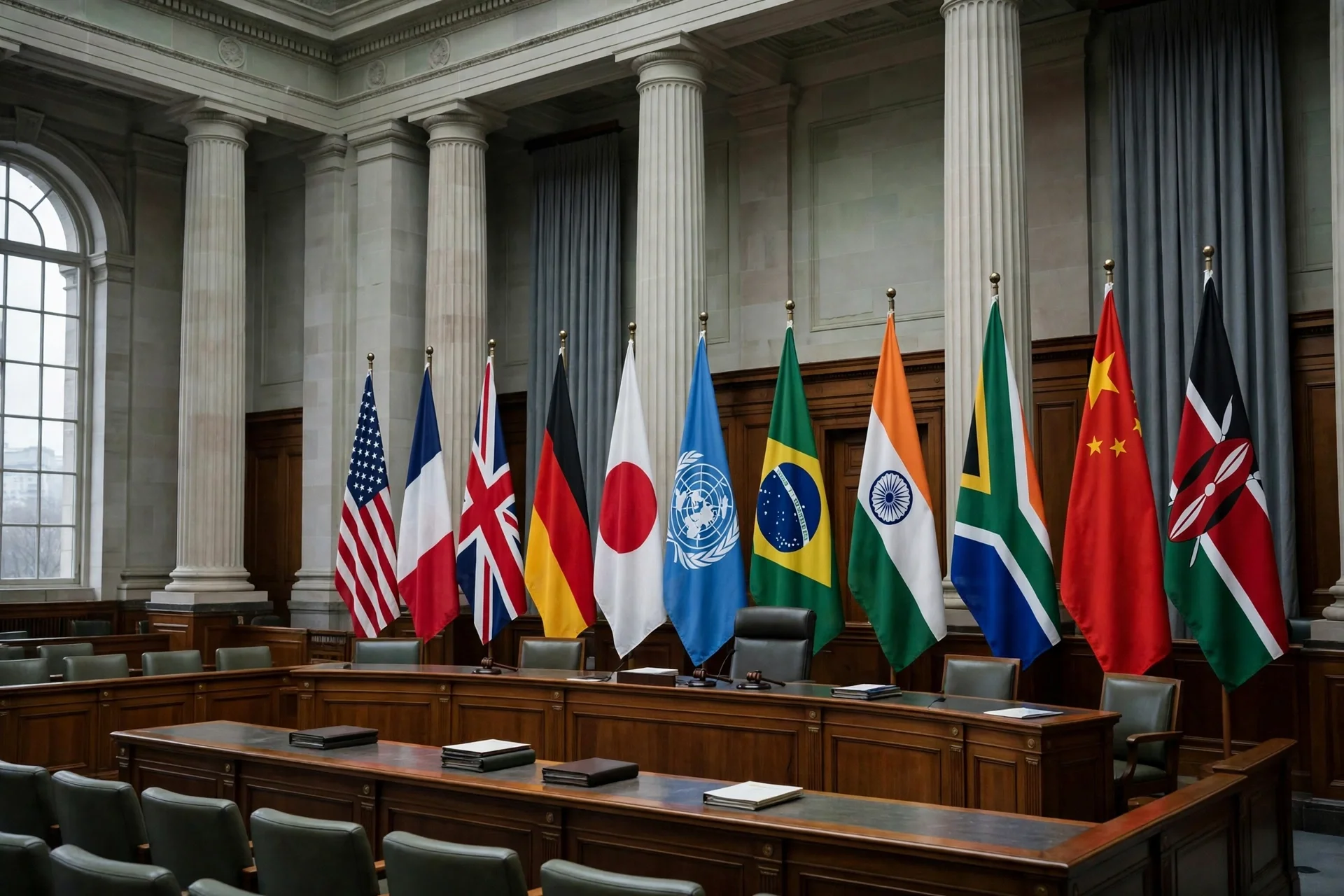
Sala de un tribunal internacional con banderas de varios países. · Imagen generada para EPM
United Kingdom backs Akande for the International Court of Justice
The United Kingdom told the General Assembly it supports Professor Dapo Akande for election to the International Court of Justice on 3 November, backed added…
United Kingdom rejects sanctions against the International Criminal Court
Lord Chancellor Alex Norris defended the authority of the International Court of Justice at the General Assembly, backed Dapo Akande for election on 3 November…
--- The context ---
For eighty years, the International Court of Justice has helped turn the Charter commitment to peaceful settlement into legal reality. It was established in the aftermath of devastating conflict and embodies the conviction that the law must give States an alternative to coercion and force. The British statement describes that conviction as an urgent necessity at a time of conflict, instability and growing pressure on the international legal order.
--- The facts ---
Lord Chancellor Alex Norris delivered the United Kingdom national statement at the General Assembly in response to the annual report of the Court. He thanked President Iwasawa for his address and his leadership of the Court, and the judges and the Registry for their dedicated service. Norris said the United Kingdom is proud to support Professor Dapo Akande for election to the Court on 3 November, noting that his national group nominations carry strong support across every United Nations region. The statement said more States have turned to the Court and participation in its proceedings has grown.
Norris also stressed that the Court turns the Charter commitment to peaceful settlement into legal reality after eighty years of work. He said the United Kingdom has accepted compulsory jurisdiction and urged other States to consider doing so under the Statute, presenting that acceptance as part of steadfast support.
--- The positions ---
The United Kingdom said its support is practical as well as principled. It supported additional resources to meet the Court staffing needs and contributed to the trust fund for its Judicial Fellowship Programme, which helps young jurists from developing countries gain professional experience. Norris also noted that the United Kingdom has accepted the compulsory jurisdiction of the Court and encouraged States that have not yet done so to consider accepting its jurisdiction in accordance with its Statute.
--- What remains unknown ---
The statement does not say how the election on 3 November will end, nor whether more States will follow the British call to accept compulsory jurisdiction. It also does not detail how the additional resources it supported will be distributed, or how many young jurists from developing countries will benefit from the fellowship trust fund in future cycles of the programme.
--- Unanswered questions ---
Will Professor Dapo Akande be elected to the Court on 3 November? Will more States accept compulsory jurisdiction after the British call? Will the additional resources be enough for the Court to manage its growing workload while maintaining the quality and rigour on which its authority depends?
--- EPM analysis ---
The strength of the statement lies in joining support for a candidate with concrete measures on capacity and access. By linking judges of the highest calibre, drawn from different legal traditions, with support for young jurists from developing countries, the United Kingdom presents the legitimacy of the Court as something also built through broad participation and through having sufficient means to sustain a growing workload effectively.
📌 EPM Take: In EPM's view, the British backing for Akande and for the Court carries weight because it goes beyond a statement of principle and adds resources, training for jurists from developing countries and acceptance of compulsory jurisdiction. That combination points toward a court that is both more capable and more representative, a necessary condition if peaceful settlement is to remain a real practice among States that accept settling their differences through law rather than power.
--- The context ---
For eighty years, the International Court of Justice has helped turn the Charter commitment to peaceful settlement into legal reality. The British statement presents the Court as the expression of an ordering idea: relations between States must be governed by law, not merely by power, so that disagreements are placed before an independent judicial body, heard on an equal footing and decided on a determination founded in law rather than power.
--- The facts ---
Lord Chancellor Alex Norris delivered the United Kingdom statement at the General Assembly in response to the annual report of the Court. He thanked President Iwasawa for his address and his leadership, and the judges and the Registry for their dedicated service. Norris announced British support for Professor Dapo Akande for election to the Court on 3 November, stressing that his national group nominations enjoy strong support across every United Nations region. The statement credits Akande with the independence, legal rigour, judgement and breadth of perspective that the Court needs.
He also described Professor Akande as a candidate whose support reaches across every United Nations region through a high number of national group nominations. Norris said that breadth reflects the respect Akande commands across the international legal community and the breadth of perspective he would bring to the Court.
--- The positions ---
The United Kingdom recalled that it has accepted the compulsory jurisdiction of the Court and encouraged States that have not yet done so to consider accepting its jurisdiction in accordance with its Statute. It also said it supported additional resources for staffing needs and contributed to the trust fund for the Judicial Fellowship Programme. In the same address, Norris confirmed that the United Kingdom does not support sanctions against the International Criminal Court, because attempts to impede its work weaken the wider international legal order on which all States rely.
--- What remains unknown ---
The statement does not predict the outcome of the election on 3 November, nor does it say whether other States will accept the compulsory jurisdiction of the Court. It also does not specify the practical reach of the additional resources it supported, or their effect on the capacity of the Court to manage its workload while maintaining the quality and rigour on which its authority depends.
--- Unanswered questions ---
Will Professor Dapo Akande be elected to the Court on 3 November? Will more States answer the British call on compulsory jurisdiction? Can the Court meet sustained and growing demand without losing the quality and rigour on which its authority depends?
--- EPM analysis ---
Read as a defence of order, the strongest element of the address is its support for institutions able to act independently, impartially and with integrity. Backing a candidate for his rigour, accepting compulsory jurisdiction at home and rejecting sanctions against an international court all follow the same idea: the authority of the law is preserved by respecting the rules even when they are demanding, and by sustaining the real capacity of those who must apply them.
📌 EPM Take: In EPM's view, the British position is right to defend the international legal order with verifiable commitments rather than words alone, by accepting compulsory jurisdiction, sustaining the capacity of the Court and rejecting sanctions that would impede the work of the International Criminal Court. Its support for Akande also rests on clear institutional criteria, including his independence and rigour, and on broad support across regions, which strengthens the authority the Court needs.
Reino Unido respalda a Akande para la Corte Internacional de Justicia
Reino Unido respaldó ante la Asamblea General al profesor Dapo Akande para su elección a la Corte Internacional de Justicia el 3 de noviembre, defendió más…
Londres defiende el orden jurídico y respalda a Akande ante la Corte
El Lord Chancellor Alex Norris defendió ante la Asamblea General la autoridad de la Corte Internacional de Justicia, respaldó a Dapo Akande para su elección el…
--- El contexto ---
La Corte Internacional de Justicia lleva ochenta años convirtiendo el compromiso de la Carta de las Naciones Unidas con la solución pacífica de controversias en una realidad jurídica. Nació tras un conflicto devastador y encarna la convicción de que el derecho debe ofrecer a los Estados una alternativa frente a la coerción y la fuerza, una necesidad que el discurso británico describe como urgente en tiempos de conflicto e inestabilidad.
--- Los hechos ---
El Lord Chancellor Alex Norris presentó ante la Asamblea General la declaración nacional británica en respuesta al informe anual de la Corte. Agradeció al presidente Iwasawa su discurso y su liderazgo, y a los jueces y la Secretaría su servicio dedicado a la justicia internacional. Norris afirmó que Reino Unido respalda al profesor Dapo Akande para su elección a la Corte el 3 de noviembre, y destacó que Akande reúne nominaciones de grupos nacionales con apoyo en todas las regiones de las Naciones Unidas. Según la declaración, cada vez más Estados acuden a la Corte y crece la participación en sus procedimientos.
Norris vinculó ese respaldo con la defensa de un orden jurídico más amplio. Confirmó que Reino Unido no apoya sanciones contra la Corte Penal Internacional, porque impedir su trabajo debilita el orden del que dependen todos los Estados, y reiteró que las instituciones internacionales deben actuar con independencia, imparcialidad e integridad.
--- Las posiciones ---
Reino Unido sostuvo que su apoyo a la Corte es práctico además de basado en principios. Recordó que respaldó recursos adicionales para atender las necesidades de personal del tribunal y que aportó al fondo fiduciario de su programa de becas judiciales, que ayuda a jóvenes juristas de países en desarrollo a ganar experiencia profesional. También señaló que Reino Unido aceptó la jurisdicción obligatoria de la Corte e instó a los Estados que aún no lo han hecho a considerar aceptarla conforme a su Estatuto.
--- Lo que falta saber ---
La declaración no detalla el resultado de la elección del 3 de noviembre ni precisa si otros Estados seguirán el llamamiento británico a aceptar la jurisdicción obligatoria. Tampoco detalla cómo se repartirán los recursos adicionales ni cuántos jóvenes juristas se beneficiarán del fondo fiduciario del programa de becas judiciales en los próximos ciclos.
--- Preguntas sin respuesta ---
¿Logrará el profesor Dapo Akande ser elegido para la Corte el 3 de noviembre? ¿Aceptarán más Estados la jurisdicción obligatoria tras el llamamiento de Reino Unido? ¿Bastarán los recursos adicionales para que la Corte atienda una demanda creciente sin perder calidad ni rigor?
--- Análisis EPM ---
El valor de la declaración está en unir el respaldo a una candidatura con medidas concretas de capacidad y acceso. Al vincular la elección de jueces de alto calibre, procedentes de distintas tradiciones jurídicas, con el apoyo a jóvenes juristas de países en desarrollo, Reino Unido presenta la legitimidad de la Corte como algo que se construye con participación y con medios suficientes para sostener su carga de trabajo.
📌 Conclusion EPM: A juicio de EPM, el respaldo británico a Akande y a la Corte gana fuerza porque no se queda en una declaración de principios y suma recursos, formación para juristas de países en desarrollo y aceptación de la jurisdicción obligatoria. Esa combinación apunta a un tribunal más capaz y más representativo, condición necesaria para que la solución pacífica deje de ser una aspiración y siga siendo una práctica real entre Estados que aceptan dirimir sus diferencias con derecho y no con poder.
--- El contexto ---
Durante ochenta años, la Corte Internacional de Justicia ha ayudado a convertir el compromiso de la Carta con la solución pacífica de controversias en una realidad jurídica. La declaración británica la presenta como la expresión de una idea ordenadora: las relaciones entre Estados deben regirse por el derecho y no simplemente por el poder, de modo que las diferencias se escuchen en pie de igualdad ante un órgano judicial independiente.
--- Los hechos ---
El Lord Chancellor Alex Norris expuso ante la Asamblea General la posición de Reino Unido en respuesta al informe anual de la Corte. Agradeció al presidente Iwasawa su discurso y su liderazgo, y a los jueces y la Secretaría su servicio. Norris anunció el respaldo británico al profesor Dapo Akande para su elección a la Corte el 3 de noviembre, y subrayó que sus nominaciones por grupos nacionales cuentan con apoyo en todas las regiones de las Naciones Unidas. La declaración atribuye a Akande la independencia, el rigor jurídico, el juicio y la amplitud de perspectiva que la Corte necesita.
En el mismo discurso, Norris situó la Corte dentro de una trayectoria de ochenta años al servicio de la solución pacífica de controversias. Recordó que el tribunal permite a los Estados someter sus diferencias a un órgano independiente, ser oídos en igualdad y recibir una determinación fundada en el derecho y no en el poder.
--- Las posiciones ---
Reino Unido recordó que ha aceptado la jurisdicción obligatoria de la Corte y animó a los Estados que aún no lo han hecho a considerar aceptarla conforme a su Estatuto. También afirmó que apoyó recursos adicionales para las necesidades de personal y que contribuyó al fondo fiduciario del programa de becas judiciales. En el mismo discurso, Norris confirmó que Reino Unido no apoya sanciones contra la Corte Penal Internacional, porque los intentos de impedir su trabajo debilitan el orden jurídico internacional del que dependen todos los Estados.
--- Lo que falta saber ---
La declaración no adelanta el resultado de la elección del 3 de noviembre ni indica si otros Estados aceptarán la jurisdicción obligatoria de la Corte. Tampoco precisa el alcance práctico de los recursos adicionales respaldados ni el efecto que tendrán sobre la capacidad del tribunal para gestionar su carga de trabajo manteniendo la calidad y el rigor.
--- Preguntas sin respuesta ---
¿Será elegido el profesor Dapo Akande para la Corte el 3 de noviembre? ¿Responderán más Estados al llamamiento británico sobre la jurisdicción obligatoria? ¿Conseguirá la Corte atender una demanda creciente sin perder la calidad y el rigor en los que descansa su autoridad?
--- Análisis EPM ---
Desde una lectura de orden, lo más sólido es su defensa de instituciones que actúan con independencia, imparcialidad e integridad. Respaldar a un candidato por su rigor, aceptar la propia jurisdicción obligatoria y rechazar sanciones contra un tribunal internacional son gestos coherentes con una misma idea: la autoridad del derecho se preserva respetando las reglas incluso cuando resultan exigentes, y sosteniendo la capacidad real de quienes deben aplicarlas.
📌 Conclusion EPM: A juicio de EPM, la posición británica acierta al defender el orden jurídico internacional con hechos verificables y no solo con palabras, al aceptar la jurisdicción obligatoria, sostener la capacidad de la Corte y rechazar sanciones que impidan trabajar a la Corte Penal Internacional. El respaldo a Akande se apoya además en criterios institucionales claros, como su independencia y su rigor, y en un apoyo amplio entre regiones, lo que refuerza la autoridad que el tribunal necesita.