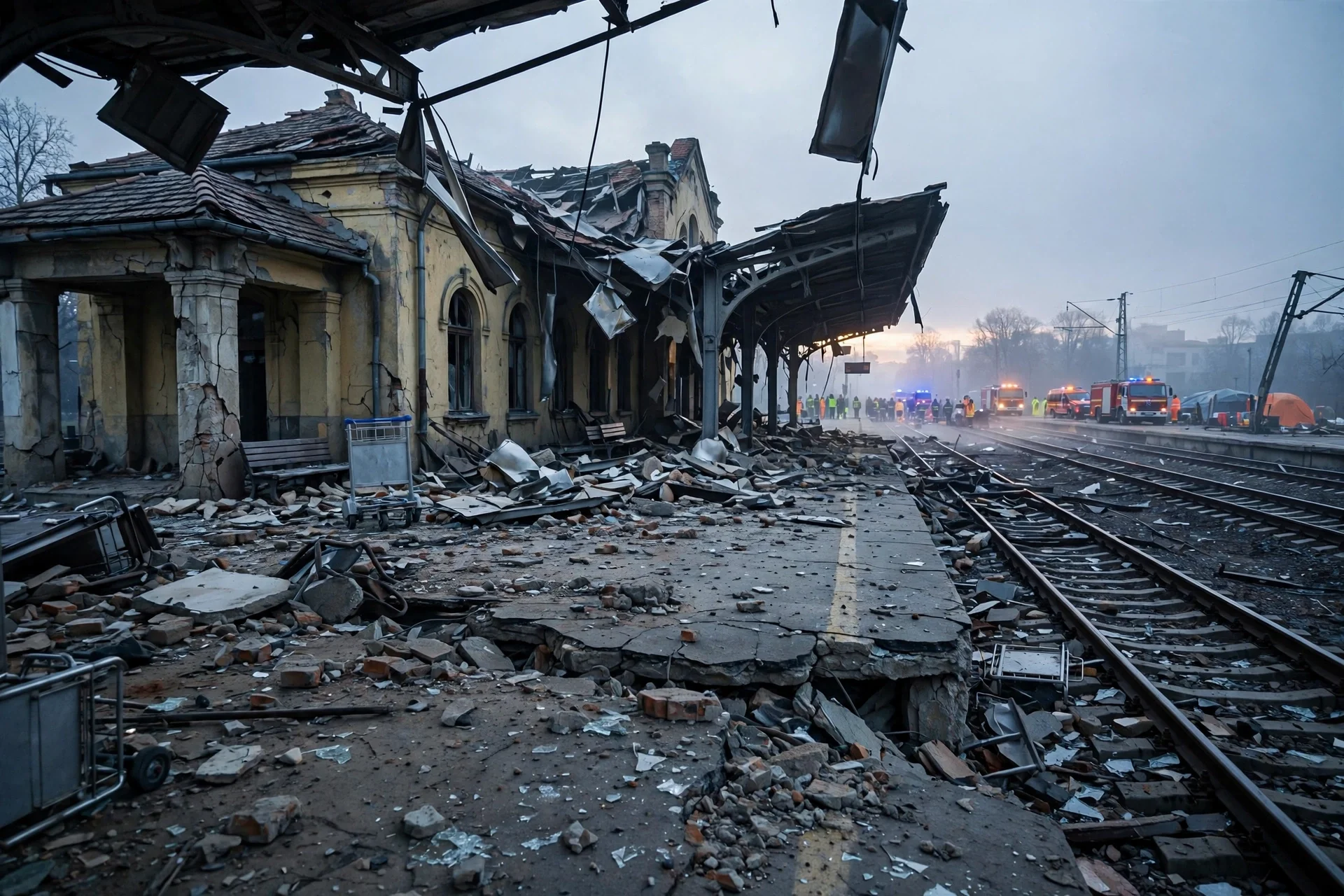
Drone strike on Dnipro railway station kills 13 civilians
A Russian drone strike on Dnipro's main railway station on Thursday killed at least 13 civilians and injured 10 others, including an 11-year-old boy.
Dnipro station drone attack leaves 13 dead and 10 injured
A Russian drone attack on Dnipro's main railway station killed at least 13 civilians and injured 10 on Thursday.
--- The context ---
Train travel is key in Ukraine, but since the start of this year every journey carries increased risk for travellers and railway workers because of Russian military strikes and air alerts.
--- The facts ---
A Russian jet-powered drone struck Dnipro's main railway station on Thursday as a train due to travel to Zaporizhzhia stood at a platform. At least 13 civilians were killed and 10 injured, including an 11-year-old boy, according to regional officials cited in reports.
A transit centre operating at the station was also affected, where displaced people and humanitarian workers were left in shock by the nearby explosions, according to the humanitarian coordinator describing the immediate aftermath of the strike there.
--- The positions ---
The UN humanitarian coordinator for Ukraine condemned the attack and offered condolences to the families. He said civilians preparing to travel or bidding farewell to loved ones faced death and devastation, and that displaced people and humanitarian workers at the transit centre were shocked.
--- What remains unknown ---
The full extent of the damage and the seriousness of every injury remain unknown. Figures from Ukraine's railway operator cited in reports show attacks on railway facilities rising from 1,206 in 2025 to 1,700 so far this year.
--- Unanswered questions ---
How will passengers on platforms be protected? What concrete steps will reduce the risk on every journey? Will what happened at Dnipro station be independently verified?
--- EPM analysis ---
Dnipro follows months of repeated attacks on bridges, hospitals, schools, shopping centres and railway stations. The coordinator warned that these images must not fade, because behind every casualty is a person and a family, and recalled the legal protection of civilian infrastructure.
📌 EPM Take: In EPM's view, a platform is not a target and a farewell should never turn into mourning. When trains, a key means of transport, become risky on every journey, the harm reaches far beyond one station and enters everyday life itself. Remembering that behind every casualty stands a person and a family is not rhetoric: it is the minimum measure against normalising what happened. The drone attack on Dnipro station killed 13 civilians and injured 10 others, including an 11-year-old boy among them.
--- The context ---
Railway stations are civilian infrastructure critical to daily life, alongside bridges, hospitals, schools and shopping centres hit in recent months. Trains are a key means of transport, and risks for travellers and workers have grown this year.
--- The facts ---
On Thursday, a Russian jet-powered drone hit Dnipro's main station while a train bound for Zaporizhzhia stood at a platform. At least 13 civilians were killed and 10 were injured, including an 11-year-old boy, according to regional officials cited in reports.
The strike also reached a wider pattern described in recent months, with repeated attacks across the country on bridges, hospitals, schools, shopping centres and railway stations that remain critical to daily civilian life in Ukraine.
--- The positions ---
The UN's top humanitarian official in Ukraine condemned the strike and expressed condolences to the families. He said displaced people and humanitarian workers at a transit centre were left in shock, and stressed that civilians and civilian infrastructure are protected under international humanitarian law.
--- What remains unknown ---
The scale of the damage and the condition of all the injured remain unclear. According to figures from Ukraine's railway operator cited in reports, attacks on railway facilities rose from 1,206 in 2025 to 1,700 so far this year.
--- Unanswered questions ---
Who will answer for an attack on civilians at a station? What protection will platforms and transit centres receive? Will there be verifiable consequences when protected infrastructure is struck?
--- EPM analysis ---
The gravity also lies in the place itself: a point of departure, arrival and farewell. The coordinator insisted that behind every casualty is a person, a family and a future changed forever, and noted that railway safety has deteriorated steadily.
📌 EPM Take: In EPM's view, the protection of civilians and civilian infrastructure admits no qualifications and no weary repetition: it is an obligation. If attacks on railway facilities rose from 1,206 in 2025 to 1,700 this year, that trend demands concrete, verifiable responses, not condemnation alone. A safe journey should be the normal expectation, and guaranteeing it is the test of whether humanitarian law still commands respect. In Dnipro, the drone strike killed 13 civilians and injured 10 others, including an 11-year-old boy among the injured.
Ataque con dron en la estación de Dnipro deja 13 muertos
Un dron ruso impactó el jueves en la estación principal de Dnipro y dejó al menos 13 civiles muertos y 10 heridos, entre ellos un niño de 11 años.
Estación de Dnipro atacada: 13 civiles muertos y 10 heridos
El ataque ruso con dron contra la estación principal de Dnipro dejó al menos 13 muertos y 10 heridos el jueves.
--- El contexto ---
Viajar en tren es clave en Ucrania, pero desde comienzos de año cada trayecto implica más riesgo para pasajeros y ferroviarios por los ataques militares rusos y las alertas aéreas.
--- Los hechos ---
Un dron ruso de propulsión a reacción impactó el jueves en la estación principal de Dnipro cuando un tren hacia Zaporizhzhia estaba en un andén. Murieron al menos 13 civiles y 10 resultaron heridos, entre ellos un niño de 11 años, según funcionarios regionales citados.
En la misma estación funcionaba un centro de tránsito donde personas desplazadas y trabajadores humanitarios quedaron en shock tras las explosiones cercanas, según relató el coordinador humanitario al describir el impacto inmediato del ataque sobre quienes se encontraban allí.
--- Las posiciones ---
El coordinador humanitario de la ONU para Ucrania condenó el ataque y dio condolencias a las familias. Señaló que civiles que viajaban o despedían a seres queridos afrontaron muerte y devastación, y que desplazados y humanitarios del centro de tránsito quedaron conmocionados.
--- Lo que falta saber ---
No se conoce el detalle completo de los daños ni la gravedad de todos los heridos. Las cifras del operador ferroviario citadas indican que los ataques contra instalaciones ferroviarias pasaron de 1,206 en 2025 a 1,700 este año.
--- Preguntas sin respuesta ---
¿Cómo se protegerá a los pasajeros en los andenes? ¿Qué medidas reducirán el riesgo en cada viaje? ¿Habrá una verificación independiente de lo ocurrido en Dnipro?
--- Análisis EPM ---
Dnipro se suma a meses de ataques contra puentes, hospitales, escuelas, centros comerciales y estaciones. El coordinador advirtió que estas imágenes no deben desvanecerse, porque detrás de cada víctima hay una persona y una familia, y recordó la protección legal de la infraestructura civil.
📌 Conclusion EPM: A juicio de EPM, un andén no es un objetivo y una despedida no debería convertirse en duelo. Cuando el tren, medio clave para desplazarse, queda expuesto en cada viaje, el daño supera la estación alcanzada y alcanza la vida cotidiana entera. Recordar que detrás de cada víctima hay una persona y una familia no es retórica: es la medida mínima para no normalizar lo ocurrido. 13 civiles muertos y 10 heridos, entre ellos un niño de 11 años, confirman esa urgencia de protección.
--- El contexto ---
Las estaciones son infraestructura civil crítica, como puentes, hospitales, escuelas y centros comerciales golpeados en meses recientes. El tren es un medio clave, y pasajeros y ferroviarios enfrentan riesgos crecientes este año.
--- Los hechos ---
El jueves, un dron ruso de propulsión a reacción alcanzó la estación principal de Dnipro mientras un tren hacia Zaporizhzhia permanecía en un andén. Murieron al menos 13 civiles y 10 resultaron heridos, entre ellos un niño de 11 años, según funcionarios regionales citados.
El impacto ocurrió mientras el tren permanecía detenido en el andén y los viajeros se encontraban en la estación, en un país donde viajar en tren sigue siendo un medio clave de transporte diario.
--- Las posiciones ---
El máximo responsable humanitario de la ONU en Ucrania condenó el hecho y expresó condolencias a las familias. Indicó que desplazados y trabajadores humanitarios del centro de tránsito quedaron conmocionados, y subrayó que civiles e infraestructura civil están protegidos por el derecho humanitario.
--- Lo que falta saber ---
Falta precisar la magnitud de los daños y la evolución de los heridos. Según cifras citadas del operador ferroviario, los ataques contra sus instalaciones subieron de 1,206 en 2025 a 1,700 en lo que va de este año.
--- Preguntas sin respuesta ---
¿Quién responderá por un ataque contra civiles en una estación? ¿Qué protección tendrán andenes y centros de tránsito? ¿Habrá consecuencias verificables cuando se golpee infraestructura protegida?
--- Análisis EPM ---
La gravedad está también en el lugar: un punto de partida, llegada y despedida. El coordinador insistió en que detrás de cada víctima hay una persona, una familia y un futuro cambiado, y en que la seguridad ferroviaria se deteriora de forma sostenida.
📌 Conclusion EPM: A juicio de EPM, la protección de civiles e infraestructura civil no admite matices ni repeticiones cansadas: es una obligación. Si los ataques contra instalaciones ferroviarias subieron de 1,206 en 2025 a 1,700 este año, la tendencia exige respuestas concretas y verificables, no solo condenas. Cada viaje seguro debería ser lo normal, y garantizarlo es la prueba de que el derecho humanitario todavía manda. El ataque con dron en Dnipro dejó 13 civiles muertos y 10 heridos, incluido un niño de 11 años.