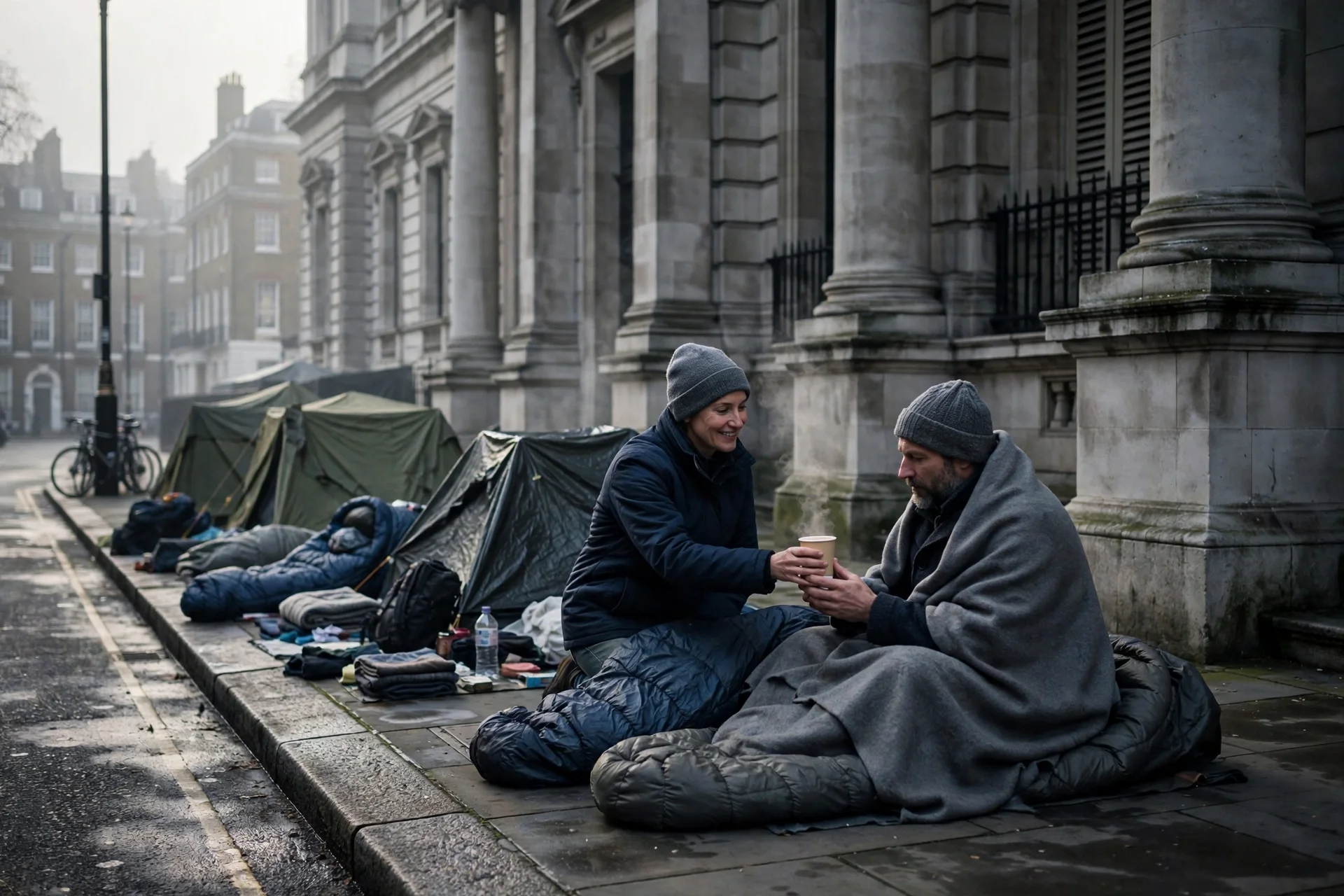
Burnham pledges a route off the streets for every person this year
British Prime Minister Andy Burnham told the first rough sleeping summit at Downing Street that the drive will be permanent, backed by the whole government and…
Burnham argues leaving people on streets costs more than helping them
Andy Burnham set out a permanent drive against rough sleeping at Downing Street, with an offer of help for every person by the end of the year.
--- The context --- British Prime Minister Andy Burnham hosted the first summit on rough sleeping at Downing Street, bringing into the most powerful place in the country a conversation about people who often feel forgotten and are walked past daily. He asked those present to pause on the moment's significance, because the message that somebody cares enough to act could itself reach people sleeping outside. Around the room sat the charitable sector, community volunteers, private sector colleagues, local government and the faith sector.
Burnham spoke a little over three months after arriving at Downing Street, having promised to put care at the heart of government. His framing was that if a country gets things right for those facing the biggest challenges, it will get them right for everybody. He also insisted that Britain need not accept nightly rough sleeping as fixed, recalling that the problem was tackled before and can be fixed again when the country pulls in one direction.
--- The facts --- The central pledge is that the drive will be permanent for as long as Burnham and his government remain in place. It will not be, he said, a passing initiative that comes and goes, but a sustained effort similar to the one seen in the 2000s, led from the front and backed by available money. Within that frame sits an immediate commitment: this year, everybody sleeping rough will be offered a route away from the street, with help reaching every person by year's end.
Burnham stressed that the offer is only the beginning, because what follows next year matters too, and planning must rest on confidence that support will not be withdrawn. Delivery rests on a whole government approach, raised at Cabinet repeatedly with buy-in from all departments, and on a whole society approach adding local government, charities, volunteers, business and faith communities. No single organisation, he warned, can claim to know everything about solving a problem bigger than any one of them but smaller than all of them together.
--- The positions --- The method comes from his years leading Greater Manchester, summed up in a mantra he now makes national: names not numbers. Start with the name, the individual in front of you, and build from there. The focus is recovery for people who have often suffered trauma, a journey that cannot be given a fixed timeframe because it differs for everybody, and one that depends on trust, which faith organisations are especially able to build. Every person, he argued, is capable of recovery, and the job of the state and society is to help them along that journey.
He named the people behind the work. Keely, from The Brick in Wigan, was praised for rallying others. Angela was credited for work alongside Flo, the Homelessness Minister, and her team that made the confident offer possible, and Burnham backed what had been heard from Lorna and from Louise, who had said the country had done this before. Kevin Lee was recognised for organising the event, the Reverend Ian Rutherford for chairing the Greater Manchester action network, and Councillor Eamonn O'Brien, of the local government association.
--- What remains unknown --- The speech contained no spending figures, no count of people to be reached and no intermediate milestones before the end of the year. That leaves open how the offer will be verified, and what evidence will show it reached people who move between places or are hardest to contact. Burnham did point to one lesson from Manchester: the city council assessed people under care legislation instead of homelessness legislation and, in the vast majority of cases, found an obligation to support them, afterwards working with pretty much everybody who came through the door.
Whether that legal route becomes national practice was not spelled out, and nor was the follow-up for people who cannot take up an offer straight away. The prime minister accepted that not everybody will be able to accept help or turn their life around immediately, while arguing that receiving the offer itself brings hope that something will change in the new year. The gap between an offer made and a recovery sustained is where this policy will be tested, and the speech left its management to the departments, councils and charities delivering it.
--- Unanswered questions --- How will the British government prove that every person sleeping rough actually received an offer of help before the year ends? What happens the following year to those who accepted, and how many times will help be re-offered to those who did not? Will councils across the country adopt the care legislation route that Manchester used, or will it remain a local choice? What formal role will faith groups and volunteers hold in delivery, and who is accountable when a named person falls through the gaps between services?
--- EPM analysis --- The most consequential move in the speech is the refusal to treat rough sleeping as a communications exercise. By declaring the drive permanent and tying it to his arrival promise of three months ago, Burnham makes retreat politically expensive, which short-lived initiatives never do. The names principle reinforces that lock, because a system organised around named individuals cannot quietly redefine success in aggregate statistics. It also changes the moral geometry: the person on the street stops being scenery and becomes the starting point from which every service must justify itself.
The risk is equally clear. A universal offer is a promise made to people whose lives rarely follow administrative timetables, and the honesty about trauma and open-ended recovery sits in tension with a fixed end-of-year deadline for the offer itself. That tension can be productive if the deadline disciplines the offer while the open timeframe governs the support. It becomes damaging only if the deadline starts governing recovery too, pushing people through processes for the count. The summit's own mantra supplies the test: if names remain attached to outcomes, the policy is working as designed.
📌 EPM Take: In EPM's view, this summit matters because it replaces pity with a dated duty: an offer of help for every person this year and a permanent effort behind it. Centring recovery, without fixed deadlines for people who have suffered trauma, respects the reality that leaving the street is a journey rather than a transaction. The promise must now survive contact with delivery, with named people tracked, supported and counted honestly after the cameras leave. Judged by its own standard, success will look like names with doors opening, not a ceremony remembered kindly by everyone who attended it.
--- The context --- Prime Minister Andy Burnham used the first rough sleeping summit at Downing Street to argue that a wealthy country should not normalise people sleeping on its streets nightly. The room held the charitable and voluntary sectors, private sector colleagues, local government and faith representatives, a breadth Burnham presented as national resolve waiting to be organised. He reminded the audience that he had stood outside Downing Street a little over three months earlier promising to put care at the heart of government, and framed the summit as that promise's hardest test.
His case drew on his time as Mayor of Greater Manchester, where he said he learned what actually moves people off the street. The lesson he carried into national government is that the problem was tackled before, in the 2000s, and can be solved again if everyone faces the same way. He cast the summit as a focal point to rally around and a statement of national character: a country better than the daily sight of people in doorways, capable of fixing a problem many citizens are told is beyond repair.
--- The facts --- The commitments are specific in aim and horizon. The effort will be permanent while this government lasts, comparable to the drive of the 2000s rather than a temporary initiative. Burnham promised to lead from the front and confirmed the money is there. This year, everybody sleeping rough will be offered a route away from the street, so that by the end of the year every single person has received an offer of help. He was equally clear that the mission does not end with that offer: what comes next year matters just as much.
Structurally, the plan runs on whole government and whole society approaches combined. The issue has been raised at Cabinet repeatedly and has buy-in from all departments, so no part of the state can treat rough sleeping as somebody else's file. Around government sits the wider network of councils, charities, volunteers, businesses and faith groups, on the reasoning that the problem is bigger than any single organisation but beatable by all of them together. Burnham named Kevin Lee, who helped organise the event, and Councillor Eamonn O'Brien, chair of the local government association.
--- The positions --- The hardest-edged argument in the speech was financial. Leaving people sleeping rough, Burnham said, works for nobody and not for the public purse, because people on the street move in and out of emergency departments and hospital beds. There is, as he relayed to the room, a rock-solid business case for ending homelessness and putting people on a path to recovery so they can contribute again. His instruction to anyone told the country cannot afford to act was blunt: it cannot afford not to, since inaction wastes public resources and, worse, people's potential.
The working method is compressed into the mantra he brought from Greater Manchester and now adopts nationally: names not numbers. Officials and charities are to start from the individual, earn that person's trust, and support a recovery from trauma with no fixed timetable. He credited Keely of The Brick in Wigan, Angela and Flo, the Homelessness Minister, for preparing the offer, and backed Lorna and Louise. The Reverend Ian Rutherford, who chaired the Greater Manchester action network, was thanked for the faith sector's role in building trust.
--- What remains unknown --- For all its clarity of aim, the speech offered no figures: no cost, no headcount and no checkpoints before the deadline. The business case, though described as rock-solid, was argued in principle rather than demonstrated, so taxpayers must trust the arithmetic without seeing the ledger. Verification will therefore depend on what the government publishes later, and on whether the offer is recorded person by person in a way that survives outside scrutiny.
The other open question is legal and local. Manchester City Council judged cases under care legislation rather than homelessness legislation and found, in most cases, an obligation to support the person, then worked with pretty much everybody who presented. Burnham regards that switch as a game changer, but did not say whether councils nationwide will be directed, funded or merely encouraged to follow it. He also conceded that not everybody will take up the offer at once, which raises the question of how persistent follow-up will be in individual cases.
--- Unanswered questions --- Will the British government publish a verifiable count of offers made and accepted when the year closes? What will the programme cost in total, and how will the claimed saving on emergency and hospital care be demonstrated? Will every council be expected to apply the care legislation test that Manchester used, and who pays where duties expand? For people who refuse an offer, how many further attempts will be made, over what period, and by which named service responsible for their case?
--- EPM analysis --- The strength of this speech is that it argues from cost and duty at once, refusing to let either cancel the other. Compassion alone rarely survives a spending round; arithmetic alone rarely motivates a volunteer. By fusing them, Burnham gives taxpayers a reason, charities a mandate and departments an instruction, all inside one commitment with a date attached. Declaring the effort permanent matters institutionally, because social policy is littered with pilots that ended just as local teams learned to make them work.
The discipline now required is unglamorous: consistent recording, the same tests in every council, and honest publication of results. The names principle, properly used, is an accountability device as much as a philosophy, because a named person cannot be averaged away. If the end-of-year reckoning names outcomes rather than rounding them, this could become a model of how a state finishes a job. If it arrives as a rounded percentage with no trail back to individuals, the mantra will read as decoration. The government has set its own standard, a refreshingly checkable one.
📌 EPM Take: In EPM's view, the most persuasive line in this speech is the simplest: leaving people on the street is the expensive option, in money and in wasted lives. A permanent commitment with an end-of-year test gives taxpayers and charities something rare in social policy, a promise that can actually be audited. What must follow is plain administration done well: the same legal test applied fairly, every offer recorded against a name, and results published without varnish. If that discipline holds, the summit will be remembered for delivery rather than for the warmth of its applause.
Burnham promete una vía de salida de la calle para cada persona este año
El primer ministro británico, Andy Burnham, anunció en la primera cumbre sobre personas que duermen en la calle que el esfuerzo será permanente, con respaldo…
Burnham defiende que sacar a la gente de la calle cuesta menos que dejarla
Andy Burnham presentó en Downing Street un plan permanente contra el dormir en la calle con una meta para fin de año: una oferta de ayuda para cada persona.
--- El contexto --- El primer ministro británico, Andy Burnham, reunió en Downing Street la primera cumbre dedicada a las personas que duermen en la calle, un encuentro pensado para poner en el centro del poder a quienes a menudo se sienten olvidados. Burnham pidió detenerse un minuto en el significado del momento: el lugar más poderoso del país abría sus puertas para hablar de las personas con mayores dificultades, y ese gesto ya envía un mensaje de que a alguien le importa.
En la sala se reunieron representantes del sector caritativo y del voluntariado comunitario, del sector privado, de los gobiernos locales y del sector de fe, Burnham recordó que llegó a Downing Street hace poco más de tres meses y que entonces anunció que pondría el cuidado de las personas en el corazón del Gobierno. También sostuvo que si el país acierta con quienes enfrentan los mayores desafíos, acertará con todo el mundo.
--- Los hechos --- El compromiso central anunciado es doble. Por un lado, el esfuerzo será permanente mientras Burnham y su Gobierno sigan en el cargo: no será una iniciativa pasajera de las que llegan y se van, sino un impulso continuo comparable al que se vio en los años 2000, con el primer ministro liderando desde el frente y el dinero disponible. Por otro lado, este año se ofrecerá a cada persona que duerme en la calle una vía para salir de esa situación, una oferta de ayuda concreta antes de que termine el año.
Burnham subrayó que lo decisivo no es solo la oferta de este año, sino lo que viene después, porque el planteamiento es de largo plazo y exige constancia. Para hacerlo posible anunció un enfoque de todo el Gobierno: el asunto se ha planteado varias veces en el Gabinete y cuenta con el respaldo de todos los departamentos. A ese enfoque se suma uno de toda la sociedad, con gobiernos locales, organizaciones comunitarias y entidades de fe trabajando en la misma dirección.
--- Las posiciones --- La posición del Gobierno británico quedó resumida en un lema que Burnham trajo de su etapa al frente de Greater Manchester y que ahora convierte en mantra nacional: names not numbers, nombres y no números. Partir de la persona concreta y de su historia es, para el primer ministro, el punto de partida que hace posible todo lo demás, incluida la confianza para iniciar el camino de salida de la calle. El foco, insistió, está en la recuperación de personas que han sufrido traumas, un recorrido que no admite plazos fijos porque será distinto para cada persona.
En la cumbre se reconocieron trayectorias concretas. Burnham destacó a Keely, de la organización The Brick en Wigan, por su capacidad de movilizar apoyos; a Angela, por el trabajo junto a Flo, la ministra responsable de vivienda y de las personas sin hogar, para poder anunciar la oferta de este año; y a Lorna y Louise, a quienes respaldó por completo. También citó a Kevin Lee, que ayudó a organizar el encuentro; al reverendo Ian Rutherford, que presidió la red de acción contra la falta de vivienda de Greater Manchester; y al concejal Eamonn O'Brien, presidente de la asociación de gobiernos locales.
--- Lo que falta saber --- La intervención no detalló montos económicos, cifras de personas afectadas ni calendarios intermedios de ejecución, y tampoco precisó cómo se medirá que la oferta llegue a cada persona. Burnham sí aportó una experiencia de Mánchester que considera un cambio de reglas: el ayuntamiento dejó de valorar los casos bajo la ley de personas sin hogar y pasó a usar la ley de cuidados, y en la gran mayoría de los casos encontró una obligación de apoyar a quienes acudían.
Ese precedente plantea una pregunta práctica: si el marco con el que se juzga cada caso cambia los resultados, extender ese enfoque exigiría decisiones que el discurso no desarrolló. Tampoco se concretó qué ocurre cuando una persona no acepta la oferta o no puede aprovecharla de inmediato; el propio primer ministro reconoció que no todo el mundo podrá aceptar la ayuda ni transformar su vida al primer intento, aunque defendió que recibir la oferta siembra esperanza de que algo cambiará.
--- Preguntas sin respuesta --- ¿Cómo verificará el Gobierno británico que cada persona que duerme en la calle ha recibido realmente una oferta de ayuda antes de que acabe el año? ¿Qué seguimiento existirá el año próximo para quienes acepten esa oferta y para quienes la rechacen o no puedan aprovecharla? ¿Se extenderá al resto del país el uso del marco de cuidados que Mánchester aplicó en lugar del marco de vivienda? ¿Qué papel formal tendrán las organizaciones de fe y del voluntariado en la ejecución diaria del plan?
--- Análisis EPM --- El giro más relevante del discurso es institucional antes que retórico. Al declarar el esfuerzo permanente, Burnham intenta sacar el problema de la lógica de los anuncios breves y colocarlo entre las políticas que sobreviven a los ciclos de noticias. La referencia a los años 2000 funciona como ancla histórica: ya se hizo antes, viene a decir, y puede volver a hacerse. El lema de los nombres ordena además el método, porque obliga a responder ante personas concretas y no ante estadísticas que diluyen responsabilidades.
La apuesta tiene también una dimensión de credibilidad personal. Burnham construye el compromiso desde su experiencia municipal en Greater Manchester y desde la promesa que hizo al llegar a Downing Street hace poco más de tres meses, de modo que su reputación queda atada al resultado de fin de año. Si la oferta se cumple y se sostiene, la cumbre habrá marcado un punto de inflexión verificable; si se queda en ceremonia, el contraste con la calle será el reproche más duro. Por eso el propio discurso se impone una vara de medir: hechos tangibles para cada persona, no solo un titular de un día.
📌 Conclusion EPM: A juicio de EPM, el valor de esta cumbre está en que convierte una promesa en una obligación fechada: ofrecer ayuda a cada persona antes de fin de año y mantener el esfuerzo después. La mirada centrada en la recuperación, sin plazos impuestos a quien ha sufrido un trauma, corrige el error de tratar la calle como un trámite. Ahora corresponde sostener la palabra con seguimiento público, nombres atendidos y continuidad real cuando la atención se apague, porque una oferta que no se repite ni se comprueba corre el riesgo de quedarse en gesto. La vara ya está puesta y es medible para todos.
--- El contexto --- El primer ministro británico, Andy Burnham, presidió en Downing Street la primera cumbre sobre personas que duermen en la calle, ante representantes del sector caritativo, del voluntariado, de la empresa privada, de los gobiernos locales y de las comunidades de fe. Burnham enmarcó el encuentro como una declaración de intenciones sobre el tipo de país que Reino Unido quiere ser: uno que no acepta que nadie duerma a la intemperie cada noche y que considera el problema solucionable, como ya ocurrió en el pasado.
El primer ministro recordó su trayectoria como alcalde de Greater Manchester, donde abordó el problema durante años, y su llegada a Downing Street hace poco más de tres meses, cuando se comprometió a poner el cuidado de las personas en el centro del Gobierno. Desde esa experiencia defendió que el esfuerzo no nace de la improvisación, sino de lecciones aprendidas, y que la presencia de tantos sectores demuestra que existe una base social amplia dispuesta a remar en el mismo sentido si el Gobierno mantiene una dirección clara.
--- Los hechos --- Lo anunciado es concreto en su objetivo y en su plazo: este año cada persona que duerme en la calle recibirá una oferta de ayuda, una vía para abandonar esa situación. Burnham prometió liderar desde el frente, aseguró que el dinero está disponible y garantizó que el impulso será permanente mientras dure su Gobierno, al modo del esfuerzo de los años 2000, y no una iniciativa temporal. También advirtió de que lo importante no termina con la oferta inicial: lo que sigue el año próximo forma parte del compromiso.
El plan se apoya en dos pilares organizativos. El primero es un enfoque de todo el Gobierno: la cuestión se ha elevado varias veces al Gabinete con respaldo de todos los departamentos, de modo que la respuesta no dependerá de un solo ministerio. El segundo es un enfoque de toda la sociedad, que suma a gobiernos locales, sector caritativo y voluntario, sector privado y organizaciones de fe. Burnham insistió en que ninguna organización conoce por sí sola toda la solución y en que el problema solo puede superarse con una red que trabaje unida.
--- Las posiciones --- Junto al componente humano, el primer ministro presentó un argumento de pura eficiencia del gasto: dejar a las personas en la calle sale más caro. Quien duerme a la intemperie entra y sale de urgencias y de las camas de hospital, con un coste que hace de la inacción la opción derrochadora. Su encargo a los presentes fue responder a quien diga que no se puede pagar esta política que lo que no se puede pagar es no hacerla, porque no actuar desperdicia recursos públicos y el potencial de las personas.
El método de trabajo que propuso resume la experiencia de Mánchester en un lema de tres palabras que ahora eleva a principio nacional: names not numbers, nombres y no números. La idea es empezar por la persona que se tiene delante, construir confianza con ella, sobre todo mediante las organizaciones comunitarias y de fe, y acompañarla en su recuperación tras el trauma, sin plazos artificiales. Burnham nombró a Keely, de The Brick en Wigan; a Angela y a Flo, la ministra responsable del área; a Lorna, Louise y Kevin Lee; al reverendo Ian Rutherford; y al concejal Eamonn O'Brien, al frente de la asociación de gobiernos locales.
--- Lo que falta saber --- El discurso no incluyó cifras de gasto, ni el número de personas a las que se espera alcanzar, ni mecanismos públicos de rendición de cuentas con fechas intermedias. Esa ausencia importa porque el argumento financiero del plan, que intervenir cuesta menos que no intervenir, se presentó sin desglose que permita comprobarlo. La credibilidad del compromiso descansará en los resultados del balance de fin de año y en que la oferta sea rastreable caso a caso.
También quedó sin desarrollar el instrumento jurídico que Mánchester usó como palanca: el ayuntamiento valoró los casos con la ley de cuidados en lugar de la ley de personas sin hogar y encontró, en la gran mayoría de los casos, una obligación de apoyar al solicitante. Si ese criterio se generaliza, tendrá consecuencias para los ayuntamientos que el discurso no detalló. Burnham admitió además que no todas las personas aceptarán la oferta ni podrán cambiar su vida de inmediato, aunque sostuvo que la oferta en sí misma ya aporta esperanza.
--- Preguntas sin respuesta --- ¿Publicará el Gobierno británico un balance verificable de cuántas personas recibieron la oferta y cuántas la aceptaron al cierre del año? ¿Qué coste total tendrá el programa y cómo se demostrará el ahorro frente al gasto en urgencias y hospitales? ¿Asumirán todos los ayuntamientos el criterio de la ley de cuidados que aplicó Mánchester o seguirá siendo una decisión local? ¿Qué ocurrirá con las personas que rechacen la ayuda: habrá nuevos intentos y con qué frecuencia se repetirán?
--- Análisis EPM --- El discurso acierta al no vender la política como un gasto compasivo sino como una corrección de un despilfarro. Ese encuadre importa: difícilmente se defiende pagar más por el peor resultado, que es lo que ocurre cuando una persona rota entre la calle, urgencias y el hospital. Al atar la permanencia a su mandato y al respaldo del Gabinete, Burnham eleva el coste político de abandonarlo, algo que las iniciativas breves nunca hacen.
Queda, no obstante, la prueba que separa un plan de un discurso: la ejecución local. La red celebrada es fortaleza si hay coordinación y debilidad si cada actor mide su éxito por separado. El lema de los nombres puede convertirse en el mejor sistema de control, porque una persona con nombre propio no desaparece de una estadística. Si a fin de año cada caso tiene nombre, oferta registrada y seguimiento abierto, el país habrá ganado un modelo; si el balance llega en cifras redondas y sin nombres, el propio lema se volverá contra sus autores.
📌 Conclusion EPM: A juicio de EPM, lo más sólido de la propuesta es su lógica de orden y de cuentas: cuesta más abandonar a una persona en la calle que ayudarla a salir, y un Estado serio no financia el fracaso más caro. El compromiso permanente y la meta de fin de año crean además una obligación comprobable, algo poco frecuente en política social. La exigencia ahora es de gestión, no de discurso: registros claros, ayuntamientos alineados y resultados publicados con la misma franqueza con la que se anunció el plan en esta cumbre histórica para el país entero.