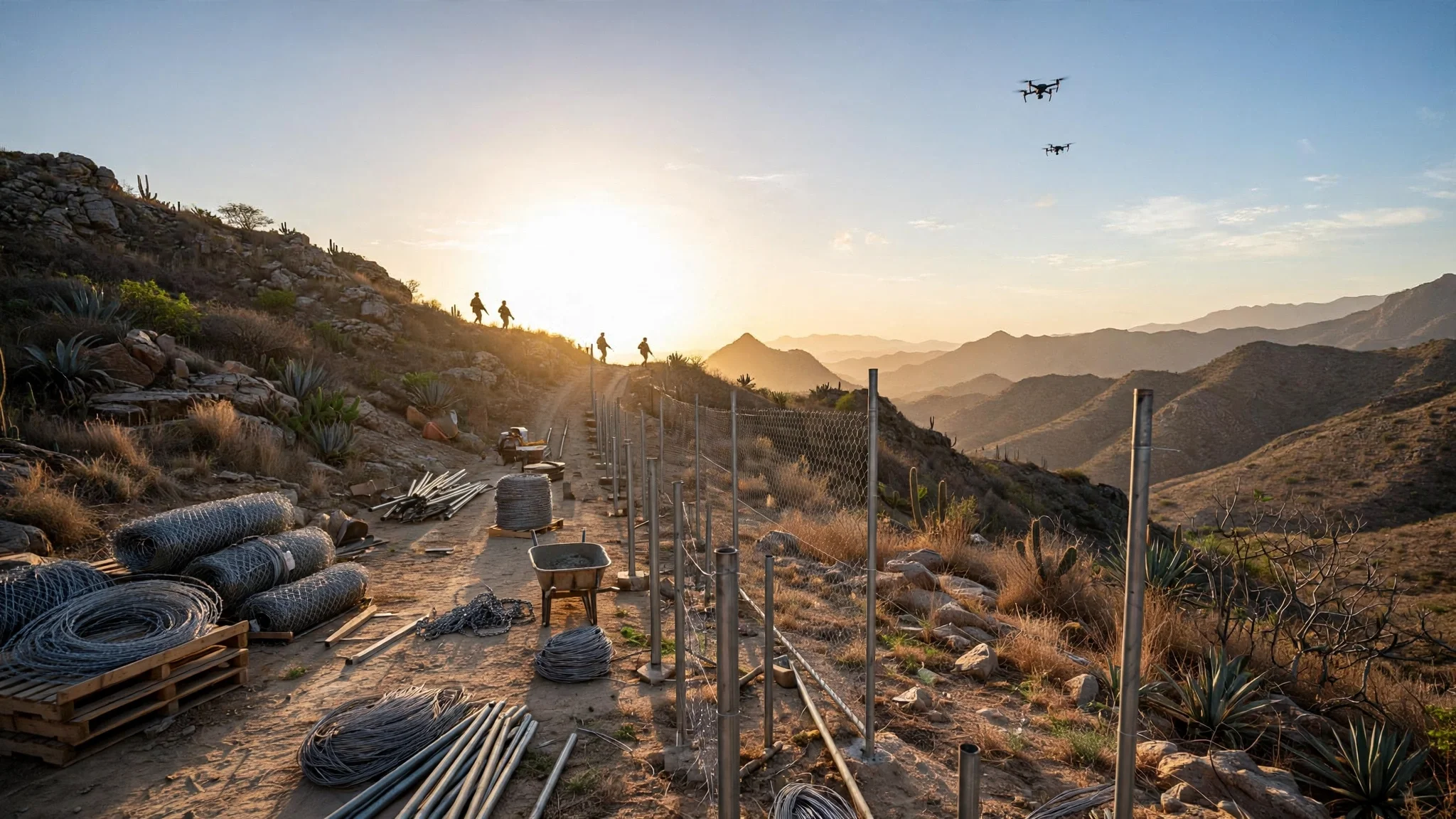
Construcción de la verja y vigilancia en la frontera dominicana. · Imagen generada para EPM
Dominican border: operational progress and a transparency debt
The fourth report by the Migration Policy Observatory acknowledges the deployment of 11,000 troops, 71,611 reported actions and 54 kilometers of completed…
Haiti border: stronger control, works under way and tasks pending
The fourth report by the Migration Policy Observatory confirms 11,000 troops, 71,611 reported actions and 54 kilometers of completed fencing on the border with…
--- The context ---
The border between the Dominican Republic and Haiti returned to the center of public debate with the presentation, on October 29, 2026, of the fourth report by the Migration Policy Observatory (OPM). The document assesses the implementation of the 15 measures announced by the Executive Branch in April 2025 and combines two levels that do not always coincide: the operational progress displayed by the State and the pending tasks on transparency, rights and verifiable results.
--- The facts ---
According to the report, the Ministry of Defense keeps 1,500 additional soldiers in place to complete a deployment of 11,000 troops on the border. Supervision is distributed across eight zones, with 16 senior officers rotating every 15 days, and improvements are reported in mobility, supply, communications and facilities, including vehicles, fibre optics, satellite internet and drones. OPM members confirmed operational progress during field visits in September and acknowledged improvements in the capacity of the General Directorate of Migration (DGM) and in the logistical conditions of the troops.
Between April and August, the three border brigades reported 60,763 detentions and the Specialised Land Border Security Corps (CESFRONT) another 10,848, for a total of 71,611. The report itself clarifies that these are reported actions and that they do not amount to the deportations later carried out by the DGM, a key distinction to avoid presenting different figures as equivalent results. On infrastructure, 54 kilometers of border fencing have been completed; another 13 kilometers between La Sal and Capotillo are at 70% with completion postponed from May to December 2026; on September 6 construction began on a 14.5 kilometers stretch in Jimaní, facing Lake Azuey, and once both works finish the fence would reach 81.5 kilometers.
--- The positions ---
The Observatory acknowledges the deployment and the logistical improvement, but it stresses what is missing: investigating reports of corruption and possible rights violations, regulating the border markets, bringing Dominican workers into agriculture and construction and technologically modernising the latter sector. It also recommends better targeted budgets, accountability mechanisms and stronger resources for the Public Prosecutor's Office and the Judiciary to prosecute migrant smuggling.
The report also includes an exploratory survey based on digital media content and social media posts, with no value as a statistical sample, which records distrust about the effectiveness of operations, surveillance and deportations.
--- What remains unknown ---
It remains unknown how many of the 71,611 reported actions led to deportations, how many cases involved specific offences and what impact the operations had on smuggling networks. The targets of several measures already considered implemented, and those of the permanent actions, have not been updated either, and perceptions of border vulnerability persist despite the investment made.
--- Unanswered questions ---
How many people were actually deported by the DGM after the detentions reported between April and August? What concrete investigations were opened into the reports of corruption and rights violations? When will the border markets be regulated and the targets of the 15 measures updated? Can the postponed stretch be completed by December 2026 and the outcome measured with public, verifiable indicators?
--- EPM analysis ---
The value of the report is that it does not set security against legality: it presents them as conditions of a single effective policy. Border control that does not investigate internal corruption or protect rights loses legitimacy and also effectiveness, because smuggling networks feed precisely on the system's blind spots. The demand for transparency is therefore not a rhetorical extra, but the mechanism that makes it possible to distinguish real progress from a well presented figure.
The caution applied to the exploratory survey is also sound: social media amplify fears and slogans, but they do not replace a representative measurement of Dominican opinion.
📌 EPM Take: In EPM's view, the fourth OPM report offers a balanced and demanding conclusion: there is deployment, there is construction and there is growing operational capacity, but there is still not enough proof of sustainable results. The 71,611 reported actions do not amount to deportations or to dismantled networks, and the fence, however necessary, is no substitute for investigation, accountability or respect for rights. Dominican migration policy will be credible when every target has a public indicator, every corruption report has a visible investigation and every figure can be verified without relying on the official announcement of the day before the country in every published balance.
--- The context ---
The Dominican Republic is sustaining its largest border control effort in years along the frontier with Haiti, and the fourth report by the Migration Policy Observatory (OPM), presented on October 29, 2026, makes it possible to measure that effort with data. The document assesses the 15 measures announced by the Executive Branch in April 2025 and recognises real progress in deployment, logistics and infrastructure.
--- The facts ---
The Ministry of Defense keeps 1,500 additional soldiers in place to complete 11,000 troops on the border, with supervision distributed across eight zones and 16 senior officers rotating every 15 days. The report records improvements in mobility, supply, communications and facilities, including vehicles, fibre optics, satellite internet and drones, as well as progress in the operational capacity of the General Directorate of Migration (DGM) and in troop conditions, confirmed by the OPM during field visits in September.
Between April and August, the three border brigades reported 60,763 detentions and the Specialised Land Border Security Corps (CESFRONT) another 10,848, for a total of 71,611. The report clarifies that these are reported actions and that they do not amount to the deportations later carried out by the DGM, a necessary precision for demanding results without inflating figures. On physical works, 54 kilometers of fencing are already complete; another 13 kilometers between La Sal and Capotillo stand at 70% and their completion moved from May to December 2026; on September 6 a 14.5 kilometers stretch began in Jimaní, facing Lake Azuey, and the projected total is 81.5 kilometers.
--- The positions ---
The Observatory values the deployment, but it asks that the job be finished: regulating the border markets, bringing Dominican workers into agriculture and construction, technologically modernising that sector and reviewing the targets of implemented and permanent measures. It also recommends better targeted budgets, accountability and more resources for the Public Prosecutor's Office and the Judiciary, so that migrant smuggling can be investigated and prosecuted and reports of corruption and possible rights violations properly addressed.
The report adds an exploratory survey of digital content and social media, which is not a statistical sample, where distrust appears about the effectiveness of DGM operations, surveillance, deportations and judicial prosecutions.
--- What remains unknown ---
What is missing is precision on how many of the 71,611 reported actions ended in deportation, what effect they had on smuggling networks and why the perception of vulnerability persists despite the investment and the deployment. Updated targets with verifiable indicators and public results on the corruption investigations are also missing.
--- Unanswered questions ---
When will the border markets, identified as a pending task of the plan, finally be regulated? What concrete results have the investigations into corruption and migrant smuggling produced so far? Will the postponed fencing stretch be completed by December 2026 and the projected 81.5 kilometers reached? Will the Government publish updated targets and verifiable indicators for each of the 15 measures?
--- EPM analysis ---
A country has the right and the duty to control its border, and this report confirms that the Dominican Republic is deploying means that did not exist before: troops, technology and physical works. But firmness without administration wears thin. If the markets remain without clear rules, if Dominican labour does not enter agriculture and construction and if corruption goes unpunished, the military effort will carry alone a problem that belongs to the whole State.
The practical conclusion is one of order and continuity: complete the fence, sustain the deployment, deport in accordance with the law those who must be deported and pursue the networks that profit from irregular crossings.
📌 EPM Take: In EPM's view, the report confirms that the Dominican Republic is advancing on the essentials: 11,000 troops, infrastructure under way and an operational capacity that the Observatory itself acknowledges on the ground. But governing the border is not only about deploying; it is about finishing the works, regulating the markets, updating the targets and punishing the corruption that sabotages any control from within. The 71,611 reported actions are a starting point, not the finish line: the result that counts is an orderly border, with verifiable deportations, prosecuted smuggling networks and citizens who trust again that the State commands its territory and always upholds the law.
Frontera dominicana: avances operativos y una deuda de transparencia
El cuarto informe del Observatorio de Políticas Migratorias reconoce el despliegue de 11,000 efectivos, 71,611 actuaciones reportadas y 54 kilómetros de verja…
Frontera con Haití: más control, obra en marcha y tareas por terminar
El cuarto informe del Observatorio de Políticas Migratorias confirma 11,000 efectivos, 71,611 actuaciones reportadas y 54 kilómetros de verja concluidos en la…
--- El contexto ---
La frontera entre República Dominicana y Haití volvió al centro del debate público con la presentación, el 29 de octubre de 2026, del cuarto informe del Observatorio de Políticas Migratorias (OPM). El documento evalúa la aplicación de las 15 medidas migratorias anunciadas por el Poder Ejecutivo en abril de 2025 y combina dos planos que no siempre coinciden: los avances operativos que exhibe el Estado y las tareas pendientes en transparencia, derechos y resultados verificables.
--- Los hechos ---
Según el informe, el Ministerio de Defensa mantiene 1,500 soldados adicionales hasta completar una dotación de 11,000 efectivos en la frontera. La supervisión se distribuye en ocho zonas, con 16 oficiales superiores que rotan cada 15 días, y se reportan mejoras en movilidad, abastecimiento, comunicaciones e instalaciones, con vehículos, fibra óptica, internet satelital y drones de apoyo. Miembros del OPM constataron avances operativos en visitas de campo realizadas en septiembre y reconocieron mejoras en la capacidad de la Dirección General de Migración (DGM) y en las condiciones logísticas de las tropas.
Entre abril y agosto, las tres brigadas fronterizas reportaron 60,763 detenciones y el Cuerpo Especializado en Seguridad Fronteriza Terrestre (CESFRONT) otras 10,848, para un total de 71,611. El propio informe aclara que son actuaciones reportadas y que no equivalen a las deportaciones ejecutadas posteriormente por la DGM, una distinción clave para no presentar cifras distintas como resultados equivalentes. En infraestructura, se han concluido 54 kilómetros de verja; otros 13 kilómetros entre La Sal y Capotillo avanzan al 70%, con terminación aplazada de mayo a diciembre de 2026; el 6 de septiembre comenzó un tramo de 14.5 kilómetros en Jimaní, frente al lago Azuey, y al concluir ambas obras la verja alcanzaría 81.5 kilómetros.
--- Las posiciones ---
El Observatorio reconoce el despliegue y la mejora logística, pero coloca el acento en lo que falta: investigar denuncias de corrupción y posibles vulneraciones de derechos, regular los mercados fronterizos, incorporar trabajadores dominicanos a la agricultura y la construcción y modernizar tecnológicamente ese sector. También recomienda orientar mejor los presupuestos, crear mecanismos de rendición de cuentas y fortalecer al Ministerio Público y al Poder Judicial para procesar el tráfico ilícito de migrantes.
El informe incorpora además un sondeo exploratorio basado en contenidos de medios digitales y redes sociales, sin valor de muestra estadística, que recoge desconfianza sobre la eficacia de los operativos, la vigilancia y las deportaciones.
--- Lo que falta saber ---
Falta saber cuántas de las 71,611 actuaciones derivaron en deportaciones, cuántos casos correspondieron a infracciones concretas y qué impacto tuvieron los operativos sobre las redes de tráfico. Tampoco están actualizadas las metas de varias medidas ya consideradas ejecutadas ni las de las actuaciones permanentes, y persisten percepciones de vulnerabilidad fronteriza pese a la inversión realizada.
--- Preguntas sin respuesta ---
¿Cuántas personas fueron efectivamente deportadas por la DGM tras las detenciones reportadas entre abril y agosto? ¿Qué investigaciones concretas se abrieron por las denuncias de corrupción y de vulneración de derechos? ¿Cuándo se regularán los mercados fronterizos y se actualizarán las metas de las 15 medidas? ¿Podrá completarse en diciembre de 2026 el tramo aplazado y medirse el resultado con indicadores públicos y verificables?
--- Análisis EPM ---
El valor del informe está en que no opone seguridad y legalidad: las presenta como condiciones de una misma política eficaz. Un control fronterizo que no investiga la corrupción interna ni protege derechos pierde legitimidad y también eficacia, porque las redes de tráfico se alimentan precisamente de los puntos ciegos del sistema. Por eso la exigencia de transparencia no es un añadido retórico, sino el mecanismo que permite distinguir un avance real de una cifra bien presentada.
También es acertada la cautela con el sondeo exploratorio: las redes amplifican temores y consignas, pero no sustituyen una medición representativa de la opinión dominicana.
📌 Conclusion EPM: A juicio de EPM, el cuarto informe del OPM deja una conclusión equilibrada y exigente: hay despliegue, hay obra y hay capacidad operativa en crecimiento, pero todavía no hay prueba suficiente de resultados sostenibles. Las 71,611 actuaciones reportadas no equivalen a deportaciones ni a redes desmanteladas, y la verja, por necesaria que sea, no sustituye investigación, rendición de cuentas ni respeto a los derechos. La política migratoria dominicana será creíble cuando cada meta tenga un indicador público, cada denuncia de corrupción tenga una investigación visible y cada cifra pueda verificarse sin depender del anuncio oficial de turno en cada balance presentado ante el país.
--- El contexto ---
República Dominicana sostiene su mayor esfuerzo de control fronterizo en años frente a Haití, y el cuarto informe del Observatorio de Políticas Migratorias (OPM), presentado el 29 de octubre de 2026, permite medirlo con datos. El documento evalúa las 15 medidas migratorias anunciadas por el Poder Ejecutivo en abril de 2025 y reconoce avances reales en despliegue, logística e infraestructura.
--- Los hechos ---
El Ministerio de Defensa mantiene 1,500 soldados adicionales hasta completar 11,000 efectivos en la frontera, con supervisión distribuida en ocho zonas y 16 oficiales superiores que rotan cada 15 días. El informe registra mejoras en movilidad, abastecimiento, comunicaciones e instalaciones, con vehículos, fibra óptica, internet satelital y drones, además de avances en la capacidad operativa de la Dirección General de Migración (DGM) y en las condiciones de las tropas, constatados por el OPM en visitas de campo realizadas en septiembre.
Entre abril y agosto, las tres brigadas fronterizas reportaron 60,763 detenciones y el Cuerpo Especializado en Seguridad Fronteriza Terrestre (CESFRONT) otras 10,848, para un total de 71,611. El informe aclara que son actuaciones reportadas y que no equivalen a las deportaciones ejecutadas después por la DGM, precisión necesaria para exigir resultados sin inflar las cifras. En obra física, ya se concluyeron 54 kilómetros de verja; otros 13 kilómetros entre La Sal y Capotillo llevan 70% de avance y su cierre pasó de mayo a diciembre de 2026; el 6 de septiembre empezó un tramo de 14.5 kilómetros en Jimaní, frente al lago Azuey, y la proyección total es de 81.5 kilómetros.
--- Las posiciones ---
El Observatorio valora el despliegue, pero pide terminar la tarea: regular los mercados fronterizos, incorporar trabajadores dominicanos a la agricultura y la construcción, modernizar tecnológicamente ese sector y revisar las metas de las medidas ejecutadas y permanentes. También recomienda presupuestos mejor orientados, rendición de cuentas y más recursos para el Ministerio Público y el Poder Judicial, a fin de investigar y procesar el tráfico ilícito de migrantes y atender las denuncias de corrupción y de posibles vulneraciones de derechos.
El informe suma un sondeo exploratorio de contenidos digitales y redes sociales, que no constituye una muestra estadística, donde aparece desconfianza sobre la eficacia de los operativos de la DGM, la vigilancia, las deportaciones y los sometimientos judiciales.
--- Lo que falta saber ---
Falta precisar cuántas de las 71,611 actuaciones terminaron en deportación, qué efecto tuvieron sobre las redes de tráfico y por qué persiste la percepción de vulnerabilidad pese a la inversión y al despliegue. Faltan también metas actualizadas con indicadores verificables y resultados públicos sobre las investigaciones de corrupción.
--- Preguntas sin respuesta ---
¿Cuándo se regularán los mercados fronterizos, identificados como tarea pendiente del plan? ¿Qué resultados concretos han dado las investigaciones por corrupción y tráfico ilícito de migrantes? ¿Se completará en diciembre de 2026 el tramo de verja aplazado y se alcanzarán los 81.5 kilómetros proyectados? ¿Publicará el Gobierno metas actualizadas e indicadores verificables para cada una de las 15 medidas?
--- Análisis EPM ---
Un país tiene derecho y deber de controlar su frontera, y este informe confirma que República Dominicana está poniendo medios que antes no existían: tropa, tecnología y obra física. Pero la firmeza sin administración se desgasta. Si los mercados siguen sin reglas claras, si la mano de obra dominicana no entra a la agricultura y la construcción y si la corrupción no se castiga, el esfuerzo militar cargará solo con un problema que es de todo el Estado.
La conclusión práctica es de orden y continuidad: completar la verja, sostener el despliegue, deportar conforme a la ley a quien corresponda y perseguir a las redes que lucran con el cruce irregular.
📌 Conclusion EPM: A juicio de EPM, el informe confirma que República Dominicana avanza en lo esencial: 11,000 efectivos, infraestructura en marcha y una capacidad operativa que el propio Observatorio reconoce sobre el terreno. Pero gobernar la frontera no es solo desplegar; es terminar la obra, regular los mercados, actualizar las metas y castigar la corrupción que sabotea desde dentro cualquier control. Las 71,611 actuaciones reportadas son un punto de partida, no la meta: el resultado que cuenta es una frontera ordenada, con deportaciones verificables, redes de tráfico procesadas y ciudadanos que vuelvan a confiar en que el Estado manda en su territorio y cumple la ley siempre.