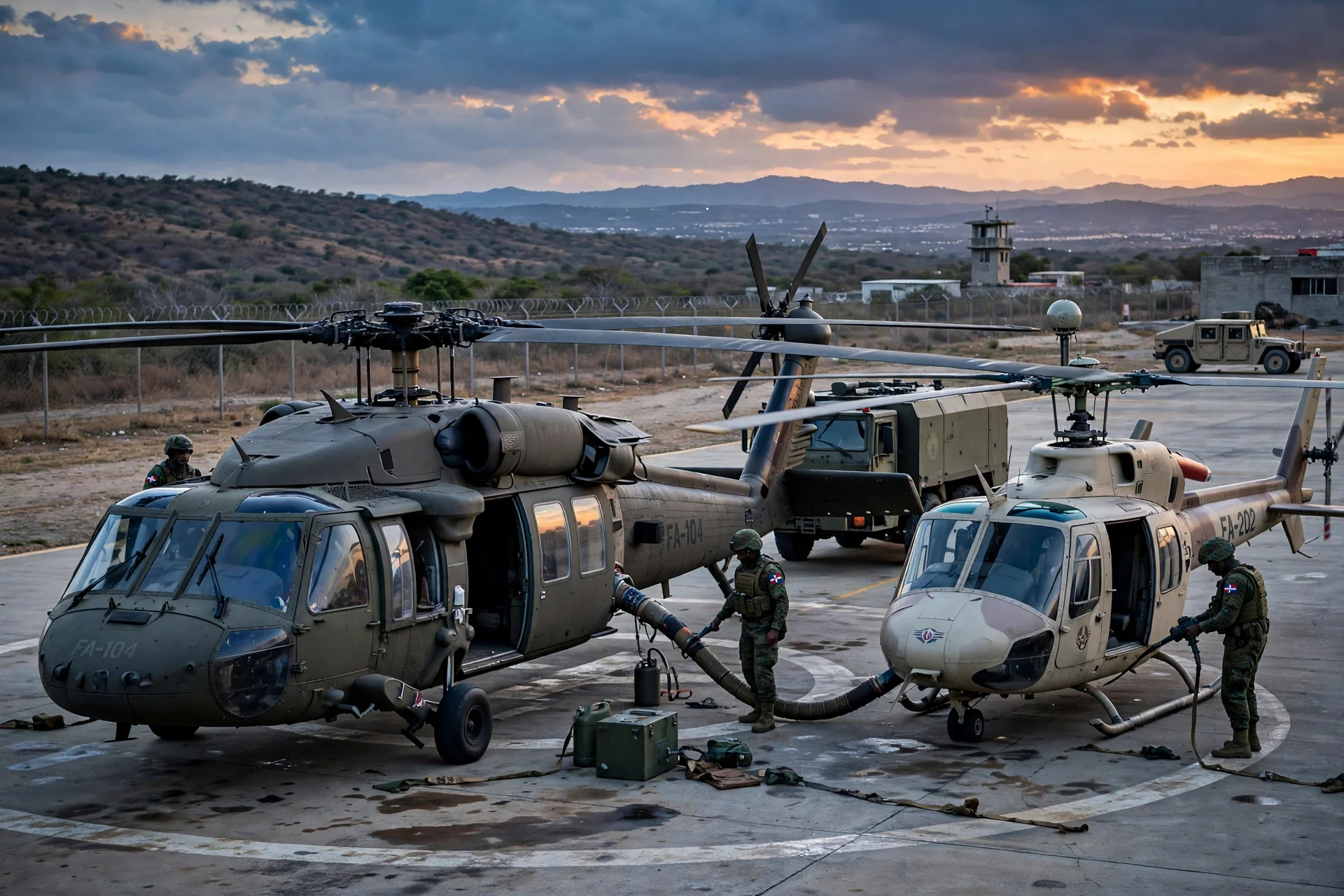
Helicópteros militares durante una escala de abastecimiento, en una imagen alusiva al movimiento aéreo hacia Haití. · Imagen generada para EPM
Seven Helicopters Stop in Jimaní on Their Way to Haiti
Seven military helicopters, five Salvadoran combat aircraft and two Black Hawks, stopped on Thursday at the El Rodeo fortress in Jimaní to refuel before…
Regional Military Cooperation Uses Jimaní as Stop Toward Haiti
Seven military helicopters made an orderly stop on Thursday at the El Rodeo fortress in Jimaní to refuel en route to Haiti: five Salvadoran combat aircraft and…
--- The context ---
Haiti is going through a security crisis marked by armed gangs controlling territory, constant clashes and the daily exposure of the civilian population. In that setting, international operations seek to recover communities and reduce violence, while the civilian population remains exposed to displacement and insecurity.
--- The facts ---
On Thursday, seven military helicopters stopped at the El Rodeo fortress, headquarters of the 14th Infantry Battalion of the Dominican Republic Army in Jimaní, before continuing into Haitian territory. According to a security report, five Salvadoran combat helicopters, identified as MD500E-48, MD500E-52, MD500E-54, MD500E-49 and MD500E-53, landed at 3:45 p.m. carrying Salvadoran military personnel to refuel.
At 4:10 p.m., two additional Black Hawk helicopters arrived and also landed at the military heliport for refueling work, bringing the total to seven aircraft at the Dominican facility. The combat aircraft had been transported to Dominican territory on a charter flight operated by a National Airlines Boeing 747-400 that landed at Las Américas International Airport (AILA) early on Wednesday. At 5:00 p.m., according to the report, the helicopters took off bound for Haiti.
--- The positions ---
The movement is part of El Salvador's military deployment in Haiti, expanded after the October 18 ambush in the locality of Santo, in Croix-des-Bouquets. According to the available information, four Salvadoran military technicians disappeared in that attack attributed to armed gangs, and the report speaks of four technicians whose whereabouts are being sought after the ambush. The expanded operations aim to locate them and confront the criminal groups responsible for the violence.
--- What remains unknown ---
The number of Salvadoran personnel transported on the aircraft has not been specified, nor has the full detail of the operations they will carry out after arriving in Haiti.
--- Unanswered questions ---
Where are the four Salvadoran technicians whose whereabouts are being sought after the October 18 ambush now? What concrete measures will accompany the deployment to protect civilians exposed to the clashes? How long will Salvadoran forces remain operating in Haitian territory and with what measurable results?
--- EPM analysis ---
The stop shows that the response to the Haitian crisis now depends on a regional logistical chain that includes Dominican territory. However, an increase in military movements does not by itself guarantee improved security for the population.
📌 EPM Take: In EPM's view, the stop in Jimaní reveals the regional scale of a crisis that Haiti cannot face alone and that leaves civilians at the center of the risk. Military cooperation can add operational capacity, but without effective protection for displaced communities and verifiable results on the missing technicians, the deployment risks becoming a movement of forces without real relief for people living under gang violence every single day in Haiti.
--- The context ---
The border between the Dominican Republic and Haiti is a strategic space for regional security. While Haiti faces a security crisis driven by criminal gangs, the countries involved have intensified international operations against those groups.
--- The facts ---
On Thursday, seven military helicopters stopped at the El Rodeo fortress, headquarters of the 14th Infantry Battalion of the Dominican Republic Army in Jimaní, before continuing to Haiti. According to a security report, five Salvadoran combat helicopters, identified as MD500E-48, MD500E-52, MD500E-54, MD500E-49 and MD500E-53, landed at 3:45 p.m. carrying Salvadoran military personnel who needed to refuel.
At 4:10 p.m., two additional Black Hawk helicopters arrived and landed at the military heliport to carry out refueling work, raising the total to seven aircraft at the facility. The combat aircraft had arrived in Dominican territory on a charter flight operated by a National Airlines Boeing 747-400 that landed at Las Américas International Airport (AILA) early on Wednesday. At 5:00 p.m. they took off bound for Haiti.
--- The positions ---
The movement is part of El Salvador's military deployment in Haiti, expanded after the October 18 ambush in the locality of Santo, in Croix-des-Bouquets. According to the available information, four Salvadoran military technicians disappeared in that attack attributed to armed gangs, and the report speaks of four technicians whose whereabouts are being sought after the ambush. The expansion seeks to locate the technicians and confront the criminal groups responsible for the violence, amid growing pressure on international forces.
--- What remains unknown ---
The available information does not specify the number of Salvadoran personnel transported or the full operational plan once in Haiti. It also does not detail the expected duration of this phase of the deployment or the coordination mechanisms after the stop.
--- Unanswered questions ---
What will be the specific mission of the seven aircraft once deployed in Haiti? How will Dominican logistical support be coordinated if new stops in Jimaní are required? When will there be verified information on the whereabouts of the four Salvadoran technicians?
--- EPM analysis ---
The episode shows practical cooperation among countries that share concern over the advance of gangs in Haiti. For the Dominican Republic, lending its border infrastructure in an orderly stop strengthens its position as a logistical partner without assuming the leading role in the deployment.
📌 EPM Take: In EPM's view, the stop in Jimaní confirms the strategic value of regional military cooperation and of the Dominican logistical role on its own border. Facilitating the orderly transit and refueling of allied forces strengthens the response against gangs that threaten stability across the area. The challenge now is to sustain that coordination with operational discipline and concrete results in locating the technicians and recovering territorial control in Haiti with verifiable clarity and sustained commitment.
Siete helicópteros hacen escala en Jimaní rumbo a Haití
Siete helicópteros militares, cinco de combate salvadoreños y dos Black Hawk, hicieron escala este jueves en la fortaleza El Rodeo de Jimaní para abastecerse…
Cooperación militar regional usa Jimaní como escala hacia Haití
Siete helicópteros militares hicieron escala ordenada este jueves en la fortaleza El Rodeo de Jimaní para abastecerse rumbo a Haití: cinco de combate…
--- El contexto ---
Haití atraviesa una crisis de inseguridad marcada por el control territorial de pandillas armadas, los enfrentamientos constantes y la exposición diaria de la población civil. En ese escenario, las operaciones internacionales buscan recuperar comunidades y reducir la violencia, mientras la población civil continúa expuesta a los desplazamientos y la inseguridad.
--- Los hechos ---
Este jueves, siete helicópteros militares hicieron escala en la fortaleza El Rodeo, sede del 14.º Batallón de Infantería del Ejército de República Dominicana en Jimaní, antes de continuar hacia territorio haitiano. Según un informe de seguridad, a las 3:45 de la tarde aterrizaron cinco helicópteros de combate de matrícula salvadoreña, identificados como MD500E-48, MD500E-52, MD500E-54, MD500E-49 y MD500E-53, con militares salvadoreños a bordo para abastecerse de combustible.
A las 4:10 de la tarde llegaron otros dos helicópteros tipo Black Hawk, que también aterrizaron en el helipuerto militar para labores de abastecimiento. Las cinco aeronaves de combate habían sido transportadas a territorio dominicano en un vuelo chárter operado por un Boeing 747-400 de National Airlines que aterrizó en el Aeropuerto Internacional de Las Américas (AILA) la madrugada del miércoles. A las 5:00 de la tarde, según el informe, los helicópteros despegaron con destino a Haití.
--- Las posiciones ---
El movimiento se inscribe en el despliegue militar de El Salvador en Haití, ampliado tras la emboscada del pasado 18 de octubre en la localidad de Santo, en Croix-des-Bouquets. De acuerdo con la información disponible, en ese ataque atribuido a pandillas armadas desaparecieron cuatro técnicos militares salvadoreños, y el informe habla de cuatro técnicos cuyo paradero se busca tras la emboscada.
--- Lo que falta saber ---
No se ha especificado la cantidad de militares salvadoreños transportados en las aeronaves ni el detalle completo de las operaciones que realizarán tras llegar a Haití.
--- Preguntas sin respuesta ---
¿Dónde se encuentran ahora los cuatro técnicos salvadoreños cuyo paradero se busca tras la emboscada del 18 de octubre? ¿Qué medidas concretas acompañarán el despliegue para proteger a la población civil expuesta a los enfrentamientos? ¿Cuánto tiempo permanecerán las fuerzas salvadoreñas operando en territorio haitiano y con qué resultados medibles?
--- Análisis EPM ---
La escala muestra que la respuesta a la crisis haitiana ya depende de una cadena logística regional que incluye territorio dominicano.
📌 Conclusion EPM: A juicio de EPM, la escala en Jimaní revela la dimensión regional de una crisis que Haití no puede enfrentar solo y que deja a la población civil en el centro del riesgo. La cooperación militar puede aportar capacidad operativa, pero sin protección efectiva para comunidades desplazadas y sin resultados verificables sobre los técnicos desaparecidos, el despliegue corre el riesgo de quedarse en movimiento de fuerzas sin alivio real para quienes viven bajo la violencia de las pandillas cada día.
--- El contexto ---
La frontera entre República Dominicana y Haití es un espacio estratégico para la seguridad regional. Mientras Haití enfrenta una crisis de inseguridad por la acción de bandas criminales, los países involucrados han intensificado las operaciones internacionales contra esos grupos.
--- Los hechos ---
Este jueves, siete helicópteros militares hicieron escala en la fortaleza El Rodeo, sede del 14.º Batallón de Infantería del Ejército de República Dominicana en Jimaní, antes de continuar hacia Haití. Según un informe de seguridad, a las 3:45 de la tarde aterrizaron cinco helicópteros de combate de matrícula salvadoreña, identificados como MD500E-48, MD500E-52, MD500E-54, MD500E-49 y MD500E-53, que transportaban militares salvadoreños y debían abastecerse de combustible.
A las 4:10 de la tarde llegaron otros dos helicópteros tipo Black Hawk, que aterrizaron en el helipuerto militar para realizar labores de abastecimiento y elevaron a siete el total de aeronaves en la instalación. Las aeronaves de combate habían llegado a territorio dominicano en un vuelo chárter operado por un Boeing 747-400 de National Airlines que aterrizó en el Aeropuerto Internacional de Las Américas (AILA) la madrugada del miércoles. A las 5:00 de la tarde despegaron con destino a Haití.
--- Las posiciones ---
El movimiento forma parte del despliegue militar de El Salvador en Haití, ampliado tras la emboscada del pasado 18 de octubre en la localidad de Santo, en Croix-des-Bouquets. Según la información disponible, en ese ataque atribuido a pandillas armadas desaparecieron cuatro técnicos militares salvadoreños, y el informe habla de cuatro técnicos cuyo paradero se busca tras la emboscada.
--- Lo que falta saber ---
La información disponible no especifica la cantidad de militares salvadoreños transportados ni el plan operativo completo una vez en Haití.
--- Preguntas sin respuesta ---
¿Cuál será la misión específica de las siete aeronaves una vez desplegadas en Haití? ¿Cómo se coordinará el apoyo logístico dominicano si se requieren nuevas escalas en Jimaní? ¿Cuándo habrá información verificada sobre el paradero de los cuatro técnicos salvadoreños?
--- Análisis EPM ---
El episodio muestra una cooperación práctica entre países que comparten la preocupación por el avance de las pandillas en Haití. Para República Dominicana, prestar su infraestructura fronteriza en una escala ordenada refuerza su posición como socio logístico sin asumir el protagonismo del despliegue. Para El Salvador, la ruta permite proyectar capacidad aérea con rapidez.
📌 Conclusion EPM: A juicio de EPM, la escala en Jimaní confirma el valor estratégico de la cooperación militar regional y del papel logístico dominicano en su propia frontera. Facilitar el tránsito ordenado y el abastecimiento de fuerzas aliadas fortalece la respuesta frente a pandillas que amenazan la estabilidad de toda la zona. El desafío ahora es sostener esa coordinación con disciplina operativa y resultados concretos en la localización de los técnicos y en la recuperación del control territorial.