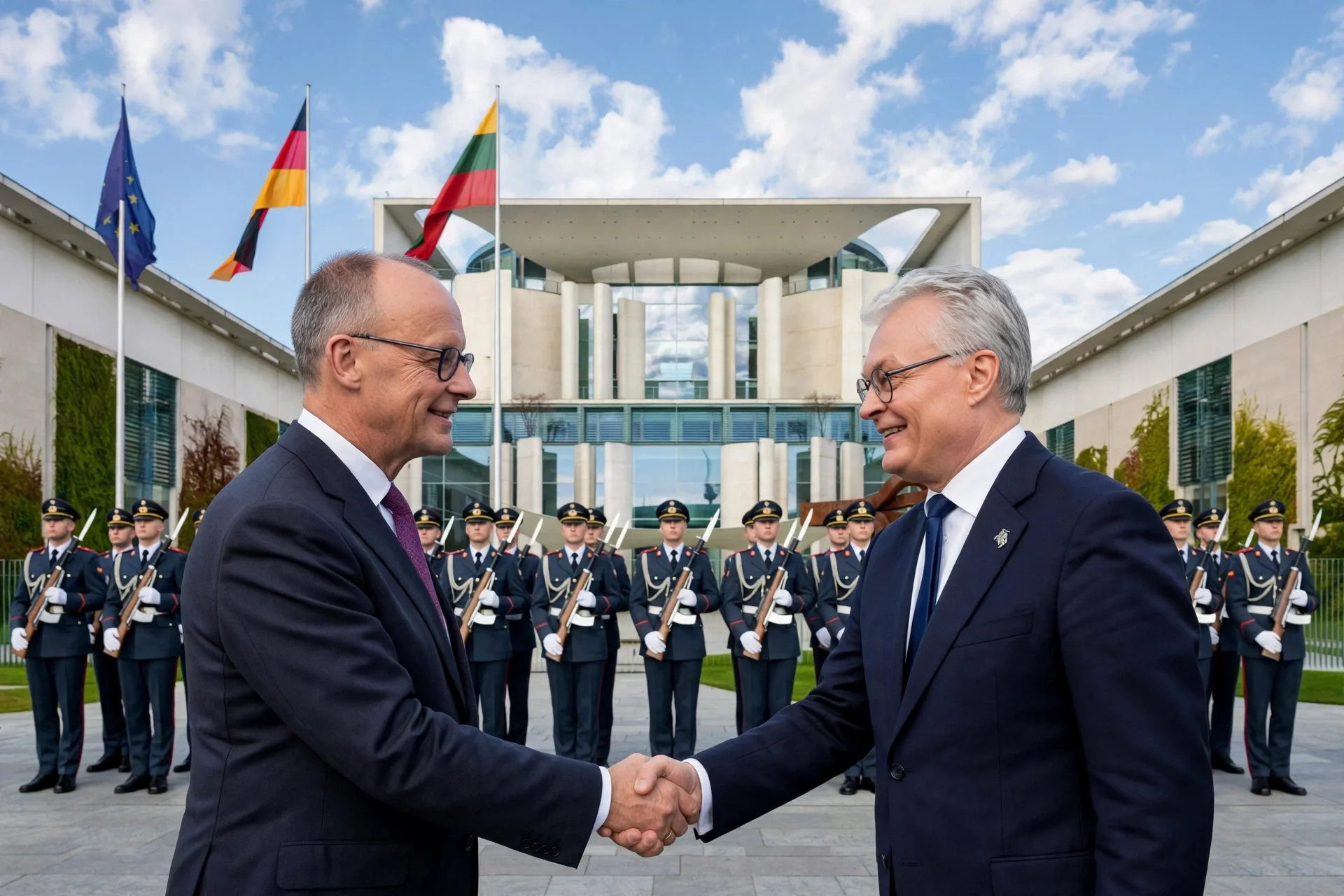
Un recibimiento con honores militares en la Cancillería Federal de Berlín, en una imagen alusiva a la visita anunciada. · Imagen generada para EPM
Merz hosts Nausėda in Berlin on Lithuanian EU presidency
Friedrich Merz hosts Gitanas Nausėda on 3 November 2026 in Berlin, with the Lithuanian Council of the EU presidency in 2027, the budget, competitiveness…
Berlin backs security focus of Lithuanian EU presidency
Friedrich Merz hosts Gitanas Nausėda on 3 November 2026 in Berlin, where security and defence, a Lithuanian presidency focus backed by the Federal Government…
--- The context ---
The Council of the EU presidency that Lithuania will assume in the first half of 2027 will be at the centre of an official visit to Berlin.
--- The facts ---
Federal Chancellor Friedrich Merz will receive the President of Lithuania, Gitanas Nausėda, on Tuesday 3 November 2026, at around 10.15, with military honours at the Federal Chancellery.
--- The positions ---
The announced agenda brings together shared central European topics: the next Multiannual Financial Framework, the implementation of the competitiveness agenda and EU enlargement. In addition, both will exchange views on security and defence, a focus of the Lithuanian presidency that the Federal Government also supports.
--- What remains unknown ---
No concrete results from the meeting are known, nor any agreements that may follow. No later timetable linked to the Lithuanian presidency has been reported either.
--- Unanswered questions ---
What results will the conversation leave on the Multiannual Financial Framework? Will there be agreements on competitiveness and EU enlargement? Will a later timetable be announced for the first half of 2027?
--- EPM analysis ---
The visit organises priorities around a future presidency and a common European agenda, without any conclusions being anticipated in advance.
📌 EPM Take: In EPM's view, the value of this visit lies in placing the Lithuanian presidency in the first half of 2027 at the centre of the shared European agenda before it begins. By bringing the next Multiannual Financial Framework, competitiveness and enlargement into a single conversation, Berlin and Vilnius show early and orderly preparation, whose real scope can only be measured once concrete results and verifiable next steps are known.
--- The context ---
Security and defence form a central part of the announced visit in Berlin. That focus belongs to the Lithuanian presidency in the first half of 2027 and has the support of the Federal Government.
--- The facts ---
Federal Chancellor Friedrich Merz will receive the President of Lithuania, Gitanas Nausėda, on Tuesday 3 November 2026, at around 10.15, with military honours at the Federal Chancellery.
--- The positions ---
Under the announced agenda, the Chancellor will exchange views with President Nausėda on security and defence, a focus of the Lithuanian presidency that the Federal Government also supports. The agenda also includes the next Multiannual Financial Framework, the competitiveness agenda and EU enlargement.
--- What remains unknown ---
No concrete security and defence agreements arising from this meeting are known. No later timetable has been reported either, nor decisions after the conversation.
--- Unanswered questions ---
What security and defence agreements will emerge in Berlin? How will Federal Government support for that focus be translated into practice? Will a later timetable for the first half of 2027 be known?
--- EPM analysis ---
The reception with military honours and German backing for that focus give the visit clear weight within a broader European agenda.
📌 EPM Take: In EPM's view, the most relevant aspect of the visit is the explicit support of the Federal Government for security and defence as a focus of the Lithuanian presidency in the first half of 2027. That support, expressed before the presidency begins, provides clarity on the announced priorities, although its definitive importance will depend on the concrete results, the agreements reached and the timetable known after the Berlin meeting.
Merz recibe a Nausėda en Berlín por la presidencia lituana
Friedrich Merz recibe el 3 de noviembre de 2026 a Gitanas Nausėda en Berlín, con la presidencia lituana del Consejo de la UE de 2027, el presupuesto, la…
Berlín respalda el eje de seguridad de la presidencia lituana
Friedrich Merz recibe el 3 de noviembre de 2026 a Gitanas Nausėda en Berlín, donde la seguridad y la defensa, eje de la presidencia lituana de 2027 apoyado por…
--- El contexto ---
La presidencia del Consejo de la UE que Lituania asumirá en el primer semestre de 2027 ocupará el centro de una visita oficial a Berlín.
--- Los hechos ---
El canciller federal Friedrich Merz recibe el martes 3 de noviembre de 2026, hacia las 10.15 horas, al presidente de Lituania, Gitanas Nausėda, con honores militares en la Cancillería Federal.
--- Las posiciones ---
La agenda anunciada reúne temas europeos centrales compartidos: el próximo Marco Financiero Plurianual, la aplicación de la agenda de competitividad y la ampliación de la UE. Además, ambos intercambiarán sobre seguridad y defensa, un eje de la presidencia lituana que también apoya el Gobierno federal.
--- Lo que falta saber ---
No se conocen resultados concretos ni acuerdos derivados de la reunión. Tampoco se ha informado de un calendario posterior vinculado a la presidencia lituana.
--- Preguntas sin respuesta ---
¿Qué resultados dejará la conversación sobre el Marco Financiero Plurianual? ¿Habrá acuerdos sobre competitividad y ampliación de la UE? ¿Se anunciará un calendario posterior para el primer semestre de 2027?
--- Análisis EPM ---
La visita ordena las prioridades en torno a una presidencia futura y a una agenda europea común, sin que se anticipen conclusiones.
📌 Conclusion EPM: A juicio de EPM, el valor de esta visita está en colocar la presidencia lituana del primer semestre de 2027 en el centro de la agenda europea compartida antes de que comience. Al reunir el próximo Marco Financiero Plurianual, la competitividad y la ampliación en una misma conversación, Berlín y Vilna muestran una preparación temprana y ordenada, cuyo alcance real solo podrá medirse cuando se conozcan resultados concretos y pasos siguientes verificables.
--- El contexto ---
La seguridad y la defensa forman parte central de la visita anunciada en Berlín, como eje de la presidencia lituana del primer semestre de 2027 apoyado por el Gobierno federal.
--- Los hechos ---
El canciller federal Friedrich Merz recibe el martes 3 de noviembre de 2026, hacia las 10.15 horas, al presidente de Lituania, Gitanas Nausėda, con honores militares en la Cancillería Federal.
--- Las posiciones ---
Según la agenda anunciada, el canciller intercambiará con el presidente Nausėda sobre seguridad y defensa, un eje de la presidencia lituana que también apoya el Gobierno federal. El temario incluye además el próximo Marco Financiero Plurianual, la agenda de competitividad y la ampliación de la UE.
--- Lo que falta saber ---
No se conocen acuerdos concretos en seguridad y defensa derivados de este encuentro. Tampoco se ha informado de un calendario posterior ni de decisiones tras la conversación.
--- Preguntas sin respuesta ---
¿Qué acuerdos en seguridad y defensa surgirán en Berlín? ¿Cómo se traducirá el apoyo del Gobierno federal a ese eje? ¿Se conocerá un calendario posterior para el primer semestre de 2027?
--- Análisis EPM ---
La recepción con honores militares y el respaldo alemán a ese eje dan peso claro a la visita.
📌 Conclusion EPM: A juicio de EPM, lo más relevante de la visita es el respaldo explícito del Gobierno federal a la seguridad y la defensa como eje de la presidencia lituana del primer semestre de 2027. Ese apoyo, expresado antes del inicio de la presidencia, aporta claridad sobre las prioridades anunciadas, aunque su importancia definitiva dependerá de los resultados concretos, los acuerdos alcanzados y el calendario que se conozca después del encuentro en Berlín.