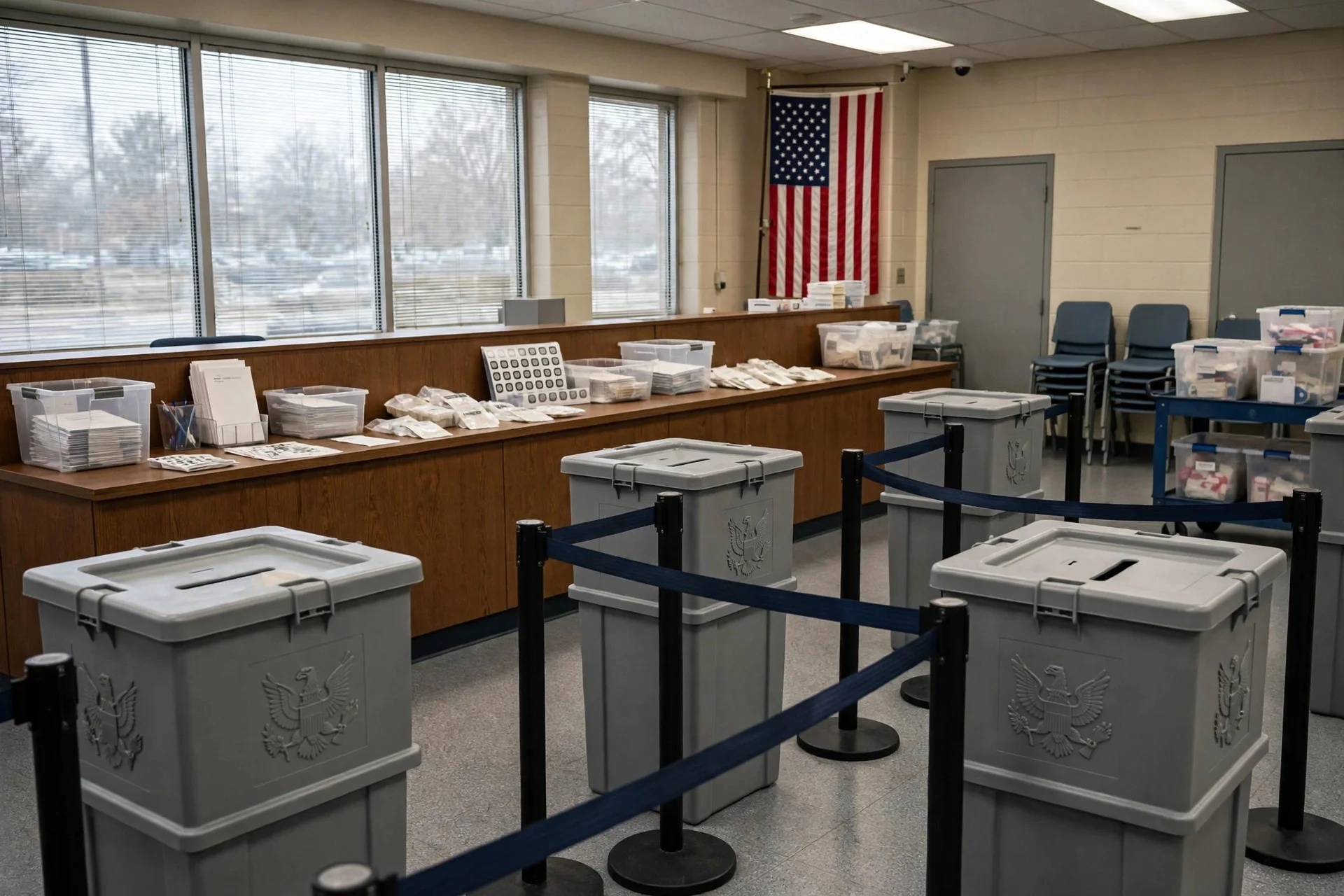
Oficina electoral con urnas y material de votación en Estados Unidos. · Imagen generada para EPM
ICE Announces 17 Cases in Nationwide Crackdown on Voter Fraud
Immigration and Customs Enforcement announced on Oct. 28 another round of arrests for alleged voter fraud within a nationwide crackdown on illegal voting.
Nationwide Crackdown on Illegal Voting Adds 17 Cases Announced by ICE
The immigration agency announced on Oct. 28 a set of 17 alleged illegal voting cases within the governmentwide crackdown on voter fraud.
--- The context ---
Registering and voting in United States elections are reserved for those who meet the legal requirements, and federal authorities argue that protecting that boundary is part of the integrity of the democratic process. Against that backdrop, Immigration and Customs Enforcement presented a new round of actions as part of a governmentwide crackdown on illegal voting across the country.
--- The facts ---
On Oct. 28, the agency announced another round of arrests of foreign nationals in connection with alleged voter fraud and election-related offenses. According to the official statement, numerous cases involve people who admitted to unlawfully registering to vote and casting ballots in American elections, as part of a larger governmentwide crackdown on illegal voting now under way nationwide.
The published list brings together 17 cases that the agency presents as part of its ongoing investigations and arrests. It includes nationals of Guatemala, India, Liberia, Jamaica, Canada, Russia, Cuba, Nicaragua, Ghana, Haiti, the Philippines, Peru, the Bahamas and Mexico, with illegal votes attributed between 2004 and 2025. Some of those named have prior convictions for other offenses.
--- The positions ---
The agency's Assistant Director for Public Affairs, Micah Bock, argued that secure elections protect the nation's sovereignty and Americans' sacred right to vote. Bock also stated that hundreds of cases of election fraud have been uncovered and that the extent of the problem continues to expand, adding that each vote by an illegal alien cancels out the vote of an American citizen.
Federal officials also said they are working to restore integrity to the nation's elections and that this administration will continue to pursue cases of voter fraud to further that end. Bock blamed the situation on the failed immigration policies of the previous administration, which in his account enabled the problem, and presented the crackdown as the current administration's commitment to fixing it.
--- What remains unknown ---
The statement does not detail the individual judicial status of each of the 17 cases or how many will end in conviction, nor does it specify what share of the hundreds of cases mentioned belongs to this round or to earlier investigations. The information available is the agency's official account, and the outcome of each file remains to be seen.
--- Unanswered questions ---
How many of the 17 announced cases will end in a final conviction for voter fraud? What share of the hundreds of uncovered cases cited by the agency involves illegal registrations, and what share involves ballots actually cast? What concrete measures will be applied to prevent new registrations by people without the right to vote without affecting voters who are duly eligible?
--- EPM analysis ---
Publishing a list with countries of origin, voting years and criminal records seeks to show concrete results from the crackdown rather than general announcements alone. At the same time, the real scale of the phenomenon will depend on what courts confirm in each case, because the announcement brings together arrests, charges and ongoing investigations under a single public presentation.
📌 EPM Take:
In EPM's view, the announcement combines a legitimate enforcement function with a presentation that still has to be measured in court, where each case will need to be proven separately. The list of 17 cases provides names, dates and concrete trajectories that allow public follow-up, but the reference to hundreds of cases without a breakdown makes it impossible to size the full phenomenon. Electoral integrity gains when verification is rigorous and transparent, and it loses when debate stays with aggregate figures lacking a checkable file for citizens and voters alike.
--- The context ---
The right to vote in the United States belongs to its citizens, and defending it is a basic duty of the state. When people without that right register and vote, a citizen's ballot is diluted. In that context, Immigration and Customs Enforcement announced a new round of arrests within the nationwide governmentwide crackdown on illegal voting that is now under way.
--- The facts ---
On Oct. 28, the agency announced another round of foreign nationals arrested in connection with alleged voter fraud and election-related offenses. The statement notes that numerous cases involve people who admitted to unlawfully registering to vote and casting ballots in American elections, as part of a larger governmentwide effort to stamp out illegal voting across the country.
The official list gathers 17 cases presented as part of ongoing investigations and arrests. It includes nationals of Guatemala, India, Liberia, Jamaica, Canada, Russia, Cuba, Nicaragua, Ghana, Haiti, the Philippines, Peru, the Bahamas and Mexico, with illegal votes between 2004 and 2025. Several carry prior convictions, and some are under final orders of removal.
--- The positions ---
The agency's Assistant Director for Public Affairs, Micah Bock, stated that secure elections protect the nation's sovereignty and Americans' sacred right to vote. He maintained that hundreds of cases of election fraud have been uncovered and that the extent of the problem continues to expand, stressing that each vote by an illegal alien cancels out the vote of an American citizen.
Bock traced the origin of the problem to the failed immigration policies of the previous administration and presented the crackdown as proof of the current administration's commitment to fixing it. Federal officials added that they are working to restore integrity to the nation's elections and that they will continue to pursue voter fraud cases until that goal is achieved across the country.
--- What remains unknown ---
The statement does not report the judicial outcome of each case or how many of those arrested will ultimately be convicted or removed. It also offers no breakdown of the hundreds of uncovered cases the agency mentions, and no closed figure of confirmed illegal votes. Those data will arrive through the individual handling of each file.
--- Unanswered questions ---
How many of the 17 cases will end in conviction and effective removal of those responsible? How many confirmed illegal votes do the hundreds of cases the agency says it has uncovered add up to in total? What failures allowed people without the right to vote to register and cast ballots for years, in some instances since 2004?
--- EPM analysis ---
The list shows a pattern sustained over time, with illegal votes recorded across two decades and profiles that in several cases already had criminal records. The announcement's value lies in its detail: names, nationalities, years and prior offenses make it possible to gauge the operation's dimension. Its limit is also clear, because these are cases announced by the agency and their definitive confirmation belongs to the judicial proceedings now under way.
📌 EPM Take:
In EPM's view, the crackdown answers an elementary requirement of any democracy: that only those with the right to vote do so, because each illegal vote in practice cancels out a citizen's vote. The 17 detailed cases, with records that in several profiles include serious offenses, show that the problem was neither anecdotal nor recent. It now falls to the courts to close each file with conviction or acquittal, and to the authorities to sustain enforcement over time so the electoral register regains full public trust.
ICE anuncia 17 casos en ofensiva nacional contra el fraude electoral
El Servicio de Inmigración y Control de Aduanas anunció el 28 de octubre otra ronda de arrestos por presunto fraude electoral dentro de una ofensiva nacional…
Ofensiva nacional contra el voto ilegal suma 17 casos anunciados por ICE
La agencia de inmigración anunció el 28 de octubre 17 casos de presunto voto ilegal dentro de la ofensiva de todo el gobierno contra el fraude electoral.
--- El contexto ---
El registro y el voto en las elecciones estadounidenses están reservados a quienes cumplen los requisitos legales, y las autoridades federales sostienen que proteger esa frontera forma parte de la integridad del proceso democrático. En ese marco, el Servicio de Inmigración y Control de Aduanas presentó una nueva ronda de actuaciones dentro de una ofensiva de todo el gobierno contra el voto ilegal.
--- Los hechos ---
El 28 de octubre, la agencia anunció otra ronda de arrestos de extranjeros vinculados con presunto fraude electoral y delitos relacionados con las elecciones. Según el comunicado oficial, numerosos casos incluyen a personas que admitieron haberse registrado de forma ilegal para votar y haber emitido sufragios en elecciones estadounidenses, dentro de una ofensiva nacional más amplia contra el voto ilegal.
La lista difundida reúne 17 casos que la agencia presenta como parte de sus investigaciones y arrestos en curso. Incluye a nacionales de Guatemala, India, Liberia, Jamaica, Canadá, Rusia, Cuba, Nicaragua, Ghana, Haití, Filipinas, Perú, Bahamas y México, con votos ilegales atribuidos entre 2004 y 2025. Algunos de los señalados registran condenas previas por otros delitos.
--- Las posiciones ---
El subdirector de Asuntos Públicos de la agencia, Micah Bock, sostuvo que unas elecciones seguras protegen la soberanía de la nación y el derecho sagrado de los estadounidenses a votar. Bock afirmó además que se han descubierto cientos de casos de fraude electoral y que la magnitud del problema sigue creciendo, y añadió que cada voto de un extranjero en situación irregular cancela el voto de un ciudadano estadounidense.
Los funcionarios federales afirmaron también que trabajan para restaurar la integridad de las elecciones del país y que esta administración seguirá persiguiendo los casos de fraude electoral con ese fin. Bock atribuyó la situación a las políticas migratorias fallidas de la administración anterior, y presentó la ofensiva como el compromiso de la actual administración para corregir el problema.
--- Lo que falta saber ---
El comunicado no detalla el estado judicial individual de cada uno de los 17 casos ni cuántos terminarán en condena, y tampoco precisa qué parte de los cientos de casos mencionados corresponde a esta ronda o a investigaciones anteriores. La información disponible es la versión oficial de la agencia, y queda por conocer la evolución de cada expediente.
--- Preguntas sin respuesta ---
¿Cuántos de los 17 casos anunciados llegarán a una condena firme por fraude electoral? ¿Qué parte de los cientos de casos descubiertos que menciona la agencia corresponde a registros ilegales y qué parte a votos efectivamente emitidos? ¿Qué medidas concretas se aplicarán para impedir nuevos registros de personas sin derecho a voto sin afectar a los votantes que sí están habilitados?
--- Análisis EPM ---
La publicación de una lista con países de origen, años de voto y antecedentes busca mostrar resultados concretos de la ofensiva y no solo anuncios generales. Al mismo tiempo, la magnitud real del fenómeno dependerá de lo que confirmen los tribunales en cada caso, porque el anuncio reúne arrestos, cargos e investigaciones en curso bajo una misma presentación pública.
📌 Conclusion EPM:
A juicio de EPM, el anuncio combina una función legítima de control con una presentación que todavía debe medirse en los tribunales, donde cada caso tendrá que probarse por separado. La lista de 17 casos aporta nombres, fechas y trayectorias concretas que permiten un seguimiento público, pero la referencia a cientos de casos sin desglose impide dimensionar el fenómeno completo. La integridad electoral gana cuando la verificación es rigurosa y transparente, y pierde cuando el debate se queda en cifras agregadas sin expediente comprobable para la ciudadanía y los votantes.
--- El contexto ---
El derecho a votar en Estados Unidos pertenece a los ciudadanos, y su defensa es una obligación básica del Estado. Cuando personas sin ese derecho se registran y votan, el sufragio de un ciudadano queda diluido. En ese contexto, el Servicio de Inmigración y Control de Aduanas anunció una nueva ronda de arrestos dentro de la ofensiva nacional de todo el gobierno contra el voto ilegal.
--- Los hechos ---
El 28 de octubre, la agencia anunció otra ronda de extranjeros arrestados en relación con presunto fraude electoral y delitos vinculados a las elecciones. El comunicado señala que numerosos casos corresponden a personas que admitieron haberse registrado ilegalmente para votar y haber emitido votos en elecciones estadounidenses, como parte de una ofensiva mayor de todo el gobierno para erradicar el voto ilegal en el país.
La relación oficial reúne 17 casos presentados como parte de investigaciones y arrestos en curso. Hay nacionales de Guatemala, India, Liberia, Jamaica, Canadá, Rusia, Cuba, Nicaragua, Ghana, Haití, Filipinas, Perú, Bahamas y México, con votos ilegales entre 2004 y 2025. Varios arrastran condenas previas y algunos tienen orden final de deportación.
--- Las posiciones ---
El subdirector de Asuntos Públicos de la agencia, Micah Bock, afirmó que unas elecciones seguras protegen la soberanía nacional y el derecho sagrado de los estadounidenses a votar. Sostuvo que se han descubierto cientos de casos de fraude electoral y que el alcance del problema continúa expandiéndose, y subrayó que cada voto de un extranjero en situación irregular cancela el voto de un ciudadano estadounidense.
Bock atribuyó el origen del problema a las políticas migratorias fallidas de la administración anterior y presentó la ofensiva como prueba del compromiso de la actual administración con corregirlo. Los funcionarios federales añadieron que trabajan para restaurar la integridad de las elecciones y que seguirán persiguiendo los casos de fraude electoral hasta lograr ese objetivo en todo el país.
--- Lo que falta saber ---
El comunicado no informa del desenlace judicial de cada caso ni de cuántos de los arrestados serán finalmente condenados o deportados. Tampoco ofrece un desglose de los cientos de casos descubiertos que menciona la agencia, ni una cifra cerrada de votos ilegales confirmados. Esos datos llegarán con la tramitación individual de cada expediente.
--- Preguntas sin respuesta ---
¿Cuántos de los 17 casos terminarán en condena y deportación efectiva de los responsables? ¿Cuántos votos ilegales confirmados suman en total los cientos de casos que la agencia dice haber descubierto? ¿Qué fallos permitieron que personas sin derecho a voto se registraran y votaran durante años, en algunos casos desde 2004?
--- Análisis EPM ---
La lista muestra un patrón sostenido en el tiempo, con votos ilegales registrados durante dos décadas y perfiles que en varios casos ya tenían antecedentes penales. El valor del anuncio está en su detalle: nombres, nacionalidades, años y delitos previos permiten comprobar la dimensión del operativo. Su límite también es claro, porque son casos anunciados por la agencia y su confirmación definitiva corresponde a los procesos judiciales en curso.
📌 Conclusion EPM:
A juicio de EPM, la ofensiva responde a una exigencia elemental de cualquier democracia: que solo vote quien tiene derecho a hacerlo, porque cada voto ilegal cancela en la práctica el voto de un ciudadano. Los 17 casos detallados, con antecedentes que en varios perfiles incluyen delitos graves, muestran que el problema no fue anecdótico ni reciente. Ahora corresponde a los tribunales cerrar cada expediente con condena o absolución, y a las autoridades sostener el control en el tiempo para que el registro electoral recupere plena confianza pública.