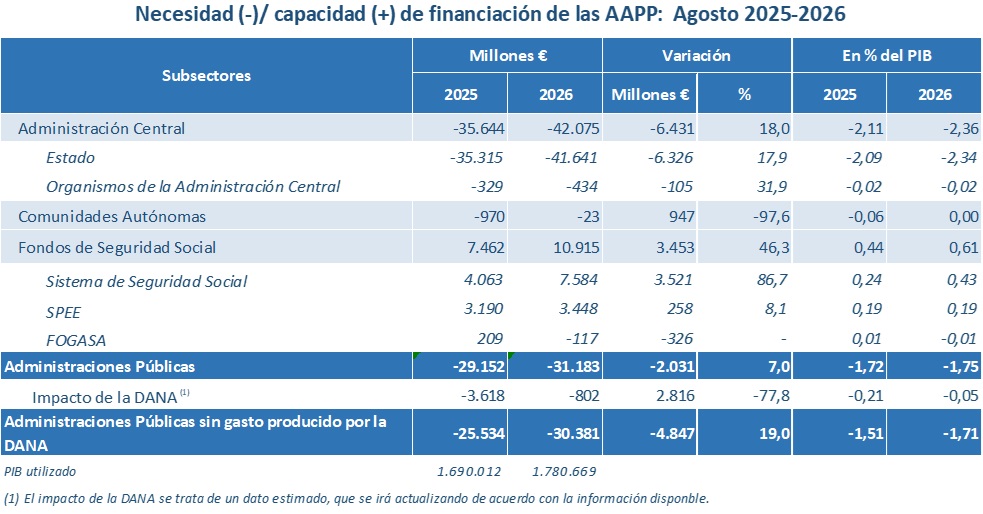
Cuadro oficial con los datos de necesidad o capacidad de financiación de las Administraciones Públicas correspondientes a agosto de 2026. · La Moncloa / Ministerio de Hacienda
Public deficit at 1.75% of GDP as primary balance improves in August
The combined deficit excluding local entities reached 31,183 million in August, or 1.75% of GDP, with a primary deficit of 2,095 million, regions close to…
Deficit rises to 1.75% of GDP as state spending grows 11.3%
The combined deficit rose in August to 31,183 million, or 1.75% of GDP, even as state taxes grew 8.4% to 201,754 million, because state expenditure increased…
--- The context ---
Spain's public accounts in August require a complete reading rather than a single headline figure. The overall balance worsened slightly compared with a year earlier, yet the underlying effort, measured before interest payments, improved clearly. That distinction matters because it separates the inherited cost of debt from what each level of government currently collects and spends, and it shows where the imbalance is being corrected and where it remains concentrated today.
--- The facts ---
The combined deficit of general government, excluding local entities, stood in August at 31,183 million, or 1.75% of GDP, compared with 1.72% of GDP in the same period of 2025. Excluding interest, the primary deficit was 2,095 million, or 0.12% of GDP, down 21.4% from 2,666 million a year earlier. That improvement points to a real adjustment in the ordinary balance, even though the headline total moved in the opposite direction during the same eight months.
The breakdown by level of government is highly uneven. The autonomous communities closed with a deficit of just 23 million, down 97.6% from 970 million in 2025, equivalent to budgetary balance as a share of GDP. The Social Security Funds posted a surplus of 10,915 million, up 46.3% from 7,462 million and equal to 0.61% of GDP, supported by social contributions of 150,710 million, up 7.2%. By contrast, central government concentrated a deficit of 42,075 million, or 2.36% of GDP.
--- The positions ---
The official reading that emerges from the figures emphasizes that primary improvement, regional balance and revenue strength. At the central state level through September, non-financial resources totaled 247,062 million, up 9.3%, with taxes at 201,754 million, up 8.4%. At the same time, non-financial expenditure reached 286,096 million, up 11.3%, while interest rose 11.6% to 29,210 million. That combination helps explain why the central balance remains under pressure despite stronger revenue across the main tax categories this year.
--- What remains unknown ---
What remains to be seen is the year-end outturn and whether the primary improvement holds once extraordinary effects fade. The state recorded a September deficit of 39,034 million, or 2.19% of GDP, although without the extraordinary measures linked to the DANA storm, flooding, the war involving Iran and the migration crisis that balance would be 1.75% of GDP. It also remains to be checked whether regional balance survives the higher-spending final months and whether contributions keep pace, with an average pension in August of 1,373.44 euros, up 4.6% from 2025.
--- Unanswered questions ---
Can the 21.4% reduction in the primary deficit be maintained at year-end without relying on extraordinary revenue? Will the autonomous communities' balance hold through the final stretch of the year or will the gap reopen? For how long can Social Security surpluses offset a deficit so heavily concentrated in central government?
--- EPM analysis ---
The strongest finding is distributional: the imbalance is no longer general, it is concentrated. Regions in balance and a Social Security system in surplus coexist with a central government absorbing interest costs, transfers between administrations and extraordinary responses. That shifts the debate away from aggregate spending toward concrete choices on financing, debt costs and temporary measures which, if repeatedly extended, stop being exceptional and become part of the structural spending base of each budget year.
📌 EPM Take: In EPM's view, the 21.4% primary improvement and regional balance deserve recognition as real progress, because they show adjustment does not depend solely on collecting more revenue. But the combined 1.75% of GDP, slightly worse than the previous 1.72%, is a reminder that the problem remains alive at the center, where interest and spending are growing at double-digit rates. Fiscal credibility will require turning that partial improvement into a sustained, verifiable path at the close of the full year, with the same breakdown by level of government that today makes it possible to distinguish real progress, temporary effects and risks that do not yet appear in the headline balance presented so far.
--- The context ---
Fiscal discipline is measured by the total balance, not only by the part of the ledger that looks best. In August, Spain's administrations, excluding local entities, spent more than they collected by a margin slightly larger than a year earlier. Behind that figure, specific gains in the regions and Social Security coexist with a central state that continues to expand spending, interest and transfers at a pace that is difficult to sustain over time.
--- The facts ---
The combined deficit reached 31,183 million in August, or 1.75% of GDP, compared with 1.72% of GDP in the same period of 2025. The primary deficit, before interest, fell to 2,095 million, or 0.12% of GDP, down 21.4% from 2,666 million in 2025. That improvement does not hide the central fact: central government recorded a deficit of 42,075 million, or 2.36% of GDP, and by itself carries the bulk of the imbalance across the entire public sector.
The autonomous communities cut their deficit by 97.6% to 23 million, a position of balance as a share of GDP compared with 970 million a year earlier. The Social Security Funds raised their surplus by 46.3% to 10,915 million, or 0.61% of GDP, with social contributions of 150,710 million, up 7.2%. Those are positive figures, but they are not enough to offset the central balance or to change the sign of the combined total, which remains negative and above last year's level.
--- The positions ---
From the taxpayer's perspective, the burden is not easing: at state level through September, non-financial resources rose 9.3% to 247,062 million, and taxes rose 8.4% to 201,754 million. Even while collecting much more, the balance does not improve because non-financial expenditure grew even faster, up 11.3% to 286,096 million, while interest increased 11.6% to 29,210 million. Spending above revenue growth turns every tax increase into temporary relief, never into a lasting correction of the public accounts.
--- What remains unknown ---
It remains to be established how much of the September balance is truly extraordinary and how much will recur. The state closed September with a deficit of 39,034 million, or 2.19% of GDP, which would fall to 1.75% of GDP if the extraordinary measures arising from the DANA storm, flooding, the war involving Iran and the migration crisis were excluded. The future cost of pensions will also need watching, with an average pension of 1,373.44 euros in August, up 4.6%, and whether the Social Security surplus withstands that dynamic at year-end.
--- Unanswered questions ---
Why does the total deficit rise to 1.75% of GDP if state revenue grows by 9.3%? What concrete plan will reduce spending that is advancing by 11.3%, above revenue growth? When will extraordinary measures stop explaining the balance and instead be recognized as a recurring item without clear funding?
--- EPM analysis ---
The order of factors points to spending. When expenditure grows by 11.3% and interest by 11.6%, no partial primary improvement is enough on its own. The regions show that approaching balance is possible and Social Security provides a cushion, but the center still operates with a central-level deficit of 2.36% of GDP. Without enforceable spending rules and a transparent separation between temporary and structural items, the effort will fall once again on taxes and debt.
📌 EPM Take: In EPM's view, the figure that matters is the total: 31,183 million and 1.75% of GDP, worse than the 1.72% recorded a year ago, despite collecting 8.4% more in taxes. Recognizing the primary improvement and regional balance does not require celebrating a model that spends 11.3% more each year. Fiscal responsibility begins by containing central spending and by stopping the practice of presenting as extraordinary what already recurs in every single budget year, because each year of delay adds interest costs, reduces the room to respond to the next crisis and shifts onto taxpayers a burden that no partial improvement can offset on its own over time.
Déficit en 1,75% del PIB con mejora primaria y regiones en equilibrio
El déficit conjunto sin entidades locales fue en agosto de 31.183 millones, el 1,75% del PIB, con déficit primario de 2.095 millones, regiones casi en…
El déficit sube a 1,75% del PIB y el gasto del Estado crece 11,3%
El déficit conjunto subió en agosto a 31.183 millones, el 1,75% del PIB, pese a que los impuestos del Estado crecieron un 8,4% hasta 201.754 millones, porque…
--- El contexto ---
Las cuentas públicas llegan a agosto con una foto mixta que exige leerla completa y sin recortes. El saldo conjunto empeora levemente frente a un año antes, pero el esfuerzo de fondo, medido sin intereses, mejora con claridad. Esa diferencia importa porque separa lo heredado del coste de la deuda de lo que hoy ingresa y gasta cada administración, y porque muestra dónde se está corrigiendo el desequilibrio y dónde sigue concentrado.
--- Los hechos ---
El déficit conjunto de las Administraciones Públicas, excluidas las Entidades Locales, se situó en agosto en 31.183 millones, el 1,75% del PIB, frente al 1,72% del PIB en el mismo periodo de 2025. Sin los intereses, el déficit primario fue de 2.095 millones, el 0,12% del PIB, un 21,4% menos que los 2.666 millones registrados un año antes, una mejora que apunta a un ajuste real en el saldo ordinario.
El reparto por niveles es muy desigual. Las Comunidades Autónomas cerraron con un déficit de apenas 23 millones, un 97,6% menos que los 970 millones de 2025, lo que equivale a equilibrio presupuestario en porcentaje del PIB. Los Fondos de la Seguridad Social lograron un superávit de 10.915 millones, un 46,3% más que los 7.462 millones anteriores y el 0,61% del PIB, apoyados en cotizaciones sociales de 150.710 millones, un 7,2% más. En cambio, la Administración Central concentró un déficit de 42.075 millones, el 2,36% del PIB.
--- Las posiciones ---
La lectura oficial que se desprende de los datos pone el acento en esa mejora primaria, en el equilibrio regional y en la fortaleza de los ingresos. En el Estado, hasta septiembre, los recursos no financieros sumaron 247.062 millones, un 9,3% más, con impuestos por 201.754 millones, un 8,4% más. Al mismo tiempo, los empleos no financieros llegaron a 286.096 millones, un 11,3% más, y los intereses crecieron un 11,6%, hasta 29.210 millones, lo que explica parte de la tensión del saldo central.
--- Lo que falta saber ---
Falta por ver el cierre del año y si la mejora primaria se mantiene cuando se normalicen los efectos extraordinarios. El Estado registró en septiembre un déficit de 39.034 millones, el 2,19% del PIB, aunque sin las medidas extraordinarias vinculadas a la DANA, las inundaciones, la guerra de Irán y la crisis migratoria ese saldo sería del 1,75% del PIB. También falta comprobar si el equilibrio regional se sostiene en los meses de mayor gasto y si las cotizaciones mantienen su ritmo, con una pensión media en agosto de 1373,44 euros, un 4,6% más que en 2025.
--- Preguntas sin respuesta ---
¿Podrá mantenerse la reducción del 21,4% del déficit primario en el cierre anual sin depender de ingresos extraordinarios? ¿El equilibrio de las Comunidades Autónomas resistirá el último tramo del ejercicio o volverá a abrirse la brecha? ¿Hasta cuándo podrá la Seguridad Social compensar con su superávit el déficit concentrado en la Administración Central?
--- Análisis EPM ---
El dato más sólido es distributivo: el desequilibrio ya no es general, está concentrado. Regiones en equilibrio y Seguridad Social en positivo conviven con una Administración Central que absorbe el coste de los intereses, las transferencias entre administraciones y las respuestas extraordinarias. Eso desplaza el debate desde el gasto agregado hacia decisiones concretas sobre financiación, coste de la deuda y medidas temporales que, si se prolongan, dejan de ser excepcionales y pasan a formar parte del gasto estructural de cada ejercicio.
📌 Conclusion EPM: A juicio de EPM, la mejora primaria del 21,4% y el equilibrio regional merecen reconocerse como avances reales, porque muestran que el ajuste no depende solo de recaudar más. Pero el 1,75% del PIB conjunto, ligeramente peor que el 1,72% anterior, recuerda que el problema sigue vivo en el centro, donde intereses y gasto crecen a doble dígito. La credibilidad fiscal exigirá convertir esa mejora parcial en una trayectoria sostenida y verificable al cierre del año completo, con el mismo detalle por administraciones que hoy permite distinguir avances reales, efectos temporales y riesgos que todavía no aparecen en el saldo principal presentado.
--- El contexto ---
La disciplina fiscal se mide en el saldo total, no solo en la parte que mejor sale en la foto. En agosto el conjunto de las administraciones, sin las entidades locales, gastó más de lo que ingresó por un margen ligeramente mayor que un año antes. Detrás de esa cifra conviven avances puntuales en regiones y Seguridad Social con un Estado central que sigue ampliando gasto, intereses y transferencias a un ritmo difícil de sostener.
--- Los hechos ---
El déficit conjunto alcanzó en agosto 31.183 millones, el 1,75% del PIB, frente al 1,72% del PIB del mismo periodo de 2025. El déficit primario, sin intereses, bajó a 2.095 millones, el 0,12% del PIB, un 21,4% menos que los 2.666 millones de 2025. Esa mejora no oculta el dato central: la Administración Central registró un déficit de 42.075 millones, el 2,36% del PIB, y soporta por sí sola el grueso del desequilibrio de todo el sistema público.
Las Comunidades Autónomas redujeron su déficit un 97,6%, hasta 23 millones, una situación de equilibrio en porcentaje del PIB frente a los 970 millones anteriores. Los Fondos de la Seguridad Social elevaron su superávit un 46,3%, hasta 10.915 millones, el 0,61% del PIB, con cotizaciones sociales de 150.710 millones, un 7,2% más. Son datos positivos, pero insuficientes para compensar el saldo central ni para cambiar el signo del conjunto, que sigue en negativo y por encima del registro del año pasado.
--- Las posiciones ---
Desde la óptica del contribuyente, la presión no baja: en el Estado, hasta septiembre, los recursos no financieros subieron un 9,3%, hasta 247.062 millones, y los impuestos un 8,4%, hasta 201.754 millones. Aun recaudando mucho más, el saldo no mejora porque los empleos no financieros crecieron aún más rápido, un 11,3%, hasta 286.096 millones, y los intereses aumentaron un 11,6%, hasta 29.210 millones. Gastar por encima del crecimiento de los ingresos convierte cada subida recaudatoria en un alivio temporal, nunca en corrección.
--- Lo que falta saber ---
Queda por comprobar cuánto del saldo de septiembre es realmente extraordinario y cuánto se repetirá. El Estado cerró septiembre con un déficit de 39.034 millones, el 2,19% del PIB, que bajaría al 1,75% del PIB si se descuentan las medidas extraordinarias derivadas de la DANA, las inundaciones, la guerra de Irán y la crisis migratoria. También habrá que vigilar el coste futuro de las pensiones, con una pensión media de 1373,44 euros en agosto, un 4,6% más, y si el superávit de la Seguridad Social resiste esa dinámica en el cierre anual.
--- Preguntas sin respuesta ---
¿Por qué el déficit total sube al 1,75% del PIB si los ingresos del Estado crecen un 9,3%? ¿Qué plan concreto reducirá un gasto que avanza un 11,3%, por encima de la recaudación? ¿Cuándo dejarán las medidas extraordinarias de explicar el saldo para convertirse en una partida permanente sin cobertura clara?
--- Análisis EPM ---
El orden de los factores señala al gasto. Cuando los empleos crecen un 11,3% y los intereses un 11,6%, ninguna mejora primaria parcial basta por sí sola. Las regiones muestran que acercarse al equilibrio es posible y la Seguridad Social aporta un colchón, pero el centro sigue operando con un déficit del 2,36% del PIB en su nivel central. Sin reglas de gasto exigibles y sin separar con transparencia lo temporal de lo estructural, el esfuerzo recaerá otra vez sobre impuestos y deuda.
📌 Conclusion EPM: A juicio de EPM, el dato que manda es el total: 31.183 millones y un 1,75% del PIB, peor que el 1,72% de hace un año, pese a recaudar un 8,4% más en impuestos. Reconocer la mejora primaria y el equilibrio regional no obliga a celebrar un modelo que gasta un 11,3% más cada año. La responsabilidad fiscal empieza por contener el gasto central y por dejar de presentar como extraordinario lo que ya se repite en cada ejercicio presupuestario, porque cada año de demora añade intereses, reduce el margen ante la próxima crisis y traslada a los contribuyentes un coste que ninguna mejora parcial consigue compensar por sí sola.