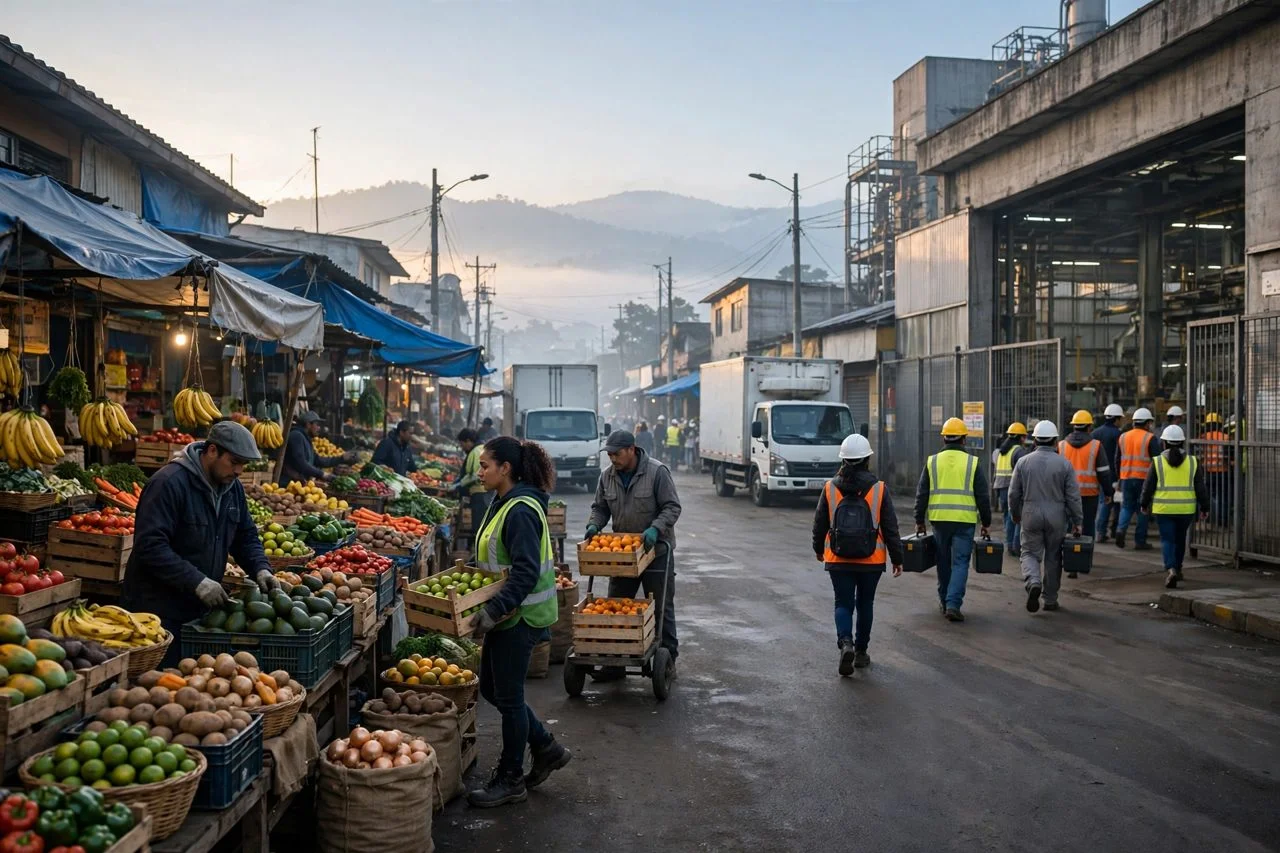
Mercado e industria en actividad al amanecer, en un mes de crecimiento del empleo impulsado por el comercio y la manufactura. · Imagen generada para EPM
Colombian employment grows in September while farming falls back
Unemployment in Colombia fell to 8 % in September and employed people reached 24.24 million, with 322.000 more workers than a year earlier, according to DANE.
Trade and industry drive Colombian jobs as farming loses ground
Colombia recorded an unemployment rate of 8 % in September and 24.24 million employed people, 322.000 more than a year earlier, according to DANE.
--- The context ---
The Colombian labor market showed signs of recovery in September, although the progress did not reach every branch of activity equally. According to results from the National Administrative Department of Statistics (DANE), growth was driven mainly by trade, manufacturing and transport, while the agricultural sector recorded the largest reduction in employed people during the month.
--- The facts ---
The unemployment rate stood at 8 %, compared with 8.2 % in the same month of 2025, and the number of employed people reached 24.24 million, an increase of 322.000 workers from the previous year. Trade and vehicle repair led job creation: they added 162.000 employed people, reached about 4.2 million people, represented 17.3 % of the national total and contributed 0.7 percentage points to the change in the employed population.
Manufacturing added 100.000 additional workers and reached nearly 2.77 million employed people, with a share of 11.4 % of national employment and a contribution of 0.4 percentage points. Transport and storage added 84.000 employed people, reaching approximately 1.94 million, equivalent to 8 % of the national total. Professional, scientific, technical and administrative service activities also grew, with 73.000 additional employed people, as did electricity, gas, water and waste management, with 57.000 new workers.
Other increases were smaller: financial and insurance activities added 47.000, real estate 42.000, accommodation and food services 20.000 and construction 15.000. At the other extreme, agriculture, livestock, hunting, forestry and fishing lost 184.000 employed people, stood at nearly 3.19 million people, equivalent to 13.1 % of national employment, and subtracted 0.8 percentage points from the total change. Arts and entertainment activities fell by 49.000, the public administration, education and health group lost 23.000, and information and communications declined by 21.000.
--- The positions ---
The reading left by the DANE figures is twofold: the recovery is real, but it is concentrated in urban and service branches, while farming and several cultural and public activities lose workers. That difference matters because the positive national balance coexists with a sharp setback in the very sector that subtracted the most jobs in September.
--- What remains unknown ---
The available information does not explain the causes of the agricultural decline or specify whether the loss was concentrated in a particular activity within the sector. It is also unknown whether the pace of job creation in trade and manufacturing will hold in the coming months.
--- Unanswered questions ---
What explains the loss of 184.000 employed people in the agricultural sector? Can trade and industry sustain this pace of job creation? Will the arts and service activities that also lost workers recover?
--- EPM analysis ---
The central fact is how uneven the advance is: almost all of the momentum came from a few branches, and the largest of them, trade, contributed 0.7 percentage points on its own. When a single sector supports much of the growth, the strength of the whole depends on that engine not stopping.
📌 EPM Take: In EPM's view, September brings good news with a clear warning: there are 322.000 more employed people and a lower unemployment rate than a year earlier, but the recovery is not reaching farming, which lost 184.000 workers and still accounts for 13.1 % of national employment. An improvement that leaves out such a large sector remains incomplete, and the pending task is for growth in trade and industry to coexist with an agricultural recovery that does not yet appear in the DANE figures.
--- The context ---
September brought a sign of momentum in the Colombian labor market, led by productive and service activities. Results from the National Administrative Department of Statistics (DANE) show that growth was driven mainly by trade, manufacturing and transport, while the agricultural sector recorded the largest reduction in employed people among all branches of activity.
--- The facts ---
The unemployment rate stood at 8 %, compared with 8.2 % in the same month of 2025, and employed people reached 24.24 million, that is, 322.000 more workers than the previous year. Trade and vehicle repair were the main engine: they added 162.000 employed people, reached approximately 4.2 million people, represented 17.3 % of all employed people and contributed 0.7 percentage points to the national change.
Manufacturing came second, adding 100.000 additional workers and reaching nearly 2.77 million employed people, with 11.4 % of national employment and a contribution of 0.4 percentage points. Transport and storage added 84.000 employed people, reaching approximately 1.94 million, equivalent to 8 % of the total. Professional, scientific, technical and administrative service activities generated 73.000 additional employed people, and electricity, gas, water and waste management added 57.000 new workers.
Financial and insurance activities also rose, with 47.000; real estate, with 42.000; accommodation and food services, with 20.000, and construction, with 15.000. By contrast, agriculture, livestock, hunting, forestry and fishing lost 184.000 employed people, stood at nearly 3.19 million people, equivalent to 13.1 % of national employment, and subtracted 0.8 percentage points from the total change. Arts and entertainment activities fell by 49.000, the public administration, education and health group lost 23.000, and information and communications reported 21.000 fewer employed people.
--- The positions ---
The figures support an orderly conclusion: when trade, manufacturing and transport move forward, national employment grows. The other side is farming, whose drop of 184.000 employed people was the largest of the month and deserves attention, because it is a branch that still represents 13.1 % of all employed people in the country.
--- What remains unknown ---
The published results do not explain the reasons behind the agricultural fall or indicate whether it reflects a one-off September pattern or a longer trend. Nor do they detail how much of the trade advance corresponds to vehicle repair and how much to commercial activity itself.
--- Unanswered questions ---
What is behind the loss of 184.000 employed people in the agricultural sector? Will manufacturing and transport keep their contribution in the coming months? Will construction grow more strongly than the 15.000 jobs recorded in September?
--- EPM analysis ---
Growth was broad in the number of branches but uneven in size: between trade, with 162.000 new employed people, and construction, with 15.000, there is a wide gap. That distance shows where the capacity to generate jobs lies today and where progress is still weak.
📌 EPM Take: In EPM's view, the September figure confirms that employment grows when productive and commercial activities move: 322.000 more employed people and unemployment at 8 % are the result of that momentum, led by trade with 162.000 jobs and followed by industry with 100.000. The warning sign is in farming, which lost 184.000 workers in a year. Sustaining the advance will require that the dynamism of the sectors now pushing does not slow and that the agricultural setback does not become permanent.
El empleo colombiano crece en septiembre y el agro retrocede
El desempleo en Colombia bajó a 8 % en septiembre y los ocupados llegaron a 24,24 millones, con 322.000 trabajadores más que el año anterior, según el DANE.
Comercio e industria empujan el empleo mientras el campo pierde
Colombia registró en septiembre una tasa de desempleo de 8 % y 24,24 millones de ocupados, 322.000 más que el año anterior, según el DANE.
--- El contexto ---
El mercado laboral colombiano mostró señales de recuperación en septiembre, aunque el avance no llegó por igual a todas las ramas. Según los resultados del Departamento Administrativo Nacional de Estadística (DANE), el crecimiento estuvo impulsado principalmente por el comercio, la industria manufacturera y el transporte, mientras el agro registró la mayor reducción de ocupados.
--- Los hechos ---
La tasa de desempleo se ubicó en 8 %, frente al 8,2 % registrado en el mismo mes de 2025, y las personas ocupadas llegaron a 24,24 millones, 322.000 más que el año anterior. El comercio y la reparación de vehículos encabezaron la generación de puestos: sumaron 162.000 ocupados, alcanzaron cerca de 4,2 millones, representaron el 17,3 % del total y aportaron 0,7 puntos porcentuales a la variación nacional.
La industria manufacturera incorporó 100.000 trabajadores y llegó a cerca de 2,77 millones de ocupados, con el 11,4 % de participación y 0,4 puntos porcentuales de contribución. El transporte y almacenamiento sumó 84.000 ocupados, hasta 1,94 millones, el 8 % del total nacional. También crecieron las actividades profesionales, científicas, técnicas y de servicios administrativos, con 73.000 ocupados adicionales, y el suministro de electricidad, gas, agua y gestión de desechos, con 57.000 nuevos trabajadores.
Otros aumentos fueron menores: actividades financieras y de seguros sumaron 47.000, las inmobiliarias 42.000, el alojamiento y los servicios de comida 20.000 y la construcción 15.000. En el extremo contrario, la agricultura, ganadería, caza, silvicultura y pesca perdió 184.000 ocupados, quedó en cerca de 3,19 millones, el 13,1 % del empleo nacional, y restó 0,8 puntos porcentuales a la variación total. Las actividades artísticas y de entretenimiento bajaron 49.000, el grupo de administración pública, educación y salud perdió 23.000 e información y comunicaciones redujo 21.000.
--- Las posiciones ---
La lectura que dejan los datos del DANE es doble: la recuperación existe, pero se concentra en ramas urbanas y de servicios, mientras el campo y varias actividades culturales y públicas pierden trabajadores. Esa diferencia importa porque el saldo positivo convive con un retroceso fuerte en el sector que más puestos restó en septiembre.
--- Lo que falta saber ---
La información disponible no explica las causas del retroceso agropecuario ni si la pérdida se concentró en alguna actividad del sector. Tampoco se conoce si el ritmo del comercio y la manufactura se mantendrá en los meses siguientes.
--- Preguntas sin respuesta ---
¿Qué explica la pérdida de 184.000 ocupados en el sector agropecuario? ¿Podrán el comercio y la industria sostener este ritmo de generación de empleo? ¿Se recuperarán las actividades artísticas y de servicios que también perdieron trabajadores?
--- Análisis EPM ---
El dato central es la desigualdad del avance: casi todo el impulso vino de unas pocas ramas, y el comercio aportó por sí solo 0,7 puntos porcentuales. Cuando un sector sostiene buena parte del crecimiento, la solidez del conjunto depende de que ese motor no se detenga.
📌 Conclusion EPM: A juicio de EPM, septiembre deja una buena noticia con una advertencia clara: hay 322.000 ocupados más y una tasa de desempleo menor que la del año anterior, pero la recuperación no está llegando al campo, que perdió 184.000 trabajadores y sigue pesando el 13,1 % del empleo nacional. Una mejora que excluye a un sector tan grande queda incompleta, y la tarea pendiente es que el crecimiento del comercio y la industria conviva con una recuperación agropecuaria que hoy no aparece en los datos del DANE.
--- El contexto ---
Septiembre dejó una señal de dinamismo en el mercado laboral colombiano, liderada por las actividades productivas y de servicios. Los resultados del Departamento Administrativo Nacional de Estadística (DANE) muestran que el crecimiento estuvo impulsado principalmente por el comercio, la industria manufacturera y el transporte, mientras el agro registró la mayor reducción de ocupados.
--- Los hechos ---
La tasa de desempleo se ubicó en 8 %, frente al 8,2 % del mismo mes de 2025, y las personas ocupadas llegaron a 24,24 millones, 322.000 más que el año anterior. El comercio y la reparación de vehículos fueron el principal motor: sumaron 162.000 ocupados, alcanzaron cerca de 4,2 millones, representaron el 17,3 % del total y aportaron 0,7 puntos porcentuales a la variación nacional.
La industria manufacturera ocupó el segundo lugar al incorporar 100.000 trabajadores y llegar a cerca de 2,77 millones de ocupados, con el 11,4 % del empleo nacional y 0,4 puntos porcentuales de contribución. El transporte y almacenamiento sumó 84.000 ocupados, hasta 1,94 millones, el 8 % del total. Las actividades profesionales, científicas, técnicas y de servicios administrativos generaron 73.000 ocupados adicionales, y el suministro de electricidad, gas, agua y gestión de desechos añadió 57.000 nuevos trabajadores.
También registraron aumentos las actividades financieras y de seguros, con 47.000; las inmobiliarias, con 42.000; el alojamiento y los servicios de comida, con 20.000, y la construcción, con 15.000. En contraste, la agricultura, ganadería, caza, silvicultura y pesca perdió 184.000 ocupados, se ubicó en cerca de 3,19 millones, el 13,1 % del empleo nacional, y restó 0,8 puntos porcentuales a la variación total. Las actividades artísticas y de entretenimiento bajaron 49.000, el grupo de administración pública, educación y salud perdió 23.000 e información y comunicaciones reportó 21.000 ocupados menos.
--- Las posiciones ---
Los datos respaldan una conclusión ordenada: cuando el comercio, la manufactura y el transporte avanzan, el empleo crece. La contracara es el agro, cuya caída de 184.000 ocupados fue la mayor del mes y merece atención, porque esa rama todavía representa el 13,1 % de los ocupados del país.
--- Lo que falta saber ---
Los resultados no explican las razones de la caída agropecuaria ni si responde a un comportamiento puntual de septiembre o a una tendencia más larga. Tampoco se detalla qué parte del avance del comercio corresponde a reparación de vehículos.
--- Preguntas sin respuesta ---
¿A qué se debe la pérdida de 184.000 ocupados en el sector agropecuario? ¿Mantendrán la manufactura y el transporte su aporte en los próximos meses? ¿Volverá la construcción a crecer con más fuerza que los 15.000 puestos de septiembre?
--- Análisis EPM ---
El crecimiento fue amplio en ramas, pero desigual en magnitud: entre el comercio, con 162.000 nuevos ocupados, y la construcción, con 15.000, hay una distancia grande. Esa brecha muestra dónde está hoy la capacidad de generar puestos y dónde el avance es débil.
📌 Conclusion EPM: A juicio de EPM, el dato de septiembre confirma que el empleo crece cuando las actividades productivas y comerciales se mueven: 322.000 ocupados más y un desempleo de 8 % son el resultado de ese impulso, encabezado por el comercio con 162.000 puestos y seguido por la industria con 100.000. La señal de alerta está en el campo, que perdió 184.000 trabajadores en un año. Sostener el avance exigirá que el dinamismo de los sectores que hoy empujan no se frene y que el retroceso agropecuario no se vuelva permanente.