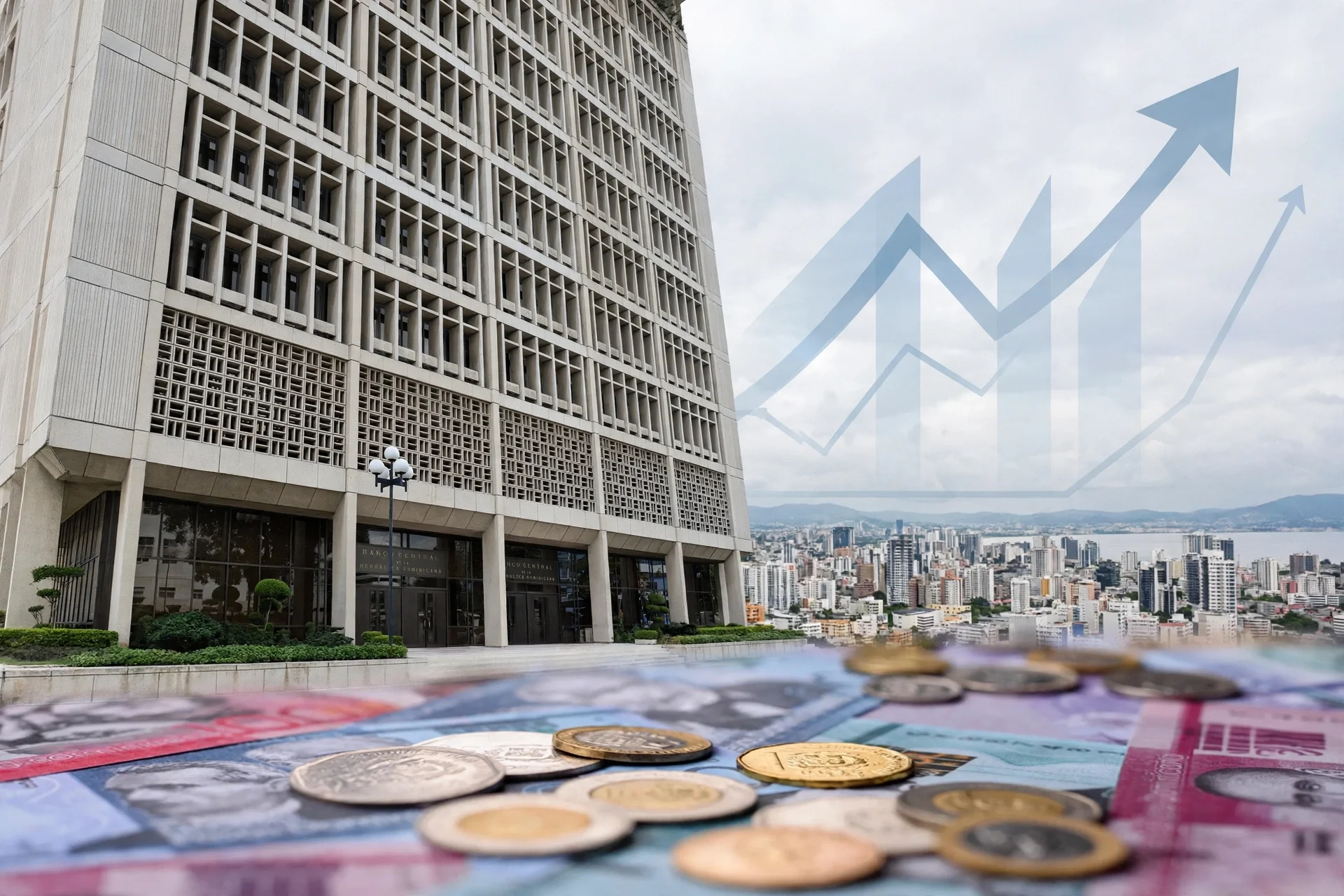
Imagen alusiva a la decisión de política monetaria de octubre de 2026 en República Dominicana.
Dominican Central Bank Holds Rate at 5.50% to Back Growth
The central bank kept its policy rate at 5.50% per year, with repos at 6.00% and overnight deposits at 4.75%, as inflation eased to 5.12% in September, the…
Dominican Central Bank Holds Rate at 5.50% on Discipline
The central bank kept its policy rate at 5.50% per year and the rest of the corridor unchanged, with core inflation at 4.61% within the range, reserves at…
--- The context ---
The October decision comes as year-on-year inflation keeps a gradual convergence toward the target range of 4 % ± 1 %, easing from 5.67 % in June to 5.12 % in September, while economic activity remains solid and the peso shows a cumulative appreciation of around 4 % at the close of October 2026, according to the central bank's own account of the meeting.
--- The facts ---
The Central Bank of the Dominican Republic decided to keep its monetary policy rate at 5.50% per year, with the permanent liquidity expansion facility at 6.00% per year and remunerated overnight deposits at 4.75% per year. Core inflation moderated from 4.96% in June to 4.61% in September and stayed within the target range, in a dynamic shaped by government subsidies that partially passed the increase in refined petroleum products through to fuel prices.
The economy grew 5.6% year-on-year in September and accumulated an expansion of 4.6% in the first nine months of the year, supported by construction, financial intermediation and hotels, bars and restaurants. International reserves stood at around 15,200 million dollars at the close of September, equivalent to about 10.5% of GDP and some 5 months of imports, above the metrics recommended by the IMF, and private credit in domestic currency expanded by around 7.4% year-on-year.
--- The positions ---
The central bank's position is to leave the rate corridor unchanged and to actively manage the liquidity of the financial system so that it stays at adequate levels. That stance protects the investment impulse and financing for productive sectors, which accounts for much of the growth, while medium-term expectations remain anchored to the center of the target and short-term expectations have moderated, as the monetary authority itself explained.
--- What remains unknown ---
The authority's forecasting system indicates that year-on-year inflation would return to the target range of 4.0% ± 1.0% during the fourth quarter, but that return is still a projection rather than an observed result. Upside risks persist, linked to ongoing armed conflicts and to the possible impact of climate phenomena on food prices, alongside an external environment in which rate increases are expected toward the end of the year.
--- Unanswered questions ---
Will inflation actually enter the target range during the fourth quarter, as the forecasting system anticipates? What will happen to credit for productive sectors if the external environment forces tighter financial conditions? Will the growth of around 4.5% projected for 2026 be reached if the risks hanging over food prices persist throughout the remainder of the year?
--- EPM analysis ---
Holding the rate at 5.50% per year balances two fronts: it does not brake an economy growing above the regional average and, at the same time, it accompanies a disinflation that has already placed core inflation within the range. Strong reserves and the appreciation of the peso provide room to maneuver, although that room depends on the external sector keeping its resilience and on fuel subsidies continuing to contain the pass-through of prices.
📌 EPM Take:
In EPM's view, the monetary pause is consistent with an economy that grew 5.6% year-on-year in September, accumulated 4.6% in the year and sustains productive credit at 7.4%, even though inflation has not finished converging. The decision will be judged in the fourth quarter: if inflation enters the range of 4.0% ± 1.0% and reserves stay at around 15,200 million dollars, the strategy will have protected growth without surrendering the price stability that today supports the Dominican peso and household purchasing power.
--- The context ---
The October 2026 monetary policy meeting took place with year-on-year inflation still above the center of the target, although easing gradually from 5.67% in June to 5.12% in September, and with core inflation already within the target range. In that setting, the monetary authority's credibility rests on sustaining discipline until the announced convergence toward the range of 4 % ± 1 % is fully completed.
--- The facts ---
The Central Bank of the Dominican Republic kept its monetary policy rate at 5.50% per year, the permanent liquidity expansion facility at 6.00% per year and the remunerated deposit rate at 4.75% per year. Core inflation moderated from 4.96% in June to 4.61% in September, in a dynamic shaped by government subsidies that partially passed the increase in refined petroleum products through to fuel prices, according to the authority.
The economy grew 5.6% year-on-year in September and accumulated an expansion of 4.6% in the first nine months of the year, supported by construction, financial intermediation and hotels, bars and restaurants. International reserves stood at around 15,200 million dollars at the close of September, equivalent to about 10.5% of GDP and some 5 months of imports, exceeding the metrics recommended by the IMF, while private credit in domestic currency expanded by around 7.4% year-on-year at the close of September.
--- The positions ---
The central bank's position is to leave rates unchanged and to actively manage liquidity so that it remains at adequate levels, a signal of continuity intended to preserve the anchoring of medium-term expectations to the center of the target set in the Monetary Program. The authority acknowledges at the same time that the inflation outlook keeps upside risks, so the pause does not amount to declaring the convergence task finished or the target already secured.
--- What remains unknown ---
The authority's forecasting system anticipates that year-on-year inflation will return to the target range of 4.0% ± 1.0% during the fourth quarter, but that return still has to be confirmed by data. Upside risks depend on the persistence of armed conflicts and on the potential impact of climate phenomena on food, and the external environment adds pressure with rate increases expected in the United States and the euro area toward the close of 2026.
--- Unanswered questions ---
Will the return of inflation to the range of 4.0% ± 1.0% projected by the authority be confirmed in the fourth quarter? Will medium-term expectations keep their anchoring to the center of the target if external risks materialize during the coming months? Will active liquidity management be enough to sustain exchange rate stability without additional adjustments to interest rates?
--- EPM analysis ---
The pause rests on discipline: with core inflation at 4.61% and within the range, and with reserves covering some 5 months of imports, the authority can wait without softening its message. The peso's cumulative appreciation of around 4% at the close of October supports that reading, although headline inflation of 5.12% is a reminder that convergence is gradual and that any premature easing would put accumulated credibility at risk.
📌 EPM Take:
In EPM's view, keeping the policy rate at 5.50% per year is a decision of discipline and credibility: core inflation is already within the range, medium-term expectations remain anchored and reserves exceed the recommended metrics. The risk lies not in the pause but in reading it as a finished cycle. Until headline inflation enters the range of 4.0% ± 1.0% and conflicts and climate keep pressuring food prices, prudence calls for holding the current corridor and strict liquidity management.
BCRD mantiene la TPM en 5.50 % y protege el crecimiento
El Banco Central mantuvo la TPM en 5.50 % anual, con repos en 6.00 % y overnight en 4.75 %, mientras la inflación bajó a 5.12 % en septiembre, la economía…
BCRD mantiene la TPM en 5.50 % por disciplina monetaria
El Banco Central mantuvo la TPM en 5.50 % anual y el resto del corredor sin cambios, con la inflación subyacente en 4.61 % dentro del rango, reservas en torno…
--- El contexto ---
La decisión de octubre llega con la inflación interanual en convergencia gradual hacia el rango meta de 4 % ± 1 %, tras reducirse de 5.67 % en junio a 5.12 % en septiembre, mientras la actividad conserva un desempeño sólido y el peso se apreció en torno al 4 % al cierre de octubre de 2026.
--- Los hechos ---
El Banco Central de la República Dominicana decidió mantener su tasa de interés de política monetaria en 5.50 % anual, con la facilidad permanente de expansión de liquidez en 6.00 % anual y los depósitos remunerados en 4.75 % anual. La inflación subyacente se moderó de 4.96 % en junio a 4.61 % en septiembre y permaneció dentro del rango objetivo, en una dinámica condicionada por los subsidios del Gobierno a los combustibles.
La economía creció 5.6 % interanual en septiembre y acumuló una expansión de 4.6 % en los primeros nueve meses del año, sustentada por la construcción, la intermediación financiera y los hoteles, bares y restaurantes. Las reservas internacionales se ubicaron en torno a 15,200 millones de dólares al cierre de septiembre, equivalentes a 10.5 % del PIB y a unos 5 meses de importaciones, por encima de las métricas recomendadas por el FMI, y el crédito privado en moneda nacional se expandió en torno a 7.4 % interanual.
--- Las posiciones ---
La posición del Banco Central es mantener sin cambios el corredor de tasas y gestionar activamente la liquidez para mantenerla en niveles adecuados. Esa postura protege la inversión y el financiamiento productivo, mientras las expectativas de mediano plazo permanecen ancladas al centro de la meta y las de corto plazo se han moderado, según lo expuesto por la propia autoridad monetaria.
--- Lo que falta saber ---
El sistema de pronósticos de la autoridad indica que la inflación retornaría al rango objetivo de 4.0 % ± 1.0 % durante el cuarto trimestre, pero ese retorno es todavía una proyección, no un dato observado. Persisten riesgos al alza ligados a los conflictos bélicos y a fenómenos climáticos sobre los alimentos, además de aumentos de tasas previstos en el exterior hacia el cierre del año.
--- Preguntas sin respuesta ---
¿Logrará la inflación entrar efectivamente al rango meta durante el cuarto trimestre, como anticipa el sistema de pronósticos? ¿Qué ocurrirá con el crédito a los sectores productivos si el entorno externo obliga a endurecer las condiciones financieras? ¿Alcanzará el crecimiento en torno a 4.5 % proyectado para 2026 si persisten los riesgos sobre los precios de los alimentos?
--- Análisis EPM ---
Mantener la tasa en 5.50 % anual equilibra dos frentes: no frena una economía que crece sobre el promedio regional y acompaña una desinflación que ya colocó la subyacente dentro del rango. Las reservas y la apreciación del peso dan margen, aunque depende de la resiliencia del sector externo y de que los subsidios sigan conteniendo el traspaso de precios.
📌 Conclusion EPM:
A juicio de EPM, la pausa monetaria es coherente con una economía que crece 5.6 % interanual en septiembre, acumula 4.6 % en el año y sostiene el crédito productivo en 7.4 %, sin que la inflación haya terminado de converger. El acierto de la decisión se medirá en el cuarto trimestre: si la inflación entra al rango de 4.0 % ± 1.0 % y las reservas se mantienen en torno a 15,200 millones de dólares, la estrategia habrá protegido el crecimiento sin ceder la estabilidad de precios que hoy respalda al peso dominicano.
--- El contexto ---
La reunión de octubre de 2026 se produjo con la inflación interanual aún sobre el centro de la meta, aunque en descenso gradual de 5.67 % en junio a 5.12 % en septiembre, y con la subyacente ya dentro del rango objetivo. En ese cuadro, la credibilidad descansa en sostener la disciplina hasta completar la convergencia hacia el rango de 4 % ± 1 %.
--- Los hechos ---
El Banco Central de la República Dominicana mantuvo la TPM en 5.50 % anual, la facilidad permanente de expansión de liquidez en 6.00 % anual y los depósitos remunerados en 4.75 % anual. La inflación subyacente se moderó de 4.96 % en junio a 4.61 % en septiembre, en una dinámica condicionada por los subsidios del Gobierno a los combustibles.
La actividad creció 5.6 % interanual en septiembre y acumuló 4.6 % en nueve meses, apoyada en la construcción, la intermediación financiera y los hoteles, bares y restaurantes. Las reservas internacionales se ubicaron en torno a 15,200 millones de dólares al cierre de septiembre, equivalentes a 10.5 % del PIB y a unos 5 meses de importaciones, superando las métricas recomendadas por el FMI, mientras el crédito privado en moneda nacional se expandió en torno a 7.4 % interanual al cierre de septiembre.
--- Las posiciones ---
La posición del Banco Central es no mover las tasas y gestionar activamente la liquidez para que se mantenga en niveles adecuados, una señal de continuidad que busca preservar el anclaje de las expectativas de mediano plazo al centro de la meta del Programa Monetario. La autoridad reconoce que las perspectivas mantienen riesgos al alza, por lo que la pausa no equivale a declarar terminada la convergencia.
--- Lo que falta saber ---
El sistema de pronósticos de la autoridad anticipa que la inflación interanual retornará al rango objetivo de 4.0 % ± 1.0 % durante el cuarto trimestre, pero esa vuelta aún debe confirmarse con datos. Los riesgos dependen de los conflictos bélicos y de fenómenos climáticos sobre los alimentos, y el exterior suma presión con aumentos de tasas previstos en Estados Unidos y la Zona Euro hacia el cierre de 2026.
--- Preguntas sin respuesta ---
¿Se confirmará en el cuarto trimestre el retorno de la inflación al rango de 4.0 % ± 1.0 % que proyecta la autoridad? ¿Mantendrán las expectativas de mediano plazo su anclaje al centro de la meta si los riesgos externos se materializan? ¿Será suficiente la gestión activa de la liquidez para sostener la estabilidad del tipo de cambio sin ajustes adicionales de tasas?
--- Análisis EPM ---
La pausa es disciplina: con la subyacente en 4.61 %, dentro del rango, y reservas que cubren unos 5 meses de importaciones, la autoridad puede esperar sin aflojar el mensaje. La apreciación del peso en torno al 4 % al cierre de octubre respalda esa lectura, aunque la inflación de 5.12 % recuerda que la convergencia es gradual y que un relajamiento prematuro pondría en riesgo la credibilidad.
📌 Conclusion EPM:
A juicio de EPM, mantener la TPM en 5.50 % anual es una decisión de disciplina y credibilidad: la inflación subyacente ya está dentro del rango, las expectativas de mediano plazo permanecen ancladas y las reservas superan las métricas recomendadas. El riesgo no está en la pausa, sino en interpretarla como un ciclo terminado. Mientras la inflación general no entre al rango de 4.0 % ± 1.0 % y los conflictos y el clima sigan presionando los alimentos, la prudencia manda sostener el corredor actual y la gestión estricta de la liquidez.