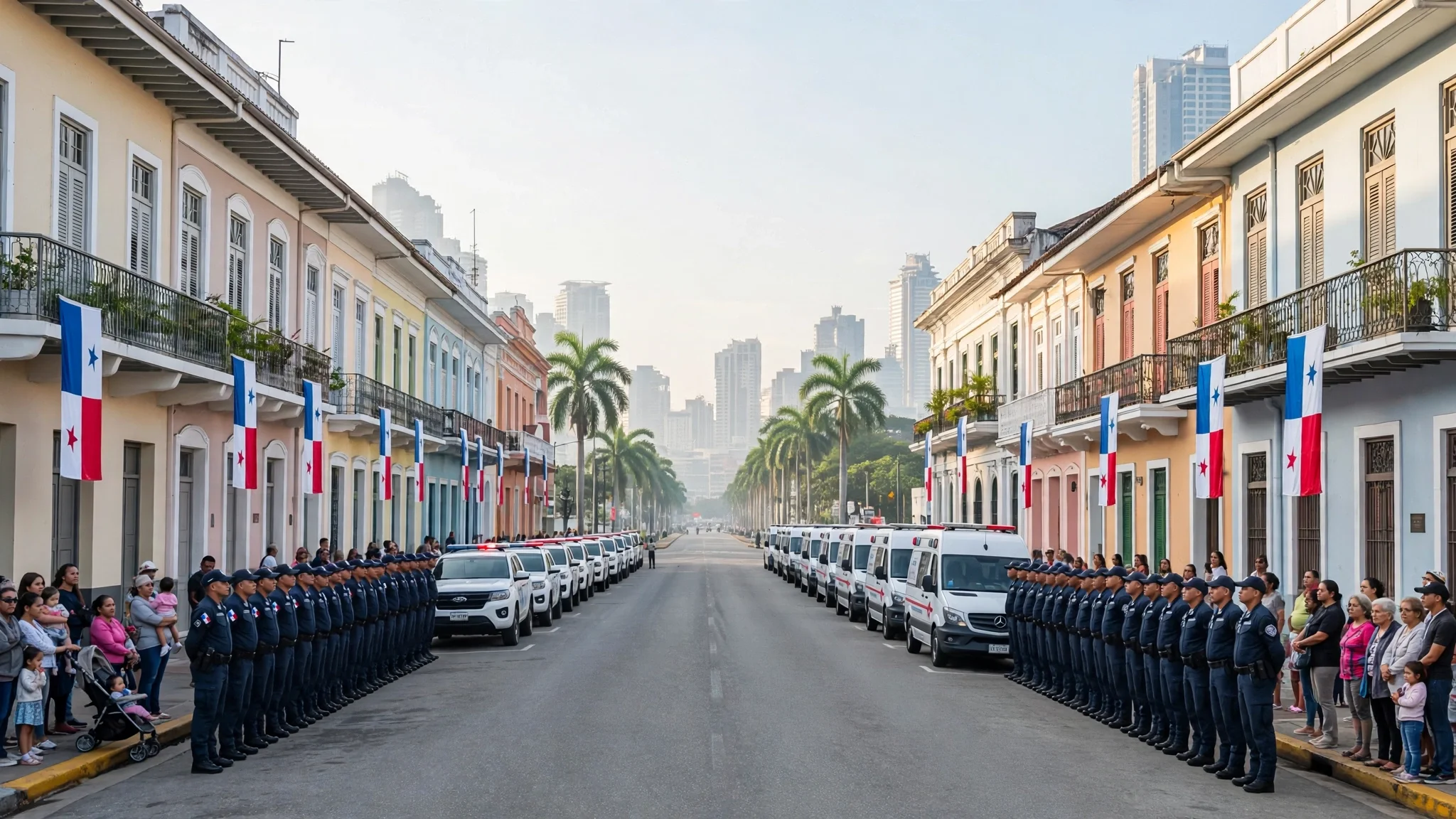
Imagen alusiva: despliegue de seguridad y banderas panameñas en una avenida de desfiles durante las Fiestas Patrias.
Panama deploys a vast patriotic operation without halting earthquake aid
Panama will mobilize ten thousand two hundred ninety-four personnel during the patriotic holidays, covering parades, beaches, ports and islands, while keeping…
Order and State presence: the patriotic holidays operation takes shape
The patriotic operation will bring together ten thousand two hundred ninety-four personnel with patrols, traffic controls and lane reversals on the…
Panama will launch a nationwide security and emergency operation during the November patriotic holidays with of ten thousand two hundred ninety-four security and emergency personnel, at a moment when four central provinces are still facing the consequences of the magnitude seven point five earthquake that struck on the ninth of October. The deployment will cover parades, travel routes, beaches, ports, islands and airports, and the authorities assured that it will not interrupt aid to the communities affected by the earthquake.
--- The context ---
The patriotic holidays bring one of the largest movements of people toward the interior of the country each year, with school parades, civic ceremonies and family travel that fill the highways and tourist destinations. This year, however, the celebration coexists with an open emergency: numerous homes, schools and public facilities are damaged in the central provinces, and assessment and recovery work is still under way. Festivity and emergency coincide, and that requires sustained vigilance without abandoning humanitarian assistance.
--- The facts ---
According to the Ministry of Public Security, the operation will bring together personnel from the National Police, the National Aeronaval Service, the National Border Service and Migration, together with the medical care agencies. The deployment will have four hundred sixty-one means of transport, divided among three hundred eighty-one land vehicles, sixty-eight maritime resources and twelve aircraft. Coverage will comprise sixty-three beaches, thirty-four ports and docks, fifteen islands, eleven airports and nine control points to supervise the movement of travelers. Coordination will be centralized at the National Operations Center, from where the institutions will follow the civic activities and the main communication routes. For the parades on the third and fourth of November, the medical emergency services will have eighty-four units assigned to cover the metropolitan routes and their dispatch center, within the Plan Firmeza coordinated by the ministry itself.
--- The positions ---
The authorities assured that the Patriotic Holidays Operation will not interrupt Operation Resguardo, which is responsible for assisting the communities affected by the earthquake. In Los Santos, Herrera, Veraguas and Cocle, the patriotic parades on the third and fourth of November were suspended because of the damage recorded, and the parades on the tenth of November in San Miguelito and Juan Diaz, linked to the First Cry of Independence of La Villa de Los Santos, were also suspended. In contrast, Panama City will keep its parades along two traditional routes: Route One, through the Old Town and the area of the Presidency, and Route Two, along Via Espana. The Minister of Education, Ventura Vega, explained that the capital celebrations will be held in solidarity with the affected families. Outside the capital, the decision belongs to the local governments, and in Colon it will be the responsibility of the provincial governor.
--- What remains unknown ---
The detailed distribution of personnel between festive vigilance and direct support for the damaged areas is not yet known, nor is the updated balance of homes and schools affected in each province. It has not been specified either whether the local governments that must decide on their parades will apply uniform structural safety criteria, or how long the assessment and recovery work will continue in the communities where the celebration was suspended in solidarity with those affected.
--- Unanswered questions ---
How will Operation Resguardo keep its pace in the affected provinces while the festive deployment lasts? What criteria will the local governments and the governor of Colon apply to authorize or suspend parades in their territories? When will affected families have a clear balance of the damage to their homes and schools? Will the eighty-four medical units be enough to comfortably cover the metropolitan routes during the two days of parades?
--- EPM analysis ---
The operation tests the capacity of the State to do two demanding things at once: protect those who celebrate and travel, and sustain without pause the care of those who lost almost everything in the earthquake. Suspending parades in the damaged provinces recognizes that there is no possible festivity where schools and homes still bear the marks of the quake, while keeping the ceremonies in the capital preserves a civic space that is also part of the life of students and families. The key will be whether the declared solidarity becomes a real and sustained presence in the affected communities.
📌 EPM Take:
In EPM's view, the most important measure of this operation is not its size, but the promise that the celebration will not stop the aid: if Operation Resguardo keeps its pace in Los Santos, Herrera, Veraguas and Cocle while the country parades, the deployment will have fulfilled its human purpose before its festive one. Civil protection is judged in the long days of recovery, not only on the days of flags, and that is why every unit assigned to guard routes and beaches must coexist with an equally firm presence beside the families still waiting to repair their homes and reopen their schools.
The Government of Panama will activate during the November patriotic holidays a nationwide operation with ten thousand two hundred ninety-four security and emergency personnel, patrols, traffic controls and special vigilance on parade routes, commercial sectors, residential areas and tourist destinations. The deployment will be carried out in the middle of the emergency caused by the magnitude seven point five earthquake of the ninth of October, mandated to guarantee order without interrupting assistance to the affected communities.
--- The context ---
The patriotic season moves thousands of families toward the interior, fills the highways and concentrates crowds at parades and civic ceremonies, This year there is an extraordinary factor: four central provinces still carry damage to homes, schools and public facilities, with recovery work still under way. Order and continuity in the emergency are the requirement weighing on the institutions.
--- The facts ---
The Ministry of Public Security reported that the operation will bring together the National Police, the National Aeronaval Service, the National Border Service and Migration, together with the medical care agencies. There will be four hundred sixty-one means of transport: three hundred eighty-one land vehicles, sixty-eight maritime resources and twelve aircraft. Coverage will span sixty-three beaches, thirty-four ports and docks, fifteen islands, eleven airports and nine traveler control points. Everything will be coordinated from the National Operations Center. For the parades on the third and fourth of November there will be eighty-four medical emergency units on the metropolitan routes. In addition, the National Police will apply lane reversals on the Inter-American Highway: it began on Friday the thirtieth of October, this Saturday the thirty-first it runs from six in the morning to six in the evening between El Nazareno, in La Chorrera, and Campana, in Capira, and for the return there will be reversals on Thursday the fifth and Sunday the eighth of November from El Nance to Sajalices and from Campana to El Nazareno.
--- The positions ---
The authorities assured that the Patriotic Holidays Operation will not interrupt Operation Resguardo, which assists those affected by the earthquake. In Los Santos, Herrera, Veraguas and Cocle the parades on the third and fourth of November were suspended, as were those on the tenth of November in San Miguelito and Juan Diaz, linked to the First Cry of Independence of La Villa de Los Santos. The capital will keep its parades: Route One will pass through the Old Town and the area of the Presidency and Route Two will run along Via Espana, as announced by the Minister of Education, Ventura Vega, who explained that the celebrations will be held in solidarity with the affected families. Outside the capital, the local governments will decide, and in Colon, the provincial governor, weighing the safety conditions and the damage in each territory. The National Directorate of Transit Operations recommended respecting the instructions of the officers, keeping prudent speeds and checking the mechanical condition of vehicles before traveling.
--- What remains unknown ---
The detailed deployment by province and the damage balance the authorities are using to decide each parade outside the capital remain to be seen. The scope of the controls in commercial sectors and residential areas during the busiest days has not been detailed either, nor has the full recovery calendar for the affected public facilities. Information on how the emergency evolves in the central provinces will remain decisive to judge whether the balance between celebration and assistance holds in practice.
--- Unanswered questions ---
Will the National Operations Center maintain effective coordination among institutions throughout all the days of the operation? Will the lane reversals reduce congestion on the Inter-American Highway during the departure and return of travelers? Will the local governments apply firm safety criteria before authorizing parades in territories with structural damage? Will the presence on beaches, ports and routes translate into holidays without serious incidents?
--- EPM analysis ---
An operation of this scale sends a clear signal: the State will be present where people celebrate, where they travel and where they trade. The lane reversals order the flow toward the interior and back, the control points supervise the movement of travelers, and the simultaneous vigilance on beaches and highways protects families on the days of greatest exposure. Suspending parades in the provinces struck by the quake also shows that authority knows how to distinguish between celebrating and exposing people: where there is damage, prudence commands; where there are conditions, the festivity continues with order and with rules.
📌 EPM Take:
In EPM's view, the strength of this operation lies in its combination of presence and judgment: ten thousand two hundred ninety-four personnel guarding routes, beaches, ports and parades, and at the same time the sober decision to suspend the ceremonies where the earthquake left real damage. Order is not improvised on festive days; it is prepared with central coordination, visible controls and respect for traffic instructions. If the authorities maintain that firmness throughout the whole season, the patriotic holidays can be celebrated safely, with commerce protected and without abandoning the provinces still recovering.
Panamá despliega su mayor operativo patrio sin detener la ayuda por el terremoto
Panamá movilizará diez mil doscientas noventa y cuatro unidades durante las Fiestas Patrias, con cobertura en desfiles, playas, puertos e islas, mientras…
Orden y presencia del Estado: así será el operativo de las Fiestas Patrias
El operativo patrio reunirá diez mil doscientas noventa y cuatro unidades con patrullajes, controles de tránsito e inversión de carriles en la vía…
Panamá pondrá en marcha un operativo nacional de seguridad y emergencia durante las Fiestas Patrias de noviembre con diez mil doscientas noventa y cuatro unidades de seguridad y de los organismos de atención, tras el terremoto de magnitud siete coma cinco ocurrido el nueve de octubre. El despliegue cubrirá desfiles, rutas, playas, puertos, islas y aeropuertos, sin interrumpir la ayuda a los damnificados.
--- El contexto ---
Las Fiestas Patrias concentran cada año una de las mayores movilizaciones de personas hacia el interior del país, con desfiles escolares, actos cívicos y desplazamientos familiares que saturan las carreteras y los destinos turísticos. Este año, sin embargo, la celebración convive con una emergencia abierta: numerosas viviendas, escuelas e instalaciones públicas presentan daños en las provincias centrales y todavía se desarrollan labores de evaluación y recuperación. Fiesta y emergencia coinciden, y eso obliga a sostener la vigilancia sin desatender la asistencia humanitaria.
--- Los hechos ---
Según informó el Ministerio de Seguridad Pública, el operativo reunirá a personal de la Policía Nacional, el Servicio Nacional Aeronaval, el Servicio Nacional de Fronteras y Migración, además de los organismos de atención médica. El dispositivo contará con cuatrocientos sesenta y un medios de transporte, distribuidos entre trescientos ochenta y un vehículos terrestres, sesenta y ocho recursos marítimos y doce aeronaves. La cobertura comprenderá sesenta y tres playas, treinta y cuatro puertos y embarcaderos, quince islas, once aeropuertos y nueve puntos de control para supervisar el movimiento de viajeros. La coordinación estará centralizada en el Centro de Operaciones Nacional, Para los desfiles de los días tres y cuatro de noviembre, los servicios de emergencia médica dispondrán de ochenta y cuatro unidades destinadas a cubrir las rutas metropolitanas y su centro de despacho.
--- Las posiciones ---
Las autoridades aseguraron que la Operación Fiestas Patrias no interrumpirá las labores de la Operación Resguardo, encargada de atender a las comunidades damnificadas por el terremoto. En Los Santos, Herrera, Veraguas y Coclé se suspendieron los desfiles patrios de los días tres y cuatro de noviembre por las afectaciones registradas, y también se suspendieron los desfiles del diez de noviembre en San Miguelito y Juan Díaz, del Primer Grito de Independencia de La Villa de Los Santos. En contraste, la ciudad de Panamá mantendrá sus desfiles en dos recorridos tradicionales: la Ruta Uno, por el Casco Antiguo y el área de la Presidencia, y la Ruta Dos, sobre la vía España. El ministro de Educación, Ventura Vega, explicó que las celebraciones capitalinas se realizarán guardando solidaridad con las familias damnificadas. Fuera de la capital, la decisión corresponde a los gobiernos locales, y en Colón será responsabilidad del gobernador provincial.
--- Lo que falta saber ---
Todavía no se conoce el detalle de cómo se repartirán las unidades entre la vigilancia festiva y el apoyo directo a las zonas dañadas, ni el balance actualizado de viviendas y escuelas afectadas en cada provincia. Tampoco se ha precisado si los gobiernos locales que deben decidir sobre sus desfiles aplicarán criterios uniformes de seguridad estructural, ni cuánto se prolongarán las labores de evaluación y recuperación en las comunidades donde la celebración quedó suspendida por solidaridad con los damnificados.
--- Preguntas sin respuesta ---
¿Cómo se garantizará que la Operación Resguardo mantenga su ritmo en las provincias afectadas mientras dura el despliegue festivo? ¿Qué criterios aplicarán los gobiernos locales y el gobernador de Colón para autorizar o suspender los desfiles en sus territorios? ¿Cuándo tendrán las familias damnificadas un balance claro de los daños en sus viviendas y escuelas? ¿Alcanzarán las ochenta y cuatro unidades médicas para cubrir con holgura las rutas metropolitanas durante los dos días de desfiles?
--- Análisis EPM ---
El operativo pone a prueba la capacidad del Estado para hacer dos cosas exigentes a la vez: proteger a quienes celebran y viajan, y sostener sin pausa la atención de quienes lo perdieron casi todo con el terremoto. La suspensión de desfiles en las provincias dañadas reconoce que no hay fiesta posible donde las escuelas y las casas siguen marcadas por el sismo, mientras la continuidad de los actos en la capital preserva un espacio cívico que también forma parte de la vida de estudiantes y familias. La clave estará en que la solidaridad declarada se traduzca en presencia real y sostenida en las comunidades afectadas.
📌 Conclusion EPM:
A juicio de EPM, la medida más importante de este operativo no es su tamaño, sino la promesa de que la celebración no detendrá la ayuda: si la Operación Resguardo mantiene su ritmo en Los Santos, Herrera, Veraguas y Coclé mientras el país desfila, el despliegue habrá cumplido su sentido humano antes que su sentido festivo. La protección civil se juzga en los días largos de la recuperación, no solo en los días de bandera, y por eso cada unidad destinada a cuidar rutas y playas debe convivir con una presencia igual de firme junto a las familias que todavía esperan reparar sus casas y reabrir sus escuelas.
El Gobierno de Panamá activará durante las Fiestas Patrias de noviembre un operativo nacional con diez mil doscientas noventa y cuatro unidades de seguridad y emergencia, patrullajes, controles de tránsito y vigilancia especial en rutas de desfiles, sectores comerciales, áreas residenciales y destinos turísticos. El despliegue se ejecutará en plena emergencia por el terremoto de magnitud siete coma cinco del nueve de octubre, con orden de garantizar el orden sin interrumpir la atención a los damnificados.
--- El contexto ---
La temporada patria mueve a miles de familias hacia el interior, llena las carreteras y concentra multitudes en desfiles y actos cívicos, Este año se suma un factor: cuatro provincias centrales arrastran daños en viviendas, escuelas e instalaciones públicas tras el sismo, con evaluación y recuperación todavía en curso. Orden y continuidad en la emergencia son la exigencia que pesa sobre las instituciones.
--- Los hechos ---
El Ministerio de Seguridad Pública informó que la operación reunirá a la Policía Nacional, el Servicio Nacional Aeronaval, el Servicio Nacional de Fronteras y Migración, junto a los organismos de atención médica. Habrá cuatrocientos sesenta y un medios de transporte: trescientos ochenta y un vehículos terrestres, sesenta y ocho recursos marítimos y doce aeronaves. La cobertura abarcará sesenta y tres playas, treinta y cuatro puertos y embarcaderos, quince islas, once aeropuertos y nueve puntos de control de viajeros. Se coordinará desde el Centro de Operaciones Nacional. Para los desfiles de los días tres y cuatro de noviembre habrá ochenta y cuatro unidades de emergencia médica en las rutas metropolitanas. Además, la Policía Nacional aplicará inversión de carriles en la vía Interamericana: comenzó el viernes treinta de octubre, este sábado treinta y uno funciona de seis de la mañana a seis de la tarde entre El Nazareno, en La Chorrera, y Campana, en Capira, y para el retorno habrá inversiones el jueves cinco y el domingo ocho de noviembre desde El Nance hasta Sajalices y de Campana hasta El Nazareno.
--- Las posiciones ---
Las autoridades aseguraron que la Operación Fiestas Patrias no interrumpirá la Operación Resguardo, que atiende a los damnificados del terremoto. En Los Santos, Herrera, Veraguas y Coclé se suspendieron los desfiles de los días tres y cuatro de noviembre, y también los del diez de noviembre en San Miguelito y Juan Díaz, ligados al Primer Grito de Independencia de La Villa de Los Santos. La capital sí mantendrá sus desfiles: la Ruta Uno pasará por el Casco Antiguo y el área de la Presidencia y la Ruta Dos recorrerá la vía España, según anunció el ministro de Educación, Ventura Vega, quien explicó que se celebrará guardando solidaridad con las familias damnificadas. Fuera de la capital decidirán los gobiernos locales, y en Colón, el gobernador provincial, valorando la seguridad y las afectaciones de cada territorio. La Dirección Nacional de Operaciones de Tránsito recomendó respetar las indicaciones de los agentes, mantener velocidades prudentes y verificar las condiciones mecánicas de los vehículos antes de viajar.
--- Lo que falta saber ---
Queda por ver el despliegue detallado por provincia y el balance de daños que manejan las autoridades para decidir cada desfile fuera de la capital. Tampoco se ha detallado el alcance de los controles en sectores comerciales y áreas residenciales durante los días de mayor movimiento, ni el calendario completo de recuperación de las instalaciones públicas afectadas. La información sobre la evolución de la emergencia en las provincias centrales seguirá siendo decisiva para juzgar si el equilibrio entre celebración y atención se sostiene en la práctica.
--- Preguntas sin respuesta ---
¿Mantendrá el Centro de Operaciones Nacional una coordinación efectiva entre instituciones durante todos los días del operativo? ¿Reducirá la inversión de carriles los congestionamientos en la vía Interamericana durante la salida y el retorno de los viajeros? ¿Aplicarán los gobiernos locales criterios firmes de seguridad antes de autorizar desfiles en territorios con daños estructurales? ¿Logrará la presencia en playas, puertos y rutas traducirse en unas fiestas sin incidentes graves?
--- Análisis EPM ---
Un operativo de esta escala envía una señal clara: el Estado estará presente donde se celebra, donde se viaja y donde se comercia. La inversión de carriles ordena el flujo hacia el interior y de regreso, los puntos de control supervisan el movimiento de viajeros y la vigilancia simultánea en playas y carreteras protege a las familias en los días de mayor exposición. La suspensión de desfiles en las provincias golpeadas por el sismo muestra, además, que la autoridad sabe distinguir entre celebrar y exponer: donde hay daños, manda la prudencia; donde hay condiciones, la fiesta sigue con orden y con reglas.
📌 Conclusion EPM:
A juicio de EPM, la fortaleza de este operativo está en su combinación de presencia y criterio: diez mil doscientas noventa y cuatro unidades custodiando rutas, playas, puertos y desfiles, y a la vez la decisión sobria de suspender los actos donde el terremoto dejó daños reales. El orden no se improvisa en los días de fiesta; se prepara con coordinación central, controles visibles y respeto a las indicaciones de tránsito. Si la autoridad mantiene esa firmeza durante toda la temporada, las Fiestas Patrias podrán celebrarse con seguridad, con comercio protegido y sin abandonar a las provincias que aún se recuperan.