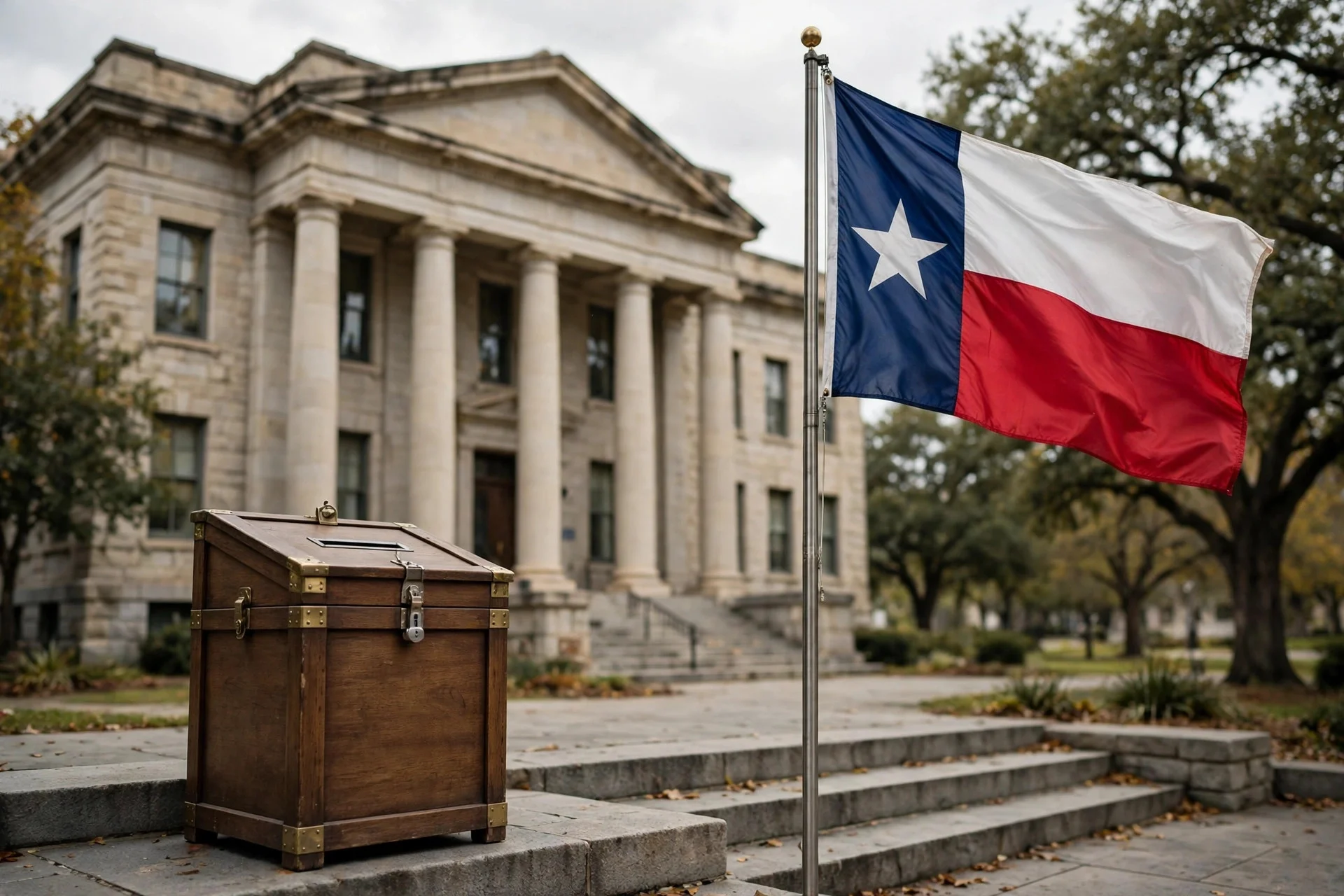
Imagen alusiva: urna y bandera de Texas en un caso de votación ilegal investigado por la fiscalía estatal.
Texas arrests accused of voting while ineligible
The Texas attorney general announced arrests of convicted felons accused of illegally voting, after an October 27 Harris County report and verification…
Texas arrests accused of illegal voting
Texas authorities arrested convicted felons accused of illegal voting after checking a citizen report and confirming with the Department of Criminal Justice…
--- The context ---
Texas Attorney General Ken Paxton announced the arrests of convicted felons accused of illegally casting ballots in state elections. According to the attorney general's office, the arrests are the latest action by its Election Integrity Unit, which investigates election crimes across Texas.
--- The facts ---
On October 27, 2026, a concerned citizen reported that convicted felons who were incarcerated, on parole, or on probation had allegedly cast ballots in Harris County. According to the office, the citizen provided open-source information, and unit members opened an investigation into potential violations of the Texas Election Code.
Analysts verified the individuals' identities, reviewed their voter registration records and examined whether they had cast ballots in the 2026 election. Investigators then referred them to the Texas Department of Criminal Justice, which confirmed that multiple individuals were on parole when they voted, making them ineligible to vote under Texas law.
--- The positions ---
According to the office, Paxton said in indirect terms that his office had arrested the accused, that the unit is actively investigating additional reports of election crimes, and that it will continue protecting the lawful votes of Texans. The source contains no statement yet from the accused persons or from any defense counsel.
--- What remains unknown ---
On October 30, 2026, arrest warrants were issued in Montgomery County for the individuals identified so far, and officers from the attorney general's office arrested them. The source does not give the total number of people arrested, nor individual charges, hearing dates or any subsequent court schedule.
--- Unanswered questions ---
How many people were arrested in total in this investigation? What specific charges does each accused person face and in which court will the cases proceed? Will the additional reports the unit says it is investigating lead to further verifications or arrests?
--- EPM analysis ---
The official account combines a citizen report, record checks and an institutional status confirmation before the warrants were issued. That sequence offers a verifiable method, although the absence of totals and of any defense voice leaves the public assessment of the case's real scope incomplete for now.
📌 EPM Take: In EPM's view, this case requires firmness and precision at the same time: the attorney general's office describes checks of identity, registration records and status with the Department of Criminal Justice before the arrests, but the source does not state how many people were arrested or what the courts will decide. Protecting lawful votes also means upholding the presumption of innocence for each accused person and publishing complete data. Without that verifiable transparency, a legitimate enforcement action can lose public trust instead of fully strengthening it.
--- The context ---
Texas Attorney General Ken Paxton announced the arrests of convicted felons accused of illegally voting. According to the attorney general's office, the operation is part of the ongoing work of its Election Integrity Unit to investigate election crimes and protect Texas elections.
--- The facts ---
On October 27, 2026, a concerned citizen reported that convicted felons who were incarcerated, on parole, or on probation had allegedly cast ballots in Harris County. According to the office, the citizen supplied open-source information and investigators began collecting evidence of potential Texas Election Code violations.
Unit analysts verified identities, reviewed voter registration records and checked whether the individuals had voted in the 2026 election. The Texas Department of Criminal Justice then confirmed that multiple individuals were on parole when they cast their ballots, which rendered them ineligible to vote under Texas law.
--- The positions ---
According to the office, Paxton said in indirect terms that his office arrested the accused, that the Election Integrity Unit is actively investigating additional reports, and that it will keep working to protect the lawful votes of Texans. The source records no public response yet from the accused or from defense attorneys.
--- What remains unknown ---
On October 30, 2026, arrest warrants were issued in Montgomery County for the individuals identified thus far, and officers from the attorney general's office carried out the arrests. The source does not state the overall number arrested or the individual details of each pending court case.
--- Unanswered questions ---
How many people were arrested in total under the Montgomery County warrants? What evidence will prosecutors present in each case to sustain the accusation in court? Will the open investigation produce further arrests for illegal voting in Texas?
--- EPM analysis ---
The sequence described moves from a citizen alert to documentary verification and then to court warrants, a path that supports the idea of checks before arrests. The pending point is documentary: without totals or detailed charges, the deterrent impact is real, but its magnitude cannot yet be measured precisely by the public.
📌 EPM Take: In EPM's view, when a citizen report is checked against voting records and the Department of Criminal Justice confirms that several accused persons were on parole, arrest is the response that corresponds under Texas law. Eligibility is not an administrative detail: it is the boundary that protects the value of the lawful vote. That the investigation remains open reinforces the deterrent message, provided each case is proven in court with clear evidence and full respect for legal due process for every defendant involved.
Texas detiene a acusados de votar sin ser elegibles
La fiscalía de Texas anunció detenciones de personas con condenas previas acusadas de votar ilegalmente, tras una denuncia del 27 de octubre en Harris County y…
Texas arresta a acusados de votación ilegal
La fiscalía de Texas detuvo a personas con condenas previas acusadas de votar ilegalmente, después de verificar una denuncia ciudadana y confirmar con Justicia…
--- El contexto ---
El fiscal general de Texas, Ken Paxton, anunció la detención de personas con condenas previas acusadas de haber votado ilegalmente en elecciones del estado. Según informó la fiscalía, el operativo es la acción más reciente de su Unidad de Integridad Electoral, dedicada a investigar delitos electorales.
--- Los hechos ---
El 27 de octubre de 2026, un ciudadano denunció que personas condenadas que estaban encarceladas, en libertad condicional o en libertad vigilada habrían votado en el condado de Harris. Según la fiscalía, la denuncia incluyó información de fuentes abiertas para respaldar la acusación inicial.
Analistas de la unidad verificaron las identidades, revisaron los registros de inscripción electoral y examinaron si los señalados habían votado en la elección de 2026. Después remitieron los casos al Departamento de Justicia Criminal de Texas para confirmar su estatus, y ese departamento confirmó que varios estaban en libertad condicional cuando votaron, por lo que no eran elegibles según la ley de Texas.
--- Las posiciones ---
Según la fiscalía, Paxton sostuvo en indirecto que su oficina detuvo a condenados acusados de votar ilegalmente, que la unidad sigue investigando otros reportes de delitos electorales y que continuará protegiendo los votos legales de los texanos. En la fuente no consta todavía ningún pronunciamiento de los acusados ni de su defensa.
--- Lo que falta saber ---
El 30 de octubre de 2026 se emitieron órdenes de arresto en el condado de Montgomery contra las personas identificadas hasta ese momento, y agentes de la fiscalía ejecutaron las detenciones. La fuente no precisa el número total de detenidos ni detalla cargos individuales, audiencias o fechas judiciales posteriores al arresto.
--- Preguntas sin respuesta ---
¿Cuántas personas fueron detenidas en total en esta investigación? ¿Qué cargos concretos enfrenta cada acusado y ante qué tribunal avanzarán los casos? ¿Habrá nuevas verificaciones o detenciones derivadas de los reportes adicionales que la unidad dice estar investigando?
--- Análisis EPM ---
El relato oficial combina una denuncia ciudadana, cruces de registros y una confirmación institucional de estatus antes de las órdenes judiciales. Esa secuencia aporta un método verificable, aunque la ausencia de cifras totales y de la voz de la defensa deja incompleta la evaluación pública del alcance real del caso.
📌 Conclusion EPM: A juicio de EPM, el caso exige firmeza y precisión al mismo tiempo: la fiscalía describe verificaciones de identidad, registros y estatus ante el Departamento de Justicia Criminal antes de las detenciones, pero la fuente no precisa cuántas personas fueron arrestadas ni qué resolverán los tribunales. Proteger el voto legal también significa sostener la presunción de inocencia de cada acusado y publicar datos completos. Sin esa transparencia verificable, una acción legítima de control puede perder confianza pública en lugar de reforzarla plenamente.
--- El contexto ---
El fiscal general de Texas, Ken Paxton, anunció la detención de personas con condenas previas acusadas de haber votado ilegalmente. Según informó la fiscalía, la acción forma parte del trabajo continuo de su Unidad de Integridad Electoral para investigar delitos contra el proceso electoral texano.
--- Los hechos ---
El 27 de octubre de 2026, un ciudadano alertó de que personas condenadas encarceladas, en libertad condicional o en libertad vigilada habrían emitido votos en el condado de Harris. Según la fiscalía, el denunciante aportó información de fuentes abiertas y la unidad abrió una investigación sobre posibles violaciones del Código Electoral de Texas.
Los analistas verificaron identidades y registros de inscripción, y comprobaron si los señalados habían votado en 2026. El Departamento de Justicia Criminal de Texas confirmó después que varios estaban en libertad condicional al votar, condición que los hacía no elegibles según la ley estatal vigente.
--- Las posiciones ---
Según la fiscalía, Paxton afirmó en indirecto que su oficina detuvo a los acusados, que la unidad investiga activamente otros reportes y que seguirá protegiendo los votos legales de los texanos. En la fuente no consta aún respuesta pública de los acusados ni de abogados defensores sobre los señalamientos formulados.
--- Lo que falta saber ---
El 30 de octubre de 2026, un tribunal del condado de Montgomery emitió las órdenes de arresto contra las personas identificadas hasta entonces y agentes de la fiscalía las detuvieron. La fuente no ofrece el total de arrestados ni el detalle individual de cada expediente judicial en curso.
--- Preguntas sin respuesta ---
¿Cuántas personas fueron arrestadas en total tras las órdenes del condado de Montgomery? ¿Qué pruebas presentará la fiscalía en cada caso para sostener la acusación ante el tribunal? ¿Conducirá la investigación abierta a nuevas detenciones por votación ilegal en Texas?
--- Análisis EPM ---
La secuencia descrita parte de una alerta ciudadana, pasa por la verificación documental y culmina en órdenes judiciales, un recorrido que refuerza la idea de control previo antes de detener. El punto pendiente es documental: sin totales ni cargos detallados, el impacto disuasorio existe, pero su magnitud todavía no puede medirse con precisión.
📌 Conclusion EPM: A juicio de EPM, cuando una denuncia ciudadana se verifica contra registros de votación y el Departamento de Justicia Criminal confirma que varios acusados estaban en libertad condicional, la detención es la respuesta que corresponde bajo la ley de Texas. La elegibilidad no es un detalle administrativo: es la frontera que protege el valor del voto legal. Que la investigación siga abierta refuerza el mensaje de disuasión, siempre que cada expediente se pruebe en tribunales con evidencia clara y respeto pleno al debido proceso legal.