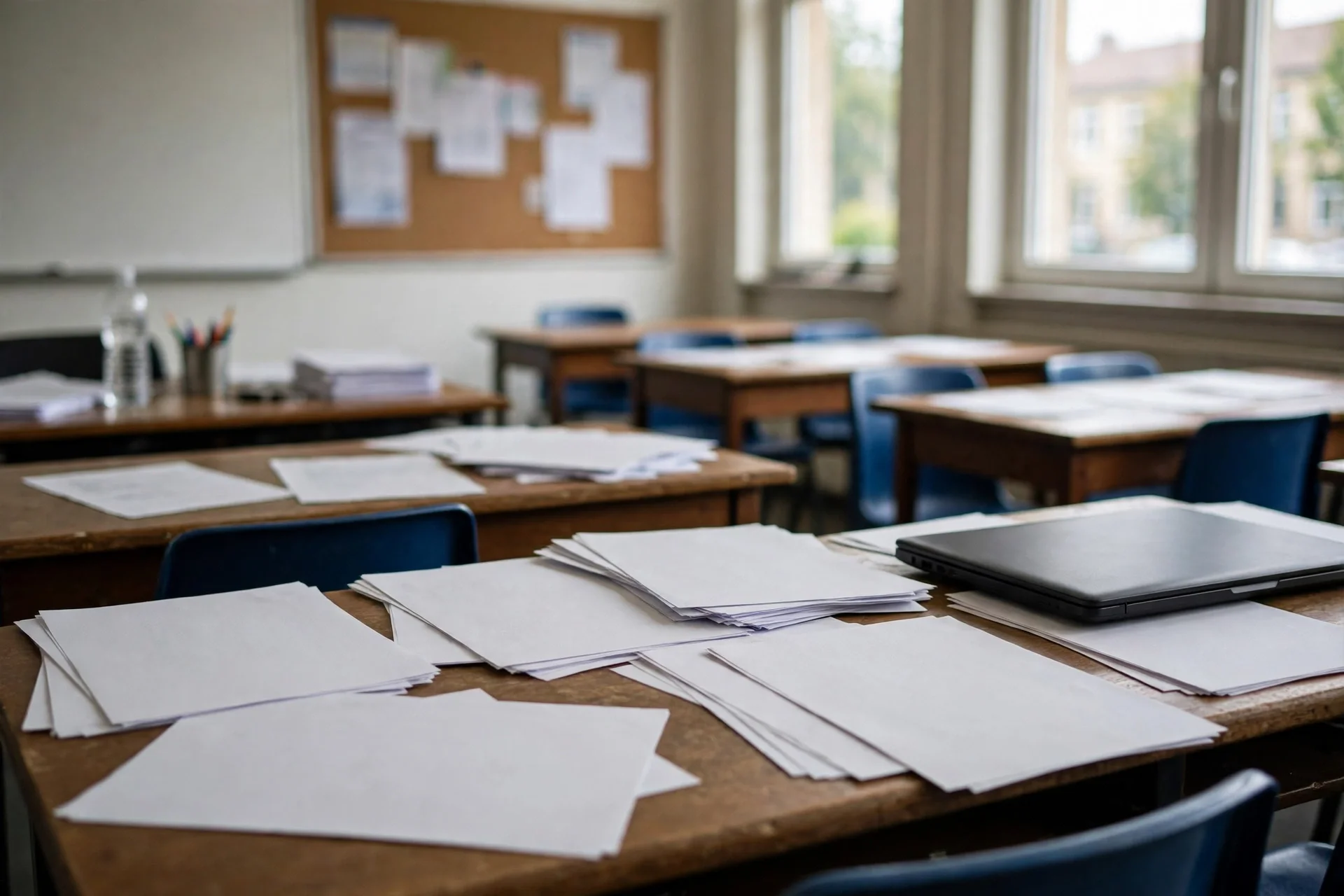
Imagen alusiva: pupitres con exámenes en papel y una laptop cerrada, en un aula universitaria vacía.
Berkeley returns to paper: a Fields Medalist stops grading online
Richard Borcherds, a Berkeley mathematician and Fields Medal winner, abandoned online grading because he cannot distinguish human work from work generated by…
A Berkeley professor restores the paper exam in the face of AI
Fields Medal winner Richard Borcherds of Berkeley stopped grading online exams, calling them a waste of time because of artificial intelligence use.
--- The context ---
Richard Borcherds, a mathematician at the University of California, Berkeley, and a Fields Medal winner known for his research on infinite-dimensional algebras and quantum field theory, concluded that online assessment no longer measures what his students know: artificial intelligence delivers the correct answer in seconds and the remote exam rewards whoever uses it.
--- The facts ---
According to Borcherds, online exams became a waste of time because several students use artificial intelligence to answer the questions and he cannot tell which ones do, although he notices that the average score rises sharply in that format. Faced with the impossibility of distinguishing human work from machine-produced work, he abandoned online grading of his mathematics students' exams and assignments.
His answer was to return to traditional paper exams, with no electronic devices. And lacking a better alternative, he acknowledged that he currently grades assignments simply because the student turned them in, without evaluating their content: he admitted it is not a very good system, but that he has no other viable option for now.
--- The positions ---
Borcherds said grading for correctness adds an enormous incentive to use artificial intelligence on assignments instead of doing them, because it guarantees a correct answer, and that it penalizes honest students. In his account, paying to grade machine-generated answers is a waste of time and money.
The institution looked for another way out: Berkeley evaluated content detection tools such as Turnitin and Rumi and concluded that none was reliable enough for standardized implementation across campus.
--- What remains unknown ---
The Berkeley Division of the Academic Senate asks faculty to include in their syllabi a statement on the permitted use of artificial intelligence tools, although concrete policies are left to each professor and vary by level and subject area. Anne Marie Richard, associate vice provost for Undergraduate Education and director of Academic Technology, pointed out that the AI Hub, the campus directory on these tools, offers model statements for drafting those guidelines.
--- Unanswered questions ---
Can remote assessment be preserved when no detector is reliable? Is it fair to grade an assignment merely for being turned in? What happens to honest students if the machine answer is rewarded? Will paper become the norm again?
--- EPM analysis ---
After OpenAI announced the resolution, through artificial intelligence agents, of the existence and smoothness problem of Navier-Stokes, one of the hardest unsolved problems, Borcherds warned that if the technology keeps its current pace, in a few years there will be nothing human mathematicians can do that the machine cannot do better. He admitted he no longer knows what to advise those considering mathematics, a career that until five years ago seemed among the most sheltered, and recounted that ChatGPT itself could not tell him what will happen. Even so, he considered that academic inertia could keep the department largely unchanged, like paper journals, useless for two decades in his account. He recalled that looms displaced hand weaving and automobiles horses, but held that this is the first time something like this happens in mathematics.
📌 EPM Take:
In EPM's view, Borcherds's decision protects something no detector managed to guarantee: that a grade means real learning and that honest effort does not end up losing. Returning to paper is not nostalgia, it is a practical defense of fairness while the institution defines clear rules. Berkeley's challenge will be to turn that individual reaction into a common policy that does not leave each professor alone before a technology advancing faster than the regulations.
--- The context ---
Richard Borcherds, a mathematician at the University of California, Berkeley, and a Fields Medal winner known for his research on infinite-dimensional algebras and quantum field theory, has abandoned online grading of exams and assignments. His diagnosis is common sense: if human work cannot be distinguished from work produced by artificial intelligence, grading at a distance stops making sense.
--- The facts ---
According to the professor, online exams are now a waste of time because several students simply use artificial intelligence to answer the questions. He said he cannot know which students use it, but he notices that the average score increases a great deal in online exams, a signal that distorts any honest comparison among students.
That is why he chose to return to traditional paper exams, with no electronic devices. And lacking a better alternative, he acknowledged that he currently grades assignments simply because the student turned them in, without evaluating their content. He admitted it is not a very good system, although he held that for the moment he has no other viable option.
--- The positions ---
Borcherds said grading for correctness adds an enormous incentive to use artificial intelligence on assignments instead of doing them, because it guarantees a correct answer, and that it penalizes honest students. He also held that paying to grade machine-generated answers is a waste of time and money.
Berkeley evaluated different detection tools, among them Turnitin and Rumi, and concluded that none was reliable enough for standardized implementation across campus. Without a trustworthy control instrument, the professor's authority and the paper exam remain the guarantee available.
--- What remains unknown ---
The Berkeley Division of the Academic Senate asks faculty to include in their syllabi a statement on the permitted use of artificial intelligence tools, although concrete policies are left to each professor and vary by level and subject area. Anne Marie Richard, associate vice provost for Undergraduate Education and director of Academic Technology, pointed out that the AI Hub, the campus directory on these tools, offers model statements for drafting those guidelines.
--- Unanswered questions ---
Will other professors restore the paper exam as a guarantee of honesty? Can grading an assignment solely for being turned in hold up? What responsibility does the university assume with no reliable detector? Will there be common rules, or will each classroom follow its own judgment?
--- EPM analysis ---
After OpenAI announced the resolution, through artificial intelligence agents, of the existence and smoothness problem of Navier-Stokes, one of the hardest unsolved problems, Borcherds held that if the technology keeps its current pace, in a few years there will be nothing human mathematicians can do that the machine cannot do better. He admitted he no longer knows what to advise those considering mathematics, a career that until five years ago seemed among the most sheltered, and recounted that ChatGPT itself could not tell him what will happen. Still, he considered that academic inertia could keep the department largely unchanged, like paper journals, useless for two decades in his account. He recalled that looms displaced hand weaving and automobiles horses, but concluded that this is the first time something like this happens in mathematics.
📌 EPM Take:
In EPM's view, Borcherds did what an academic authority should do: if the instrument no longer distinguishes merit from artifice, the instrument is changed, and no one pretends the grade still carries the same worth. Paper and presence are not a step backward, they restore the rule that each student answers for his or her own work. Berkeley should back that standard with uniform rules, instead of leaving honesty in each professor's hands.
Berkeley vuelve al papel ante la IA en los exámenes en línea
Richard Borcherds, matemático de Berkeley y ganador de la Medalla Fields, abandonó la calificación en línea porque no puede distinguir el trabajo humano del…
Un profesor de Berkeley restablece el examen en papel frente a la IA
Richard Borcherds, ganador de la Medalla Fields en Berkeley, dejó de calificar exámenes en línea al considerarlos una pérdida de tiempo por el uso de…
--- El contexto ---
Richard Borcherds, matemático de la Universidad de California en Berkeley y ganador de la Medalla Fields, reconocido por sus investigaciones en álgebras de dimensión infinita y la teoría cuántica de campos, concluyó que evaluar en línea dejó de medir lo que sus estudiantes saben: la inteligencia artificial entrega la respuesta correcta en segundos y el examen a distancia premia a quien la usa.
--- Los hechos ---
Según explicó Borcherds, los exámenes en línea se volvieron una pérdida de tiempo porque varios estudiantes recurren a la inteligencia artificial y él no puede saber quiénes lo hacen, aunque nota que el puntaje promedio aumenta mucho en esa modalidad. Sin poder distinguir el trabajo humano del producido por una máquina, abandonó la calificación en línea.
Su respuesta fue volver a los exámenes tradicionales en papel, sin dispositivos electrónicos. Ante la falta de una alternativa mejor, reconoció que por ahora califica las tareas solo por entregarlas, sin evaluar su contenido: admitió que no es un sistema muy bueno, pero que no cuenta con otra opción viable.
--- Las posiciones ---
Borcherds afirmó que la calificación por corrección agrega un enorme incentivo para usar inteligencia artificial en las tareas en lugar de hacerlas, porque garantiza una respuesta correcta, y penaliza a los estudiantes honestos. A su juicio, pagar para calificar respuestas generadas por una máquina es una pérdida de tiempo y de dinero.
Berkeley evaluó detectores como Turnitin y Rumi y concluyó que ninguno era lo suficientemente confiable para estandarizarlo en el campus.
--- Lo que falta saber ---
La División de Berkeley del Senado Académico solicita a los docentes incluir en los programas una declaración sobre el uso permitido de herramientas de inteligencia artificial, aunque las políticas concretas quedan a criterio de cada profesor y varían según el nivel y el área. Anne Marie Richard, vicerrectora adjunta de Educación de Pregrado y directora de Tecnología Académica, señaló que el AI Hub, directorio del campus sobre estas herramientas, ofrece modelos de declaraciones para redactar esos lineamientos.
--- Preguntas sin respuesta ---
¿Puede preservarse la evaluación a distancia cuando ningún detector resulta confiable? ¿Es justo calificar una tarea solo por entregarla? ¿Qué ocurrirá con los estudiantes honestos si se premia la respuesta de una máquina? ¿Volverá el papel a ser la norma?
--- Análisis EPM ---
Tras el anuncio de OpenAI sobre la resolución mediante agentes de inteligencia artificial del problema de existencia y suavidad de Navier-Stokes, uno de los más difíciles sin resolver, Borcherds advirtió que si la tecnología sigue al ritmo actual, en unos años no habrá nada que los matemáticos humanos puedan hacer que la máquina no haga mejor. Admitió que ya no sabe qué aconsejar a quienes consideran estudiar matemáticas, carrera que hasta hace cinco años parecía de las más resguardadas, y relató que ni ChatGPT supo decirle qué pasará. Pese a ello, consideró que la inercia académica podría mantener sin grandes cambios al departamento, como las revistas en papel, inútiles desde hace dos décadas según él. Recordó que los telares desplazaron al tejido manual y los automóviles a los caballos, pero sostuvo que es la primera vez que algo así ocurre en las matemáticas.
📌 Conclusion EPM:
A juicio de EPM, la decisión de Borcherds protege algo que ningún detector logró garantizar: que una nota signifique aprendizaje real y que el esfuerzo honesto no salga perdiendo. Volver al papel no es nostalgia, es una defensa práctica de la equidad mientras la institución define reglas claras. El desafío de Berkeley será convertir esa reacción individual en una política común que no deje solo a cada profesor frente a una tecnología que avanza más rápido que los reglamentos.
--- El contexto ---
Richard Borcherds, matemático de la Universidad de California en Berkeley y ganador de la Medalla Fields, reconocido por sus investigaciones en álgebras de dimensión infinita y la teoría cuántica de campos, abandonó la calificación en línea de exámenes y tareas. Su diagnóstico es de sentido común: si no se distingue el trabajo humano del producido por inteligencia artificial, calificar a distancia deja de tener sentido.
--- Los hechos ---
Según explicó el profesor, los exámenes en línea ahora son una pérdida de tiempo porque varios estudiantes solo usan inteligencia artificial para responder. Afirmó que no puede saber qué alumnos la utilizan, pero que el puntaje promedio aumenta mucho en esa modalidad, señal que desvirtúa cualquier comparación honesta.
Por eso optó por regresar a los exámenes tradicionales en papel, sin dispositivos electrónicos. Ante la falta de una alternativa mejor, reconoció que califica las tareas solo por entregarlas, sin evaluar su contenido. Admitió que no es un sistema muy bueno, aunque sostuvo que no cuenta con otra opción viable.
--- Las posiciones ---
Borcherds afirmó que la calificación por corrección agrega un enorme incentivo para usar inteligencia artificial en las tareas en lugar de hacerlas, porque garantiza una respuesta correcta, y penaliza a los estudiantes honestos. También sostuvo que pagar para calificar respuestas generadas por inteligencia artificial es una pérdida de tiempo y de dinero.
Berkeley evaluó detectores como Turnitin y Rumi y concluyó que ninguno era lo suficientemente confiable para estandarizarlo en el campus. Sin un control fiable, la autoridad del profesor y el examen en papel quedan como la garantía disponible.
--- Lo que falta saber ---
La División de Berkeley del Senado Académico solicita a los docentes incluir en los programas una declaración sobre el uso permitido de herramientas de inteligencia artificial, aunque las políticas concretas quedan a criterio de cada profesor y varían según el nivel y el área. Anne Marie Richard, vicerrectora adjunta de Educación de Pregrado y directora de Tecnología Académica, señaló que el AI Hub, directorio del campus sobre estas herramientas, ofrece modelos de declaraciones para redactar esos lineamientos.
--- Preguntas sin respuesta ---
¿Recuperarán otros profesores el examen en papel? ¿Puede sostenerse calificar la tarea solo por su entrega? ¿Qué responsabilidad asume la universidad sin un detector confiable? ¿Habrá reglas comunes o cada aula seguirá a su criterio?
--- Análisis EPM ---
Tras el anuncio de OpenAI sobre la resolución mediante agentes de inteligencia artificial del problema de existencia y suavidad de Navier-Stokes, uno de los más difíciles sin resolver, Borcherds sostuvo que si la tecnología sigue al ritmo actual, en unos años no habrá nada que los matemáticos humanos puedan hacer que la máquina no haga mejor. Admitió que ya no sabe qué aconsejar a quienes consideran estudiar matemáticas, carrera que hasta hace cinco años parecía de las más resguardadas, y relató que ni ChatGPT supo decirle qué pasará. Aun así, consideró que la inercia académica podría mantener sin grandes cambios al departamento, como las revistas en papel, inútiles desde hace dos décadas según él. Recordó que los telares desplazaron al tejido manual y los automóviles a los caballos, pero concluyó que es la primera vez que algo así ocurre en las matemáticas.
📌 Conclusion EPM:
A juicio de EPM, Borcherds hizo lo que corresponde a una autoridad académica: si el instrumento ya no distingue el mérito del artificio, se cambia el instrumento, no se finge que la nota sigue valiendo lo mismo. El papel y la presencia no son un retroceso, restablecen la regla de que cada estudiante responde por su propio trabajo. Berkeley debería respaldar ese criterio con normas uniformes, en lugar de dejar la honestidad en manos de cada profesor.