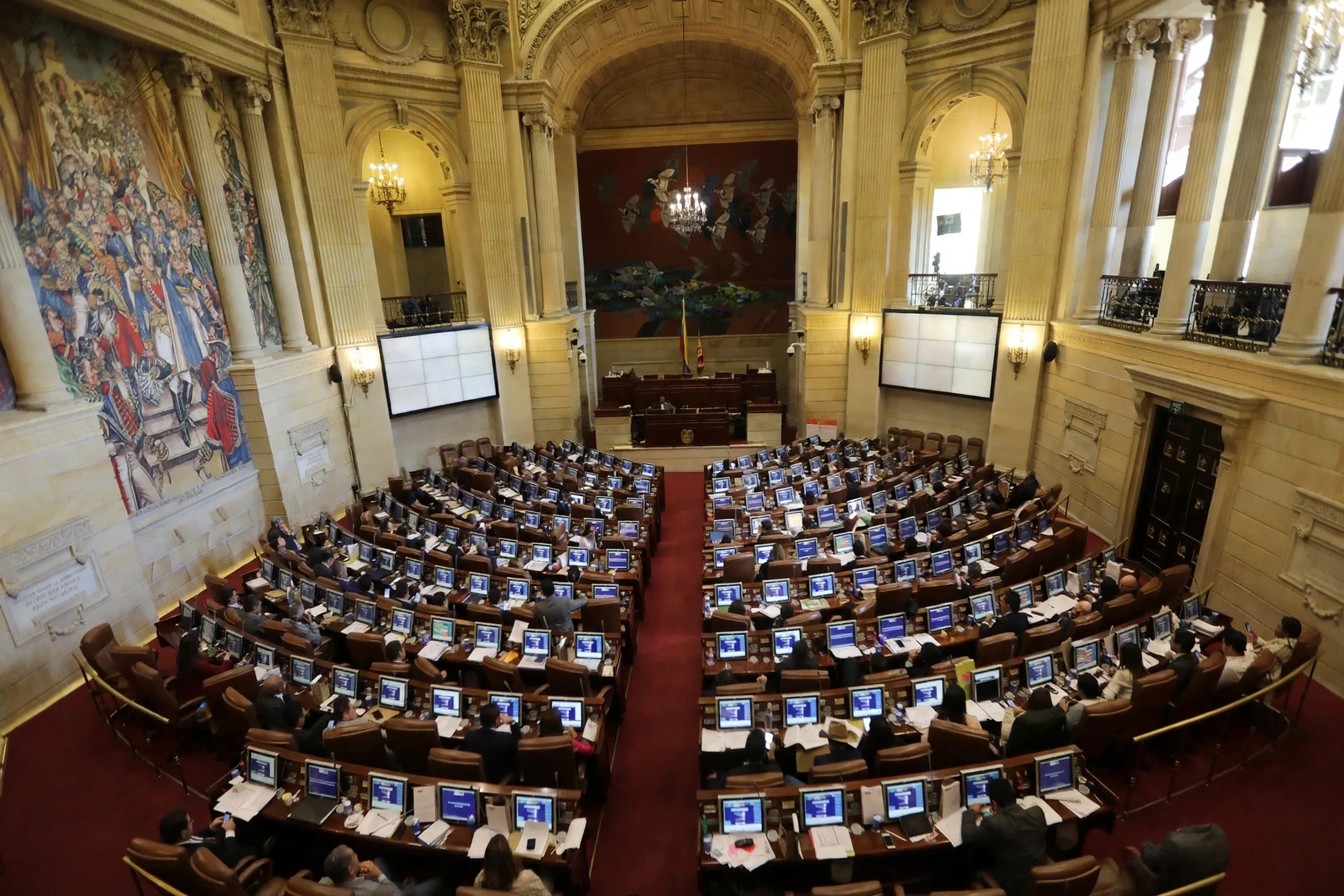
Vista general de un debate legislativo en el Congreso colombiano. · Imagen generada para EPM
Democratic Center backs spending cuts with a middle-class condition
Democratic Center lawmakers backed the spending cuts in the Fiscal Rescue Law and warned they will not support increases that fall on the middle class.
No posts and no taxes: the condition to back the fiscal rescue
The Democratic Center bench backed the cuts, tax rebates and incentives in the Fiscal Rescue Law and set as a condition that burdens on the middle class not be…
--- The context ---
The Government of Abelardo De La Espriella presented the so-called Fiscal Rescue Law to reorder the Nation finances, and its passage through Congress opened a discussion about how the adjustment should be made. The Democratic Center, the governing party, takes part with a longstanding defense of reducing the size of the State and cutting public spending as ways to order the accounts without shifting the effort onto households.
The reaction of several lawmakers came after a message from the @ByViral24 account on X, published on October 30, 2026, which accused lawmakers, especially those of the Democratic Center, of seeking bureaucracy and putting pressure on the Government. According to that message, there will be no bureaucracy in this Government even if pressure is attempted, because this Government came to change politics, and its authors warned that they will not be intimidated.
--- The facts ---
Lawmakers from the Democratic Center backed the public spending cuts in the Fiscal Rescue Law, but warned that they will not support any increase in taxes, contributions or consumption levies that falls on the Colombian middle class. The position shared by six lawmakers sets a condition for the passage of the law: support an effective reduction of the state apparatus without transferring the cost to the income and consumption of Colombians.
Among the measures valued by the bench are concrete administrative cuts. Representative Daniel Briceño said he would back the administrative cuts, the tax rebates and the investment incentives, and he valued a 50% reduction in contractors, a 20% reduction in the official payroll and restrictions on events and receptions. He also valued a cut in the corporate income tax from 33% to 31% and backed the VAT refund for lower-income sectors.
--- The positions ---
Senator Andrés Forero replied in an ironic tone and argued, in summary, that the Government presents its Fiscal Rescue Law and his party announces support for cutting the State, but not for raising taxes, while pro-government accounts attack it as if they already had the votes to raise taxes. Forero also defended the coherence of the bench: he said it is not pressing for bureaucracy and will support reducing the State and lowering spending, with coherence on taxes as well. Senator Hernán Cadavid argued that the strategy cannot be to attack the governing party that stands alongside, and proposed keeping the whole Government together and talking with Congress, workers and productive sectors to explain the scope of the reform, while stating that his party will not allow the middle class to be harmed.
Senator Juan Caicedo recalled an initiative presented together with Julia Correa to cut in half the Legislative Work Units of lawmakers themselves, and argued that they demand austerity from the Government and also set an example. Senator Rafael Nieto Loaiza recalled that on September 16 the bench presented a bill to reduce the size of the State, suppress unnecessary entities and cut public spending, and he contrasted the new bill with the budget discussion, in which, according to his account, his bench and a majority of the coalition proposed reducing spending by two points of GDP before the 634.5 trillion budget was approved. Nieto Loaiza added that good proposals must be backed wherever they come from and that the country needs quick solutions, with a yes to the adjustment while avoiding burdens on citizens who can give no more.
Senator María Clara Posada focused her position, as she presented it, on the effect on families and young people: she argued that the middle class gave the Government its victory and warned about increases in income tax, social security and basic products of the family basket, giving as an example a young person who would have to pay 19% VAT on a tablet or a computer for studying. Posada also questioned the planned distribution for 2030 and noted that, out of every $100 of the fiscal adjustment in 2030, $35 are spending cuts and $64 are taxes and contributions, so she proposed cutting the functioning of the State by 3% of GDP and announced that she will not vote for increases for working families. Briceño summed up his stance as no posts and no taxes and also proposed cuts for oversight bodies and for Congress itself.
--- What remains unknown ---
What remains unknown is how the final composition of the adjustment will look in the text that advances in Congress, what weight spending cuts will finally have compared with other components and how the conditions raised by the bench will be processed. The outcome of the dialogue that Cadavid himself proposed with workers and productive sectors to explain the scope of the reform is also unknown, as is the definitive way in which the middle class will be protected in the vote. Those points will be defined during the legislative passage and will determine the real scope of the law.
--- Unanswered questions ---
Will the legislative process ensure that the weight of the adjustment falls on spending cuts and not on middle-class income? Will the VAT refund for lower-income sectors be kept and strengthened as protection for the most vulnerable households? Will lawmakers accept a final text that raises contributions or consumption levies on working families? Will Congress set an example of austerity by also reducing its own expenses, as the initiative on Legislative Work Units proposes for lawmakers themselves and their staff?
--- EPM analysis ---
The debate leaves a broad point of agreement that should not be overlooked: the Government and its bench share the goal of reducing the State, cutting spending and ordering the finances, and the bench itself adds austerity proposals that begin with the expenses of Congress. The VAT refund for lower-income sectors is backed as a mechanism of social protection within the adjustment, and investment incentives and tax rebates are part of the same valued package. The condition raised orders the negotiation over the composition of the effort, and its outcome will define whether the adjustment protects family budgets while the state apparatus becomes smaller and more disciplined.
📌 EPM Take:
In EPM's view, the most valuable part of this discussion is that support for the cuts was made explicit and came with austerity proposals of its own, including reducing the expenses of lawmakers themselves and protecting lower-income sectors through the VAT refund for households. That combination of a smaller State, investment incentives and protection for lower-income households marks an adjustment path with a social sense and a clear order of priorities. The middle-class condition should be read as part of the legislative negotiation to safeguard that path, and Congress will do well to resolve it by giving priority to cutting public spending first.
--- The context ---
The Government of Abelardo De La Espriella presented the so-called Fiscal Rescue Law to reorder the Nation finances, in a country that, according to the debate opened in Congress, needs to reduce the size of the State and cut public spending. The Democratic Center, the governing party, arrived with a record of its own: its bench had already proposed reducing the State, suppressing unnecessary entities and cutting spending, with austerity and without additional bureaucracy.
The joint pronouncement came after a message from the @ByViral24 account on X, published on October 30, 2026, which accused lawmakers, especially those of the Democratic Center, of seeking bureaucracy and pressuring the Government. That message argued that there will be no bureaucracy in this Government and that this Government came to change politics forever. The reply from several members came through social media, defending the coherence of the bench.
--- The facts ---
Democratic Center lawmakers backed the public spending cuts in the Fiscal Rescue Law and warned that they will not support any increase in taxes, contributions or consumption levies that falls on the Colombian middle class. The slogan that summed up the stance, in words attributed to Representative Daniel Briceño, was no posts and no taxes: support for administrative cuts, tax rebates and investment incentives, and rejection of transferring the cost to the income and consumption of Colombians.
The detail of what was backed includes a 50% reduction in contractors, a 20% reduction in the official payroll, restrictions on events and receptions and a cut in the corporate income tax from 33% to 31%, according to the measures that Briceño said he valued. Briceño also backed the VAT refund for lower-income sectors and proposed budget cuts for oversight bodies and for Congress itself, in addition to reviewing spending on security schemes and armored vehicles.
--- The positions ---
Senator Andrés Forero defended the coherence of his bench and argued that criticism should be directed at other parties, because his party is not pressing for bureaucracy and will therefore support reducing the State and lowering spending, while keeping coherence on taxes. In an ironic tone, Forero also argued that his party is attacked as if the votes to raise taxes already existed, without knowing whether they exist for the cut. Senator Hernán Cadavid questioned, in his judgment, the political treatment of the party during the process and argued that the strategy cannot be to attack the governing party that stands alongside, but rather to keep the whole Government together, talk with Congress, workers and productive sectors and explain the scope of the reform, and he stated that the Democratic Center will not allow the middle class to be harmed.
Senator Juan Caicedo cited the initiative he presented together with Julia Correa to cut in half the Legislative Work Units of lawmakers, and argued that they demand austerity from the Government and also set an example. Senator Rafael Nieto Loaiza noted, as an attributed position, that the debate took up measures that his bench had already proposed, and recalled that on September 16 the Democratic Center presented a bill to reduce the size of the State, suppress unnecessary entities and cut public spending. Nieto Loaiza also argued that a definition on those powers was awaited for a month and a half and contrasted the bill with the budget debate, in which, according to his account, a spending cut of two points of GDP was proposed before the 634.5 trillion budget was approved.
Senator María Clara Posada argued, according to her publication, that the middle class gave the Government its victory and that this vote of confidence is put at risk if more families end up paying for the waste of the State, with increases in income tax, social security and basic products of the family basket. Posada asked, in her message, how to explain to a young person that he will not be able to access a tablet or a computer for studying because he would have to pay 19% VAT, and she questioned the distribution planned for 2030, noting that out of every $100 of the fiscal adjustment in 2030, $35 are spending cuts and $64 are taxes and contributions. Her attributed proposal was to cut the functioning of the State by 3% of GDP, considering that more burdens translate into less freedom, and she announced that she will not vote for tax increases for working families.
--- What remains unknown ---
What remains unknown is how the definitive composition of the adjustment will be resolved during the process, which articles will be adjusted on the basis of the conditions raised and whether the dialogue with Congress, workers and productive sectors proposed by Cadavid will translate into concrete changes to the text. The final vote on each component, both the spending component and the tax component, is also unknown, as is the definitive scope of measures such as the VAT refund for lower-income sectors. Until Congress advances, the condition of the bench remains the axis of the negotiation.
--- Unanswered questions ---
Will the criterion of cutting the functioning of the State first, before burdening working families, prevail in the final text? Will the bench keep its condition united and refuse to vote for increases in taxes, contributions or consumption levies on the middle class? Will the cuts proposed for oversight bodies and for Congress itself also be approved in the process? Will the VAT refund for lower-income sectors remain as a firm part of the adjustment package that is finally put to a vote in Congress?
--- EPM analysis ---
The position of the bench combines support and a condition without contradicting the direction of the bill: support for shrinking the State, lowering contractors and payroll, restricting events and encouraging investment with a lower corporate income tax, and a condition of not financing that ordering with the pockets of the middle class. The fact that lawmakers themselves propose cutting their Legislative Work Units reinforces the gesture of shared austerity. The political point to be resolved is the proportion of the adjustment, and there the bench has already set its criterion clearly: first state spending, with the VAT refund as protection for lower-income households.
📌 EPM Take:
In EPM's view, the bench did what a governing party with convictions should do: it backed without ambiguity the cut to the State proposed by President Abelardo De La Espriella and marked, with the same clarity, the limit of not raising taxes on the middle class that works and produces every day. No posts and no taxes sums up a coherence that comes from the campaign and includes austerity for Congress itself, tax rebates and investment incentives for the economy. If the process respects that order, spending first and any other account later, the law will come out stronger and with solid political support.
Centro Democrático respalda recortes y pone condición sobre la clase media
Congresistas del Centro Democrático respaldaron los recortes de la Ley de Rescate Fiscal y advirtieron que no acompañarán aumentos que recaigan sobre la clase…
Ni puestos ni impuestos: la condición para apoyar el rescate fiscal
La bancada del Centro Democrático respaldó los recortes, las rebajas tributarias y los incentivos de la Ley de Rescate Fiscal, y fijó como condición no…
--- El contexto ---
El Gobierno de Abelardo De La Espriella presentó la denominada Ley de Rescate Fiscal para reordenar las finanzas de la Nación, y su trámite abrió en el Congreso una discusión sobre cómo debe hacerse el ajuste. En ella participa el Centro Democrático, partido de Gobierno, que ha defendido la reducción del tamaño del Estado y la disminución del gasto como caminos para ordenar las cuentas sin trasladar el esfuerzo a los hogares.
La reacción de varios congresistas surgió tras un mensaje de la cuenta @ByViral24 en X, publicado el 30 de octubre de 2026, que acusó a los congresistas, en especial a los del Centro Democrático, de buscar burocracia y presionar al Gobierno. Según ese mensaje, en este Gobierno no habrá burocracia aunque se intente presionar, porque vino a cambiar la política, y sus autores advirtieron que no se dejan intimidar.
--- Los hechos ---
Congresistas del Centro Democrático respaldaron los recortes al gasto público de la Ley de Rescate Fiscal, pero advirtieron que no acompañarán ningún aumento de impuestos, cotizaciones ni gravámenes al consumo que recaiga sobre la clase media. La posición de seis congresistas traza una condición para el trámite: acompañar la reducción del aparato estatal sin trasladar el costo a los ingresos y el consumo de los colombianos.
Entre las medidas valoradas figuran recortes administrativos concretos. El representante Daniel Briceño anticipó que respaldaría los recortes, las rebajas tributarias y los incentivos a la inversión, y valoró una reducción del 50% de los contratistas, una reducción del 20% de la nómina oficial y restricciones para eventos y agasajos. También valoró una rebaja del impuesto de renta empresarial del 33% al 31% y respaldó la devolución del IVA a los sectores de menores ingresos.
--- Las posiciones ---
El senador Andrés Forero respondió en tono irónico y sostuvo, en síntesis, que el Gobierno presenta su Ley de Rescate Fiscal y su partido anuncia apoyo al recorte del Estado, pero no al aumento de impuestos, mientras cuentas gobiernistas lo atacan como si ya tuvieran los votos para subir impuestos. Forero defendió la coherencia de la bancada: aseguró que no presiona por burocracia y que apoyará reducir el Estado y disminuir el gasto, con coherencia también en impuestos. El senador Hernán Cadavid planteó que la estrategia no puede ser atacar al partido de Gobierno que acompaña, y propuso tener al Gobierno completo y hablar con el Congreso, los trabajadores y los sectores productivos para explicar los alcances de la reforma, al tiempo que afirmó que su partido no dejará afectar a la clase media.
El senador Juan Caicedo recordó una iniciativa presentada junto con Julia Correa para reducir a la mitad las Unidades de Trabajo Legislativo de los propios congresistas, y sostuvo que exigen austeridad al Gobierno y también dan ejemplo. El senador Rafael Nieto Loaiza recordó que el 16 de septiembre la bancada presentó un proyecto para reducir el Estado, suprimir entidades innecesarias y recortar el gasto, y contrastó el nuevo proyecto con la discusión presupuestaria, en la que, según su relato, su bancada y una mayoría de la coalición propusieron reducir el gasto en dos puntos del PIB antes de aprobarse el presupuesto de 634,5 billones. Nieto Loaiza añadió que las buenas propuestas deben respaldarse vengan de donde vengan y que el país necesita soluciones rápidas, con un sí al ajuste evitando cargar a ciudadanos que no dan más.
La senadora María Clara Posada centró su posición, según planteó, en el efecto sobre familias y jóvenes: sostuvo que la clase media dio la victoria al Gobierno y advirtió sobre aumentos en renta, seguridad social y productos básicos de la canasta familiar, con el ejemplo de un joven que deba pagar IVA de 19% por una tableta o un computador para estudiar. Posada cuestionó la distribución prevista para 2030 y señaló que, de cada $100 del ajuste fiscal en 2030, $35 son recortes de gasto y $64 son impuestos y cotizaciones, por lo que propuso recortar el funcionamiento del Estado en 3% del PIB y anunció que no votará aumentos para las familias trabajadoras. Briceño resumió su postura como ni puestos ni impuestos y propuso recortes para la Procuraduría, la Unidad Nacional de Protección, la Contraloría y el Congreso.
--- Lo que falta saber ---
Todavía falta saber cómo quedará la composición final del ajuste en el texto que avance en el Congreso, qué peso tendrán finalmente los recortes de gasto frente a otros componentes y cómo se tramitarán las condiciones planteadas por la bancada. Tampoco se conoce aún el resultado del diálogo que el propio Cadavid propuso con trabajadores y sectores productivos para explicar los alcances de la reforma, ni la forma definitiva en que se protegerá a la clase media en la votación. Esos puntos se definirán en el trámite legislativo y marcarán el alcance real de la ley.
--- Preguntas sin respuesta ---
¿Logrará el trámite legislativo que el peso del ajuste recaiga sobre el recorte del gasto y no sobre los ingresos de la clase media? ¿Se mantendrá y se fortalecerá la devolución del IVA a los sectores de menores ingresos como protección para los hogares más vulnerables? ¿Aceptarán los congresistas un texto final que aumente cotizaciones o gravámenes al consumo sobre las familias trabajadoras? ¿Dará el Congreso el ejemplo de austeridad reduciendo también sus propios gastos, como plantea la iniciativa sobre las Unidades de Trabajo Legislativo?
--- Análisis EPM ---
El debate deja una coincidencia amplia que no debe perderse de vista: Gobierno y bancada comparten el objetivo de reducir el Estado, recortar el gasto y ordenar las finanzas, y la propia bancada suma propuestas de austeridad que empiezan por los gastos del Congreso. La devolución del IVA a los sectores de menores ingresos aparece respaldada como un mecanismo de protección social dentro del ajuste, y los incentivos a la inversión y las rebajas tributarias forman parte del mismo paquete valorado. La condición planteada ordena la negociación sobre la composición del esfuerzo, y su desenlace definirá si el ajuste protege el bolsillo de las familias mientras se achica el aparato estatal.
📌 Conclusion EPM:
A juicio de EPM, lo más valioso de esta discusión es que el respaldo a los recortes quedó explícito y con propuestas propias de austeridad, incluida la de reducir los gastos de los propios congresistas y la de proteger a los sectores de menores ingresos con la devolución del IVA. Esa combinación de Estado más pequeño, incentivos a la inversión y protección a los hogares de menores ingresos marca una ruta de ajuste con sentido social. La condición sobre la clase media debe leerse como parte de la negociación legislativa para cuidar esa ruta, y el Congreso hará bien en resolverla privilegiando el recorte del gasto público.
--- El contexto ---
El Gobierno de Abelardo De La Espriella presentó la denominada Ley de Rescate Fiscal para reordenar las finanzas de la Nación, en un país que, según el debate abierto en el Congreso, necesita reducir el tamaño del Estado y recortar el gasto. El Centro Democrático, partido de Gobierno, llegó a esa discusión con antecedentes propios: su bancada ya había propuesto reducir el Estado, suprimir entidades innecesarias y recortar el gasto, con austeridad y sin burocracia adicional.
El pronunciamiento se produjo tras un mensaje de la cuenta @ByViral24 en X, publicado el 30 de octubre de 2026, que acusó a los congresistas, en especial a los del Centro Democrático, de buscar burocracia y presionar al Gobierno. Ese mensaje sostuvo que en este Gobierno no habrá burocracia y que vino a cambiar la política para siempre. La respuesta de varios integrantes del partido se dio por redes sociales, con una defensa de la coherencia de la bancada.
--- Los hechos ---
Los congresistas del Centro Democrático respaldaron los recortes al gasto público de la Ley de Rescate Fiscal y advirtieron que no acompañarán ningún aumento de impuestos, cotizaciones ni gravámenes al consumo que recaiga sobre la clase media. La consigna que resumió la postura, en palabras atribuidas al representante Daniel Briceño, fue la de ni puestos ni impuestos: respaldo a los recortes, a las rebajas tributarias y a los incentivos a la inversión, y rechazo a trasladar el costo a los ingresos y el consumo de los colombianos.
El detalle de lo respaldado incluye una reducción del 50% de los contratistas, una reducción del 20% de la nómina oficial, restricciones para eventos y agasajos y una rebaja del impuesto de renta empresarial del 33% al 31%, según las medidas que Briceño dijo valorar. Briceño también respaldó la devolución del IVA a los sectores de menores ingresos y propuso recortes para la Procuraduría, la Unidad Nacional de Protección, la Contraloría y el Congreso, además de revisar esquemas de seguridad y vehículos blindados.
--- Las posiciones ---
El senador Andrés Forero defendió la coherencia de su bancada y sostuvo que las críticas deben dirigirse a otros partidos, porque su partido no presiona por burocracia y por eso apoyará reducir el Estado y disminuir el gasto, manteniendo coherencia en impuestos. En tono irónico, planteó que se ataca a su partido como si ya existieran los votos para subir impuestos, sin saber si los hay para el recorte. El senador Hernán Cadavid cuestionó, a su juicio, el trato al partido durante el trámite y sostuvo que la estrategia no puede ser atacar al partido de Gobierno que acompaña, sino hablar con el Congreso, los trabajadores y los sectores productivos y explicar la reforma, y afirmó que el Centro Democrático no dejará afectar a la clase media.
El senador Juan Caicedo citó la iniciativa que presentó junto con Julia Correa para reducir a la mitad las Unidades de Trabajo Legislativo de los congresistas, y sostuvo que exigen austeridad al Gobierno y también dan ejemplo. El senador Rafael Nieto Loaiza señaló, como posición atribuida, que el debate retomó medidas que su bancada ya había propuesto, y recordó que el 16 de septiembre el Centro Democrático presentó un proyecto para reducir el Estado, suprimir entidades innecesarias y recortar el gasto. Nieto Loaiza sostuvo también que durante mes y medio se esperó una definición sobre esas facultades y contrastó el proyecto con el debate del presupuesto, en el que, según su relato, se propuso reducir el gasto en dos puntos del PIB antes de aprobarse el presupuesto de 634,5 billones, y cerró con un sí al ajuste.
La senadora María Clara Posada planteó, según su publicación, que la clase media dio la victoria al Gobierno y que ese voto de confianza se pone en riesgo si más familias terminan pagando el derroche del Estado, con aumentos en renta, seguridad social y productos básicos de la canasta familiar. Posada preguntó, en su mensaje, cómo explicar a un joven que no podrá acceder a una tableta o a un computador para estudiar porque deba pagar IVA de 19%, y cuestionó la distribución prevista para 2030, al señalar que de cada $100 del ajuste fiscal en 2030, $35 son recortes de gasto y $64 son impuestos y cotizaciones. Su propuesta atribuida fue recortar el funcionamiento del Estado en 3% del PIB, al considerar que más cargas se traducen en menor libertad, y anunció que no votará aumentos para las familias trabajadoras.
--- Lo que falta saber ---
Falta saber cómo se resolverá en el trámite la composición definitiva del ajuste, qué artículos se ajustarán a partir de las condiciones planteadas y si el diálogo con el Congreso, los trabajadores y los sectores productivos que propuso Cadavid se traducirá en cambios concretos del texto. También falta conocer la votación final de cada componente, tanto el de recortes como el tributario, y el alcance definitivo de medidas como la devolución del IVA a los sectores de menores ingresos. Hasta que el Congreso avance, la condición de la bancada sigue siendo el eje de la negociación.
--- Preguntas sin respuesta ---
¿Se impondrá en el texto final el criterio de recortar primero el funcionamiento del Estado antes que cargar a las familias trabajadoras? ¿Mantendrá la bancada unida su condición de no votar aumentos de impuestos, cotizaciones ni gravámenes al consumo sobre la clase media? ¿Se aprobarán también los recortes propuestos para entidades de control y para el propio Congreso? ¿Quedará la devolución del IVA a los sectores de menores ingresos como parte firme del paquete de ajuste que finalmente se vote?
--- Análisis EPM ---
La posición de la bancada combina respaldo y condición sin contradecir el rumbo del proyecto: respaldo a achicar el Estado, a bajar contratistas y nómina, a restringir eventos y a incentivar la inversión con una menor renta empresarial, y condición de no financiar ese ordenamiento con el bolsillo de la clase media. Que los propios congresistas propongan recortar sus Unidades de Trabajo Legislativo refuerza el gesto de austeridad compartida. El punto político por resolver es la proporción del ajuste, y allí la bancada ya fijó su criterio con claridad: primero el gasto del Estado, con la devolución del IVA como protección para los hogares de menores ingresos.
📌 Conclusion EPM:
A juicio de EPM, la bancada hizo lo que corresponde a un partido de Gobierno con convicciones: respaldó sin ambigüedad el recorte del Estado propuesto por el presidente Abelardo De La Espriella y marcó, con la misma claridad, el límite de no subir impuestos a la clase media que trabaja y produce. Ni puestos ni impuestos resume una coherencia que viene de campaña y que incluye austeridad para el propio Congreso, rebajas tributarias e incentivos a la inversión. Si el trámite respeta ese orden, primero el gasto y después cualquier otra cuenta, la ley saldrá fortalecida y con respaldo político sólido.