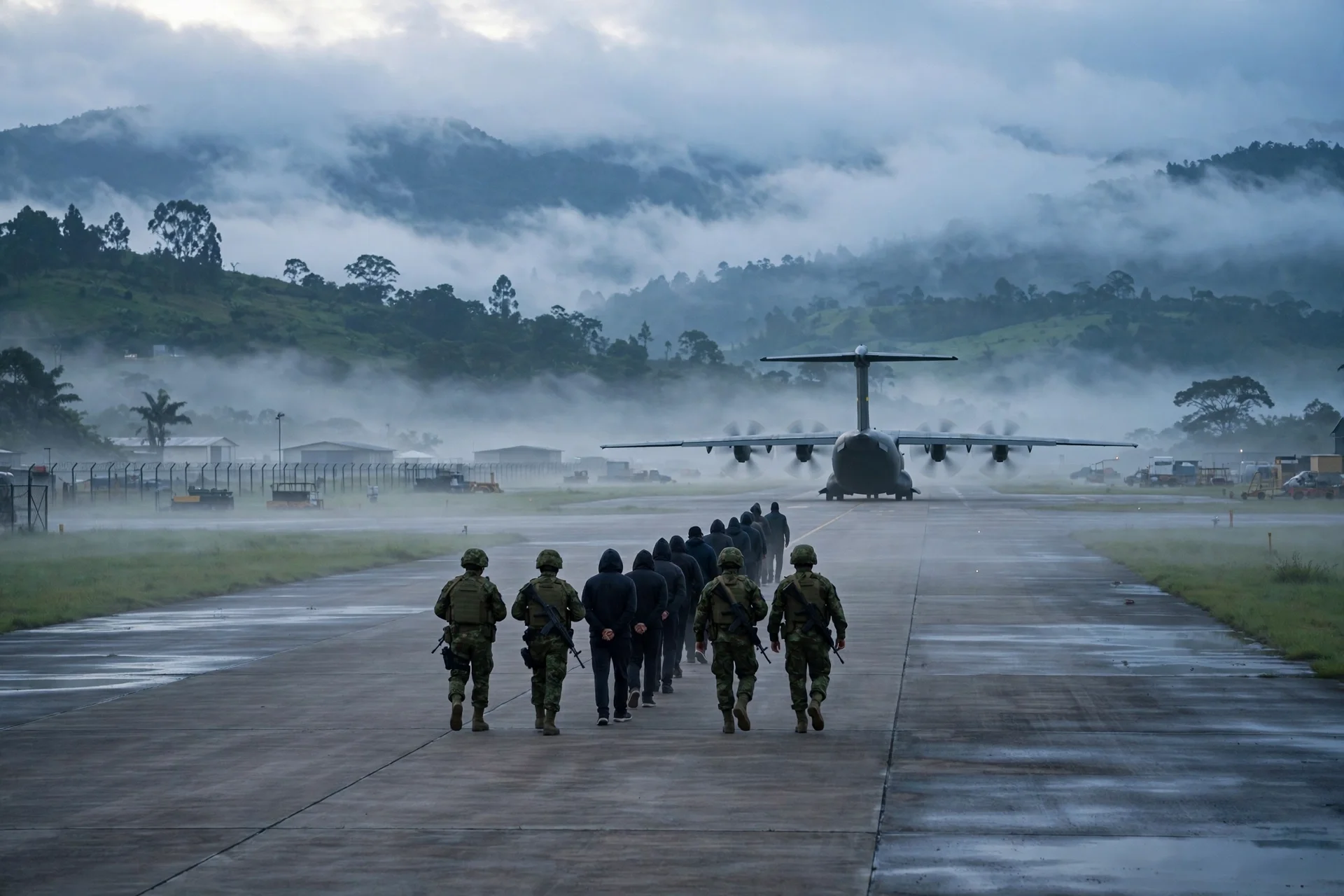
Imagen alusiva a un operativo de traslado penitenciario en aeronave de transporte militar. · EPM
Colombia moves 33 inmates from San Andres to Bogota
President Abelardo De La Espriella announced the transfer of 33 high profile inmates from San Andres to Bogota, in an Air Force, National Police and INPEC…
De La Espriella moves high profile inmates to Bogota
Abelardo De La Espriella announced that 33 high profile inmates were taken from San Andres to Bogota by the Air Force, National Police and INPEC, to enter…
--- The context ---
Prisons have been identified by the government as places from which criminal gangs operate. In that context, President Abelardo De La Espriella announced an operation to move high profile inmates from San Andres to the capital, seeking to restore control inside the penitentiary system.
--- The facts ---
On Saturday, October 31, 33 people deprived of liberty were transferred from the island of San Andres to Bogota. The operation was coordinated by the Colombian Air Force, the National Police and INPEC, and the inmates were reassigned to maximum security penitentiary facilities, according to the information provided by the president.
--- The positions ---
The president said, in indirect terms, that criminal structures would not be allowed to keep spreading fear or challenging the state from prisons, and that there would be no privileges for crime. INPEC, for its part, said these actions seek to strengthen security, control and surveillance in facilities across the national territory.
--- What remains unknown ---
The names of those transferred and the exact destination facilities are not yet known. It has also not been reported whether there will be further transfers, what follow-up will target the networks operating from San Andres, or how contact with families and legal defense will be guaranteed.
--- Unanswered questions ---
What criteria were used to define each transferred inmate as high profile? Will there be similar operations from other prisons in the country? How will authorities measure whether this measure actually reduces gang activity directed from prison?
--- EPM analysis ---
The move combines air logistics, police custody and prison management in a single operation. Its effect will depend on what happens after landing, with controls that prevent networks from regrouping in the new facilities and with verifiable information on results, without losing sight of basic guarantees for people deprived of liberty.
📌 EPM Take: In EPM's view, the transfer can help disrupt criminal networks if it is paired with sustained controls, respect for the guarantees of those transferred and public follow-up on the results. Security improves when the state acts firmly and also under clear rules, because isolating high risk profiles without permanent oversight would only move the problem to another facility.
--- The context ---
The government has argued that part of criminal activity is directed from inside prisons. Faced with that challenge, President Abelardo De La Espriella announced the transfer of high profile inmates from San Andres to Bogota, a measure presented as part of a direct fight against gangs operating from behind bars.
--- The facts ---
On Saturday, October 31, 33 people deprived of liberty were transferred from the island of San Andres to Bogota. The Colombian Air Force, the National Police and INPEC took part, and the inmates were reassigned to maximum security penitentiary facilities, according to what the president himself reported.
--- The positions ---
The president stated, in indirect terms, that criminal structures would not continue spreading fear or defying the state from prisons and that there would be no room for privileges. INPEC, in the video accompanying the announcement, said the goal is to strengthen security, control and surveillance nationwide.
--- What remains unknown ---
The identities of those transferred and the exact list of receiving facilities have not been disclosed. It remains to be seen whether the measure will continue, what surveillance changes will apply at destination and how authorities will prevent the same structures from reorganizing in the new facilities.
--- Unanswered questions ---
Will transfers of high profile inmates continue in upcoming operations? What surveillance reinforcements will the maximum security facilities receiving them obtain? When will an official assessment of this operation's impact be made public?
--- EPM analysis ---
The operation shows coordination between security forces and the prison authority and puts the focus on regaining command inside prisons. Its real value will be seen in continuity, in the intelligence behind it and in the state's capacity to sustain control without yielding space to criminal networks.
📌 EPM Take: In EPM's view, the decision sends a clear signal of authority against structures that sought to operate from prison and strengthens state control over maximum security facilities. Keeping that line, with coordination among institutions and constant surveillance, is key so transfers are not an isolated gesture but part of a sustained strategy against organized crime inside prisons.
Traslado de 33 reclusos de San Andrés a Bogotá
El presidente Abelardo De La Espriella anunció el traslado de 33 reclusos de alto perfil desde San Andrés hacia Bogotá, en una operación de la Fuerza Aérea, la…
De La Espriella ordena mover reclusos de alto perfil
Abelardo De La Espriella anunció que 33 reclusos de alto perfil fueron llevados de San Andrés a Bogotá por Fuerza Aérea, Policía Nacional e INPEC, para…
--- El contexto ---
Las cárceles han sido señaladas por el Gobierno como espacios desde donde operan bandas criminales. En ese contexto, el presidente Abelardo De La Espriella anunció una operación para mover a internos de alto perfil desde San Andrés hacia la capital, buscando recuperar control dentro del sistema penitenciario.
--- Los hechos ---
Este sábado 31 de octubre, 33 personas privadas de la libertad fueron trasladadas desde la isla de San Andrés hacia Bogotá. La operación estuvo coordinada por la Fuerza Aérea Colombiana, la Policía Nacional y el INPEC, y los reclusos fueron reasignados a establecimientos penitenciarios y carcelarios de máxima seguridad, según la información entregada por el mandatario.
--- Las posiciones ---
El presidente sostuvo, en indirecto, que no se permitirá que estructuras criminales sigan generando miedo ni desafíen al Estado desde las cárceles, y que no habrá privilegios frente a la delincuencia. Por su parte, el INPEC indicó que estas acciones buscan fortalecer la seguridad, el control y la vigilancia en los establecimientos del territorio nacional.
--- Lo que falta saber ---
Aún no se conocen los nombres de los trasladados ni los establecimientos de destino. Tampoco se ha informado si habrá nuevos traslados, qué seguimiento se hará sobre las redes de San Andrés ni cómo se garantizará el contacto con familias y defensas.
--- Preguntas sin respuesta ---
¿Qué criterios se usaron para definir el alto perfil de cada trasladado? ¿Habrá nuevos operativos similares desde otras cárceles del país? ¿Cómo se medirá si esta medida reduce realmente la actividad de las bandas desde prisión?
--- Análisis EPM ---
El movimiento combina logística aérea, custodia policial y gestión penitenciaria. Su efecto dependerá de lo que ocurra después, con controles que impidan reagrupar redes en los nuevos centros e información verificable, sin perder de vista las garantías básicas de los internos.
📌 Conclusion EPM: A juicio de EPM, el traslado puede ayudar a romper redes criminales si se acompaña de controles sostenidos, respeto a las garantías de las personas trasladadas y seguimiento público de los resultados. La seguridad gana cuando el Estado actúa con firmeza y también con reglas claras, porque aislar a perfiles de alto riesgo sin supervisión permanente solo desplaza el problema hacia otro penal.
--- El contexto ---
El Gobierno ha planteado que parte de la criminalidad se dirige desde el interior de las cárceles. Frente a ese desafío, el presidente Abelardo De La Espriella anunció el traslado de internos de alto perfil desde San Andrés hacia Bogotá, una medida presentada como parte del combate directo contra las bandas que operan desde prisión.
--- Los hechos ---
Este sábado 31 de octubre fueron trasladadas 33 personas privadas de la libertad desde la isla de San Andrés hacia Bogotá. Participaron la Fuerza Aérea Colombiana, la Policía Nacional y el INPEC, y los reclusos quedaron reasignados a establecimientos penitenciarios y carcelarios de máxima seguridad, de acuerdo con lo informado por el propio presidente.
--- Las posiciones ---
El mandatario afirmó, en términos indirectos, que las estructuras criminales no seguirán sembrando miedo ni desafiando al Estado desde las cárceles y que no habrá espacio para privilegios. El INPEC, en el video que acompañó el anuncio, señaló que el objetivo es fortalecer la seguridad, el control y la vigilancia en todo el territorio nacional.
--- Lo que falta saber ---
No se ha divulgado la identidad de los trasladados ni los centros receptores. Falta saber si la medida tendrá continuidad, qué vigilancia se aplicará en destino y cómo se evitará que las estructuras se rearticulen allí.
--- Preguntas sin respuesta ---
¿Continuarán los traslados de reclusos de alto perfil en próximos operativos? ¿Qué refuerzos de vigilancia recibirán los centros de máxima seguridad que los acogen? ¿Cuándo se conocerá una evaluación oficial del impacto de esta operación?
--- Análisis EPM ---
La operación muestra coordinación entre fuerza pública y autoridad penitenciaria y pone el foco en recuperar el mando en las cárceles. Su valor se verá en la continuidad y en la capacidad del Estado para sostener el control sin ceder espacios al crimen.
📌 Conclusion EPM: A juicio de EPM, la decisión envía una señal clara de autoridad frente a estructuras que pretendían operar desde prisión y refuerza el control del Estado sobre centros de máxima seguridad. Mantener esa línea, con coordinación entre instituciones y vigilancia constante, es clave para que los traslados no sean un gesto aislado sino parte de una estrategia sostenida contra el crimen organizado penitenciario.