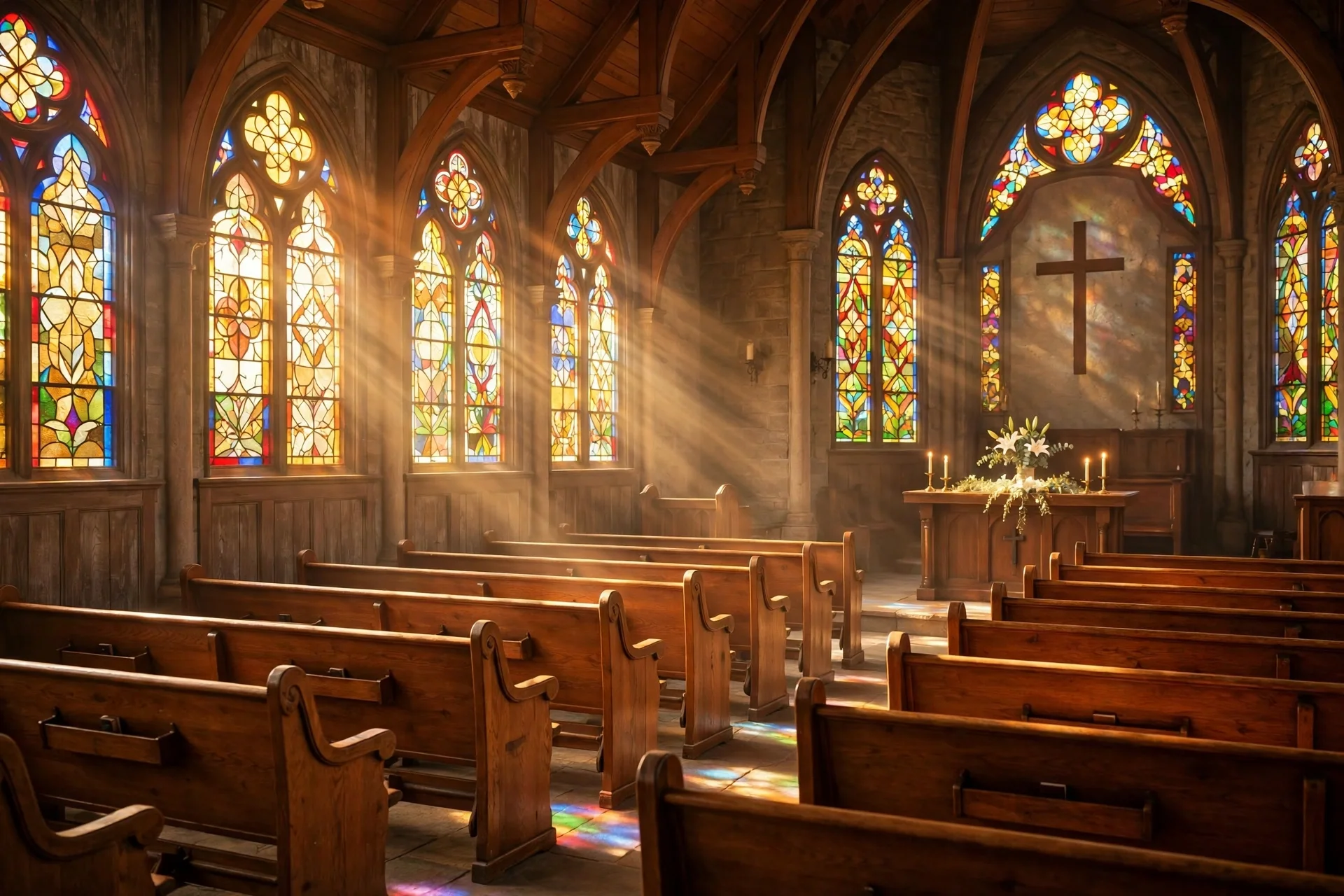
Vitrales con luz cálida en el interior de una iglesia, en el marco del mensaje presidencial por el Día de Todos los Santos. · EPM
Trump Honors Saints in All Saints Day Presidential Message
President Donald Trump issued an official All Saints Day message that traces saints through American cities, universities, and hospitals, honors Junípero…
Presidential Message Praises the Spiritual Heritage of Saints
President Donald Trump issued an official All Saints Day message praising the nation's spiritual heritage in its cities and institutions, honoring four saints…
--- The context ---
President Donald Trump issued an official message for All Saints Day in which he joins Christians across the nation in honoring the men and women who, through the centuries, lived lives of extraordinary faithfulness. According to the message, those lives reveal the great goodness and love to which human beings can aspire.
--- The facts ---
The message notes that the names of saints are interwoven throughout the American landscape: San Francisco, California, is named for Saint Francis of Assisi; San Antonio, Texas, for Saint Anthony of Padua; St. Louis, Missouri, for a saintly king of France; and St. Paul, Minnesota, for the great Apostle. From Santa Monica, California, to St. Augustine, Florida, saints greet Americans on maps and road signs across the country.
That presence extends to trusted institutions: families turn to St. Jude Children's Research Hospital when a child is gravely ill, and young Americans study at Saint John's University, Saint Louis University, and Saint Bonaventure University. Every March, millions celebrate Saint Patrick's Day with parades, music, and the wearing of green. Professional sports carry the same legacy: New Orleans received its National Football League franchise on November 1, 1966, All Saints Day, and a local businessman championed the name Saints, inspired by the jazz anthem When the Saints Go Marching In.
The message especially honors Saint Junípero Serra, who carried the Christian faith through the missions of California; Saint Elizabeth Ann Seton, who helped build Catholic education in America; Saint Katharine Drexel, who devoted her fortune and her life to educating and serving poor and impoverished communities; and Saint Frances Xavier Cabrini, who established schools, orphanages, and hospitals.
--- The positions ---
The message holds that a great civilization needs more than material success: it needs examples of goodness and heroes of mercy, sacrifice, humility, and love. It also holds that death does not have the final word and that, in the Christian faith, the Resurrection opened eternal life to all who believe. Trump states that he will always defend the freedom of Americans to express their faith openly and without fear, and together with Melania he offers warm greetings to all who observe the feast.
--- What remains unknown ---
The message announces no concrete measures or official events tied to the date: it is a commemorative proclamation. It also does not detail how the promised defense of the freedom to express faith will translate into action.
--- Unanswered questions ---
What practical reach will the presidential promise to defend the freedom to express faith openly actually have? Will the universities and institutions named mark the date with observances of their own? Will this commemoration remain an annual fixture of the official presidential message calendar?
--- EPM analysis ---
The thread running through the piece is service to others: hospitals caring for gravely ill children, schools raised for poor communities, orphanages and classrooms. Read that way, the message presents holiness as concrete work on behalf of one's neighbor and places that legacy in institutions that still serve families across the country today.
📌 EPM Take: In EPM's view, the strength of the message lies in where it places its focus: not on abstract celebration, but on hospitals, schools, and communities where service to others still happens every day. That reading brings the feast close to the real lives of millions of families and recalls that organized charity built part of the nation's social fabric. The pledge to defend the freedom to express faith openly completes a text that joins memory, gratitude, and public commitment to believing communities.
--- The context ---
President Donald Trump issued an official message for All Saints Day in which he joins Christians across the nation in honoring the men and women who, through the centuries, lived lives of extraordinary faithfulness. According to the message, every generation has understood the power of the example of a heroic and holy life, which is why the names of saints are interwoven throughout the American landscape.
--- The facts ---
The message notes that San Francisco, California, is named for Saint Francis of Assisi; San Antonio, Texas, for Saint Anthony of Padua; St. Louis, Missouri, for a saintly king of France; and St. Paul, Minnesota, for the great Apostle. From Santa Monica, California, to St. Augustine, Florida, saints greet Americans on maps and road signs from sea to shining sea, a constant reminder of the nation's roots.
Institutions confirm that heritage: families turn to St. Jude Children's Research Hospital when a child is gravely ill, and young Americans study at Saint John's University, Saint Louis University, and Saint Bonaventure University. Every March, millions celebrate Saint Patrick's Day with parades, music, and the wearing of green. Even professional sports carry the legacy: New Orleans received its National Football League franchise on November 1, 1966, All Saints Day, and a local businessman championed the name Saints, inspired by the jazz anthem When the Saints Go Marching In.
The message especially honors Saint Junípero Serra, who carried the Christian faith through the missions of California; Saint Elizabeth Ann Seton, who helped build Catholic education in America; Saint Katharine Drexel, who devoted her fortune and her life to educating and serving poor and impoverished communities; and Saint Frances Xavier Cabrini, who established schools, orphanages, and hospitals, putting Christian charity into action.
--- The positions ---
The message holds that a great civilization needs more than material success: it needs examples of goodness and heroes not only of strength and achievement but also of mercy, sacrifice, humility, and love. It also holds that death does not have the final word and that, in the Christian faith, the Resurrection opened eternal life to all who believe. Trump states that he will always defend the freedom of Americans to express their faith openly and without fear, and together with Melania he offers warm greetings to all who observe the feast.
--- What remains unknown ---
The message announces no concrete measures or official events tied to the date: it is a commemorative proclamation. It also does not detail how the promised defense of the freedom to express faith will translate into action.
--- Unanswered questions ---
What practical reach will the presidential promise to defend the freedom to express faith openly and without fear actually have? Will the schools and universities named reclaim this date as part of their public identity? Will this commemoration remain an annual fixture of the official presidential message calendar?
--- EPM analysis ---
The piece defends a demanding idea: the greatness of a nation is also measured by its examples of virtue. The message presents the spiritual inheritance as a living patrimony that deserves gratitude, defense, and continuity in public life.
📌 EPM Take: In EPM's view, the message is right to recall that American identity was also written with the names of saints across its cities, classrooms, and hospitals, and that this spiritual inheritance is not an ornament of the past but a living foundation. The explicit defense of the freedom to express faith openly and without fear gives the text its central commitment. Altogether, it is a proclamation of gratitude and principle: virtue, sacrifice, and faith as pillars of national life.
Trump honra a los santos en su mensaje del Día de Todos los Santos
El presidente Donald Trump difundió un mensaje oficial por el Día de Todos los Santos que recorre ciudades, universidades y hospitales con nombres de santos…
Mensaje presidencial exalta la herencia espiritual de Estados Unidos
El presidente Donald Trump difundió un mensaje oficial por el Día de Todos los Santos que exalta la herencia espiritual del país en sus ciudades e…
--- El contexto ---
El presidente Donald Trump difundió un mensaje oficial por el Día de Todos los Santos en el que se suma a los cristianos de todo el país para honrar a los hombres y mujeres que, a lo largo de los siglos, vivieron con una fidelidad extraordinaria. Según el mensaje, esas vidas revelan la gran bondad y el amor a los que todo ser humano puede aspirar.
--- Los hechos ---
El mensaje recuerda que los nombres de santos están entretejidos en el mapa del país: San Francisco, en California, lleva el nombre de San Francisco de Asís; San Antonio, en Texas, el de San Antonio de Padua; St. Louis, en Missouri, el de un rey santo de Francia, y St. Paul, en Minnesota, el del gran Apóstol. De Santa Monica, en California, a St. Augustine, en Florida, los santos saludan en mapas y señales de carretera.
Las familias acuden al St. Jude Children's Research Hospital cuando un niño está gravemente enfermo, y jóvenes estudian en Saint John's University, Saint Louis University y Saint Bonaventure University. Cada marzo, millones celebran el Saint Patrick's Day con desfiles, música y el color verde. El deporte guarda el mismo legado: New Orleans recibió su franquicia de la National Football League el 1 de noviembre de 1966, Día de Todos los Santos, y un empresario local impulsó el nombre Saints, inspirado en el himno de jazz When the Saints Go Marching In.
El mensaje honra de manera especial a San Junípero Serra, que llevó la fe cristiana por las misiones de California; a Santa Elizabeth Ann Seton, que ayudó a construir la educación católica en América; a Santa Katharine Drexel, que dedicó su fortuna y su vida a educar y servir a comunidades pobres, y a Santa Frances Xavier Cabrini, que fundó escuelas, orfanatos y hospitales.
--- Las posiciones ---
El mensaje sostiene que una gran civilización necesita más que éxito material: necesita ejemplos de bondad y héroes de misericordia, sacrificio, humildad y amor. Sostiene además que la muerte no tiene la última palabra y que, según la fe cristiana, la resurrección abrió la vida eterna a quienes creen. Trump afirma que siempre defenderá la libertad de expresar la fe abiertamente y sin miedo, y saluda junto a Melania a quienes observan la fiesta.
--- Lo que falta saber ---
El mensaje no anuncia medidas concretas ni actos oficiales vinculados a la fecha: es una proclamación conmemorativa. Tampoco detalla cómo se traducirá en acciones la defensa de la libertad de expresar la fe que el presidente promete en el texto.
--- Preguntas sin respuesta ---
¿Qué alcance práctico tendrá la promesa presidencial de defender la libertad de expresar la fe abiertamente? ¿Organizarán las universidades e instituciones nombradas actos propios por esta fecha? ¿Se mantendrá esta conmemoración como una cita anual del calendario oficial de mensajes presidenciales?
--- Análisis EPM ---
El hilo que une la pieza es el servicio a los demás: hospitales, escuelas para comunidades pobres, orfanatos y aulas. Así, el mensaje presenta la santidad como trabajo concreto en favor del prójimo, en instituciones que hoy siguen atendiendo a familias de todo el país.
📌 Conclusion EPM: A juicio de EPM, el valor del mensaje está en dónde pone el foco: no en la celebración abstracta, sino en hospitales, escuelas y comunidades concretas donde el servicio a los demás sigue ocurriendo cada día. Esa lectura acerca la fecha a la vida real de millones de familias y recuerda que la caridad organizada construyó parte de la infraestructura social del país. La promesa de defender la libertad de expresar la fe completa un texto que une memoria, gratitud y compromiso público con las comunidades creyentes.
--- El contexto ---
El presidente Donald Trump difundió un mensaje oficial por el Día de Todos los Santos en el que se suma a los cristianos de todo el país para honrar a los hombres y mujeres que, a lo largo de los siglos, vivieron con una fidelidad extraordinaria. Según el mensaje, cada generación ha entendido el poder del ejemplo de una vida heroica y santa, y por eso los nombres de santos forman parte del paisaje nacional.
--- Los hechos ---
El mensaje recuerda que San Francisco, en California, lleva el nombre de San Francisco de Asís; San Antonio, en Texas, el de San Antonio de Padua; St. Louis, en Missouri, el de un rey santo de Francia, y St. Paul, en Minnesota, el del gran Apóstol. De Santa Monica, en California, a St. Augustine, en Florida, los santos aparecen en mapas y señales de costa a costa.
Las familias acuden al St. Jude Children's Research Hospital cuando un niño está gravemente enfermo, y jóvenes estudian en Saint John's University, Saint Louis University y Saint Bonaventure University. Cada marzo, millones celebran el Saint Patrick's Day con desfiles, música y el color verde. Incluso el deporte profesional la lleva consigo: New Orleans recibió su franquicia de la National Football League el 1 de noviembre de 1966, Día de Todos los Santos, y un empresario local impulsó el nombre Saints, inspirado en el himno de jazz When the Saints Go Marching In.
El mensaje honra a San Junípero Serra, que llevó la fe por las misiones de California; a Santa Elizabeth Ann Seton, que ayudó a construir la educación católica; a Santa Katharine Drexel, que dedicó su fortuna a educar y servir a comunidades pobres, y a Santa Frances Xavier Cabrini, que fundó escuelas, orfanatos y hospitales.
--- Las posiciones ---
El mensaje sostiene que una gran civilización necesita más que éxito material: necesita ejemplos de bondad y héroes no solo de fuerza y logros, sino también de misericordia, sacrificio, humildad y amor. Sostiene además que la muerte no tiene la última palabra y que, según la fe cristiana, la resurrección abrió la vida eterna a quienes creen. Trump afirma que siempre defenderá la libertad de expresar la fe abiertamente y sin miedo, y saluda junto a Melania a quienes observan la fiesta.
--- Lo que falta saber ---
El mensaje no anuncia medidas concretas ni actos oficiales vinculados a la fecha: es una proclamación conmemorativa. Tampoco detalla cómo se traducirá en acciones la defensa de la libertad de expresar la fe que el presidente promete en el texto.
--- Preguntas sin respuesta ---
¿Qué alcance práctico tendrá la promesa presidencial de defender la libertad de expresar la fe abiertamente y sin miedo? ¿Recuperarán las escuelas y universidades nombradas esta fecha como parte de su identidad pública? ¿Se mantendrá esta conmemoración como una cita anual del calendario oficial de mensajes presidenciales?
--- Análisis EPM ---
La pieza defiende una idea exigente: la grandeza de una nación se mide también por sus ejemplos de virtud. El mensaje presenta la herencia espiritual como un patrimonio vivo que merece gratitud, defensa y continuidad en la vida pública.
📌 Conclusion EPM: A juicio de EPM, el mensaje acierta al recordar que la identidad estadounidense se escribió también con nombres de santos en sus ciudades, aulas y hospitales, y que esa herencia espiritual no es un adorno del pasado sino un fundamento presente. La defensa explícita de la libertad de expresar la fe abiertamente y sin miedo da al texto su compromiso central. Es, en conjunto, una proclamación de gratitud y de principios: virtud, sacrificio y fe como pilares de la vida nacional.