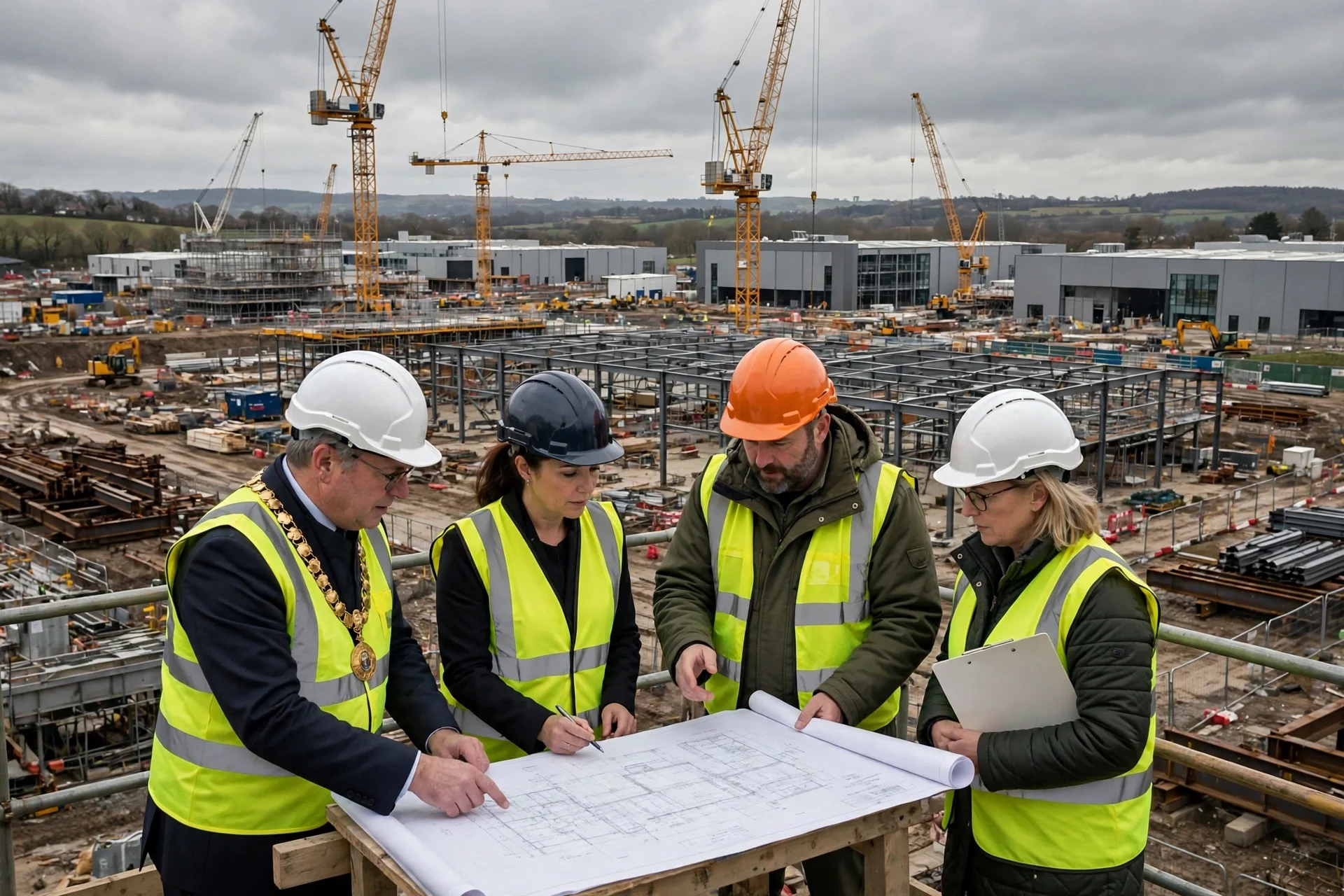
Un gran sitio industrial en desarrollo, con grúas y responsables locales revisando los planos del proyecto. · Imagen generada por EPM
UK seeks ten major strategic investment sites nationwide
The British Government has launched a £700 million accelerator to unlock up to ten major industrial and commercial sites, working with mayors and local…
Britain ties ten strategic sites to real market demand
The British Government will deploy £700 million for up to ten industrial and commercial sites, but only viable projects with genuine market demand will…
--- The context ---
The British Government has launched a nationwide search to identify up to 10 major industrial and commercial sites capable of driving the country's reindustrialisation. Mayors and local leaders share the diagnosis: land with real potential and investor demand exists, but development stalls on planning constraints, grid connections and access to finance, barriers that no local authority can solve on its own.
The new programme, called the Strategic Sites Accelerator, is a major step in the Government's Industrial Strategy. It covers high-growth sectors such as advanced manufacturing, digital and tech, defence and life sciences, and it will be open to sites in every nation and region, from science parks and manufacturing sites to innovation districts held back by viability constraints.
--- The facts ---
The Accelerator will deploy around £700 million, alongside expert support, to help unlock up to 10 major sites. Its aim is to crowd in up to £2 billion in private investment over time and to support tens of thousands of jobs. The Government's public ambition is to support six to 10 sites, and individual investments will be subject to the necessary commercial assessment, due diligence and approvals, so final employment will depend on the sites and investments ultimately brought forward.
Support will come in several forms, from loans and equity and targeted grant funding to technical expertise, bringing government, local partners and developers together to tackle specific barriers at each site. The programme will focus on commercially viable sites with strong investor demand, where government backing can help overcome the barriers stopping development from moving ahead.
The Accelerator brings together the Office for Investment and the National Wealth Fund, with CBRE as its National Delivery Partner, and it will work with investors, developers and regional partners. No10 North will work alongside the programme and local leaders, exchanging pipelines of priority projects in support of the National Economic Council. The Accelerator is already engaging on potential sites in Glasgow, Burgess Hill and Sheffield with technical support and expertise.
Opportunities are being explored in Greater Manchester, West Yorkshire, West Midlands, South Yorkshire, Liverpool City Region, the North East, Glasgow City Region and Cardiff Capital Region, building on the National Wealth Fund's strategic partnerships in these regions. The sector backdrop reinforces the announcement: £4 billion of investment has flooded into life sciences since July 2025, the technology sector is valued at more than £1 trillion, and digital jobs can attract salaries upwards of £45,000, well above the national average. Mayors will also gain a share of business rates from 2027 and an assignment of income tax from 2028, and a further £285 million will support areas moving towards devolution deals, including £120 million of capital funding to develop investment opportunities.
--- The positions ---
The Chancellor of the Exchequer argued, in remarks attributed by the Government, that local leaders know their communities best and that only by trusting them with real power and resources will change happen, presenting the £700 million package as help to break down barriers to local growth. The Business Secretary attributed the drag on investment to outdated infrastructure, insufficient access to finance and problems with planning, and defended empowering local leaders to attract billions in investment and tens of thousands of good-quality jobs.
The Mayor of Greater Manchester linked the programme to an integrated pipeline that, she said, will turbocharge £10billion of investment over the next decade, while warning that viable developments are held back by complex infrastructure, remediation and delivery challenges. The Mayor of Cambridgeshire and Peterborough stressed that viability remains one of the most pressing concerns in the market, and the Mayor of the East Midlands called for flexible support to bring strategic sites into productive use and support a more resilient, green industrial future.
The Mayor of South Yorkshire highlighted the Don Valley Corridor and Runway Park, and pointed to the advanced manufacturing cluster built around a centre celebrating its 25th birthday this year, already home to major companies growing their presence in the region. The Mayor of the West Midlands identified infrastructure, access to finance and getting sites ready for development as the practical barriers to remove. The Mayor of West Yorkshire recalled that her local plan is backed by a £450 million capital fund made possible by devolution, and the Mayor of the West of England focused on brownfield land, citing regeneration in Bristol and Bath.
--- What remains unknown ---
The final list of chosen sites has not been published, nor has the split of funding between loans, equity and grants in each case.
--- Unanswered questions ---
Which sites will finally make the list of up to ten strategic locations and when will they be announced? How much of the expected £2 billion in private investment is already committed and how much depends on future decisions? On what timetable could projects translate into concrete jobs for each region? What will happen to sites that do not pass the planned commercial assessment and due diligence?
--- EPM analysis ---
The underlying reading is that London recognises that the bottleneck for regional growth is not a lack of ideas but viability: land that needs remediation, grids that do not reach the site and finance that does not close. By putting mayors at the centre of the search, the Government makes local knowledge part of the selection mechanism, and by combining public money with technical expertise it tries to make each public pound pull in additional private investment in sectors paying above-average wages. The risk lies in delivery, and the programme should be measured by sites unlocked and works started, not by announcements accumulated across territories.
📌 EPM Take: In EPM's view, the Accelerator gets it right by treating reindustrialisation as a practical problem of sites, grids and finance rather than a national slogan. Putting mayors in charge of identifying locations, backing them with £700 million and requiring real investor demand gives the programme a firmer base than generic funding rounds of the past. Its worth, however, will only be proven when the first sites pass due diligence, attract private capital and generate verifiable jobs in the regions. Until then, the promise is credible in design and demanding in the concrete results owed to communities that have waited years.
--- The context ---
The British Government has opened a nationwide search for up to 10 major industrial and commercial sites, with a condition that orders the whole programme: only commercially viable locations with genuine market demand will move forward. The initiative responds to barriers repeated across the regions, such as outdated infrastructure, insufficient access to finance and planning problems, which cool would-be investors and block projects with real potential.
The programme, called the Strategic Sites Accelerator, forms part of the Government's Industrial Strategy and targets high-growth sectors such as advanced manufacturing, digital and tech, defence and life sciences. Sites in every nation and region may apply, from science parks and manufacturing sites to innovation districts held back by viability constraints, provided a credible proposition stands behind each bid.
--- The facts ---
The Accelerator will deploy around £700 million, alongside expert support, with the ambition of crowding in up to £2 billion of private investment and supporting tens of thousands of jobs over time. The Government's public ambition is to support six to 10 sites. The official framing makes clear that individual investments will be subject to the necessary commercial assessment, due diligence and approvals, and that employment will depend on the sites and investments ultimately brought forward.
Forms of support include loans and equity, targeted grant funding and technical and advisory expertise. The governing criterion is to concentrate resources where public backing can remove a specific barrier preventing investment or development, not to subsidise projects without demand. That is why the programme insists on working with investors, developers and regional partners on commercially credible sites where there is genuine market demand.
The structure brings together the Office for Investment and the National Wealth Fund, with CBRE as its National Delivery Partner. No10 North will work alongside the programme and local leaders, exchanging pipelines of priority projects in support of the National Economic Council. The Accelerator is already engaging on potential sites in Glasgow, Burgess Hill and Sheffield with technical support, and will back mayors and local authorities with blended finance across the country.
Opportunities are being explored in Greater Manchester, West Yorkshire, West Midlands, South Yorkshire, Liverpool City Region, the North East, Glasgow City Region and Cardiff Capital Region, building on the National Wealth Fund's strategic partnerships in these regions. The announcement cites recent sector momentum: £4 billion of investment has flooded into life sciences since July 2025, the technology sector is valued at more than £1 trillion, and digital jobs can attract salaries upwards of £45,000, well above the national average. The package adds a share of business rates for mayors from 2027 and an assignment of income tax from 2028, plus a further £285 million for areas moving towards devolution deals, including £120 million of capital funding.
--- The positions ---
The Chancellor of the Exchequer argued, according to the official account, that local leaders know their communities best and that only by trusting them with real power and resources will change be seen, presenting the £700 million package as a way to break down barriers to local growth. The Business Secretary described the concrete brakes, outdated infrastructure, insufficient finance and planning problems, and maintained that the programme will get the ball rolling for up to 10 of the UK's most important potential sites.
The Mayor of Greater Manchester offered the most ambitious regional figure, saying the region's integrated pipeline will turbocharge £10billion of investment over the next decade, while acknowledging that viable developments are held back by complex infrastructure, remediation or delivery challenges. The Mayor of Cambridgeshire and Peterborough was direct in identifying viability as one of the most pressing concerns in the market, and the Mayor of the East Midlands asked for flexible support that works for businesses, places and local economies.
The Mayor of South Yorkshire offered the region's track record as collateral, with an advanced manufacturing cluster around a centre celebrating its 25th birthday this year and first-tier companies growing their presence, and presented Runway Park, in the Don Valley Corridor, as the opportunity to unlock. The Mayor of the West Midlands insisted that the practical barriers of infrastructure, finance and site readiness separate good ideas from real jobs. The Mayor of West Yorkshire recalled that her local growth plan already carries a £450 million capital fund made possible by devolution, and the Mayor of the West of England stressed the opportunities on brownfield land, with examples in Bristol and Bath. From the delivery partner, the launch of the initiative was welcomed.
--- What remains unknown ---
No closed list of sites or amount per site has been published yet, nor a timetable of approvals case by case.
--- Unanswered questions ---
Which sites will pass the commercial assessment and due diligence and which will fall away? What share of the expected private investment rests on firm commitments from identifiable investors? What safeguards will protect public funds if a supported site never reaches development? Will the Government publish measurable results per site, including jobs and investment actually secured?
--- EPM analysis ---
The healthiest element of the design is its internal discipline: public money is presented as leverage to unlock sites with demand, not as a substitute for the market. Loans, equity and targeted grants sit alongside an explicit warning about assessment and approvals, placing the burden of proof on each project. If that filter is applied rigorously, the programme can correct concrete coordination failures, such as a grid connection or the remediation of a site, without rewarding unviable developments.
📌 EPM Take: In EPM's view, the Accelerator will be as good as its filter. The requirement of commercial viability, genuine demand and due diligence is the part of the announcement that deserves the closest watching, because it protects the taxpayer and gives credibility with private investors. If London holds that bar and publishes results site by site, the £700 million could mobilise several times more capital in high-wage sectors. If the bar gives way under regional pressure, the programme will become another round of distributed promises. For now, the design earns credit and the delivery deserves permanent, demanding scrutiny.
Reino Unido busca diez grandes sitios estratégicos de inversión
El Gobierno británico lanzó un acelerador de 700 millones de libras para desbloquear hasta diez grandes sitios industriales y comerciales con apoyo de alcaldes…
Londres condiciona diez sitios estratégicos a demanda real
El Gobierno británico desplegará 700 millones de libras para hasta diez sitios industriales y comerciales, pero solo avanzarán los proyectos viables y con…
--- El contexto ---
El Gobierno británico ha puesto en marcha una búsqueda nacional para identificar hasta diez grandes sitios industriales y comerciales capaces de sostener la reindustrialización del país. Alcaldes y líderes locales comparten el diagnóstico: existen terrenos con potencial y demanda de inversores, pero su desarrollo se frena por la planificación, las conexiones a la red eléctrica y el acceso a la financiación, barreras que ninguna administración local puede resolver en solitario.
El nuevo programa, denominado Strategic Sites Accelerator, es un paso importante de la estrategia industrial del Ejecutivo. Abarca sectores de alto crecimiento como la manufactura avanzada, el ámbito digital y tecnológico, la defensa y las ciencias de la vida, y estará abierto a emplazamientos en todas las naciones y regiones, desde parques científicos y plantas de manufactura hasta distritos de innovación frenados por problemas de viabilidad.
--- Los hechos ---
El acelerador desplegará alrededor de 700 millones de libras, junto con apoyo especializado, para desbloquear hasta diez sitios de gran escala. Su objetivo es atraer hasta dos mil millones de libras de inversión privada con el tiempo y respaldar decenas de miles de empleos. La ambición pública del Gobierno es apoyar entre seis y diez sitios, y cada inversión quedará sujeta a la evaluación comercial, la diligencia debida y las aprobaciones correspondientes, por lo que el empleo final dependerá de los proyectos que salgan adelante.
El apoyo podrá adoptar formas diversas, desde préstamos y participación en capital hasta subvenciones específicas y experiencia técnica, reuniendo al Gobierno, los socios locales y los promotores para atacar barreras concretas en cada emplazamiento.
El dispositivo reúne a la Oficina de Inversión y al Fondo Nacional de Patrimonio, con una firma especializada como socio nacional de ejecución, y trabajará con inversores, promotores y socios regionales. La estructura conocida como No10 North colaborará con el programa y con los líderes locales, intercambiando carteras de proyectos prioritarios en apoyo del Consejo Económico Nacional. El acelerador ya trabaja sobre posibles sitios en Glasgow, Burgess Hill y Sheffield con apoyo técnico.
Las oportunidades se exploran en Gran Mánchester, Yorkshire Occidental, los Midlands Occidentales, Yorkshire del Sur, la región urbana de Liverpool, el Noreste, la región urbana de Glasgow y la región capital de Cardiff, sobre las alianzas estratégicas previas del Fondo Nacional de Patrimonio. El contexto sectorial refuerza el anuncio: en ciencias de la vida han entrado cuatro mil millones de libras desde julio de 2025, el sector tecnológico está valorado en más de un billón de libras y los empleos digitales pueden superar las cuarenta y cinco mil libras de salario, por encima de la media nacional. Además, los alcaldes tendrán una parte de las tasas empresariales desde 2027 y una asignación del impuesto sobre la renta desde 2028, y otros 285 millones de libras apoyarán a zonas en vías de devolución de competencias, incluidos 120 millones de libras de capital para desarrollar oportunidades de inversión.
--- Las posiciones ---
El ministro de Hacienda sostuvo, en términos atribuidos por el propio Ejecutivo, que los líderes locales conocen mejor a sus comunidades y que solo confiándoles poder y recursos reales se producirá el cambio, y presentó el paquete como una ayuda para derribar las barreras al crecimiento local. El ministro de Empresa atribuyó el freno de la inversión a infraestructuras anticuadas, financiación insuficiente y problemas de planificación, y defendió empoderar a los líderes locales para captar miles de millones en inversión y decenas de miles de empleos de calidad.
Desde Gran Mánchester, su alcaldesa vinculó el programa con una cartera integrada que, según expuso, impulsará diez mil millones de libras de inversión en la próxima década, aunque advirtió de que desarrollos viables se frenan por retos de infraestructura, saneamiento del suelo y ejecución. El alcalde de Cambridgeshire y Peterborough subrayó que la viabilidad es una de las preocupaciones más apremiantes del mercado, y la alcaldesa de los Midlands Orientales defendió un apoyo flexible para poner sitios estratégicos en uso productivo y avanzar hacia un futuro industrial más verde y resiliente.
El alcalde de Yorkshire del Sur destacó el corredor del valle del Don y el parque Runway Park, y recordó el clúster de manufactura avanzada construido en torno a un centro que cumple veinticinco años y acoge a grandes compañías que amplían su presencia en la región. El alcalde de los Midlands Occidentales señaló la financiación, la infraestructura y la preparación de los sitios como los frenos prácticos a retirar. La alcaldesa de Yorkshire Occidental recordó que su plan local cuenta con un fondo de capital de 450 millones de libras hecho posible por la devolución de competencias, y la alcaldesa del Oeste de Inglaterra puso el acento en los suelos industriales abandonados, con regeneraciones en Bristol y Bath.
--- Lo que falta saber ---
Todavía no se ha publicado la lista definitiva de sitios elegidos ni el reparto del fondo entre préstamos, capital y subvenciones en cada caso.
--- Preguntas sin respuesta ---
¿Qué sitios formarán finalmente la lista de hasta diez emplazamientos estratégicos y cuándo se anunciarán? ¿Cuánto de los dos mil millones de libras de inversión privada esperados está ya comprometido y cuánto depende de decisiones futuras? ¿En qué plazo podrían traducirse los proyectos en empleos concretos para cada región? ¿Qué ocurrirá con los sitios que no superen la evaluación comercial y la diligencia debida previstas?
--- Análisis EPM ---
La lectura de fondo es que Londres reconoce que el cuello de botella del crecimiento regional no es la falta de ideas, sino la viabilidad: suelos que necesitan saneamiento, redes que no llegan y financiación que no cierra. El riesgo está en la ejecución, y el programa deberá medirse por sitios desbloqueados y obras iniciadas, no por anuncios acumulados.
📌 Conclusion EPM: A juicio de EPM, el acelerador acierta al tratar la reindustrialización como un problema práctico de sitios, redes y financiación, y no como un eslogan nacional. Poner a los alcaldes a identificar los emplazamientos, respaldarlos con 700 millones de libras y exigir demanda real de inversores da al programa una base más sólida que repartos genéricos del pasado. Su valor, sin embargo, se demostrará solo cuando los primeros sitios superen la diligencia debida, atraigan capital privado y generen empleo verificable en las regiones. Hasta entonces, la promesa es creíble en diseño y exigente en resultados concretos para las comunidades que llevan años esperando.
--- El contexto ---
El Gobierno británico ha abierto una búsqueda nacional de hasta diez grandes sitios industriales y comerciales, con una condición que ordena todo el programa: solo avanzarán los emplazamientos comercialmente viables y con demanda genuina de mercado. La iniciativa responde a barreras repetidas en las regiones, como infraestructuras anticuadas, acceso insuficiente a la financiación y trabas de planificación, que enfrían a los inversores y bloquean proyectos con potencial real.
El programa, denominado Strategic Sites Accelerator, forma parte de la estrategia industrial del Ejecutivo y se dirige a sectores de alto crecimiento como la manufactura avanzada, el ámbito digital y tecnológico, la defensa y las ciencias de la vida. Podrán optar sitios de todas las naciones y regiones, desde parques científicos y plantas de manufactura hasta distritos de innovación contenidos por problemas de viabilidad, siempre que exista una propuesta creíble detrás de cada candidatura.
--- Los hechos ---
El acelerador desplegará alrededor de 700 millones de libras, junto con apoyo especializado, con la ambición de atraer hasta dos mil millones de libras de inversión privada y respaldar decenas de miles de empleos con el tiempo. La ambición pública del Gobierno es apoyar entre seis y diez sitios. El planteamiento oficial deja claro que cada inversión quedará sujeta a la evaluación comercial, la diligencia debida y las aprobaciones necesarias, y que el empleo dependerá de los sitios y las inversiones que finalmente se concreten.
Las formas de apoyo incluyen préstamos, participación en capital, subvenciones específicas y experiencia técnica y de asesoramiento. El criterio rector es concentrar los recursos donde el respaldo público pueda retirar una barrera específica que impide la inversión o el desarrollo, y no subvencionar proyectos sin demanda.
En la estructura participan la Oficina de Inversión y el Fondo Nacional de Patrimonio, con una firma especializada como socio nacional de ejecución. La estructura conocida como No10 North trabajará junto al programa y a los líderes locales, intercambiando carteras de proyectos prioritarios en apoyo del Consejo Económico Nacional. El acelerador ya está en contacto con posibles sitios en Glasgow, Burgess Hill y Sheffield, con apoyo técnico, y respaldará a alcaldes y autoridades locales con financiación combinada en todo el país.
Las oportunidades se exploran en Gran Mánchester, Yorkshire Occidental, los Midlands Occidentales, Yorkshire del Sur, la región urbana de Liverpool, el Noreste, la región urbana de Glasgow y la región capital de Cardiff, sobre las alianzas estratégicas del Fondo Nacional de Patrimonio en esas regiones. El anuncio cita el empuje sectorial reciente: cuatro mil millones de libras han entrado en ciencias de la vida desde julio de 2025, el sector tecnológico está valorado en más de un billón de libras y los empleos digitales pueden superar las cuarenta y cinco mil libras de salario. El paquete se completa con una parte de las tasas empresariales para los alcaldes desde 2027 y una asignación del impuesto sobre la renta desde 2028, más otros 285 millones de libras para zonas en vías de devolución de competencias, incluidos 120 millones de libras de capital.
--- Las posiciones ---
El ministro de Hacienda defendió, según la versión oficial, que los líderes locales conocen mejor a sus comunidades y que solo confiándoles poder y recursos reales se verá el cambio, presentando el paquete de 700 millones de libras como un instrumento para romper las barreras al crecimiento local. El ministro de Empresa describió los frenos concretos, infraestructuras anticuadas, financiación insuficiente y problemas de planificación, y sostuvo que el programa pondrá en marcha hasta diez de los sitios potenciales más importantes del país.
La alcaldesa de Gran Mánchester aportó la cifra regional más ambiciosa al afirmar que la cartera integrada de su región impulsará diez mil millones de libras de inversión en la próxima década, aunque reconoció que desarrollos viables se frenan por retos de infraestructura, saneamiento y ejecución. El alcalde de Cambridgeshire y Peterborough señaló la viabilidad como una de las preocupaciones más apremiantes del mercado, y la alcaldesa de los Midlands Orientales reclamó un apoyo flexible que funcione para las empresas, los lugares y las economías locales.
El alcalde de Yorkshire del Sur puso como aval la trayectoria de su región, con un clúster de manufactura avanzada en torno a un centro que cumple veinticinco años y compañías de primer nivel que amplían su presencia, y presentó el parque Runway Park, en el corredor del valle del Don, como la oportunidad a desbloquear. El alcalde de los Midlands Occidentales insistió en que las barreras prácticas de infraestructura, financiación y preparación de sitios separan las buenas ideas de los empleos reales. La alcaldesa de Yorkshire Occidental recordó que su plan local ya cuenta con un fondo de capital de 450 millones de libras gracias a la devolución de competencias, y la alcaldesa del Oeste de Inglaterra subrayó las oportunidades sobre suelo industrial abandonado, con ejemplos en Bristol y Bath. Desde el socio de ejecución se celebró el lanzamiento del programa.
--- Lo que falta saber ---
No se ha publicado la lista cerrada de sitios ni el importe que recibirá cada uno, ni el calendario de aprobaciones caso por caso.
--- Preguntas sin respuesta ---
¿Qué sitios superarán la evaluación comercial y la diligencia debida y cuáles quedarán fuera? ¿Qué parte de la inversión privada esperada responde a compromisos firmes de inversores identificables? ¿Qué salvaguardas protegerán los fondos públicos si un sitio apoyado no llega a desarrollarse? ¿Publicará el Gobierno resultados medibles por sitio, incluidos empleo e inversión efectivamente captada?
--- Análisis EPM ---
El elemento más sano del diseño es su disciplina interna: el dinero público se presenta como palanca para desbloquear sitios con demanda, no como sustituto del mercado. Préstamos, capital y subvenciones específicas conviven con una advertencia explícita de evaluación y aprobaciones, lo que sitúa la carga de la prueba en cada proyecto. Si ese filtro se aplica con rigor, el programa puede corregir fallos concretos de coordinación, como la conexión a la red o el saneamiento de un suelo, sin premiar desarrollos inviables.
📌 Conclusion EPM: A juicio de EPM, el acelerador será tan bueno como su filtro. La exigencia de viabilidad comercial, demanda genuina y diligencia debida es la parte del anuncio que más debe vigilarse, porque protege al contribuyente y da credibilidad frente a los inversores privados. Si Londres mantiene ese listón y publica resultados por sitio, los 700 millones de libras pueden movilizar capital varias veces mayor en sectores de salarios altos. Si el listón cede ante la presión regional, el programa se convertirá en otro reparto de promesas. Por ahora, el diseño merece crédito y la ejecución, escrutinio permanente y exigente.