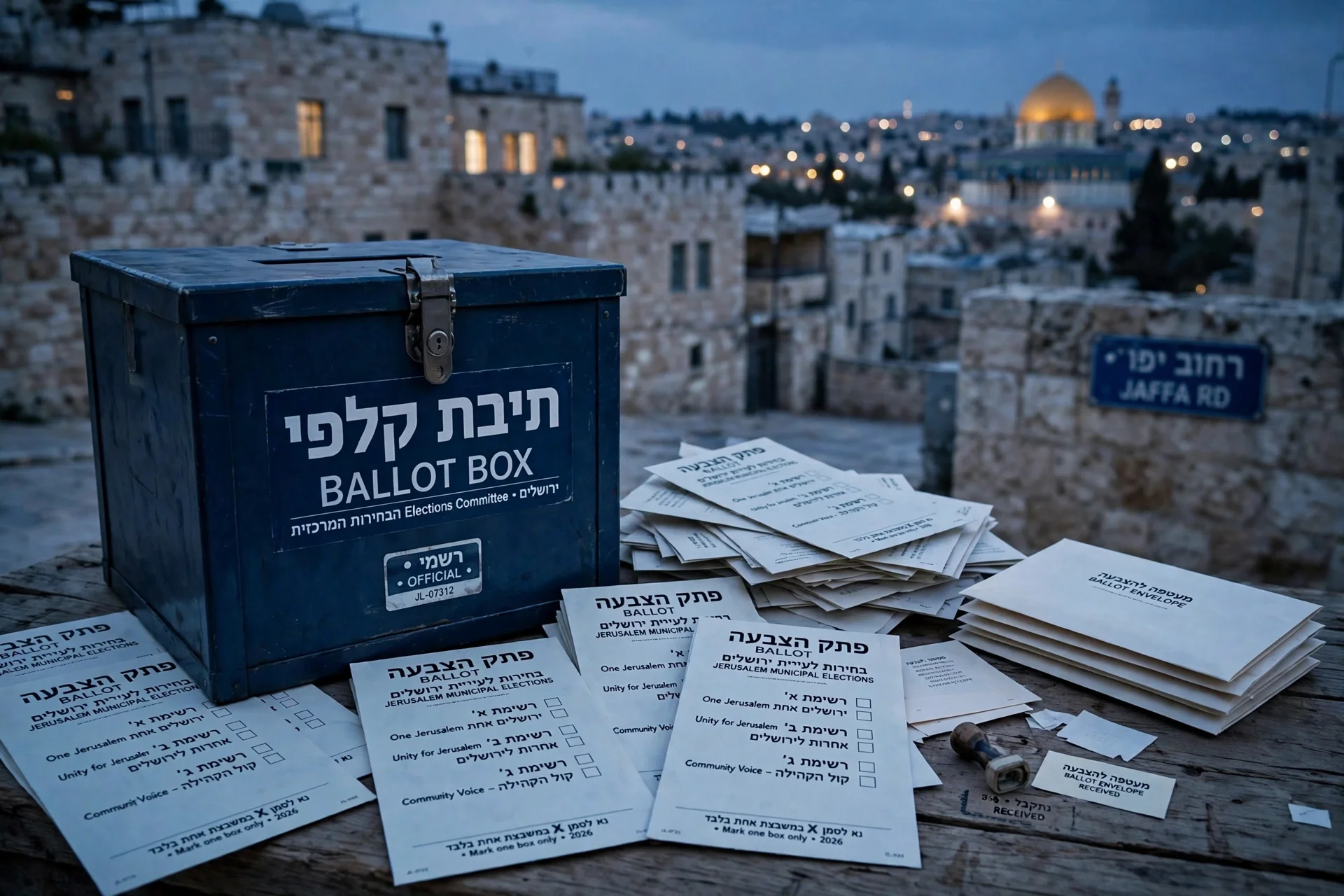
Urna y papeletas electorales en Jerusalén durante el escrutinio. · Imagen generada por EPM
Netanyahu bloc leads with 54 seats as Raam rises to 6
With 72.4% of the vote counted in Israel, the Netanyahu bloc totals 54 seats against 48 for the Eisenkot bloc, according to the Central Electoral Committee.
Netanyahu bloc holds 54 seats against Eisenkot bloc with 48
With 72.4% counted, the Netanyahu bloc reaches 54 seats and keeps the lead against 48 for the Eisenkot bloc, according to the Central Electoral Committee.
--- The context ---
Israel is counting votes in an election that left a fragmented Parliament with no clear majority. With 72.4% of the vote counted, figures from the Central Electoral Committee and the published calculations show two blocs unable to govern alone.
Prime Minister Benjamín Netanyahu lost a seat as the count advanced, but kept the lead as the most voted candidate. Pre-election polls had given Eisenkot a majority of the vote, an advantage the count has not confirmed.
--- The facts ---
Likud, the party of Netanyahu, fell to 27 seats. The Islamist formation Raam, led by Mansur Abás, gained 2 seats and reached a total of 6, the most notable movement of the count so far.
In the Netanyahu bloc, Judaísmo Unido de la Torá holds 7 seats and Shas 7, both ultra-Orthodox parties. Poder Judío contributes 7 and Sionismo Religioso contributes 6, the parties of ultranationalist ministers Itamar Ben Gvir and Bezalel Smotrich, respectively.
The Eisenkot bloc totals 48 seats against 54 for the Netanyahu bloc. Eisenkot holds 21 seats, Beyajad contributes 11, Los Demócratas 8 and Israel Beitenu 8, with Lista Conjunta at around 12 seats outside both blocs.
--- The positions ---
Arithmetic rules over any speech. Parliament has 120 seats and the majority stands at 61, so neither bloc reaches the threshold for a stable government alone if the distribution does not change.
That math places the Arab parties at the center of any negotiation, because they are the only ones excluded from the two blocs and they channel the votes of Arab Israelis, mostly Palestinians holding Israeli citizenship. Without their support, no majority is possible.
--- What remains unknown ---
Part of the vote remains uncounted and the final distribution may still change. It is also unknown which support each bloc will seek and what conditions the Arab parties, whose backing looks necessary, will set.
--- Unanswered questions ---
Will the 54 seats of the Netanyahu bloc hold when the count ends? Will the Arab parties sustain a government from either bloc, and in exchange for what? Can Eisenkot turn his 48 seats into a real alternative?
--- EPM analysis ---
The story is the rise of Raam, which gained 2 seats and reached 6, because Arab representation gains weight exactly when its support becomes indispensable. Likud fell to 27 seats, but still holds the largest bloc in the country.
📌 EPM Take: In EPM's view, the count rewards the persistence of the Netanyahu bloc, which totals 54 seats, but it punishes any temptation to govern alone, because the majority of 61 remains out of its reach. The key will be which leader manages to talk with the Arab parties without breaking his own camp. Raam, with 6 seats, and Lista Conjunta, with around 12, occupy the center of gravity of Israeli politics and can turn that weight into real influence.
--- The context ---
With 72.4% of the vote counted in Israel, the country moves toward an outcome that rewards continuity over the announced change. Figures from the Central Electoral Committee and the published calculations leave two blocs far from a majority in a Parliament of 120 seats.
Benjamín Netanyahu lost a seat, but kept the leadership as the most voted candidate. Pre-election polls had given Eisenkot a majority of the vote, a forecast that exit polls and the count have contradicted.
--- The facts ---
Likud fell to 27 seats, a contained drop that does not take away its command of its bloc. Raam, the Islamist formation led by Mansur Abás, gained 2 seats and rose to 6, confirming its parliamentary growth.
Alongside Likud, Judaísmo Unido de la Torá holds 7 seats and Shas holds 7, the two ultra-Orthodox parties. Poder Judío contributes 7 and Sionismo Religioso contributes 6, the formations of ultranationalist ministers Itamar Ben Gvir and Bezalel Smotrich, respectively.
The rival bloc totals 48 seats against 54 for the Netanyahu bloc. Eisenkot contributes 21, Beyajad 11, the party of former prime ministers Naftali Bénet and Yair Lapid, Los Demócratas 8 and Israel Beitenu 8.
--- The positions ---
Governability is again the central question. With the majority set at 61 seats, neither bloc can form a stable government alone if the distribution holds, and every remaining seat is worth double.
The Arab parties, excluded from both blocs, channel the votes of Arab Israelis, mostly Palestinians holding Israeli citizenship. Lista Conjunta would stand at around 12 seats and, with the 6 of Raam, their support is necessary for any majority.
--- What remains unknown ---
The count still has to be completed and it remains to be confirmed whether the gap between 54 seats and 48 seats holds. It also remains to be seen which support each camp will pursue and what price each potential partner will demand.
--- Unanswered questions ---
Will the full count confirm the 54 seats of Netanyahu? What support will each bloc accept to reach the majority of 61? Will Likud, with 27 seats, keep its ultra-Orthodox and ultranationalist partners united?
--- EPM analysis ---
The picture favors the incumbent. Netanyahu keeps the largest bloc, his partners are holding, and the rival camp, despite totaling 48 seats, needs more pieces. The question is no longer who won, but how much governing will cost.
📌 EPM Take: In EPM's view, the lesson is that experience and cohesion weigh more than polls, because the Netanyahu bloc totals 54 seats after a campaign many had written off. But winning the count is not enough when the majority demands 61 and the decisive support sits outside the bloc. The next government will be born from hard bargaining, and its stability will depend on turning a short lead into a majority built to last.
Netanyahu lidera con 54 escaños y Raam sube a 6 en Israel
Con el 72,4 % del voto escrutado en Israel, el bloque de Netanyahu suma 54 escaños frente a 48 del bloque de Eisenkot, según el Comité Electoral Central.
El bloque de Netanyahu suma 54 escaños frente a 48 de Eisenkot
Con el 72,4 % escrutado, el bloque de Netanyahu alcanza 54 escaños y mantiene el liderazgo frente a 48 del bloque de Eisenkot, según el Comité Electoral…
--- El contexto ---
Israel escruta unas elecciones que dejaron un Parlamento fragmentado y sin mayoría clara. Con el 72,4 % del voto escrutado, los datos del Comité Electoral Central y los cálculos publicados muestran dos bloques incapaces de gobernar en solitario.
El primer ministro, Benjamín Netanyahu, perdió un escaño, pero mantuvo el liderazgo como el más votado. Las encuestas previas daban una mayoría del voto a Eisenkot, ventaja que el escrutinio no ha confirmado.
--- Los hechos ---
El Likud, el partido de Netanyahu, bajó a 27 escaños. La formación islamista Raam, liderada por Mansur Abás, ganó 2 asientos y alcanzó 6, el movimiento más destacado de la jornada.
En su bloque, Judaísmo Unido de la Torá suma 7 escaños y Shas 7, ambos ultraortodoxos. Poder Judío aporta 7 y Sionismo Religioso aporta 6, los partidos de los ministros ultranacionalistas Itamar Ben Gvir y Bezalel Smotrich, respectivamente.
El bloque de Eisenkot suma 48 frente a 54 del bloque de Netanyahu. Eisenkot reúne 21 escaños, Beyajad aporta 11, Los Demócratas 8 e Israel Beitenu 8, mientras la Lista Conjunta rondaría los 12 fuera de ambos bloques.
--- Las posiciones ---
La aritmética manda. El Parlamento tiene 120 escaños y la mayoría se sitúa en 61, de modo que ningún bloque alcanza solo el umbral para formar un Gobierno estable si el reparto no varía.
Esa cuenta coloca a los partidos árabes en el centro, porque son los únicos excluidos de los dos bloques y canalizan el voto de los árabes israelíes, mayoritariamente palestinos con ciudadanía de Israel. Sin su apoyo no hay mayoría posible.
--- Lo que falta saber ---
Queda voto por escrutar y el reparto definitivo puede variar. Tampoco se conoce qué apoyos buscará cada bloque ni qué condiciones pondrán los partidos árabes, cuyo respaldo aparece como necesario para un Gobierno estable.
--- Preguntas sin respuesta ---
¿Se mantendrá la ventaja de 54 escaños de Netanyahu al concluir el escrutinio? ¿Aceptarán los partidos árabes sostener un Gobierno de alguno de los dos bloques y a cambio de qué? ¿Podrá Eisenkot convertir sus 48 escaños en una alternativa real?
--- Análisis EPM ---
El dato de fondo es el ascenso de Raam, que ganó 2 escaños y llegó a 6: la representación árabe gana peso justo cuando su apoyo se vuelve imprescindible. El Likud bajó a 27, pero conserva el bloque más numeroso.
📌 Conclusion EPM: A juicio de EPM, el escrutinio premia la constancia del bloque de Netanyahu, que suma 54 escaños, pero castiga cualquier tentación de gobernar en solitario, porque la mayoría de 61 queda fuera de su alcance. La clave estará en quién logre hablar con los partidos árabes sin romper su propio campo. Raam, con 6 escaños, y la Lista Conjunta, con cerca de 12, ocupan el centro de gravedad de la política israelí y pueden convertir ese peso en influencia real.
--- El contexto ---
Con el 72,4 % del voto escrutado en Israel, el país se acerca a un desenlace que premia la continuidad. Los datos del Comité Electoral Central y los cálculos publicados dejan dos bloques lejos de la mayoría en un Parlamento de 120 escaños.
Benjamín Netanyahu perdió un escaño, pero mantuvo el liderazgo como el más votado. Las encuestas previas daban una mayoría del voto a Eisenkot, pronóstico que las encuestas a pie de urna y el escrutinio han desmentido.
--- Los hechos ---
El Likud bajó a 27 escaños, caída contenida que no le arrebata el mando de su bloque. Raam, la formación islamista liderada por Mansur Abás, ganó 2 asientos y subió a 6, confirmando su crecimiento parlamentario.
Junto al Likud, Judaísmo Unido de la Torá suma 7 escaños y Shas 7, los dos partidos ultraortodoxos. Poder Judío aporta 7 y Sionismo Religioso aporta 6, las formaciones de los ministros ultranacionalistas Itamar Ben Gvir y Bezalel Smotrich, respectivamente.
El bloque rival suma 48 escaños frente a 54 del bloque de Netanyahu. Eisenkot aporta 21, Beyajad 11, el partido de los ex primeros ministros Naftali Bénet y Yair Lapid, Los Demócratas 8 e Israel Beitenu 8.
--- Las posiciones ---
La gobernabilidad es la cuestión central. Con la mayoría fijada en 61 escaños, ninguno de los dos bloques puede formar un Gobierno estable en solitario si el reparto se mantiene, y cada escaño restante vale doble.
Los partidos árabes, excluidos de ambos bloques, canalizan el voto de los árabes israelíes, mayoritariamente palestinos con ciudadanía de Israel. La Lista Conjunta rondaría los 12 escaños y, junto a los 6 de Raam, su apoyo resulta necesario para cualquier mayoría.
--- Lo que falta saber ---
Falta completar el escrutinio y confirmar si se mantiene la distancia entre los 54 escaños de un bloque y los 48 del otro. También falta saber qué apoyos buscará cada campo y a qué precio.
--- Preguntas sin respuesta ---
¿Confirmará el escrutinio completo los 54 escaños de Netanyahu? ¿Qué apoyos aceptará cada bloque para alcanzar la mayoría de 61? ¿Mantendrá el Likud, con 27 escaños, unidos a sus socios ultraortodoxos y ultranacionalistas en la negociación?
--- Análisis EPM ---
La fotografía favorece a quien ya gobierna. Netanyahu conserva el bloque mayor, sus socios responden y el campo rival, pese a sumar 48 escaños, necesita más piezas. La duda ya no es quién ganó, sino cuánto costará gobernar.
📌 Conclusion EPM: A juicio de EPM, la lección es que la experiencia y la cohesión pesan más que las encuestas, porque el bloque de Netanyahu suma 54 escaños tras una campaña que muchos daban por perdida. Pero ganar el recuento no basta cuando la mayoría exige 61 y los apoyos decisivos están fuera del bloque. El próximo Gobierno nacerá de una negociación dura y su estabilidad dependerá de convertir una ventaja corta en una mayoría durable.