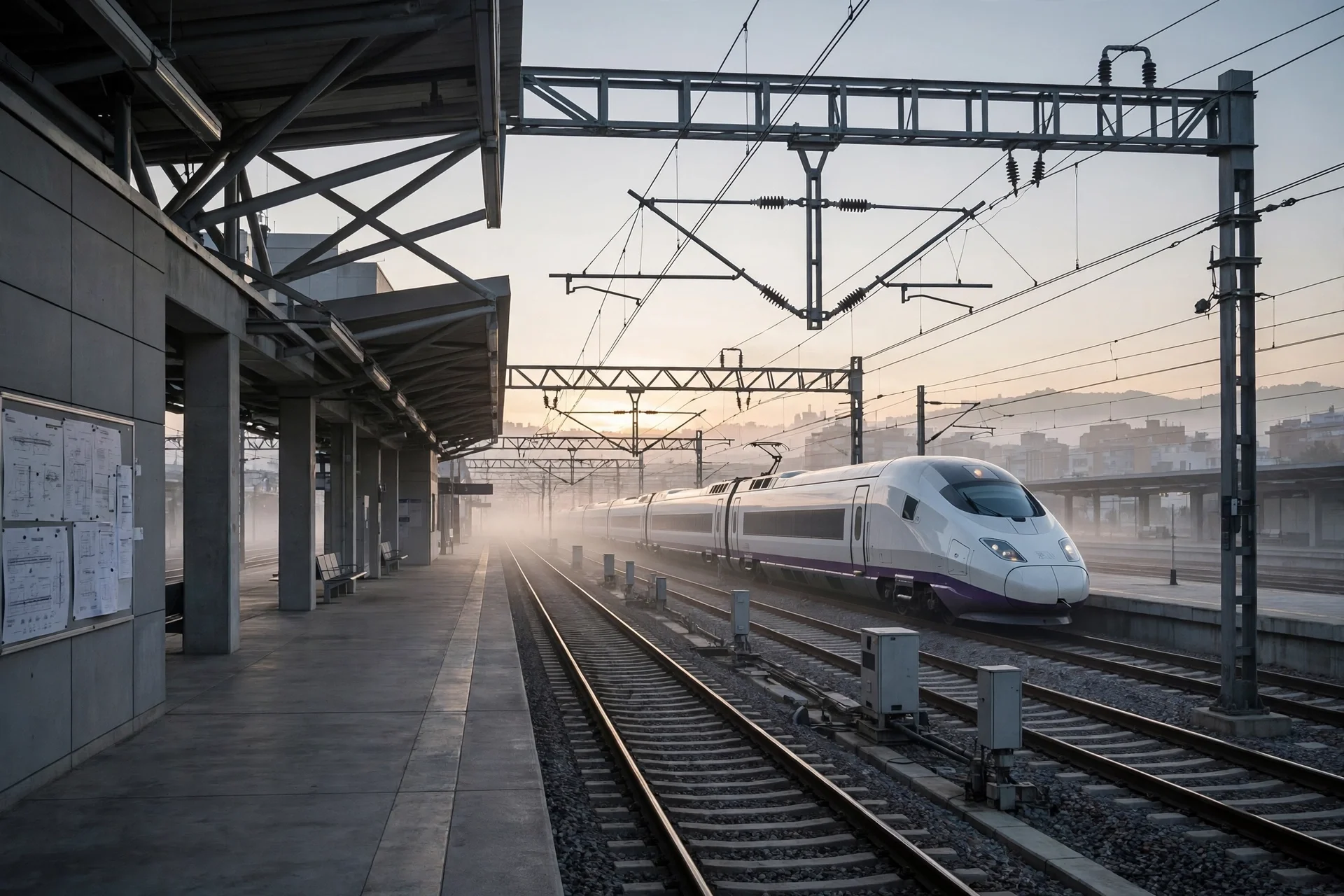
Un tren de alta velocidad en una estación española al amanecer. · Imagen generada para EPM
Montero proposes renationalising railways after the Urda tragedy
After the Urda accident, the second on the high-speed network in a year, Irene Montero proposes renationalising the railway under Article 128 of the…
Rail debate after Urda: investment, liberalisation and Article 128
The Urda accident reopens the clash between those blaming underinvestment and those blaming railway liberalisation since 2021.
--- The context ---
Spain long took pride in its high-speed rail network, but the tragic railway accident in Urda, the second on that network in barely a year, has reopened a fundamental debate about safety, investment and public control. The argument is no longer only about the immediate causes of the crash: it now reaches who maintains the tracks, who controls signalling and who answers when essential services fail under private contracts.
In that debate, maintenance, prevention, control and signalling appear as essential services now outsourced to private companies, a fragmentation which, in the account given, leaves safety responsibility divided among multiple firms primarily seeking to maximise their own benefits.
--- The facts ---
Article 128 of the Constitution recognises public initiative in economic activity and allows, by law, reserving essential resources or services for the public sector, especially in a monopoly, and intervening in companies when the general interest so requires. In 2024, with three operators established, long-distance services carried close to 40 million passengers, 77% more than in 2019, while infrastructure investment fell to 1,764 million euros, its lowest level of the period, and conservation spending per traveller dropped to 8.5 euros.
--- The positions ---
Podemos leader Irene Montero has proposed renationalising the railway through that route, noting that workers and rail unions had warned for years about safety problems derived from liberalisation. In her account, maintenance, prevention, control and signalling services are outsourced: signalling on the affected section depends on Hitachi and Siemens, while ACS, Sacyr, Ferrovial and Acciona carry out maintenance work. Podemos, Compromis and Izquierda Unida blame liberalisation from late 2020 and early 2021, while PP and Vox point to a lack of investment.
--- What remains unknown ---
What remains missing is a complete assessment of each section and of how responsibility is shared today among operators, maintenance companies and the administration when a risk is detected. Ouigo, the low-cost subsidiary of France's SNCF, began operations on 11 May 2021 on the Madrid-Barcelona corridor, and Iryo, majority-owned by Ferrovie dello Stato, joined the same corridor in November 2022. Nor are the long-term results of comparable reversals yet known, which makes careful measurement essential.
--- Unanswered questions ---
What public controls now guarantee that signalling and maintenance put safety ahead of profit? What additional investment would direct public control of the railway require? Can Article 128 be applied to a sector where, as the debate itself acknowledges, there is currently no monopoly situation?
--- EPM analysis ---
The precedent cited is the United Kingdom, which in 2024 announced renationalising its passenger railway within a maximum of five years, as private contracts expired and without paying compensation. The process began on 31 May with Govia Thameslink Railway, whose routes account for 17% of journeys, and the British Executive argued it would save 150 million pounds a year in fees alone. Minister Peter Hendy defended ending the bureaucracy of a fragmented, privatised system.
📌 EPM Take: In EPM's view, the Urda tragedy requires treating the railway as an essential service and not only as a market. The Constitution offers a route, but invoking it demands proving the general interest, assigning responsibility with data and guaranteeing sustained safety investment. If fragmented management dilutes controls, the debate over public control is legitimate and urgent. The answer cannot be limited to promises after an accident: it must become verifiable supervision, sufficient maintenance and a clear parliamentary decision on which model best protects travellers.
--- The context ---
The tragic railway accident in Urda, the second on the high-speed network in barely a year, has revived debate over an infrastructure Spain had always boasted about. The discussion pits two different diagnoses against each other: whether the main failure lies in scarce resources for the network or in the competition model opened a few years ago, and what real room the Constitution offers to change that model.
--- The facts ---
Article 128 recognises public initiative and allows, by law, reserving essential services for the public sector, especially in a monopoly, and intervening in companies when the general interest so requires. That precision matters, because Spain's railway is not currently a monopoly. In 2024 long-distance services carried close to 40 million passengers, 77% more than in 2019, although infrastructure investment fell to 1,764 million euros, the lowest level of the period, and conservation spending per traveller dropped to 8.5 euros.
The competition described brings together Ouigo, the low-cost subsidiary of the French SNCF, and Iryo, majority-owned by Ferrovie dello Stato, both present on the Madrid-Barcelona corridor following the opening of the Spanish railway sector to rivals.
--- The positions ---
PP and Vox point to a lack of investment as the central cause, while Podemos, Compromis and Izquierda Unida blame liberalisation from late 2020 and early 2021. Podemos leader Irene Montero proposes renationalisation under Article 128 and argues workers and unions had warned of safety problems. Signalling on the affected section depends on Hitachi and Siemens, and ACS, Sacyr, Ferrovial and Acciona take part in maintenance and prevention, a contracting scheme that demands rigorous oversight, not necessarily public ownership of the whole system.
--- What remains unknown ---
Ouigo began operations on 11 May 2021 on the Madrid-Barcelona corridor and Iryo joined the same corridor in November 2022, expanding the offer with three operators on the main routes. What exactly failed in Urda, what prior reports existed on the section and whether available investment was spent effectively all remain to be clarified. Without that verified chain of facts, blaming a single management model risks turning a tragedy into a slogan.
--- Unanswered questions ---
Do the data prove that competition, rather than investment management, caused the alleged deterioration? What would renationalising current contracts cost and under what legal guarantees would it be done? Would safety improve simply by changing ownership, without reforming oversight and investment?
--- EPM analysis ---
The reference cited is the United Kingdom, which in 2024 announced renationalising its passenger railway within a maximum of five years, without compensation, starting on 31 May with Govia Thameslink Railway, with 17% of journeys. The British Executive estimated savings of 150 million pounds a year and Minister Peter Hendy spoke of removing bureaucracy. Yet the account itself warns that the long-term results of that turn, after the liberalisation of the nineties, are still unknown.
📌 EPM Take: In EPM's view, the priority after Urda must be establishing causes, auditing investment and demanding concrete accountability before reordering the entire sector on impulse. Article 128 exists, but using it requires a law, a proven general interest and respect for the conditions the text itself sets. Competition brought more travellers and more services; preserving those gains requires fixing oversight failures without creating unnecessary uncertainty. Safety, executed investment and transparency should prevail over ideological debate.
Montero propone renacionalizar el ferrocarril tras la tragedia de Urda
Tras el accidente de Urda, el segundo en alta velocidad en un año, Irene Montero propone renacionalizar el ferrocarril mediante el artículo 128 de la…
El debate ferroviario tras Urda: inversión, liberalización y artículo 128
El accidente de Urda reabre el choque entre quienes culpan a la falta de inversión y quienes culpan a la liberalización ferroviaria desde 2021.
--- El contexto ---
España ha presumido durante décadas de su red de alta velocidad, pero el accidente ferroviario en Urda, el segundo en esa red en apenas un año, ha reabierto el debate sobre seguridad, inversión y modelo de gestión. La discusión alcanza a quién mantiene las vías, quién controla la señalización y quién responde cuando fallan servicios esenciales.
En ese debate, el mantenimiento, la prevención, el control y la señalización aparecen como servicios esenciales hoy externalizados, una fragmentación que, según lo planteado, deja la seguridad repartida entre múltiples empresas privadas con lógicas de beneficio.
--- Los hechos ---
El artículo 128 reconoce la iniciativa pública y permite, mediante ley, reservar al sector público recursos o servicios esenciales, especialmente en caso de monopolio, y acordar la intervención de empresas cuando lo exija el interés general. En 2024, con tres operadores asentados, la larga distancia transportó cerca de 40 millones de pasajeros, un 77% más que en 2019, mientras la inversión en infraestructura cayó a 1.764 millones de euros, su nivel más bajo del período, y el gasto en conservación por viajero bajó a 8,5 euros.
--- Las posiciones ---
La líder de Podemos, Irene Montero, ha propuesto renacionalizar el ferrocarril por esa vía y ha señalado que trabajadores y sindicatos llevaban años advirtiendo de problemas de seguridad derivados de la liberalización. Según su planteamiento, servicios de mantenimiento, prevención, control y señalización están externalizados: la señalización del tramo afectado depende de Hitachi y Siemens, y ACS, Sacyr, Ferrovial y Acciona realizan tareas de mantenimiento. Podemos, Compromís e Izquierda Unida atribuyen el deterioro a la liberalización iniciada a finales de 2020 e inicios de 2021, mientras PP y Vox apuntan a la falta de inversión.
--- Lo que falta saber ---
Falta una evaluación completa del estado de cada tramo. Ouigo, filial de bajo coste de la francesa SNCF, inició operaciones el 11 de mayo de 2021 en el corredor Madrid-Barcelona, e Iryo, participada mayoritariamente por Ferrovie dello Stato, se sumó en noviembre de 2022 al mismo corredor. Falta precisar cómo se reparten hoy responsabilidades entre operadores, empresas de mantenimiento y administración cuando se detecta un riesgo.
--- Preguntas sin respuesta ---
¿Qué controles públicos garantizan hoy que la señalización y el mantenimiento priorizan la seguridad sobre el beneficio? ¿Qué inversión adicional exigiría recuperar un control público directo del ferrocarril? ¿Puede aplicarse el artículo 128 a un sector donde, como reconoce el propio debate, no existe hoy una situación de monopolio?
--- Análisis EPM ---
El precedente citado es el Reino Unido, que en 2024 anunció renacionalizar su ferrocarril de viajeros en un máximo de cinco años, al expirar los contratos y sin abonar indemnizaciones. Comenzó el 31 de mayo con Govia Thameslink Railway, cuyas rutas concentran el 17% de los desplazamientos, y el Ejecutivo británico sostuvo que ahorraría 150 millones de libras al año en comisiones. El ministro Peter Hendy defendió eliminar la burocracia de un sistema fragmentado.
📌 Conclusion EPM: A juicio de EPM, la tragedia de Urda obliga a discutir el ferrocarril como servicio esencial y no solo como mercado. La Constitución ofrece una vía, pero invocarla exige demostrar interés general, repartir responsabilidades con datos y garantizar inversión sostenida en seguridad. Si la gestión fragmentada diluye controles, el debate sobre el control público es legítimo y urgente. La respuesta no puede limitarse a promesas tras un accidente: debe traducirse en supervisión verificable, mantenimiento suficiente y una decisión parlamentaria clara sobre qué modelo protege mejor a los viajeros.
--- El contexto ---
El accidente ferroviario en Urda, el segundo en la red de alta velocidad en apenas un año, ha reavivado el debate sobre una infraestructura de la que España siempre había presumido. La discusión enfrenta dos diagnósticos: si el fallo está en la escasez de recursos o en el modelo de competencia abierto hace pocos años, y qué margen real ofrece la Constitución para cambiarlo.
--- Los hechos ---
El artículo 128 reconoce la iniciativa pública y permite, mediante ley, reservar al sector público servicios esenciales, especialmente en caso de monopolio, y acordar la intervención de empresas cuando lo exija el interés general. Esa precisión importa, porque en el ferrocarril español no se da hoy una situación de monopolio. En 2024 la larga distancia transportó cerca de 40 millones de pasajeros, un 77% más que en 2019, aunque la inversión en infraestructura cayó a 1.764 millones de euros, el nivel más bajo del período, y el gasto en conservación por viajero descendió a 8,5 euros.
La competencia descrita reúne a Ouigo, filial de bajo coste de la francesa SNCF, y a Iryo, participada mayoritariamente por Ferrovie dello Stato, ambas presentes en el corredor Madrid-Barcelona tras la apertura del sector ferroviario español.
--- Las posiciones ---
PP y Vox apuntan a la falta de inversión, mientras Podemos, Compromís e Izquierda Unida lo achacan a la liberalización desde finales de 2020 e inicios de 2021. La líder de Podemos, Irene Montero, propone renacionalizar por el artículo 128 y sostiene que trabajadores y sindicatos advertían de problemas de seguridad. La señalización del tramo afectado depende de Hitachi y Siemens, y ACS, Sacyr, Ferrovial y Acciona participan en mantenimiento y prevención, un esquema que exige control riguroso, no titularidad pública.
--- Lo que falta saber ---
Ouigo inició operaciones el 11 de mayo de 2021 en el corredor Madrid-Barcelona e Iryo se sumó en noviembre de 2022, ampliando la oferta con tres operadores. Queda por aclarar qué falló en Urda, qué informes previos existían sobre el tramo y si la inversión disponible se ejecutó con eficacia. Sin esa cadena verificada, atribuir el accidente a un modelo corre el riesgo de convertir una tragedia en consigna.
--- Preguntas sin respuesta ---
¿Demuestran los datos que la competencia, y no la gestión de la inversión, causó el deterioro denunciado? ¿Qué coste tendría renacionalizar contratos vigentes y con qué garantías jurídicas se haría? ¿Mejoraría la seguridad por el solo hecho de cambiar la titularidad, sin reformar controles e inversión?
--- Análisis EPM ---
Como referencia se cita al Reino Unido, que en 2024 anunció renacionalizar el ferrocarril de viajeros en un máximo de cinco años, sin indemnizaciones, empezando el 31 de mayo por Govia Thameslink Railway, con el 17% de los desplazamientos. El Ejecutivo británico estimó un ahorro de 150 millones de libras al año y el ministro Peter Hendy habló de eliminar burocracia. Sin embargo, aún faltan los resultados a largo plazo de aquel giro tras la liberalización de los años noventa.
📌 Conclusion EPM: A juicio de EPM, la prioridad tras Urda debe ser esclarecer causas, auditar inversión y exigir responsabilidades concretas antes que reordenar todo el sector por impulso. El artículo 128 existe, pero su uso exige ley, interés general acreditado y respeto a las condiciones que el propio texto establece. La competencia trajo más viajeros y más oferta; preservar esos avances exige corregir fallos de control sin crear incertidumbre innecesaria. Seguridad, inversión ejecutada y transparencia deben mandar sobre el debate ideológico.