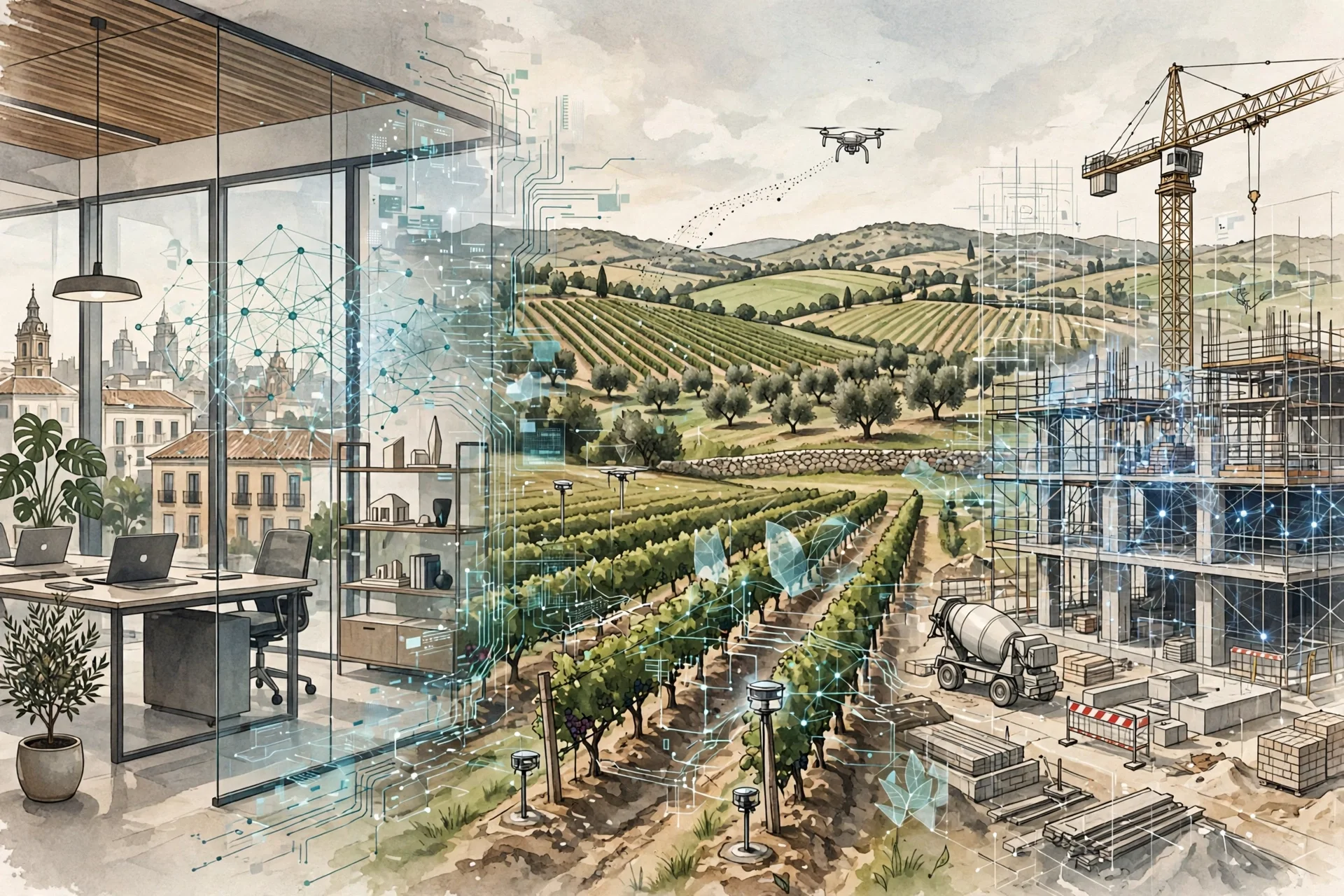
Oficina, agricultura y construcción comparten la adopción de la inteligencia artificial en España. · Imagen generada por EPM
AI spreads in Spain without cutting workforces
A Bank of Spain study based on its business survey for the first quarter of 2026 shows that close to 89% of companies report no major headcount changes from…
Spanish firms adopt AI without destroying jobs
The Bank of Spain concludes that artificial intelligence is advancing in Spanish companies without generalized job destruction, with close to 89% of firms…
--- The context ---
Artificial intelligence is making its way into Spanish companies without, for the moment, translating into a generalized destruction of jobs, according to a study prepared by the Bank of Spain from its Business Activity Survey for the first quarter of 2026 and from company balance sheet information. The analysis portrays a technological transformation advancing at different speeds, with uneven implementation across sectors and company sizes, and with effects on headcounts that remain limited so far, even though an important share of companies already perceives improvements in productivity and investment.
Sectors such as agriculture and construction, which started from lower adoption levels, have accelerated their incorporation, while information and communications activities continue to lead the use of these tools across the Spanish business fabric as a whole.
--- The facts ---
Close to 89% of the companies surveyed say that introducing these tools has not had major effects on employment over the last three years. Among the companies that have experienced changes, the shares that reduced their headcounts and that increased them stand at around 6% in both cases, without the results reflecting a generalized tendency to replace workers with artificial intelligence systems, at least during the period analyzed by the Bank of Spain in this study.
The impact is more noticeable among companies that use these tools intensively. Among those declaring a high use of generative artificial intelligence, around 13% have increased their number of employees, while close to 10% have reduced their headcounts. In companies using these tools moderately, the share that increased employment stands around 8.5%, compared with approximately 7% that decreased it, according to the business survey data cited throughout the study prepared by the central bank.
In agriculture and construction, the use of predictive or generative artificial intelligence technologies already reaches almost 30% of companies, close to 20 percentage points more than in 2024. Growth is concentrated especially in generative artificial intelligence, which has eased access to tools capable of producing texts, analyzing information or helping to solve tasks from instructions in natural language. Information and communications companies continue to lead adoption, since almost 60% use predictive or generative artificial intelligence, compared with close to 40% recorded two years earlier, followed by professional and scientific activities, with around half of companies using them.
The main motivations declared are linked to improving the quality and reliability of processes, as well as to automating certain tasks. For predictive artificial intelligence, 32.5% of the companies using it point to improving quality or reliability as one of the reasons for adopting it, and for generative artificial intelligence that share stands at 30.7%. Automating tasks previously performed by workers appears at 21.5% for predictive and 27% for generative, while improving production processes that were already automated was mentioned by 25.2% and 20.9%, respectively.
--- The positions ---
The Bank of Spain cautions, in its reading of the data, that the report distinguishes between the effects observed so far and expectations for the coming years, and it notes that the transformation of the labor market could intensify as companies move from experimenting with these tools to integrating them more deeply into their production and organization processes.
Companies that do not yet use these technologies point to resource constraints as the main obstacle, at 61%, a category that includes both implementation costs and the lack of qualified staff. Next come the perception that the technology is not useful for the company's activity, at 18%, technical difficulties, at 11%, and regulatory or ethical concerns, at 8%. The document estimates that approximately 70% of the companies surveyed have not yet adopted artificial intelligence tools of any kind.
--- What remains unknown ---
The report does not detail which specific applications each agricultural or construction company uses, so it does not allow the growth recorded in those sectors to be attributed to specific tools or processes. Nor does it yet allow anyone to know whether the limited effects on headcounts will hold when the integration of these technologies into production and organization processes becomes deeper, a possibility the study itself leaves open by separating what has been observed so far from expectations for the coming years.
How the composition of employment will evolve also remains to be seen. Over the next three years, 44% of large companies anticipate a reduction in positions linked to repetitive or routine tasks, and close to 20% foresee an increase in occupations with a greater analytical content. Among smaller companies, the outlook is more conservative, because 83% expect no changes in jobs associated with repetitive tasks, and management positions would, overall, be the least affected by the incorporation of these technologies.
--- Unanswered questions ---
Will headcount stability hold when companies integrate artificial intelligence more deeply into their processes? Will smaller companies be able to close the adoption gap with large firms if the resource constraints cited by 61% of non-users persist? Will the business fabric manage to resolve the shortage of qualified staff, which around half of companies identify as an obstacle and which exceeds 55% in industry and energy, transport and agriculture?
--- EPM analysis ---
Read together, the data show a technological diffusion that no longer concentrates only in the most digitized sectors, even though the gap between branches has widened instead of closing. That agriculture and construction reach almost 30% after starting from low levels indicates that generative artificial intelligence has lowered the entry barrier by easing access to tools that work with natural language. At the same time, the fact that approximately 70% of companies have not yet adopted these tools defines the real size of the change observed so far.
Future plans reinforce that distance between sizes. Over the next three years, 79% of large companies plan to strengthen the training of their workers and 62% contemplate hiring more specialized staff, compared with 35% and 17% among smaller companies, respectively.
📌 EPM Take:
In EPM's view, the most valuable finding is that artificial intelligence is reaching sectors that started behind, such as agriculture and construction, without so far producing a generalized destruction of jobs in Spain. That combination of wider diffusion and stable headcounts opens a real opportunity if training keeps pace with the change, because the shortage of qualified staff already holds back around half of companies and the gap between large firms and smaller businesses could keep growing over the next three years unless sustained investment and training correct it in time. The evidence available today does not justify stronger conclusions in either direction.
--- The context ---
A study by the Bank of Spain, prepared from its Business Activity Survey for the first quarter of 2026 and from company balance sheet information, concludes that artificial intelligence is making its way into Spanish companies without, for the moment, translating into a generalized destruction of jobs. The document describes a transformation advancing at different speeds, with uneven implementation between sectors and between small and medium-sized companies and large firms, and with effects on headcounts that remain limited during the period analyzed by the researchers.
Context matters because the public debate has been marked by fear that task automation would replace workers. The available data do not confirm that scenario for now, but neither do they describe complete adoption, since an important share of companies perceives improvements in productivity and investment while most of the business fabric still does not use these tools.
--- The facts ---
Close to 89% of the companies surveyed say that introducing these tools has not had major effects on employment over the last three years. Among the companies that have experienced changes, the shares that reduced their headcounts and that increased them stand at around 6% in both cases. In other words, according to the study, the results do not reflect a generalized tendency to replace workers with artificial intelligence systems, at least during the period analyzed.
Where the impact is most noticeable is among companies that use these tools intensively. Among those declaring a high use of generative artificial intelligence, around 13% have increased their number of employees, while close to 10% have reduced their headcounts. In companies with moderate use, the share that increased employment stands around 8.5%, compared with approximately 7% that decreased it.
In agriculture and construction, two sectors that have traditionally ranked among the most laggard in adopting these tools, the use of predictive or generative artificial intelligence already reaches almost 30% of companies, close to 20 percentage points more than in 2024, with growth concentrated especially in generative tools. Information and communications companies continue to lead adoption, since almost 60% use predictive or generative artificial intelligence, compared with close to 40% recorded two years earlier, and professional and scientific activities follow, with around half of companies using them.
The motivations declared by companies focus on improving the quality and reliability of processes and on automating certain tasks. Among users of predictive artificial intelligence, 32.5% point to improving quality or reliability, a share that stands at 30.7% for generative artificial intelligence. Automating tasks previously performed by workers reaches 21.5% for predictive and 27% for generative, while improving production processes that were already automated was mentioned by 25.2% and 20.9%, respectively, and goals such as reducing costs carry a relatively smaller weight overall.
--- The positions ---
The Bank of Spain maintains in the study that the transformation of the labor market could intensify as companies move from experimenting with these tools to integrating them more deeply into their production and organization processes. It also notes that progress has not managed to eliminate differences between sectors and that the gap has widened, because the branches that already started from a higher technological implementation have continued advancing with more intensity than the rest of the economy covered by the survey.
On the side of companies that do not yet use these technologies, the main obstacle declared is resource constraints, cited by 61%, a category that includes both implementation costs and the lack of qualified staff. It is followed by the perception that the technology is not useful for the company's activity, at 18%, technical difficulties, at 11%, and regulatory or ethical concerns, at 8%. The document estimates that approximately 70% of the companies surveyed have not yet adopted artificial intelligence tools.
--- What remains unknown ---
The report does not detail which specific applications each agricultural or construction company uses, so it does not allow the growth of those sectors to be attributed to specific tools or processes.
How the composition of employment will change over the next three years also remains to be proven. Among large companies, 44% anticipate a reduction in positions linked to repetitive or routine tasks, and close to 20% foresee an increase in occupations with a greater analytical content. Among smaller companies, 83% expect no changes in jobs associated with repetitive tasks, and management positions would, overall, be the least affected. Those expectations are not yet observed facts, and the study presents them as forecasts from the surveyed companies themselves.
--- Unanswered questions ---
Will the effects on employment change when the integration of artificial intelligence into processes becomes deeper than current experimentation? Which specific applications are agricultural and construction companies really using that explain their advance to almost 30%? Will companies be able to overcome resource constraints and the shortage of qualified staff, which exceeds 55% as an obstacle in industry and energy, transport and agriculture, without further widening the gaps between sectors and sizes?
--- EPM analysis ---
The study allows the change to be sized without exaggerating it. Adoption is growing even in laggard sectors, and generative artificial intelligence has eased access to tools capable of producing texts, analyzing information or helping to solve tasks with instructions in natural language. Even so, the lack of workers with the necessary training remains a prominent problem, identified by around half of companies as an obstacle, and the declared barriers have lost weight compared with 2024 without disappearing from the business landscape described by the survey data.
The differences in plans between large companies and smaller firms anticipate the main risk of internal inequality. Over the next three years, 79% of large companies plan to strengthen the training of their workers and 62% contemplate hiring more specialized staff, compared with 35% and 17% among smaller companies, respectively.
📌 EPM Take:
In EPM's view, prudence is warranted when reading these data, because stable headcounts coexist with still minority adoption, given that approximately 70% of companies have not yet incorporated artificial intelligence. The study supports neither alarmism about mass job destruction nor complacency, since the Bank of Spain itself separates what has been observed from what may happen when integration becomes deeper, and shortages of qualified staff and resources will keep conditioning the real pace of change across Spanish business in the coming years ahead. The evidence available today simply does not justify stronger conclusions in either direction at this stage.
La IA avanza en España sin recortar plantillas
Un estudio del Banco de España basado en su encuesta empresarial del primer trimestre de 2026 muestra que cerca del 89% de las empresas no registra grandes…
Empresas españolas adoptan IA sin destruir empleo
El Banco de España concluye que la inteligencia artificial avanza en las empresas españolas sin destrucción generalizada de empleo, con cerca del 89% de…
--- El contexto ---
La inteligencia artificial se está abriendo paso en las empresas españolas sin que, por el momento, se traduzca en una destrucción generalizada de puestos de trabajo, según el estudio elaborado por el Banco de España a partir de la Encuesta sobre la Actividad Empresarial del primer trimestre de 2026 y de información de balances empresariales.
Frente a ese temor, los datos recogidos apuntan a un impacto todavía limitado sobre el empleo y a una utilización que se extiende más allá de las actividades tradicionalmente vinculadas a la tecnología.
--- Los hechos ---
Cerca del 89% de las compañías encuestadas asegura que la introducción de estas herramientas no ha tenido grandes efectos sobre el empleo durante los últimos tres años. Entre las empresas que sí han experimentado cambios, las proporciones de las que han reducido sus plantillas y de las que las han aumentado se sitúan en torno al 6% en ambos casos, sin que los resultados reflejen una tendencia generalizada a sustituir trabajadores por sistemas de inteligencia artificial, al menos en el periodo analizado por el Banco de España.
El impacto es más perceptible entre las compañías que emplean estas herramientas de forma intensiva. En aquellas que declaran un uso elevado de la inteligencia artificial generativa, alrededor del 13% ha aumentado su número de empleados, mientras que cerca del 10% ha reducido sus plantillas. En las empresas que utilizan estas herramientas de manera moderada, la proporción que ha incrementado el empleo ronda el 8,5%, frente a aproximadamente el 7% que lo ha disminuido, según los datos de la encuesta empresarial citada en el estudio.
En agricultura y construcción, el uso de tecnologías de inteligencia artificial predictiva o generativa alcanza ya casi el 30% de las empresas, cerca de 20 puntos porcentuales más que en 2024. Las empresas de información y comunicaciones continúan encabezando la adopción, ya que casi el 60% utiliza inteligencia artificial predictiva o generativa, frente a cerca del 40% registrado dos años antes, y después figuran las actividades profesionales y científicas, con alrededor de la mitad de las empresas usuarias.
Las principales motivaciones declaradas están relacionadas con la mejora de la calidad y la fiabilidad de los procesos, así como con la automatización de determinadas tareas. En la inteligencia artificial predictiva, el 32,5% de las empresas que la usan señala la mejora de la calidad o fiabilidad como uno de los motivos para adoptarla, y en la generativa ese porcentaje se sitúa en el 30,7%. La automatización de tareas que antes realizaban los trabajadores aparece con un 21,5% en la predictiva y un 27% en la generativa, y la mejora de procesos productivos ya automatizados fue mencionada por el 25,2% y el 20,9%, respectivamente.
--- Las posiciones ---
El Banco de España advierte, en su lectura de los datos, que el informe distingue entre los efectos observados hasta ahora y las expectativas para los próximos años, y señala que la transformación del mercado laboral podría intensificarse a medida que las empresas pasen de experimentar con estas herramientas a integrarlas de manera más profunda en sus procesos de producción y organización.
Las empresas que no utilizan todavía estas tecnologías señalan como principal obstáculo las restricciones de recursos, con un 61%, categoría que incluye tanto los costes de implantación como la falta de personal cualificado. A continuación aparecen la percepción de que la tecnología no resulta útil para la actividad de la empresa, con un 18%, las dificultades técnicas, con un 11%, y las preocupaciones regulatorias o éticas, con un 8%. El documento calcula que aproximadamente el 70% de las empresas encuestadas no ha adoptado todavía herramientas de inteligencia artificial.
--- Lo que falta saber ---
El informe no detalla qué aplicaciones concretas utiliza cada compañía agrícola o constructora, por lo que no permite atribuir el crecimiento registrado en esos sectores a herramientas o procesos específicos.
También queda por ver cómo evolucionará la composición del empleo. De cara a los próximos tres años, el 44% de las grandes empresas anticipa una reducción de los puestos vinculados a tareas repetitivas o rutinarias, y cerca del 20% prevé un aumento de las ocupaciones con un mayor contenido analítico. Entre las pymes, la perspectiva es más conservadora, porque el 83% no espera cambios en los empleos asociados a tareas repetitivas, y los puestos directivos serían, en conjunto, los menos afectados por la incorporación de estas tecnologías.
--- Preguntas sin respuesta ---
¿Se mantendrá la estabilidad de las plantillas cuando las empresas integren la inteligencia artificial de forma más profunda en sus procesos? ¿Podrán las pymes cerrar la brecha de adopción frente a las grandes compañías si persisten las restricciones de recursos señaladas por el 61% de las no usuarias? ¿Conseguirá el tejido empresarial resolver la falta de personal cualificado, que alrededor de la mitad de las empresas identifica como obstáculo y que supera el 55% en industria y energía, transporte y agricultura?
--- Análisis EPM ---
La lectura conjunta de los datos muestra una difusión tecnológica que ya no se concentra solo en los sectores más digitalizados, aunque la brecha entre ramas se ha ampliado en lugar de cerrarse. Al mismo tiempo, que aproximadamente el 70% de las empresas aún no haya adoptado estas herramientas delimita el tamaño real del cambio observado hasta ahora.
Los planes de futuro refuerzan esa distancia entre tamaños. Durante los próximos tres años, el 79% de las grandes empresas prevé reforzar la formación de sus trabajadores y el 62% contempla contratar personal más especializado, frente al 35% y al 17% de las pymes, respectivamente.
📌 Conclusion EPM:
A juicio de EPM, el dato más valioso del estudio es que la inteligencia artificial está llegando también a sectores que partían rezagados, como la agricultura y la construcción, sin que por ahora se traduzca en una destrucción generalizada de empleo en España. Esa combinación de difusión amplia y plantillas estables abre una oportunidad real si la formación acompaña el cambio, porque la falta de personal cualificado ya frena a alrededor de la mitad de las empresas y la brecha entre grandes compañías y pymes puede seguir creciendo durante los próximos tres años si no se corrige con inversión y capacitación sostenidas.
--- El contexto ---
Un estudio del Banco de España, elaborado a partir de la Encuesta sobre la Actividad Empresarial del primer trimestre de 2026 y de información de balances empresariales, concluye que la inteligencia artificial se está abriendo paso en las empresas españolas sin que, por el momento, se traduzca en una destrucción generalizada de puestos de trabajo. El documento describe una transformación que avanza a distintas velocidades, con una implantación desigual entre sectores y entre pequeñas y medianas empresas y grandes compañías, y con efectos sobre las plantillas todavía reducidos en el periodo analizado.
--- Los hechos ---
Cerca del 89% de las compañías encuestadas asegura que la introducción de estas herramientas no ha tenido grandes efectos sobre el empleo durante los últimos tres años. Entre las empresas que sí han experimentado cambios, las proporciones de las que han reducido sus plantillas y de las que las han aumentado se sitúan en torno al 6% en ambos casos. Es decir, según el estudio, los resultados no reflejan una tendencia generalizada a sustituir trabajadores por sistemas de inteligencia artificial, al menos en el periodo analizado.
Donde el impacto resulta más perceptible es entre las compañías que emplean estas herramientas de forma intensiva. En las que declaran un uso elevado de la inteligencia artificial generativa, alrededor del 13% ha aumentado su número de empleados, mientras que cerca del 10% ha reducido sus plantillas. En las empresas con un uso moderado, la proporción que ha incrementado el empleo ronda el 8,5%, frente a aproximadamente el 7% que lo ha disminuido.
En agricultura y construcción, dos sectores que tradicionalmente se han situado entre los más rezagados en la adopción de estas herramientas, el uso de inteligencia artificial predictiva o generativa alcanza ya casi el 30% de las empresas, cerca de 20 puntos porcentuales más que en 2024, con un crecimiento concentrado especialmente en la generativa. Las empresas de información y comunicaciones continúan encabezando la adopción, ya que casi el 60% utiliza inteligencia artificial predictiva o generativa, frente a cerca del 40% registrado dos años antes, y las actividades profesionales y científicas figuran después, con alrededor de la mitad de las empresas usuarias.
Las motivaciones declaradas por las empresas se centran en mejorar la calidad y la fiabilidad de los procesos y en automatizar determinadas tareas. El 32,5% de las usuarias de inteligencia artificial predictiva señala la mejora de la calidad o fiabilidad, porcentaje que en la generativa se sitúa en el 30,7%. La automatización de tareas que antes realizaban los trabajadores alcanza un 21,5% en la predictiva y un 27% en la generativa, mientras la mejora de procesos productivos ya automatizados fue mencionada por el 25,2% y el 20,9%, respectivamente, y objetivos como reducir los costes tienen un peso relativamente menor.
--- Las posiciones ---
El Banco de España sostiene en el estudio que la transformación del mercado laboral podría intensificarse a medida que las empresas pasen de experimentar con estas herramientas a integrarlas de manera más profunda en sus procesos de producción y organización. También señala que el avance no ha conseguido eliminar las diferencias entre sectores y que la brecha se ha ampliado, debido a que las ramas que ya partían de una mayor implantación tecnológica han seguido avanzando con más intensidad que el resto.
Por el lado de las empresas que aún no utilizan estas tecnologías, el principal obstáculo declarado son las restricciones de recursos, señaladas por el 61%, categoría que incluye tanto los costes de implantación como la falta de personal cualificado. Le siguen la percepción de que la tecnología no resulta útil para la actividad de la empresa, con un 18%, las dificultades técnicas, con un 11%, y las preocupaciones regulatorias o éticas, con un 8%. El documento calcula que aproximadamente el 70% de las empresas encuestadas no ha adoptado todavía herramientas de inteligencia artificial.
--- Lo que falta saber ---
El informe no detalla qué aplicaciones concretas utiliza cada compañía agrícola o constructora, por lo que no permite atribuir el crecimiento de esos sectores a herramientas o procesos específicos.
También falta por comprobar cómo cambiará la composición del empleo en los próximos tres años. El 44% de las grandes empresas anticipa una reducción de los puestos vinculados a tareas repetitivas o rutinarias, y cerca del 20% prevé un aumento de las ocupaciones con un mayor contenido analítico. Entre las pymes, el 83% no espera cambios en los empleos asociados a tareas repetitivas, y los puestos directivos serían, en conjunto, los menos afectados.
--- Preguntas sin respuesta ---
¿Cambiarán los efectos sobre el empleo cuando la integración de la inteligencia artificial en los procesos sea más profunda que la experimentación actual? ¿Qué aplicaciones concretas están usando realmente las empresas agrícolas y constructoras que explican su avance hasta casi el 30%? ¿Podrán las empresas superar las restricciones de recursos y la falta de personal cualificado, que supera el 55% como obstáculo en industria y energía, transporte y agricultura, sin ampliar aún más la brecha entre sectores y tamaños?
--- Análisis EPM ---
El estudio permite dimensionar el cambio sin exagerarlo. La adopción crece incluso en sectores rezagados y la inteligencia artificial generativa ha facilitado el acceso a herramientas capaces de producir textos, analizar información o ayudar a resolver tareas con instrucciones en lenguaje natural. Sin embargo, la falta de trabajadores con la formación necesaria continúa siendo un problema destacado, identificado por alrededor de la mitad de las empresas como obstáculo, y las barreras declaradas han perdido peso respecto a 2024 sin desaparecer del panorama empresarial.
Las diferencias de planes entre grandes empresas y pymes anticipan el principal riesgo de desigualdad interna. Durante los próximos tres años, el 79% de las grandes empresas prevé reforzar la formación de sus trabajadores y el 62% contempla contratar personal más especializado, frente al 35% y al 17% de las pymes, respectivamente.
📌 Conclusion EPM:
A juicio de EPM, la prudencia manda al leer estos datos, porque la estabilidad de las plantillas convive con una adopción todavía minoritaria, dado que aproximadamente el 70% de las empresas no ha incorporado aún la inteligencia artificial. El estudio no avala ni el alarmismo sobre una destrucción masiva de empleo ni la complacencia, ya que el propio Banco de España separa lo observado de lo que puede ocurrir cuando la integración sea más profunda, y la falta de personal cualificado y de recursos seguirá condicionando el ritmo real del cambio empresarial español. Los datos disponibles hoy no justifican conclusiones más fuertes en ninguna de las dos direcciones.