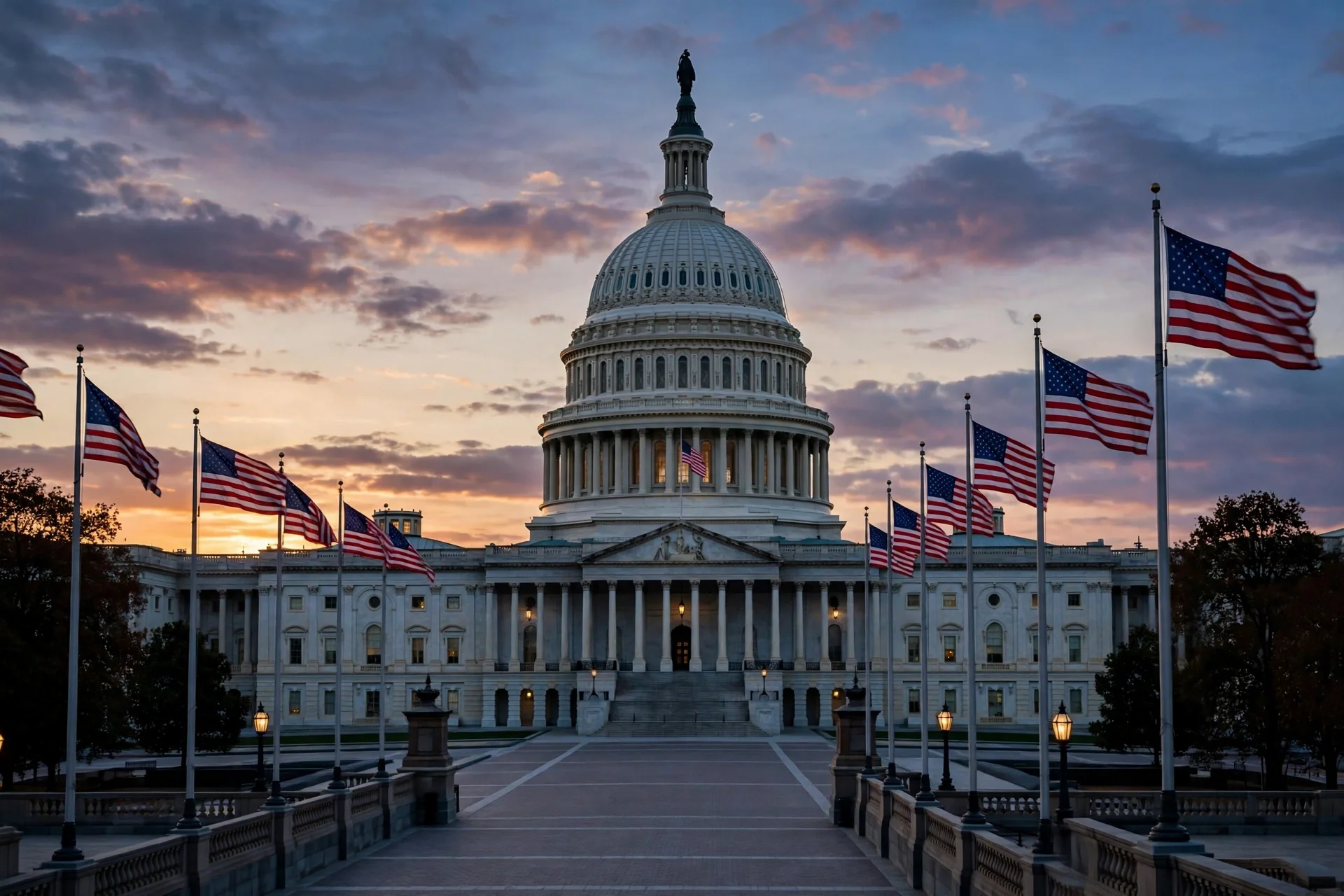
El Capitolio en Washington al atardecer, en la víspera de las elecciones de medio término. · Imagen generada para EPM
Milei builds bridges in Washington ahead of a possible Republican defeat
The Argentine government sent three officials to Washington and is preparing broader contacts ahead of a possible Republican defeat in the United States…
Buenos Aires trusts financial backing will survive the midterm vote
Ahead of a possible Republican defeat in the midterm elections, the presidential palace sent officials and lawmakers to Washington, argues that United States…
--- The context ---
President Javier Milei has maintained unconditional support for Donald Trump and built close alignment with his administration since the start of his government, according to the account provided. Even so, different sectors of the Argentine ruling coalition are already preparing for an adverse result for the Republican Party in the midterm elections being held this Tuesday in the United States.
That scenario, as described, could affect the international political narrative of the ruling coalition and raise the cost of future financial assistance for Argentina. Preparation, in this case, does not mean waiting for the count in Buenos Aires: it means being present in Washington, speaking with the private sector and opening broader institutional bridges for the day after the vote.
--- The facts ---
With that goal, the government sent to Washington the undersecretary for institutional management, Eduardo “Lule” Menem, deputy cabinet chief Ignacio Devitt, and the undersecretary for legal and technical affairs of the presidency, Ignacio María De la Riva. The three arrived over the weekend and began a round of meetings with business leaders, institutional figures and authorities linked to the United States electoral process.
On Monday, according to the account, the envoys met representatives of the United States Chamber of Commerce, described as the country leading business lobbying group, and members of the Federal Election Commission, the body in charge of regulating federal campaigns and elections. Their mission is twofold: to talk with investors about the future of the bilateral relationship and development projects in Argentina, and to report in real time to the presidential palace on how the vote evolves.
--- The positions ---
At the presidential palace, officials acknowledge that a Republican defeat would be a political blow to the alignment strategy the president built with Washington, according to the account. They trust, however, that the bilateral relationship and especially financial backing will not change substantially, because no financing Argentina has had or will have from the United States depends on Congress, as explained by a member of the leadership that handles relations with the White House.
That statement seeks to clear doubts about the continuity of the assistance provided before the legislative elections of 2025, when a currency swap was agreed and direct participation in the foreign exchange market was recorded, including support that markets closely followed at the time. A delegation of Argentine lawmakers also traveled, among them Karina Banfi, Alberto Benegas Lynch, Gabriel Bornoroni, Sebastián Galmarini, Nicolás Mayoraz, Santiago Santurio and Sabrina Selva, alongside Diógenes González, Pamela Verasay and Lisandro Nieri.
--- What remains unknown ---
It is still unknown whether the Argentine envoys will actually hold meetings with Democratic Party leaders, because according to the account those encounters had not yet taken place. It is also unclear how much a broader opposition majority could narrow the future room to repeat mechanisms similar to the swap, or how markets will react if uncertainty in the United States grows after the result this Tuesday becomes known.
--- Unanswered questions ---
Will the meetings with Democratic leaders that have not yet happened finally take place? How much would a Republican defeat raise the political cost of new financial assistance for Argentina? Can the presidential palace sustain Washington backing if the balance of power in Congress changes?
--- EPM analysis ---
The underlying reading is that the government distinguishes between the political plane and the financial plane. On the first, alignment with Trump would be exposed to a more adverse Congress, because these elections renew the entire House of Representatives and one third of the Senate, which could change the room the United States president has to sustain his domestic and foreign agenda in the coming period.
On the financial plane, by contrast, the official bet is that decisions by the Treasury and the White House do not by themselves depend on Congress. Bills such as the No Argentina Bailout Act and the American Farmers First Act remain under discussion and none would by itself prevent such a decision, although they could narrow the margins. The main risk the government identifies lies in markets, international rates and a country risk that closed October near 800 basis points.
📌 EPM Take: In EPM's view, building bridges before the result is known is the most sensible part of the strategy, because it recognizes that the alliance with Washington cannot depend on a single election or a single political force. The challenge will be to sustain that opening without weakening the bond built with the current administration and without promising financial certainties that markets have not yet confirmed. If the Republican defeat materializes, Argentina will need interlocutors across Congress and a credible explanation for investors who will look at rates, country risk and predictability before affinities. Preventive diplomacy matters only if it becomes lasting relationships rather than an election tour.
--- The context ---
The relationship between Javier Milei and Donald Trump was built on explicit political alignment and unconditional support from the Argentine president since the start of his government. That bet shaped much of the ruling coalition international projection, which now faces a concrete test: the midterm elections being held this Tuesday in the United States could leave the Republican Party in a weaker position.
Preparing for that result does not mean abandoning the alliance, but protecting it. Different sectors of the ruling coalition are already working on the hypothesis of an adverse outcome, concerned that it could affect the government international narrative and raise the cost of future financial assistance for Argentina, a country that still needs external financing on sustainable terms.
--- The facts ---
The government sent to Washington Eduardo “Lule” Menem, undersecretary for institutional management, Ignacio Devitt, deputy cabinet chief, and Ignacio María De la Riva, undersecretary for legal and technical affairs of the presidency. They arrived over the weekend and began meetings with business leaders, institutional figures and authorities linked to the electoral process, a presence that was absent in the recent Brazilian vote despite Milei active involvement in that campaign, as noted in the account.
The decision even forced the suspension of the political table scheduled for this Tuesday, because Devitt and Menem are members of that group. Two weeks have now passed since its last meeting and at least one more will be needed, amid internal tensions and challenges in the local Congress. On Monday the envoys met the United States Chamber of Commerce and the Federal Election Commission, tasked with speaking to investors and reporting in real time to the presidential palace.
--- The positions ---
At the presidential palace, officials admit that a Republican defeat would be a political blow to the alignment strategy with Washington, but they firmly maintain that financial backing will not change substantially. The institutional reason given is clear: no financing Argentina has had or will have from the United States depends on Congress, according to a member of the leadership that handles the relationship with the White House, as reported in the account.
The precedent behind that confidence is the assistance provided before the legislative elections of 2025, when a currency swap was agreed and direct participation in the foreign exchange market took place. Lawmakers from different spaces also traveled, among them Karina Banfi, Alberto Benegas Lynch, Gabriel Bornoroni, Sebastián Galmarini, Nicolás Mayoraz, Santiago Santurio and Sabrina Selva, together with Diógenes González, Pamela Verasay and Lisandro Nieri, showing an institutional presence broader than the executive alone on this mission north.
--- What remains unknown ---
It remains to be seen whether the possible meetings with Democratic Party leaders will take place, since according to the account they had not yet happened. The real effect of the bills under discussion in the United States Congress also remains to be measured, along with the market reaction, because greater uncertainty could pressure international rates, affect access to external financing and complicate the decline in country risk in the coming months ahead.
--- Unanswered questions ---
Could Argentina repeat an assistance mechanism similar to the swap if the opposition gains influence in Congress? What will happen to the tariffs on steel and aluminum if the bilateral agreement comes under greater parliamentary review? When will the local political table, suspended because of the Washington mission, meet again to address pending business?
--- EPM analysis ---
The central point is one of order and predictability. A government that bet heavily on a strategic alliance cannot improvise when its first adverse scenario appears: it needs interlocutors, real time information and a single message toward investors. The Washington mission serves that function, because it combines electoral monitoring, business dialogue and contact with the authorities that regulate the electoral process in the United States at a decisive moment for both countries.
At the same time, financial prudence requires not confusing political backing with an automatic guarantee. The bills called No Argentina Bailout Act and American Farmers First Act would not by themselves prevent a decision by the Treasury or the White House, but they could raise the political cost of new support. With country risk closing October near 800 basis points, every signal of external uncertainty quickly passes through to the financing Argentina needs to sustain its economic program and its pending negotiations.
📌 EPM Take: In EPM's view, the official confidence rests on a concrete institutional foundation, because financial assistance depends on decisions by the United States executive and not on a vote in Congress. But that confidence will only be credible if the government accompanies it with internal discipline, a political table that works again and economic results that lower country risk on its own merits. No external backing replaces domestic order, and no ally finances indefinitely someone who does not show predictability. The Washington mission is right as prevention; its real value will be measured in market calm and in the effective continuity of financing.
Milei tiende puentes en Washington ante una posible derrota republicana
El Gobierno argentino envió a tres funcionarios a Washington y prepara contactos más amplios ante una posible derrota republicana en las elecciones de medio…
Casa Rosada confía en que el respaldo financiero resistirá el voto
Ante una posible derrota republicana en las elecciones de medio término, la Casa Rosada envió funcionarios y legisladores a Washington, sostiene que el…
--- El contexto ---
El presidente Javier Milei mantiene un respaldo incondicional hacia Donald Trump y una sintonía con su administración construida desde el inicio de su gestión, según se describe en la información disponible. Aun así, en distintos sectores del oficialismo argentino ya se preparan para un resultado adverso del Partido Republicano en las elecciones de medio término que se celebran este martes en los Estados Unidos.
Ese escenario, de acuerdo con lo planteado, podría afectar la narrativa política internacional del oficialismo y elevar el costo de futuras asistencias financieras para la Argentina. La preparación no se limita a seguir el conteo desde Buenos Aires: incluye presencia en Washington, contactos con el sector privado y también la búsqueda de puentes institucionales más amplios para el día después de la votación.
--- Los hechos ---
Con ese objetivo, el Gobierno envió a Washington al subsecretario de Gestión Institucional, Eduardo “Lule” Menem, al vicejefe de Gabinete, Ignacio Devitt, y al subsecretario de Asuntos Legales y Técnicos de la Presidencia, Ignacio María De la Riva. Los tres llegaron durante el fin de semana y comenzaron una ronda de reuniones con empresarios, referentes institucionales y autoridades vinculadas con el proceso electoral estadounidense.
Este lunes, según lo informado, los enviados mantuvieron encuentros con representantes de la Cámara de Comercio de Estados Unidos, considerada el principal grupo de presión empresarial de ese país, y con integrantes de la Comisión Federal Electoral, el organismo encargado de regular las campañas y las elecciones federales. Su misión es doble: conversar con inversores sobre el futuro de la relación bilateral y los proyectos de desarrollo en la Argentina, e informar en tiempo real a la Casa Rosada sobre la evolución de los comicios.
--- Las posiciones ---
En la Casa Rosada se reconoce, según lo expuesto, que una derrota republicana implicaría un golpe político para la estrategia de alineamiento que el Presidente construyó con Washington. Sin embargo, se confía en que el vínculo bilateral y, especialmente, el respaldo financiero no cambiarán de manera sustancial, porque ningún financiamiento obtenido o por obtener de Estados Unidos depende del Congreso, de acuerdo con lo explicado por un integrante de la cúpula que maneja las relaciones con la Casa Blanca.
La afirmación busca despejar dudas sobre la continuidad de la asistencia brindada antes de las elecciones legislativas de 2025, cuando se acordó un swap por USD 20.000 millones y se registró una participación directa en el mercado cambiario. En paralelo viajó una delegación de legisladores invitados: Karina Banfi, Alberto Benegas Lynch, Gabriel Bornoroni, Sebastián Galmarini, Nicolás Mayoraz, Santiago Santurio y Sabrina Selva, además de los diputados Diógenes González, Pamela Verasay y Lisandro Nieri por otra fundación de diálogo bilateral.
--- Lo que falta saber ---
Todavía no se sabe si los enviados argentinos mantendrán efectivamente reuniones con dirigentes del Partido Demócrata, porque, según lo informado, esos encuentros por el momento no se habían desarrollado. Tampoco está claro cuánto podría condicionar una mayoría opositora más amplia los márgenes futuros para repetir mecanismos similares al swap, ni cómo reaccionarán los mercados si crece la incertidumbre en los Estados Unidos tras el resultado de este martes.
--- Preguntas sin respuesta ---
¿Se concretarán finalmente los encuentros con dirigentes demócratas que por ahora no se realizaron? ¿Cuánto encarecería una derrota republicana el costo político de una nueva asistencia financiera para la Argentina? ¿Logrará la Casa Rosada sostener el respaldo de Washington si cambia el equilibrio de fuerzas en el Capitolio?
--- Análisis EPM ---
La lectura de fondo es que el Gobierno distingue entre el plano político y el financiero. En el primero, el alineamiento con Trump quedaría expuesto a un Congreso más adverso, porque en estas elecciones se renueva la totalidad de la Cámara de Representantes y un tercio del Senado, lo que podría modificar el margen de maniobra del mandatario estadounidense para sostener su agenda interna y externa.
En el plano financiero, en cambio, la apuesta oficial es que las decisiones del Tesoro y de la Casa Blanca no dependen por sí mismas del Congreso. Proyectos como el denominado No Argentina Bailout Act y el American Farmers First Act siguen en discusión y ninguno impediría por sí solo una decisión de ese tipo, aunque podrían condicionar los márgenes. El riesgo principal que identifica el Gobierno está en los mercados, en las tasas internacionales y en un riesgo país que cerró octubre cerca de los 800 puntos básicos.
📌 Conclusion EPM: A juicio de EPM, tender puentes antes de conocer el resultado es la parte más sensata de la estrategia, porque reconoce que la alianza con Washington no puede depender de una sola elección ni de una sola fuerza política. El desafío será sostener esa apertura sin debilitar el vínculo construido con la administración actual y sin prometer certezas financieras que los mercados todavía no confirmaron. Si la derrota republicana se concreta, la Argentina necesitará interlocutores en todo el Capitolio y una explicación creíble para inversores que mirarán tasas, riesgo país y previsibilidad antes que afinidades. La diplomacia preventiva vale si se convierte en relaciones duraderas y no solo en una gira electoral.
--- El contexto ---
La relación entre Javier Milei y Donald Trump se construyó sobre una sintonía política explícita y un respaldo incondicional del mandatario argentino desde el inicio de su gestión. Esa apuesta ordenó buena parte de la proyección internacional del oficialismo, que ahora enfrenta una prueba concreta: las elecciones de medio término que se celebran este martes en los Estados Unidos podrían dejar al Partido Republicano en una posición más débil.
Prepararse para ese resultado no significa abandonar la alianza, sino protegerla. En distintos sectores del oficialismo ya se trabaja sobre la hipótesis de un resultado adverso, con la preocupación de que pueda afectar la narrativa internacional del Gobierno y elevar el costo de futuras asistencias financieras para la Argentina, un país que todavía necesita financiamiento externo en condiciones sostenibles.
--- Los hechos ---
El Gobierno envió a Washington a Eduardo “Lule” Menem, subsecretario de Gestión Institucional, a Ignacio Devitt, vicejefe de Gabinete, y a Ignacio María De la Riva, subsecretario de Asuntos Legales y Técnicos de la Presidencia. Llegaron durante el fin de semana y comenzaron reuniones con empresarios, referentes institucionales y autoridades vinculadas con el proceso electoral, una presencia que, según se subraya, no existió en los recientes comicios de Brasil pese a la participación activa de Milei en aquella campaña.
La decisión obligó incluso a suspender la mesa política prevista para este martes, porque Devitt y Menem integran ese grupo. De ese modo ya pasaron dos semanas desde la última reunión y deberá esperarse al menos una más, en medio de tensiones internas y desafíos en el Congreso local. Este lunes los enviados se reunieron con la Cámara de Comercio de Estados Unidos y con la Comisión Federal Electoral, con la tarea de dialogar con inversores e informar en tiempo real a la Casa Rosada.
--- Las posiciones ---
Desde la Casa Rosada se admite que una derrota republicana sería un golpe político para la estrategia de alineamiento con Washington, pero se sostiene con firmeza que el respaldo financiero no cambiará de manera sustancial. La razón expuesta es institucional: ningún financiamiento que la Argentina haya tenido o vaya a tener de Estados Unidos depende del Congreso, según explicó un integrante de la cúpula que maneja la relación con la Casa Blanca.
El antecedente que respalda esa confianza es la asistencia previa a las elecciones legislativas de 2025, cuando se acordó un swap por USD 20.000 millones y hubo participación directa en el mercado cambiario. También viajaron legisladores de distintos espacios, entre ellos Karina Banfi, Alberto Benegas Lynch, Gabriel Bornoroni, Sebastián Galmarini, Nicolás Mayoraz, Santiago Santurio y Sabrina Selva, junto con Diógenes González, Pamela Verasay y Lisandro Nieri, lo que muestra una presencia institucional más amplia que la del Ejecutivo.
--- Lo que falta saber ---
Falta saber si se concretarán las posibles reuniones con dirigentes del Partido Demócrata, que según lo informado todavía no se habían desarrollado. También falta medir el efecto real de los proyectos en discusión en el Congreso estadounidense y la reacción de los mercados, porque una mayor incertidumbre podría presionar las tasas internacionales, afectar el acceso al financiamiento externo y complicar la baja del riesgo país en los próximos meses.
--- Preguntas sin respuesta ---
¿Podrá la Argentina repetir un mecanismo de asistencia similar al swap si la oposición gana influencia en el Capitolio? ¿Qué pasará con los aranceles sobre el acero y el aluminio si el acuerdo bilateral queda bajo mayor revisión parlamentaria? ¿Cuándo volverá a reunirse la mesa política local, suspendida por la misión en Washington?
--- Análisis EPM ---
El punto central es de orden y previsibilidad. Un gobierno que apostó fuerte por una alianza estratégica no puede improvisar ante su primer escenario adverso: necesita interlocutores, información en tiempo real y un mensaje único hacia los inversores. La misión en Washington cumple esa función, porque combina seguimiento electoral, diálogo empresarial y contacto con las autoridades que regulan el proceso comicial en los Estados Unidos.
Al mismo tiempo, la prudencia financiera manda no confundir respaldo político con garantía automática. Los proyectos denominados No Argentina Bailout Act y American Farmers First Act no impedirían por sí solos una decisión del Tesoro o de la Casa Blanca, pero sí podrían elevar el costo político de nuevos apoyos. Con un riesgo país que cerró octubre cerca de los 800 puntos básicos, cada señal de incertidumbre externa se traslada rápido al financiamiento que la Argentina necesita.
📌 Conclusion EPM: A juicio de EPM, la confianza oficial tiene un fundamento institucional concreto, porque la asistencia financiera depende de decisiones del Ejecutivo estadounidense y no de una votación del Congreso. Pero esa confianza solo será creíble si el Gobierno la acompaña con disciplina interna, una mesa política que vuelva a funcionar y resultados económicos que bajen el riesgo país por mérito propio. Ningún respaldo externo sustituye el orden doméstico, y ningún aliado financia indefinidamente a quien no muestra previsibilidad. La misión en Washington es correcta como prevención; su valor real se medirá en la calma de los mercados y en la continuidad efectiva del financiamiento.