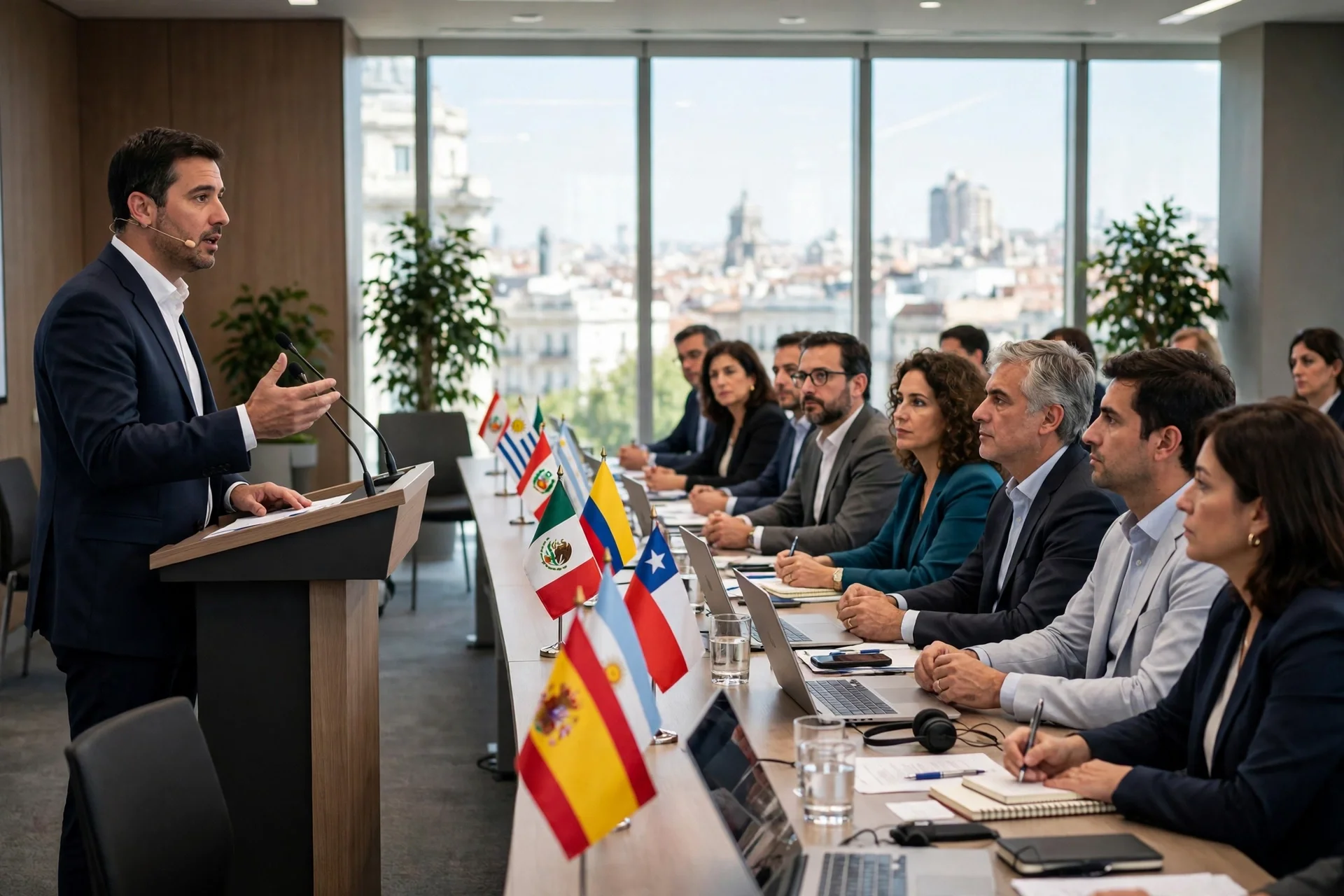
Un foro ministerial con delegados de países iberoamericanos reunidos en torno a una mesa de conferencias en Madrid. · Imagen generada para EPM
Madrid hosts 22 countries backing a humanist digital third way
Óscar López opened the Ibero-American Digital Forum in Madrid, bringing together 22 countries under the XXX Ibero-American Summit.
Lopez urges sovereign digital production at Madrid forum
Minister Óscar López opened the Ibero-American Digital Forum at the Royal Mint in Madrid, with 22 countries, companies, academia and civil society.
--- The context ---
Digital transformation now shapes work, education, health and the way citizens deal with their governments, and Ibero-America enters that revolution with a distinctive asset that has not yet become technological weight. Its languages form an immense community, yet the largest artificial intelligence engines are trained predominantly in English, and that early imbalance could harden into lasting dependence if the countries of the region act separately and without a shared agenda for rights and access.
--- The facts ---
The minister for Digital Transformation and the Civil Service, Óscar López, opened the Ibero-American Digital Forum in Madrid, held at the Royal Mint of Spain. The high-level meeting brought together 22 countries, international organisations, technology companies and representatives of academia and civil society, within the framework of the XXX Ibero-American Summit of Heads of State and Government, to debate the key issues of digital transformation.
López said at the opening that the purpose of the forum is to establish digital transformation as one of the pillars of the Ibero-American community in this century, and he noted that the subjects under discussion affect the lives of more than 700 million people. The programme included four lectures and four panels on digital rights and the protection of minors, connectivity and cybersecurity, digital administration and artificial intelligence, with leading figures in digital rights, cybersecurity and digital governance.
--- The positions ---
The minister recalled a roadmap that is already under way. At the 2021 summit in Andorra the countries set the path towards a joint Ibero-American Digital Agenda, in 2023 the Ibero-American Charter of Principles and Rights in Digital Environments was approved in the Dominican Republic, in 2024 a commitment was reached in Ecuador to promote artificial intelligence language models in Spanish and Portuguese, and in 2025 the EU-Latin America and Caribbean Supercomputing Network was created. On that basis, López stated that no Ibero-American country can live outside the digital revolution and that the region must choose between being a data farm, a dependent client or a sovereign digital producer.
López also argued that, against the models of China and the United States, Europe and Latin America can lead a humanist, multilateral, sustainable and trustworthy digital third way, and that Ibero-America can close the digital divide between the North and the Global South. After the forum, the I Ibero-American Ministerial Meeting on Digital Transformation and AI will debate the Madrid Declaration and the Ibero-American Alliance for Artificial Intelligence, intended to build convergence around sovereign, ethical and trustworthy artificial intelligence. The Ibero-American secretary general, Andrés Allamand, warned in turn that artificial intelligence will not wait for Ibero-America and argued that the region must organise itself to decide and influence its development, or others will decide for it, so that it stops being only a user of technologies designed elsewhere.
--- What remains unknown ---
The final content of the Madrid Declaration and the Ibero-American Alliance for Artificial Intelligence, once debated at the ministerial meeting, is not yet known, nor are the concrete commitments each of the 22 countries will assume. There are also no details yet on how common projects will be financed, what timetable the language models in Spanish and Portuguese will follow, or how progress on connectivity, cybersecurity and the protection of minors will be measured in the coming years.
--- Unanswered questions ---
What firm commitments will emerge from the Madrid Declaration and the Ibero-American Alliance for Artificial Intelligence? How will investment and infrastructure be shared among countries with such different digital capacities? Will Spanish, Portuguese and the other Ibero-American languages gain real weight in the training of the largest artificial intelligence models?
--- EPM analysis ---
The strength of the forum lies in its composition and its continuity. It does not start from zero, because it links the milestones of 2021, 2023, 2024 and 2025, and it is not limited to governments, because it seats companies, academia and civil society at the same table. The lectures reinforce that breadth, from Mexican activist Olimpia Coral, who spoke about digital rights and violence-free spaces for girls and women, to cybersecurity expert Elizabeth Bodine-Baron, Mateo Valero, a professor since 1974, and Sebas Muriel, with panels moderated by María González Veracruz, Antonio Hernando, Consuelo Sánchez and Manuel de la Rocha.
📌 EPM Take: In EPM's view, the proposal for a humanist digital third way will only have value if Ibero-American cooperation translates into protected rights, shared infrastructure and models trained in the languages of more than 850 million speakers. The Madrid forum is right to focus on people and on multilateral action, but its test will not be the opening speech, rather whether the Madrid Declaration and the new Alliance set obligations, resources and verifiable follow-up for the 22 countries gathered. Only then will the divide between the North and the Global South begin to close through measurable results rather than repeated declarations at each successive summit meeting.
--- The context ---
No state can govern outside the digital sphere any longer, because administration, security and the economy depend on networks, data and systems that are largely designed elsewhere. For Ibero-American countries, the underlying question is not whether they will take part in that revolution, but from what position they will do so and with what capacity of their own to set rules, protect their citizens and avoid complete dependence on outside providers and models.
--- The facts ---
The minister for Digital Transformation and the Civil Service, Óscar López, opened the Ibero-American Digital Forum at the Royal Mint of Spain in Madrid. The meeting brought together, within the framework of the XXX Ibero-American Summit of Heads of State and Government, 22 countries, international organisations, technology companies and representatives of academia and civil society, to analyse the key issues of digital transformation, subjects that, as the minister noted, affect the lives of more than 700 million people.
The minister stated that the purpose of the forum is to establish digital transformation as one of the pillars of the Ibero-American community in this century. The programme was organised into four lectures and four panels devoted to digital rights and the protection of minors, connectivity and cybersecurity, digital administration and artificial intelligence, with the participation of global leaders in those fields and senior representatives of the countries responsible for digital transformation.
--- The positions ---
López reviewed the precedents that give the forum its institutional base. The 2021 summit in Andorra set the roadmap towards a joint Ibero-American Digital Agenda, the 2023 summit in the Dominican Republic approved the Ibero-American Charter of Principles and Rights in Digital Environments, the 2024 summit in Ecuador reached the commitment to promote artificial intelligence language models in Spanish and Portuguese, and in 2025 the EU-Latin America and Caribbean Supercomputing Network was created. From that record, the minister asserted that none of the countries can live outside the digital revolution and framed the choice between being a data farm, a dependent client or a sovereign digital producer.
He also argued that Europe and Latin America, against the models of China and the United States, can lead a humanist, multilateral, sustainable and trustworthy digital third way, and that Ibero-America can close the digital divide between the North and the Global South. After the forum, the I Ibero-American Ministerial Meeting on Digital Transformation and AI will debate the Madrid Declaration and the Ibero-American Alliance for Artificial Intelligence, designed to build convergence around sovereign, ethical and trustworthy artificial intelligence. The Ibero-American secretary general, Andrés Allamand, also spoke at the opening and warned that artificial intelligence will not wait for Ibero-America, adding that the Alliance is born so that the region stops being only a user of technologies designed in other places and builds its own with its data, its languages and its priorities.
--- What remains unknown ---
It is not yet known what definitive text the ministerial meeting will approve or how binding the Madrid Declaration and the Alliance will be for the signatory governments. Nor is it clear how the Supercomputing Network created in 2025 will be sustained, what role the companies present at the forum will play, or what concrete guarantees will be offered on cybersecurity and the protection of minors, two of the central subjects of the panels held in Madrid.
--- Unanswered questions ---
Will the Madrid Declaration and the Alliance carry enforceable commitments or remain a statement of intent? What investment and what infrastructure of its own will back the ambition to be a sovereign digital producer? How will minors and women be effectively protected in digital environments where violence is already documented?
--- EPM analysis ---
The institutional value of the forum lies in ordering scattered decisions into a recognisable sequence and in convening those who must carry them out. The speakers included Mexican activist Olimpia Coral, a victim of sexual digital violence at 18 years old and promoter of the Mexican reform that recognised that violence against women, recognised in 2021 by a magazine as one of the most influential people of that year, United States scientist Elizabeth Bodine-Baron, an expert in cybersecurity, Mateo Valero, founder of the Barcelona supercomputing centre and a professor since 1974, and Sebas Muriel, with moderation by María González Veracruz, Antonio Hernando, Consuelo Sánchez and Manuel de la Rocha.
📌 EPM Take: In EPM's view, speaking of digital sovereignty requires institutions that work, clear rules and technical capacity of one's own, not only shared diagnoses. Madrid offers the 22 countries a serious base, built since 2021, to stop being dependent clients, but that ambition will only be credible if the Alliance fixes responsibilities by country, protects the data of its citizens and turns supercomputing and models in Spanish and Portuguese into sustained, assessable projects. Without deadlines, without named responsibility by country and without a check at the next summit, the third way will remain rhetoric and technological dependence will keep being decided outside Ibero-America.
Madrid reúne a 22 países por una vía digital humanista iberoamericana
Óscar López inauguró en Madrid el Foro Digital Iberoamericano, que reunió a 22 países en el marco de la XXX Cumbre Iberoamericana.
López plantea en Madrid una producción digital soberana iberoamericana
El ministro Óscar López inauguró en la Real Fábrica de Moneda y Timbre el Foro Digital Iberoamericano, con 22 países, empresas, academia y sociedad civil.
--- El contexto ---
La transformación digital ya condiciona el empleo, la educación, la salud y la relación de los ciudadanos con sus administraciones, y Iberoamérica llega a esa revolución con una riqueza propia que no se traduce en peso tecnológico. Sus lenguas suman una comunidad inmensa, pero los grandes motores de la inteligencia artificial se entrenan de forma predominante en inglés, y esa asimetría inicial puede convertirse en dependencia duradera si los países de la región actúan por separado y sin una agenda compartida.
--- Los hechos ---
El ministro para la Transformación Digital y de la Función Pública, Óscar López, inauguró en Madrid el Foro Digital Iberoamericano, celebrado en la Real Fábrica de Moneda y Timbre. El encuentro reunió a 22 países, organismos internacionales, empresas tecnológicas y representantes de la academia y de la sociedad civil, en el marco de la XXX Cumbre Iberoamericana de Jefas y Jefes de Estado y de Gobierno, para debatir los asuntos clave de la transformación digital.
López señaló al abrir el foro que su propósito es consagrar la transformación digital como uno de los pilares de la comunidad iberoamericana en el siglo XXI, y recordó que los temas tratados impactan en la vida de más de 700 millones de personas. El programa incluyó cuatro ponencias y cuatro paneles sobre derechos digitales y protección de menores, conectividad y ciberseguridad, administración digital e inteligencia artificial, con referentes en derechos digitales, ciberseguridad y gobernanza digital.
--- Las posiciones ---
El ministro recordó una hoja de ruta iniciada. En la cumbre de 2021 en Andorra los países fijaron el camino hacia una Agenda Digital Iberoamericana conjunta, en 2023 se aprobó en República Dominicana la Carta Iberoamericana de Principios y Derechos en los Entornos Digitales, en 2024 se alcanzó en Ecuador el compromiso de impulsar modelos de lenguaje en español y en portugués, y en 2025 se creó la Red de Supercomputación UE-América Latina Caribe. Sobre esa base, López afirmó que ningún país iberoamericano puede vivir fuera de la revolución digital y que la región debe elegir entre ser granja de datos, cliente dependiente o productor digital soberano.
López defendió además que, frente a los modelos de China y EEUU, Europa y Latinoamérica pueden liderar una tercera vía digital humanista, multilateral, sostenible y confiable, y que Iberoamérica puede cerrar la brecha digital entre el Norte y el Sur Globales. Tras el foro, la I Reunión Ministerial Iberoamericana de Transformación Digital e IA debatirá la Declaración de Madrid y la Alianza Iberoamericana de Inteligencia Artificial, planteadas para converger en torno a una inteligencia artificial soberana, ética y confiable. El secretario general iberoamericano, Andrés Allamand, advirtió por su parte que la inteligencia artificial no va a esperar a Iberoamérica y sostuvo que la región debe organizarse para decidir e influir en su desarrollo o serán otros quienes decidan por ella, dejando de ser solo usuaria de tecnologías diseñadas en otros lugares.
--- Lo que falta saber ---
Todavía no se conoce el contenido final que tendrán la Declaración de Madrid y la Alianza Iberoamericana de Inteligencia Artificial una vez debatidas en la reunión ministerial, ni qué compromisos concretos asumirá cada uno de los 22 países. Tampoco se ha detallado cómo se financiarán los proyectos comunes, qué calendario tendrán los modelos de lenguaje en español y portugués ni de qué manera se medirán los avances en conectividad, ciberseguridad y protección de menores.
--- Preguntas sin respuesta ---
¿Qué compromisos firmes saldrán de la Declaración de Madrid y de la Alianza Iberoamericana de Inteligencia Artificial? ¿Cómo se repartirán la inversión y la infraestructura entre países con capacidades digitales tan distintas? ¿Lograrán el español, el portugués y las demás lenguas iberoamericanas un peso real en el entrenamiento de los grandes modelos de inteligencia artificial?
--- Análisis EPM ---
La fuerza del foro está en su composición y en su continuidad. No parte de cero, porque enlaza los hitos de 2021, 2023, 2024 y 2025, y no se limita a los gobiernos, porque sienta en la misma mesa a empresas, academia y sociedad civil. Las ponencias refuerzan esa amplitud, desde la activista mexicana Olimpia Coral, que habló de derechos digitales y de espacios libres de violencia para niñas y mujeres, hasta la experta en ciberseguridad Elizabeth Bodine-Baron, Mateo Valero, profesor desde 1974, y Sebas Muriel, con mesas moderadas por María González Veracruz, Antonio Hernando, Consuelo Sánchez y Manuel de la Rocha.
📌 Conclusion EPM: A juicio de EPM, la propuesta de una tercera vía digital humanista solo tendrá valor si la cooperación iberoamericana se traduce en derechos protegidos, infraestructura compartida y modelos entrenados en las lenguas de más de 850 millones de hablantes. El foro de Madrid acierta al poner el foco en las personas y en la multilateralidad, pero su prueba no será el discurso inaugural, sino que la Declaración de Madrid y la nueva Alianza fijen obligaciones, recursos y seguimiento verificable para los 22 países reunidos. Solo así la brecha entre el Norte y el Sur Globales empezará a cerrarse con resultados medibles y no solo con declaraciones repetidas en cada cumbre.
--- El contexto ---
Ningún Estado puede ya gobernar al margen de lo digital, porque la administración, la seguridad y la economía dependen de redes, datos y sistemas que en gran parte se diseñan fuera. Para los países iberoamericanos, la pregunta de fondo no es si participarán en esa revolución, sino desde qué posición lo harán y con qué capacidad propia para fijar reglas, proteger a sus ciudadanos y no depender de proveedores y modelos ajenos.
--- Los hechos ---
El ministro para la Transformación Digital y de la Función Pública, Óscar López, inauguró el Foro Digital Iberoamericano en la Real Fábrica de Moneda y Timbre de Madrid. El encuentro reunió, en el marco de la XXX Cumbre Iberoamericana de Jefas y Jefes de Estado y de Gobierno, a 22 países, organismos internacionales, empresas tecnológicas y representantes de la academia y de la sociedad civil, para analizar los asuntos clave de la transformación digital, unos temas que, según señaló el ministro, impactan en la vida de más de 700 millones de personas.
El ministro afirmó que el propósito del foro es consagrar la transformación digital como uno de los pilares de la comunidad iberoamericana en el siglo XXI. El programa se articuló en cuatro ponencias y cuatro paneles dedicados a derechos digitales y protección de menores, conectividad y ciberseguridad, administración digital e inteligencia artificial, con la participación de referentes globales en esas materias y de altos representantes de los países competentes en transformación digital.
--- Las posiciones ---
López repasó los precedentes que dan base institucional al foro. La cumbre de 2021 en Andorra fijó la hoja de ruta hacia una Agenda Digital Iberoamericana conjunta, la de 2023 en República Dominicana aprobó la Carta Iberoamericana de Principios y Derechos en los Entornos Digitales, la de 2024 en Ecuador alcanzó el compromiso de impulsar modelos de lenguaje de inteligencia artificial en español y en portugués, y en 2025 se creó la Red de Supercomputación UE-América Latina Caribe. Desde ese recorrido, el ministro aseveró que ninguno de los países puede vivir fuera de la revolución digital y planteó la elección entre ser granja de datos, cliente dependiente o productor digital soberano.
También defendió que Europa y Latinoamérica, frente a los modelos de China y EEUU, pueden liderar una tercera vía digital humanista, multilateral, sostenible y confiable, y que Iberoamérica puede cerrar la brecha digital entre el Norte y el Sur Globales. Después del foro, la I Reunión Ministerial Iberoamericana de Transformación Digital e IA debatirá la Declaración de Madrid y la Alianza Iberoamericana de Inteligencia Artificial, concebidas para converger en torno a una inteligencia artificial soberana, ética y confiable. En la apertura intervino el secretario general iberoamericano, Andrés Allamand, quien advirtió que la inteligencia artificial no va a esperar a Iberoamérica y añadió que la Alianza nace para que la región deje de ser solo usuaria de tecnologías diseñadas en otros lugares y construya las suyas con sus datos, sus lenguas y sus prioridades.
--- Lo que falta saber ---
Aún no se sabe qué texto definitivo aprobará la reunión ministerial ni qué grado de obligación tendrán la Declaración de Madrid y la Alianza para los gobiernos firmantes. Tampoco consta cómo se sostendrá la Red de Supercomputación creada en 2025, qué papel tendrán las empresas presentes en el foro ni qué garantías concretas se ofrecerán en ciberseguridad y en protección de menores, dos asuntos centrales de los paneles de Madrid.
--- Preguntas sin respuesta ---
¿Tendrán la Declaración de Madrid y la Alianza compromisos exigibles o quedarán en una declaración de intenciones? ¿Qué inversión y qué infraestructura propia respaldarán la aspiración de ser productor digital soberano? ¿Cómo se protegerá de forma efectiva a los menores y a las mujeres en unos entornos digitales donde la violencia está documentada?
--- Análisis EPM ---
El valor institucional del foro reside en que ordena decisiones dispersas en una secuencia reconocible y en que convoca a quienes deben ejecutarlas. Entre los ponentes figuraron la activista mexicana Olimpia Coral, víctima de violencia digital sexual con 18 años e impulsora de la reforma mexicana que reconoció esa violencia contra las mujeres y reconocida en 2021 por una revista como una de las personas más influyentes de ese año, la científica estadounidense Elizabeth Bodine-Baron, experta en ciberseguridad, Mateo Valero, fundador del centro de supercomputación de Barcelona y profesor desde 1974, y Sebas Muriel, con la moderación de María González Veracruz, Antonio Hernando, Consuelo Sánchez y Manuel de la Rocha.
📌 Conclusion EPM: A juicio de EPM, hablar de soberanía digital exige instituciones que funcionen, reglas claras y capacidad técnica propia, no solo diagnósticos compartidos. Madrid ofrece a los 22 países una base construida desde 2021, para dejar de ser clientes dependientes, pero esa ambición solo será creíble si la Alianza fija responsabilidades por país, protege los datos de sus ciudadanos y convierte la supercomputación y los modelos en español y portugués en proyectos sostenidos y evaluables. Sin plazos, sin responsables por país y sin comprobación en la próxima cumbre, la tercera vía quedará en retórica y la dependencia tecnológica seguirá decidiéndose fuera de Iberoamérica.