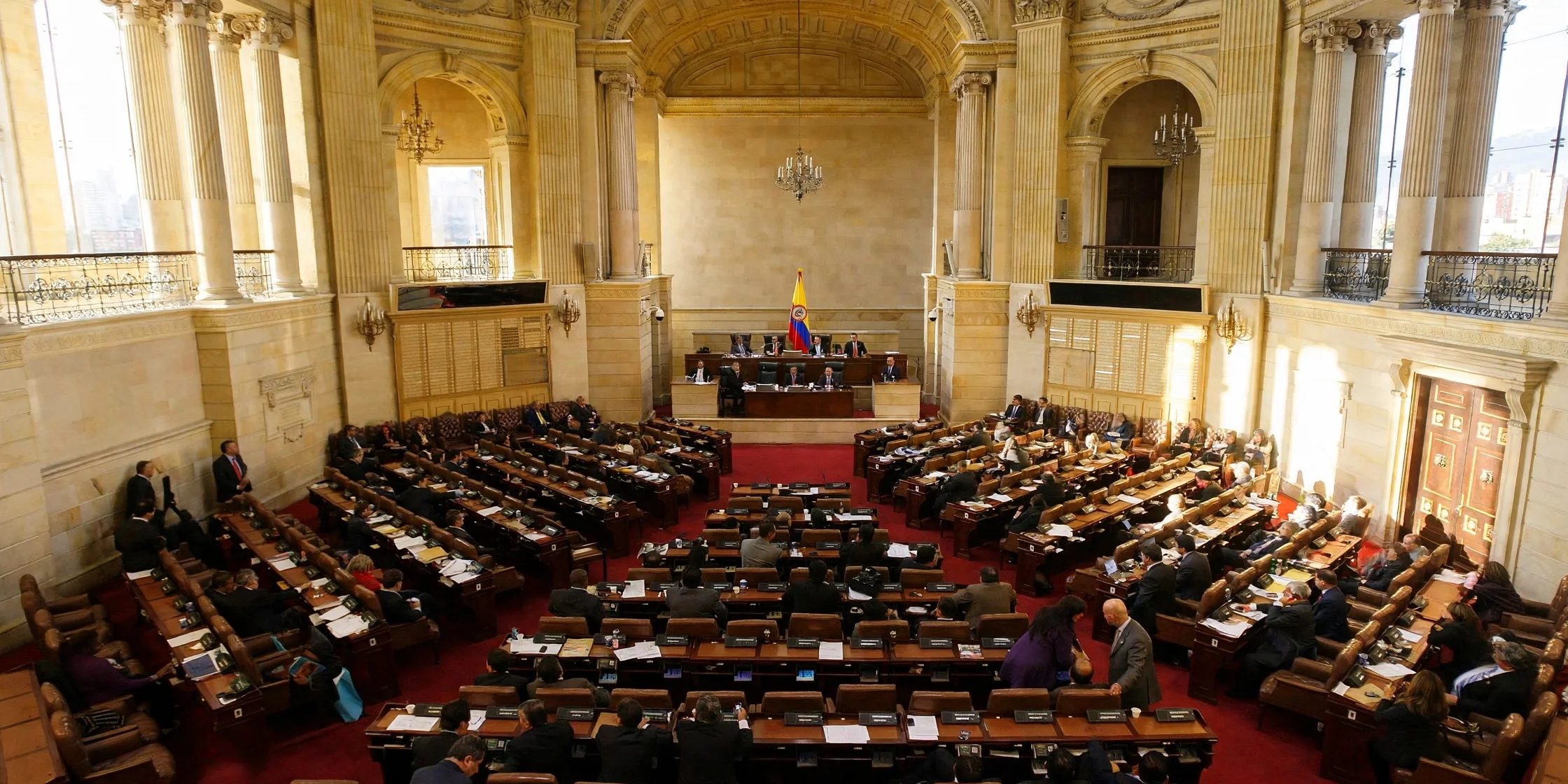
Una plenaria legislativa en sesión durante una jornada de debate. · Imagen generada para EPM
Congress Debates Submission Law in Decisive Session
The House and Senate plenary sessions debate President Abelardo De La Espriella's Submission Law this Tuesday after approving the positive report on Monday.
Submission Law Moves Forward Against the Clock
The House and Senate resume debate this Tuesday on the Submission Law after the government sectors' first major victory on Monday.
--- The context ---
The Submission Law promoted by President Abelardo De La Espriella faces a decisive day in Congress this Tuesday, November 3. It is the second legislative test of his administration in its first three months, and it seeks to redefine the legal conditions for dismantling organized crime structures and bringing their members before the courts.
--- The facts ---
The plenary sessions of the House and the Senate are debating jointly from 9:00 a. m. this Tuesday. On the holiday Monday, after almost eight hours of debate, the positive report was approved, the shelving report was rejected, the report passed by wide majorities, and voting advanced on two articles of the bill.
The president of the House, Nicolás Barguil, recalled that progress and announced that the plenary session would resume this Tuesday until approval is completed. The goal is to approve the bill today in both plenary sessions and reconcile the text on Wednesday, November 4.
--- The positions ---
Government sectors achieved their first major victory on Monday despite opposition obstacles. Political sectors cited in the report consider that this vote will test how much handling of Congress the president has today. The bill was filed by former Interior Minister Rodrigo Lara and Justice Minister Iván Cancino, and it contains 22 articles in 17 pages.
The text requires a free, express and informed statement in writing to the national government, through a designated interlocutor, and the laying down of weapons under verification mechanisms. It also requires identifying and handing over without delay recruited children, kidnapped persons and disappeared persons under their control, and ceasing all illicit activity and all harm to the civilian population.
It further requires a commitment to dismantling, handing over information on political ties and corruption lines, and an effective transition to legality.
--- What remains unknown ---
Voting on the full set of articles in both plenary sessions still has to be completed, along with the reconciliation planned for Wednesday, November 4. The urgency has a concrete reason: Law 418 of 1997, known as the Public Order Law, expires that same day, so approval must come before that deadline for the new framework to become law.
--- Unanswered questions ---
Will the House and the Senate approve the full text today in both plenary sessions? Will there be enough time to reconcile it on Wednesday, November 4, before Law 418 of 1997 expires? How will the laying down of weapons, the handing over of information and the effective dismantling of each structure be verified in practice?
--- EPM analysis ---
The initiative combines clear demands with conditional incentives: it provides a punitive reduction of 50 % of the accumulated sentence according to contributions to truth, reparation and verifiable dismantling, and of 30 % when a leadership role is exercised. That difference recognizes verifiable cooperation while keeping stricter treatment for those who led the structures.
📌 EPM Take:
In EPM's view, this Tuesday's session tests a central idea of the government: bringing organized crime to submit to justice under written, verifiable conditions and clear deadlines, not open promises. If Congress approves today and reconciles the text on Wednesday, the country will gain an orderly instrument to demand the handing over of weapons, the release of victims and the breaking of political and corruption ties. The law will prove its worth through rigorous verification and for civilian safety.
--- The context ---
Congress faces a race against the clock this Tuesday, November 3, over President Abelardo De La Espriella's Submission Law. It is his second legislative test in the first three months of his administration and will define the rules for dismantling organized crime structures and bringing their members before justice under strict conditions.
--- The facts ---
The plenary sessions of the House and the Senate are debating jointly from 9:00 a. m. On the holiday Monday, after almost eight hours of debate, the positive report was approved, the shelving report was rejected, the report passed by wide majorities, and voting advanced on two articles.
The president of the House, Nicolás Barguil, recalled what happened on Monday and announced that the plenary session would resume this Tuesday until approval is completed. The immediate goal is approval today in both chambers and reconciliation on Wednesday, November 4.
--- The positions ---
Government sectors won their first major victory on Monday despite opposition obstacles, a result that frames this Tuesday's debate. Different political sectors consider that the initiative will allow the president to confirm his handling of Congress. Former Interior Minister Rodrigo Lara and Justice Minister Iván Cancino filed the bill, a text of 22 articles and 17 pages.
The conditions are demanding: a free, express and informed statement in writing to the national government through a designated interlocutor, and the laying down of weapons under verification mechanisms. Added to that are identifying and handing over without delay recruited children, kidnapped persons and disappeared persons under their control, and ceasing all illicit activity and all harm to civilians.
The bill also requires a commitment to dismantling, handing over information on political ties and corruption lines, and an effective transition toward legality. Without those verifiable steps, there is no route to the differentiated criminal treatment the initiative proposes, with reductions conditioned on truth, reparation and verifiable dismantling.
--- What remains unknown ---
Approval of the full set of articles in the House and the Senate remains pending, as does the reconciliation on Wednesday, November 4. The deadline is decisive: Law 418 of 1997, the Public Order Law, expires that day, and the new law must be approved before that expiry to become law in Colombia.
--- Unanswered questions ---
Will both plenary sessions approve the full set of articles today without new obstacles? Will there be enough time on Wednesday, November 4, to reconcile the text before Law 418 of 1997 expires? What concrete verification will guarantee the laying down of weapons, the handing over of victims and the real dismantling of each structure?
--- EPM analysis ---
The design distinguishes responsibilities: it provides a punitive reduction of 50 % of the accumulated sentence according to contributions to truth, reparation and verifiable dismantling, and of 30 % in the case of a leadership role. Rewarding leaders less and conditioning every benefit on verifiable contributions is the part that will give the law practical credibility.
📌 EPM Take:
In EPM's view, the value of this law lies in its order: first it demands in writing, with verification, the laying down of weapons, the handing over of recruited children, kidnapped and disappeared persons, and an end to harm against civilians, and only then does it open conditional benefits. If the House and the Senate deliver today and reconcile on Wednesday, the government will have a firm tool against organized crime. Its effectiveness will depend on applying every condition without exceptions.
Congreso debate Ley de Sometimiento en jornada decisiva
Las plenarias de Cámara y Senado debaten este martes la Ley de Sometimiento del presidente Abelardo De La Espriella, tras aprobar el lunes la ponencia…
Ley de Sometimiento avanza contra el reloj en el Congreso
Cámara y Senado retoman este martes el debate de la Ley de Sometimiento, después de la primera victoria gobiernista del lunes festivo.
--- El contexto ---
La Ley de Sometimiento impulsada por el presidente Abelardo De La Espriella llega a una jornada decisiva en el Congreso. Es la segunda prueba legislativa de su administración en los primeros tres meses y busca redefinir las condiciones legales para la desarticulación y la entrega a la justicia de estructuras de crimen organizado.
--- Los hechos ---
Las plenarias de la Cámara y el Senado debaten en conjunto desde las 9:00 a. m. de este martes 3 de noviembre. El lunes festivo, tras casi ocho horas de debate, se aprobó la ponencia positiva, se negó la ponencia de archivo, se aprobó por amplias mayorías y se avanzó en la votación de dos artículos.
El presidente de la Cámara, Nicolás Barguil, recordó ese avance y anunció que este martes la plenaria se retomaría hasta culminar la aprobación. El objetivo es aprobar hoy en ambas plenarias y conciliar el texto el miércoles 4 de noviembre.
--- Las posiciones ---
Los sectores gobiernistas lograron el lunes su primera gran victoria pese a las trabas de la oposición. Distintos sectores políticos consideran que esta iniciativa permitirá al presidente confirmar su manejo del Congreso. El proyecto fue radicado por el exministro del Interior Rodrigo Lara y por el ministro de Justicia Iván Cancino, y consta de 22 artículos en 17 páginas.
El texto exige una manifestación libre, expresa e informada por escrito ante el Gobierno nacional, por medio de un interlocutor designado, y la dejación de armas con mecanismos de verificación. También ordena identificar y entregar sin dilación a la niñez reclutada, a las personas secuestradas y a las personas desaparecidas bajo su control, y cesar toda actividad ilícita y toda afectación a la población civil.
Además, exige compromiso de desmantelamiento, entrega de información sobre nexos políticos y líneas de corrupción, y tránsito a la legalidad.
--- Lo que falta saber ---
Falta culminar la votación del articulado en ambas plenarias y completar la conciliación prevista para el miércoles 4. La urgencia tiene una razón concreta: ese mismo día vence la Ley 418 de 1997, conocida como Ley de Orden Público, por lo que la aprobación debe producirse antes de ese vencimiento para que el nuevo marco se convierta en ley.
--- Preguntas sin respuesta ---
¿Lograrán Cámara y Senado aprobar hoy el texto completo en ambas plenarias? ¿Alcanzará el tiempo para conciliar el miércoles 4 antes de que venza la Ley 418 de 1997? ¿Cómo se verificarán en la práctica la dejación de armas, la entrega de información y el desmantelamiento efectivo de cada estructura?
--- Análisis EPM ---
La iniciativa combina exigencias claras con incentivos condicionados: prevé una rebaja punitiva del 50 % de la pena acumulada según aportes a la verdad, la reparación y el desmantelamiento verificable, y del 30 % cuando se ejerza un rol de liderazgo. Esa diferencia reconoce la colaboración comprobable y mantiene un trato más exigente para quienes dirigieron las estructuras.
📌 Conclusion EPM:
A juicio de EPM, la jornada de este martes pone a prueba una idea central del gobierno: someter al crimen organizado con condiciones escritas, verificables y con plazos, no con promesas abiertas. Si el Congreso aprueba hoy y concilia el miércoles, el país ganará un instrumento ordenado para exigir entrega de armas, liberación de víctimas y ruptura de nexos políticos y de corrupción. El acierto se medirá en esa verificación y en que cada beneficio dependa de resultados comprobables.
--- El contexto ---
El Congreso afronta este martes 3 de noviembre una votación contrarreloj de la Ley de Sometimiento del presidente Abelardo De La Espriella. Es su segunda prueba legislativa en los primeros tres meses de administración y definirá las reglas para desarticular estructuras de crimen organizado y llevar a sus integrantes ante la justicia con condiciones estrictas.
--- Los hechos ---
Las plenarias de la Cámara y el Senado debaten en conjunto desde las 9:00 a. m. El lunes festivo, después de casi ocho horas de debate, se aprobó la ponencia positiva, se negó la ponencia de archivo, la ponencia se aprobó por amplias mayorías y se avanzó en la votación de dos artículos del proyecto.
El presidente de la Cámara, Nicolás Barguil, recordó lo ocurrido el lunes y anunció que este martes la plenaria se retomaría hasta culminar la aprobación. La meta inmediata es aprobar hoy en ambas plenarias y conciliar el miércoles 4 de noviembre.
--- Las posiciones ---
La iniciativa fue radicada por el exministro del Interior Rodrigo Lara y el ministro de Justicia Iván Cancino. Por separado, los sectores gobiernistas aceleraron el trámite y lograron el lunes su primera gran victoria pese a las trabas de la oposición. Distintos sectores políticos consideran que la iniciativa permitirá al presidente confirmar su manejo del Congreso. El texto consta de 22 artículos y 17 páginas.
Las condiciones son exigentes: manifestación libre, expresa e informada por escrito ante el Gobierno nacional por un interlocutor designado, y dejación de armas bajo mecanismos de verificación. A ello se suman identificar y entregar sin dilación a la niñez reclutada, a las personas secuestradas y a las personas desaparecidas bajo su control, y cesar toda actividad ilícita y toda afectación a la población civil.
El proyecto también exige compromiso de desmantelamiento, entrega de información sobre nexos políticos y líneas de corrupción, y tránsito efectivo hacia la legalidad. Sin esos pasos verificables no hay ruta para el tratamiento diferenciado.
--- Lo que falta saber ---
Queda por completar la aprobación del articulado en Cámara y Senado y la conciliación del miércoles 4. El plazo manda: ese día vence la Ley 418 de 1997, la Ley de Orden Público, y la nueva ley debe estar aprobada antes de ese vencimiento para convertirse en ley en Colombia.
--- Preguntas sin respuesta ---
¿Aprobarán hoy ambas plenarias el articulado completo sin nuevas trabas? ¿Habrá tiempo suficiente el miércoles 4 para conciliar antes del vencimiento de la Ley 418 de 1997? ¿Qué verificación concreta garantizará la dejación de armas, la entrega de víctimas y el desmantelamiento real de cada estructura?
--- Análisis EPM ---
El diseño distingue responsabilidades: contempla una rebaja punitiva del 50 % de la pena acumulada según aportes a la verdad, la reparación y el desmantelamiento verificable, y del 30 % en caso de rol de liderazgo. Premiar menos a quien lideró y condicionar todo beneficio a aportes comprobables es la parte que dará credibilidad práctica a la norma.
📌 Conclusion EPM:
A juicio de EPM, el valor de esta ley está en su orden: primero exige por escrito, con verificación, la dejación de armas, la entrega de la niñez reclutada, de secuestrados y desaparecidos, y el cese de daños a civiles, y solo después abre beneficios condicionados. Si Cámara y Senado cumplen hoy y concilian el miércoles, el gobierno contará con una herramienta firme contra el crimen organizado. Su eficacia dependerá de aplicar cada condición sin excepciones y con resultados verificables para las víctimas.