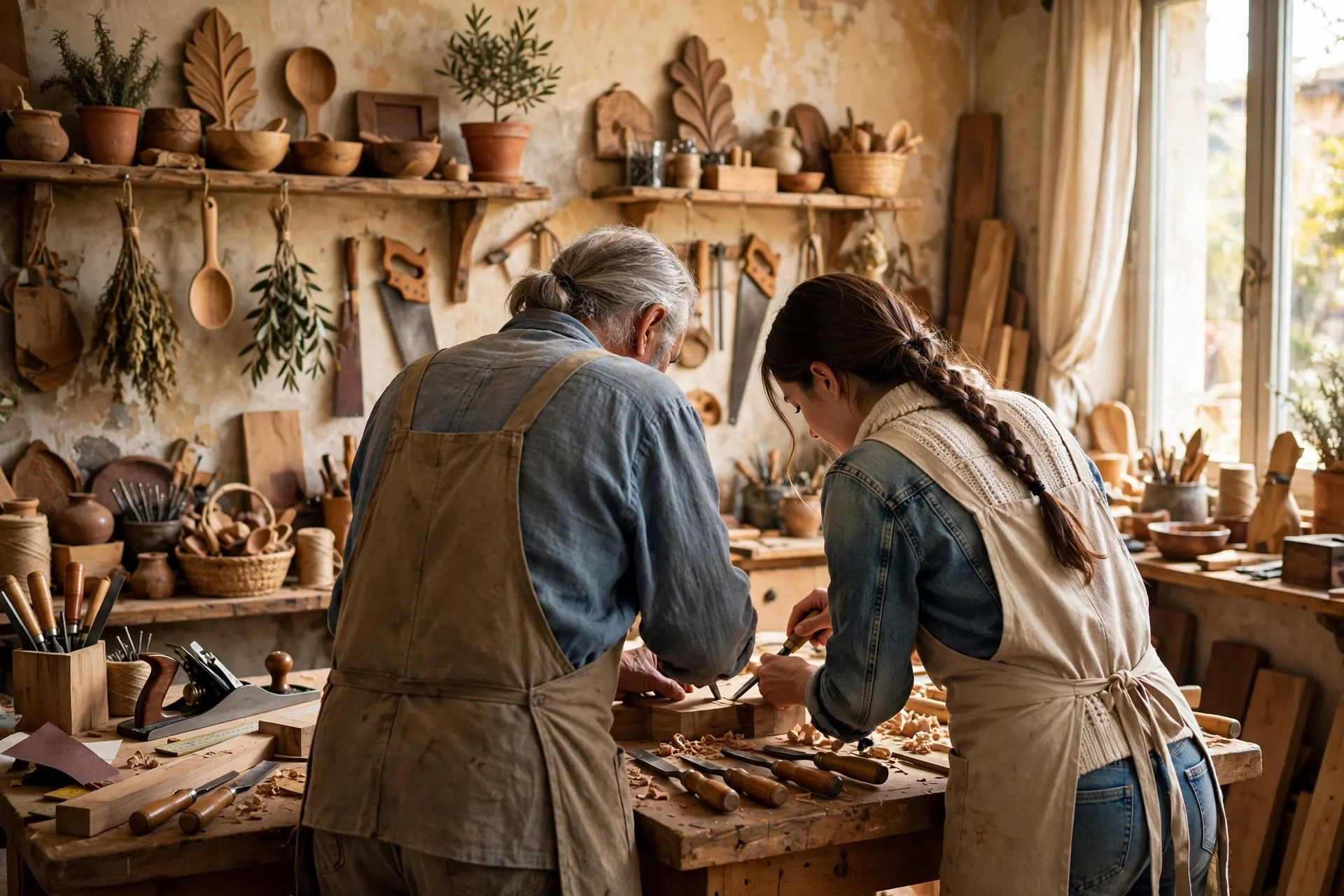
Imagen alusiva al relevo generacional en los talleres artesanos italianos. · Imagen generada para EPM
Italy to reform 1985 craft law after more than 40 years
Italy will approve today a decree reforming the 1985 craft framework law after more than 40 years, with fewer bureaucratic obligations, freedom to organise in…
Growing without ceasing to be artisans, Italy's reform pledge
After more than 40 years, Italy will reform today its 1985 craft framework law to cut bureaucracy, allow production and administration to be organised in…
--- The context ---
Italy is approaching this announcement with a craft sector that supports jobs, local communities and export strength. Speaking to the Confartigianato General Assembly in Rome, President of the Council of Ministers Giorgia Meloni placed that weight in concrete figures, recalling exports worth EUR 644 billion and fourth place in the global ranking of exporting nations.
She also argued that skilled manual work remains an answer to an increasingly impersonal and standardised economy, because every workshop that opens and survives keeps a community alive, passes on a trade and preserves knowledge that cannot be copied or easily moved elsewhere.
--- The facts ---
The central development is imminent. Today, at the Council of Ministers, after more than 40 years, the Government will approve a decree reforming the craft industry framework law dating back to 8 August 1985. The reform reduces bureaucratic obligations and recognises the freedom to organise production, administration and management also in different locations and areas, without losing artisan status.
It also sets a clear principle on ownership: in a craft business, those who work with their own hands must continue to count more than those who merely provide the capital.
That logic is completed by another measure announced through the budget law. A company that starts off as a craft business and has held that status for at least seven years will be able to keep it even if it decides to increase its number of staff, paying particular attention to skilled workers and apprentices. Growing will therefore no longer mean giving up a production identity, a contradiction that, in the account given by the President of the Council of Ministers, punished precisely those who had performed well and wanted to take the next step within the sector.
--- The positions ---
The Government presented the reform as part of a wider strategy of protection and growth. The annual law on small and medium-sized enterprises already reserved the terms craftsmanship and handcrafted to those duly enrolled with the register of craft businesses and directly producing goods and services classed as handcrafted. Since 2023, more than 30,000 open and close businesses have been shut down after operating briefly without paying taxes and reopening under a different name. On credit, the relaunch of Artigiancassa combines mixed public and private governance involving Mediocredito Centrale with an initial fund of EUR 50 million at the ministry led by Adolfo Urso.
--- What remains unknown ---
The final text of the decree, its implementation timetable and the exact way administrations will check artisan status when production and management are in different locations still need to be known. The speech also did not detail how that flexibility will be coordinated with controls against fraud, nor what follow up the EUR 50 million fund will have once it begins financing investment programmes and eligible business development projects for companies in the sector that need support to grow without losing their craft character.
--- Unanswered questions ---
When will the new freedom to organise in different locations without losing artisan status take full effect in practice? What concrete criteria will ensure that those who work with their hands continue to count more than those who only provide capital? How will fewer bureaucratic obligations be prevented from opening space for new open and close abuses? Will the EUR 50 million fund be enough to meet the real credit demand of the smallest workshops across the country?
--- EPM analysis ---
The reform links protection, credit and the future workforce in a single package. For generational handover, companies can encourage master craftspeople nearing retirement to go part time, waiving social security contributions for up to EUR 3,000 per year, provided a young person under the age of 35 is hired on a permanent contract. The Transition 5.0 Plan made almost EUR 10 billion available, with more than 27,000 projects submitted and approximately EUR 8 billion mobilised, while a tender worth EUR 450 million supports small and medium-sized enterprises in the Mezzogiorno investing in new technologies. Technical enrolments have almost quadrupled and employment is above 80% a year after graduation.
📌 EPM Take: In EPM's view, the value of this reform will be measured less by the announcement than by its ability to turn formal rights into workshops that stay open, credit that arrives on time and young people learning a trade on stable contracts. Protecting the craft name, closing open and close businesses and extending Protected Geographical Indications in the European Union to non-food craft and industrial products all point in the same direction, defending real work against imitation. If the decree cuts burdens without weakening controls and if generational handover works in practice, Italy will have taken a serious step so that growing no longer forces a business to stop being artisan.
--- The context ---
For Italy's productive tradition, the artisan workshop is not only an economic unit. It is family, territory, discipline and the transmission of a trade learned by hand. In Rome, before the Confartigianato General Assembly, President of the Council of Ministers Giorgia Meloni recalled that without craftsmanship Made in Italy would basically not exist and linked that heritage to a precise national result: exports worth EUR 644 billion and fourth place in the global ranking of exporting nations.
The quality, attention to detail and beauty of that work, she stressed, cannot be copied and cannot be delocalised.
--- The facts ---
The announced change is substantial and follows a very long wait. Today, at the Council of Ministers, after more than 40 years, the Government will approve a decree reforming the craft industry framework law dating back to 8 August 1985. The stated goal is twofold: to bring an ageing framework up to date and to meet the needs of artisans who want to combine excellence with the dynamism this era demands.
The decree introduces fewer bureaucratic obligations and allows production, administration and management to be organised also in different locations and areas, without losing artisan status.
The second pillar protects identity against a purely financial idea of the firm. The reform reaffirms that those who work with their own hands must continue to count more than those who merely provide the capital. Through the budget law, another decisive principle is introduced: a company that starts off as a craft business and has held that status for at least seven years will be able to keep it even if it increases its number of staff, paying particular attention to skilled workers and apprentices. The political message is direct, because size and artisan status can and must coexist without forcing anyone to give up what they have always been.
--- The positions ---
That defence of identity already had a precedent in the annual law on small and medium-sized enterprises, which reserves the terms craftsmanship and handcrafted to those enrolled with the register of craft businesses who directly produce that type of goods and services. Protecting the name means protecting consumers and professional dignity against those pretending to be artisans. In the same line of order and legality, since 2023 more than 30,000 open and close businesses created to operate without paying taxes and avoid inspections have been shut down. Credit is reinforced through Artigiancassa, with mixed governance involving Mediocredito Centrale, and a EUR 50 million fund linked to the ministry of Adolfo Urso.
--- What remains unknown ---
The speech did not break down the complete text of the decree or the exact deadlines for each change to become operational in registers and in the daily practice of workshops. It remains to be seen how the new freedom to organise functions in different locations will be verified and what concrete safeguards will prevent simplification from becoming a route to unfair competition. Detail is also missing on the territorial distribution of the EUR 50 million fund and on the results that will be required from the programmes it finances.
--- Unanswered questions ---
Which concrete bureaucratic obligations will disappear first for a small workshop after the decree is approved by the Government? How will a business prove in practice that it meets the requirement of at least seven years to keep its status as it grows? Will the expanded staff be subject to limits or conditions linked to skilled workers and apprentices in the final text? What controls will remain active to stop open and close businesses from reappearing under new names and methods?
--- EPM analysis ---
The package is completed by industry, territory and training. The Transition 5.0 Plan made almost EUR 10 billion available for energy efficiency and digitalisation, with more than 27,000 projects submitted and approximately EUR 8 billion mobilised, while a tender worth EUR 450 million supports small and medium-sized enterprises in the Mezzogiorno in technologies such as artificial intelligence, big data, cloud computing and cybersecurity. Generational handover receives a precise incentive: waiving social security contributions for up to EUR 3,000 per year if a person under the age of 35 is hired on a permanent contract. Technical enrolments have almost quadrupled and employment is above 80% a year after graduation.
📌 EPM Take: In EPM's view, the reform is right to treat artisan identity as an asset the State should protect, not as a ceiling that punishes growth. Reserving the name to real producers, closing open and close businesses and extending Protected Geographical Indications in the European Union to non-food craft and industrial products form a single doctrine of defending honest work. In the year when the Republic and Confartigianato mark their 80th anniversary since 1946, the challenge will be for the measure approved today to become verifiably less paperwork, more trained apprentices and workshops able to grow without losing the soul that made them valuable in the first place.
Italia reforma su ley artesana tras más de 40 años de espera
El Gobierno italiano aprobará hoy un decreto que reforma la ley marco del artesanado de 1985 tras más de 40 años, con menos burocracia, libertad de…
Crecer sin dejar de ser artesano, el eje de la reforma italiana
Tras más de 40 años, Italia reformará hoy su ley marco del artesanado de 1985 para reducir burocracia, permitir organizar producción y administración en…
--- El contexto ---
Italia llega a este anuncio con un sector artesano que sostiene empleo, identidad local y capacidad exportadora. En su intervención ante la asamblea de Confartigianato en Roma, la presidenta del Consejo de Ministros, Giorgia Meloni, situó ese peso en cifras concretas al recordar exportaciones por EUR 644 billion y el cuarto lugar mundial entre los países exportadores.
También defendió que el trabajo manual cualificado sigue siendo un antídoto frente a una economía cada vez más impersonal y estandarizada, porque cada taller que abre y sobrevive mantiene viva una comunidad, transmite oficio y conserva un saber que no se puede copiar ni deslocalizar con facilidad.
--- Los hechos ---
El hecho central es inminente. El Gobierno aprobará hoy en el Consejo de Ministros, tras más de 40 años, un decreto que reforma la ley marco del artesanado del 8 de agosto de 1985. La reforma reduce las obligaciones burocráticas y reconoce la libertad de organizar la producción, la administración y la gestión también en lugares distintos, sin perder por ello la condición artesana.
Fija además un principio claro sobre la titularidad: en una empresa artesana, quien trabaja con sus propias manos debe seguir contando más que quien solo aporta capital.
Esa misma lógica se completa con otra medida anunciada para la ley presupuestaria. Una empresa que haya nacido artesana y conserve esa condición durante al menos siete años podrá mantenerla aunque decida aumentar su plantilla, con atención particular a los trabajadores cualificados y a los aprendices. Crecer dejará así de significar renunciar a la propia naturaleza productiva, una contradicción que, según planteó la presidenta del Consejo de Ministros, castigaba precisamente a quienes habían trabajado bien y querían dar el siguiente paso dentro del sector.
--- Las posiciones ---
El Ejecutivo presentó la reforma como parte de una estrategia más amplia de protección y crecimiento. La ley anual de pymes ya reservó los términos artesanía y artesanal a quienes están debidamente inscritos en el registro de empresas artesanas y producen directamente bienes y servicios de ese tipo. Desde 2023 se han cerrado más de 30.000 empresas de abre y cierra que operaban poco tiempo sin pagar impuestos y reabrían con otro nombre. En crédito, el relanzamiento de Artigiancassa combina gobernanza mixta público privada con Mediocredito Centrale y un fondo inicial de EUR 50 million en el ministerio encabezado por Adolfo Urso.
--- Lo que falta saber ---
Todavía falta conocer el texto definitivo del decreto, su calendario de aplicación y el modo exacto en que las administraciones comprobarán la condición artesana cuando producción y gestión estén en lugares distintos. Tampoco se detalló en la intervención cómo se coordinará esa flexibilidad con los controles contra el fraude, ni qué seguimiento tendrá el fondo de EUR 50 million una vez que empiece a financiar programas de inversión y proyectos de desarrollo empresarial elegibles para las empresas del sector.
--- Preguntas sin respuesta ---
¿Cuándo entrará plenamente en vigor la nueva organización por sedes distintas sin pérdida de la condición artesana? ¿Qué criterios concretos garantizarán que quien trabaja con sus manos siga contando más que quien solo aporta capital? ¿Cómo se evitará que la menor burocracia abra espacio a nuevos abusos de empresas de abre y cierra? ¿Alcanzará el fondo de EUR 50 million para atender la demanda real de crédito de los talleres más pequeños?
--- Análisis EPM ---
La reforma conecta protección, crédito y futuro laboral en un mismo paquete. Para el relevo generacional, las empresas podrán favorecer el paso a tiempo parcial de maestros artesanos cercanos a la jubilación con una exención de cotizaciones de hasta EUR 3,000 al año si contratan a un menor de 35 años con contrato indefinido. El Plan Transición 5.0 puso a disposición casi EUR 10 billion, con más de 27,000 proyectos presentados y aproximadamente EUR 8 billion movilizados, y una licitación de EUR 450 million apoya a pymes del Mezzogiorno en nuevas tecnologías. Las matrículas técnicas casi se cuadruplicaron y el empleo supera el 80% al año de graduarse.
📌 Conclusion EPM: A juicio de EPM, el valor de esta reforma se medirá menos por el anuncio que por su capacidad de convertir derechos formales en talleres que permanecen abiertos, crédito que llega a tiempo y jóvenes que aprenden un oficio con contrato estable. La protección del término artesanal, la lucha contra las empresas de abre y cierra y la extensión europea de las Indicaciones Geográficas Protegidas a productos artesanales e industriales no alimentarios apuntan en la misma dirección, defender el trabajo real frente a la imitación. Si el decreto reduce cargas sin debilitar controles y si el relevo generacional funciona en la práctica, Italia habrá dado un paso serio para que crecer no obligue a dejar de ser artesano.
--- El contexto ---
Para la tradición productiva italiana, el taller artesano no es solo una unidad económica. Es familia, territorio, disciplina y transmisión de un oficio aprendido con las manos. En Roma, ante la asamblea de Confartigianato, la presidenta del Consejo de Ministros, Giorgia Meloni, recordó que sin artesanado el made in Italy prácticamente no existiría y vinculó ese patrimonio a un resultado nacional preciso: exportaciones por EUR 644 billion y el cuarto lugar mundial entre los países exportadores.
La calidad, la atención al detalle y la belleza de ese trabajo, subrayó, no se pueden copiar ni deslocalizar.
--- Los hechos ---
La novedad anunciada es de fondo y llega tras una espera muy larga. El Gobierno aprobará hoy en el Consejo de Ministros, tras más de 40 años, un decreto que reforma la ley marco del artesanado del 8 de agosto de 1985. El objetivo declarado es doble: actualizar una norma envejecida y responder a quienes quieren combinar la excelencia artesana con el dinamismo que exige esta época.
El decreto introduce menos obligaciones burocráticas y permite organizar la producción, la administración y la gestión también en lugares y zonas distintos, sin perder la condición artesana.
El segundo pilar protege la identidad frente a una idea puramente financiera de la empresa. La norma reafirma que quien trabaja con sus propias manos debe seguir contando más que quien solo aporta capital. Y mediante la ley presupuestaria se introduce otro principio decisivo: una empresa que empieza como artesana y mantiene esa condición durante al menos siete años podrá conservarla aunque aumente su plantilla, con atención particular a los trabajadores cualificados y a los aprendices. El mensaje político es directo, porque el tamaño y la condición artesana pueden y deben coexistir sin obligar a nadie a renunciar a lo que siempre ha sido.
--- Las posiciones ---
Esa defensa de la identidad ya tenía antecedentes en la ley anual de pymes, que reserva los términos artesanía y artesanal a los inscritos en el registro de empresas artesanas que producen directamente ese tipo de bienes y servicios. Proteger el nombre es proteger al consumidor y la dignidad profesional frente a quien finge ser artesano. En la misma línea de orden y legalidad, desde 2023 se cerraron más de 30.000 empresas de abre y cierra creadas para operar sin pagar impuestos y eludir controles. El crédito se refuerza con Artigiancassa, de gobernanza mixta con Mediocredito Centrale, y un fondo de EUR 50 million vinculado al ministerio de Adolfo Urso.
--- Lo que falta saber ---
La intervención no desglosó el articulado completo del decreto ni los plazos exactos para que cada cambio sea operativo en los registros y en la práctica diaria de los talleres. Queda por ver cómo se verificará la nueva libertad de organizar funciones en lugares distintos y qué salvaguardas concretas impedirán que la simplificación se convierta en una vía para la competencia desleal. También falta detalle sobre la distribución territorial del fondo de EUR 50 million y sobre los resultados que se exigirán a los programas financiados.
--- Preguntas sin respuesta ---
¿Qué obligaciones burocráticas concretas desaparecerán primero para un taller pequeño tras la aprobación del decreto? ¿Cómo se acreditará en la práctica que una empresa cumple el requisito de al menos siete años para conservar su condición al crecer? ¿Tendrá la plantilla ampliada límites o condiciones vinculadas a trabajadores cualificados y aprendices? ¿Qué controles seguirán activos para impedir que reaparezcan empresas de abre y cierra con nombres nuevos?
--- Análisis EPM ---
El paquete se completa con industria, territorio y formación. El Plan Transición 5.0 destinó casi EUR 10 billion a eficiencia energética y digitalización, con más de 27,000 proyectos presentados y aproximadamente EUR 8 billion movilizados, mientras una licitación de EUR 450 million impulsa a las pymes del Mezzogiorno en tecnologías como inteligencia artificial, datos masivos, nube y ciberseguridad. El relevo generacional recibe un incentivo preciso: exención de cotizaciones de hasta EUR 3,000 al año si se contrata con contrato indefinido a un menor de 35 años. Las matrículas en itinerarios técnicos casi se cuadruplicaron y el empleo supera el 80% al año de graduarse, un dato que refuerza el prestigio del saber hacer.
📌 Conclusion EPM: A juicio de EPM, la reforma acierta al tratar la identidad artesana como un activo que el Estado debe proteger, no como un techo que castiga el crecimiento. Reservar el nombre a los productores reales, cerrar empresas de abre y cierra y extender en la Unión Europea las Indicaciones Geográficas Protegidas a productos artesanales e industriales no alimentarios forman una misma doctrina de defensa del trabajo honesto. En el año en que la República y Confartigianato cumplen su 80º aniversario desde 1946, el desafío será que la norma aprobada hoy se traduzca en menos papeleo verificable, más aprendices formados y talleres capaces de crecer sin perder el alma que los hizo valiosos.